Design Patent vs Copyright for Jewelry Products
Copyright and design patents guard different things, so match the tool to the piece.
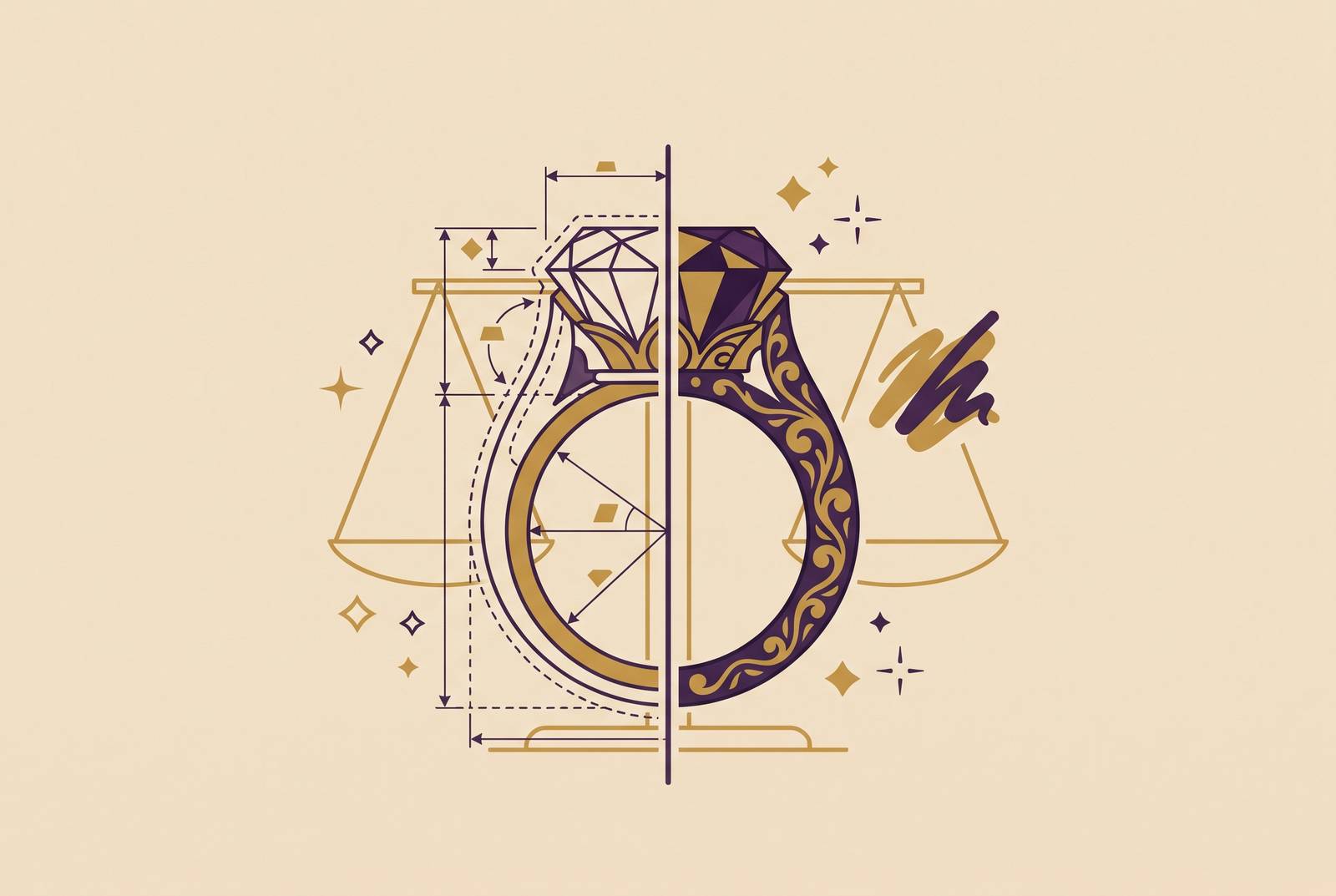
Copyright and design patents protect different parts of a jewelry design, so choosing between them starts with what needs defending. Copyright protects original creative expression. A design patent protects a new ornamental appearance. For commercially important pieces, both may be worth having, but neither gives a designer ownership of an idea. The right plan follows the design’s originality, sales potential, and enforcement risk.
Why jewelry designers need two different legal tools, not one
A competing piece appears in the market, and it looks uncomfortably like yours. The resemblance is obvious. The legal response is not, because it depends on what rights you hold and what those rights protect. A copyright claim asks whether someone copied protected expression, while a design patent claim focuses on the ornamental appearance claimed in the patent.
That difference can decide the dispute before anyone debates how many petals are on the pendant. A competitor who independently creates a similar piece can defeat a copyright claim without defeating a design patent claim. Yet neither instrument reserves a whole category, whether that is a moon-inspired ring, a braided motif, or a floral theme.
What copyright actually protects in a jewelry design, and where it stops
Copyright starts on its own when original creative expression takes a fixed form. No filing is needed for the right to exist. In jewelry, that expression might be a distinctive hand-engraved pattern, an original figurative motif, or an arrangement of elements that reflects the maker’s creative choices. Purely functional features, broad themes, and elements dictated by the article rather than creative choice fall outside that protection.
Simplicity can leave surprisingly little to defend. Herbert Rosenthal Jewelry Corp. v. Kalpakian shows how this can happen with a bee-shaped pin. The court found that the copyright merged with the idea of a bee pin and could not stop independently designed pins that were not substantially similar beyond resembling bees. When an idea has only a few ways of being expressed, copyright cannot fence off those ways and effectively award ownership of the idea.
Registration is optional for ownership but practically necessary for enforcement in US federal court. Timing also affects the available remedies. Without registration before infringement, or within three months of first publication for published works, a designer loses access to statutory damages and attorney’s fees. Those remedies can make litigation economically viable. Copyright’s life-of-the-author-plus-70-years term gives signature work that qualifies a long stretch of protection.
What a design patent actually protects, and what novelty requires
A design patent protects the ornamental appearance of a specific article of manufacture, as shown in its drawings. Those drawings set out the claim. Solid lines show which features are claimed, while broken lines show the context that is left unclaimed. Incomplete or inconsistent drawings can therefore narrow the protection or trigger objections at the USPTO.
Novelty asks more of a design than copyright’s originality requirement does. The design must be new and non-obvious over prior designs. Publicly displaying, selling, or offering a piece for sale before filing may jeopardize patent rights, which makes the order of filing and disclosure important at trade events.
For applications filed on or after May 13, 2015, the term is 15 years from grant. Protection may leave some variations in a collection uncovered, so related pieces may need more than one filing. In return, the designer gets a right that does not depend on proving copying. Independent creation is not a defense when the competing ornamental appearance infringes the claimed design.
The enforcement difference that changes the strategic calculus
To enforce copyright, a designer needs a protectable work, evidence of access, and substantial similarity. If a mass retailer encounters a studio’s design through an intermediary, tracing the copying back to the original may be difficult. Similarity alone does not close that evidentiary gap, especially when independent creation is plausible.
A designer can enforce a design patent without proving access or an intent to copy. The comparison is between the accused ornamental appearance and the design claimed in the drawings. A design patent holder can also seek the infringer’s total profits from the infringing article, potentially making the claim more valuable than one based on a reasonable royalty. The instrument changes both the proof and the financial stakes.
Pandora successfully enforced its utility patent on interchangeable spacer beads, or keepers, against Cappola Capital Corp. The utility patent case illustrates how an enforced patent can force a competitor to stop. Trueing Studio, LLC took a different route through the courts. It filed a design patent action against Serpentine Jewels, LLC on December 28, 2023, involving lighting fixture patent USD952232S, and voluntarily dismissed the case in March 2024. The case ended without a merits judgment, though the dismissal alone does not show what any settlement terms were.
When layering both protections is the right answer, and when it isn't
Commercial volume and enforcement risk are the practical triggers for layering protection. For a core SKU expected to remain in a catalog for years, patent costs can be spread across a substantial sales base. Copyright supplies an immediate underlay for eligible expression, while a design patent addresses the gap where access is hard to prove. The two rights can coexist on the same piece without protecting exactly the same thing.
A one-off commission presents a different calculation. The sales it is likely to bring may not cover the cost and wait involved in patent prosecution, so copyright alone may be the wiser choice.
Layering also cannot rescue unprotectable subject matter. A purely conventional form, standard prong setting, or common geometric shape does not acquire originality or novelty because someone submits paperwork. Nor should “add a patent later” mean waiting until public disclosure has damaged eligibility.
The real cost and timeline difference between the two instruments
Copyright registration is a low-cost administrative step, with modest legal costs if counsel is involved. Design patent prosecution comes with much higher government fees and takes a great deal of an attorney’s time. For an independent studio, that gap can determine which pieces receive patent investment.
The timelines differ just as sharply. Copyright exists from creation, although registration strengthens the designer’s enforcement position. A design patent can take from a few months to over a year to issue, so enforceable patent rights may arrive after the commercial launch. Filing permits “patent pending” marking, but that label is not a granted patent.
Designers should budget against both the launch calendar and the expected commercial life of the piece. Designers should check current USPTO fee schedules and speak with an IP attorney before basing a plan on a fixed fee quoted elsewhere. Filing before a trade fair, lookbook release, or other public disclosure avoids jeopardizing patentability through the launch itself. Once that opportunity is lost, a larger enforcement budget cannot simply buy it back.
What trade dress covers that neither copyright nor design patents can reach
Trade dress protects a configuration as a source identifier, rather than as creative expression or ornamental novelty. Consumers must learn to associate that configuration with one brand. Wal-Mart Stores, Inc. v. Samara Brothers, Inc. establishes that product design is never inherently distinctive, so unusual appearance or commercial success alone does not establish acquired distinctiveness, also called secondary meaning. Functional features remain barred regardless of recognition.
Even major brands face a demanding threshold. The TTAB’s 2025 Audemars Piguet decision upheld refusals for two three-dimensional watch configurations because features needed exclusion from the drawings and acquired distinctiveness had not been established for all features claimed in solid lines. Trade dress is therefore a long-term brand asset. Tiffany’s Blue Box® shows how protection can operate indefinitely once established, but the recognition supporting it took decades of market presence and advertising investment.
How AI-assisted design changes what copyright can and cannot protect
AI-assisted workflows create a gap where a finished design may look original but lack copyright protection. Human authorship remains the threshold. A designer who merely types a prompt and accepts the output has not supplied the human creative contribution copyright requires. If meaningful human choices are mixed with generated elements, protection extends only to the human-authored portions.
Thaler v. Perlmutter affirmed the human-authorship requirement in the circuit court’s March 2025 decision. The Supreme Court’s 2026 denial of certiorari left that decision in place without issuing an opinion of its own. The human contribution cannot be assumed from the finished object.
The practical response is to start with a human sketch or design decision, then use AI to render, refine, or visualize it. Documenting those choices helps identify the authorship being claimed. A new and non-obvious ornamental result developed from a human-originated concept may also qualify for design patent protection, making patents worth considering for commercially important AI-assisted work. CIBJO’s July 2026 pre-Congress Special Report recognized the wider problem, warning that “existing IP law is struggling to keep up with the fast-developing technology”.
Protecting designs in the manufacturing chain, before a piece ever reaches a customer
The first operational test often comes when a manufacturer receives a CAD file. That file contains the geometry and manufacturing specification needed to reproduce the piece. Registered rights provide a basis for legal action, but they do not physically prevent copying or modification. A registration certificate is not a lock on the factory door.
For high-value collections, the recommended sequence is registration before sharing, an NDA before files, and agreement terms before tooling. A dated record of rights helps back up the designer if someone later disputes who owns the design or how it was developed. The NDA limits the supplier’s use and disclosure of confidential information. It does not settle every question about who owns what.
Those questions call for clear terms on who owns what, what use is allowed, and who has tooling rights. Molds and factory-developed modifications can become contested assets when the relationship ends, even if the original design is protected. Addressing them before production closes a gap that copyright and patent claims alone cannot resolve.
A decision framework for choosing the right protection, or the right combination
The decision starts with four questions about originality, commercial potential, independent creation, and enforcement budget. How much original creative expression is in the piece? How commercially important is it likely to become? How plausible is a competitor’s independent creation, and what can the studio afford to enforce? These questions connect the legal instrument to the actual business risk.
For eligible human-authored expression, copyright is the starting point because it arises automatically. Registration makes that starting point more useful in a dispute. A design patent deserves a closer look when the ornamental configuration is truly novel, the design is key to the business, and the studio can afford prosecution costs. Where a core SKU faces difficult-to-trace copying, layering both can be rational. For one-off or low-volume work, copyright alone is usually the economical answer.
With AI-assisted work, designers also need to check authorship. Designers should keep a record of human creative decisions and avoid relying on copyright alone when it is unclear what the human contribution was. Trade dress takes time and needs consistent branding and design language, so designers should not count on it to protect a piece at launch. Each instrument has its own job and timetable.
File before showing, register before sharing, and put protection into the production workflow. CAD files that are ready for production are a natural place to keep a record because their timestamps and precise geometry can support copyright registration and design patent prosecution. They help connect the design being made with the design being protected. That connection is easier to build during production than reconstruct after a competing piece appears.