Matching Wedding Bands to an Existing Engagement Ring
Custom bands solve the geometry problem when standard rings can't fit your engagement ring's shape.
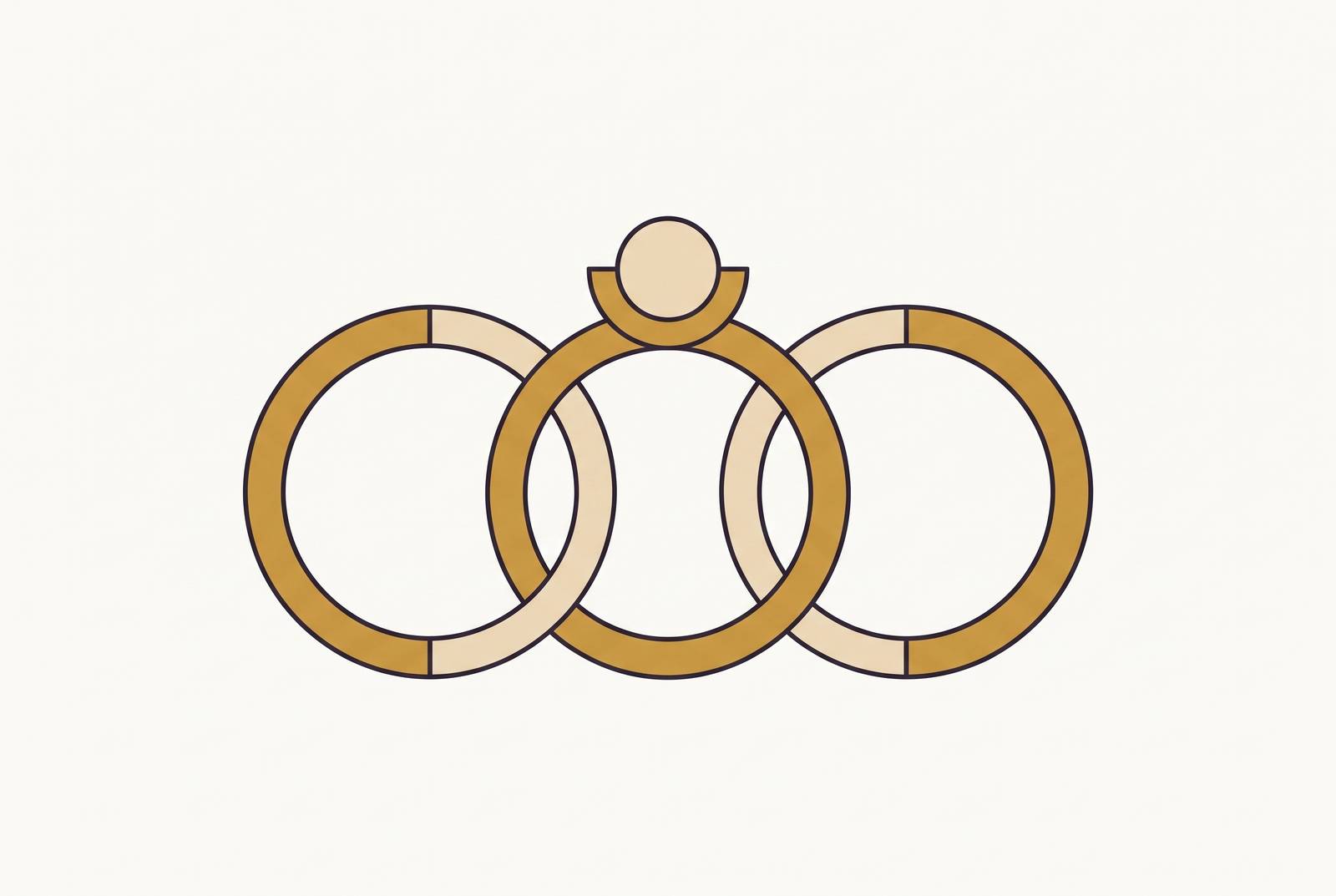
Matching wedding bands to an existing engagement ring is a fit problem before it is a style choice. The right pairing depends on the ring’s profile, metal and proportions. Standard bands work when those variables line up. When the geometry gets complicated, a custom-fitted band is the only reliable route to a flush, balanced pair.
Why matching a wedding band to an existing engagement ring is harder than it looks
A wedding band has to occupy space beside a ring that may not have left any room for it. To sit flush, it must meet the engagement ring’s shank, clear its setting and follow its profile without an awkward gap or uncomfortable misalignment. How well it fits depends on three things: the shank’s shape, the setting’s height and geometry, and the existing band’s width. A straight band cannot negotiate with a deep basket or a curve. Metal is famously poor at compromise.
That makes the engagement ring’s architecture the starting point. Deep baskets, raised cathedral arches, twisted shanks and non-standard stone shapes can all complicate the space where a wedding band should sit. Yet couples often choose the engagement ring before considering that space at all. By the time band shopping begins, the geometry is a fixed constraint.
How a ring's shank profile determines which bands can sit flush against it
The shank profile is the cross-sectional shape of the ring’s band, viewed from the side or end. Look at your engagement ring from both directions before you start looking at wedding bands. The view from above may show a pleasing outline while hiding the shape a second ring must rest against. That contact surface is the primary determinant of fit. Its shape can rule out a straight band before metal or decoration enters the conversation.
Flat or half-round shanks are the most forgiving because a standard straight wedding band can sit against them with minimal gap. A knife-edge shank instead has a ridge running along its top, so a straight flat band will rock against it unless the wedding band has a matching notch or contoured underside. A comfort-fit profile has a rounded interior for wearability. That rounding affects both how the stacked rings sit on the finger and how their outer edges look. Two rings can appear compatible from outside without sitting as a comfortable pair.
Twisted or bypass shanks are harder to fit because the band crosses or spirals and leaves no flat surface for another band to rest against. These need a custom-fitted contour band in almost every case. Curved or scalloped shanks create a different mismatch, leaving a crescent-shaped gap beside a straight band at one or both sides. Width then magnifies or softens the effect of the profile. A wider wedding band makes misalignment more obvious, while a very narrow one can sometimes slip against an irregular shape without conspicuous gapping.
Metal compatibility and what happens when the alloys differ
Even when the shapes fit, the metals matter because stacked rings touch each other. Softer metals abrade against harder ones, so different alloys can wear unevenly where they touch. Platinum is denser than gold alloys and retains metal well over time, but common gold alloys are harder and more scratch-resistant. Over time, a platinum band will show more surface scratches where the softer platinum touches a white gold engagement ring. This is a maintenance consideration, and most couples wear their rings for years without issues.
White gold and platinum can look almost the same on their own but look different up close, especially as white gold’s rhodium plating wears away. With a rose gold band beside white gold, or a two-tone band, that difference in color is a choice, though abrasion is still a concern. For daily stacking, matching the metal type as closely as possible cuts down on the care the rings will need over time, beyond what matching their color alone can do.
Visual balance across the stacked pair
A wedding band much wider than the engagement ring’s shank can dominate it, making the center stone appear lower and the setting less prominent. A very narrow band beside a wide or elaborate ring can have the opposite problem, looking like an afterthought. A useful starting point is to match or closely approximate the engagement ring’s shank width. From there, the choice depends on how much presence the wearer wants the wedding band to have.
With a cathedral or raised solitaire, the wedding band’s top surface sits below the stone, leaving visual space that changes how a plain or stone-set band reads. Pavé or channel-set bands add brilliance, but large or densely set stones can compete with the engagement ring’s center stone. AI visualization can help buyers see these proportion relationships before committing.
A setting that lifts the stone very high can leave a gap at its base when a band sits beside it. Changing the wedding band’s width or adding stones may still leave a gap caused by that shape. In those cases, a contour or shadow band becomes relevant because it changes the outline of the pairing.
When off-the-shelf bands work and when they don't
An off-the-shelf band is a reliable choice for a particular kind of engagement ring. Straight, half-round or gently domed shanks with standard widths and settings close to the finger are the straightforward candidates. Their shapes give a standard band somewhere to sit, and their proportions can be matched from ordinary size runs. That makes ready-made a sound solution when the geometry supports it. Custom work is not automatically better simply because it takes more work.
The limits appear when a standard band meets a shape it cannot follow. Curved and twisted shanks need a matching contour, while very tall or unusual settings can leave a gap at the base. Very wide or narrow shanks may be difficult to balance using standard widths. Decoration creates another obstruction when pavé wraps down the shank’s side or metalwork extends along it. A straight band then butts against the detail.
Before you shop, put a straight ruler or flat card against the side of the engagement ring’s shank. If a gap appears between that edge and the shank, a standard straight band will show the same gap. Buying a coordinated set can settle the matching choice when the engagement ring is sold, but buying the ring alone leaves that choice for later. The outcome is now clearer, namely that a standard band will work or a fitted solution is needed.
What a custom-fitted contour band actually involves
A custom-fitted contour band is designed around the existing engagement ring’s geometry. The work starts with its shank profile, ideally captured through measurements or the original CAD file. The existing band’s width and setting height establish where the new contour must rise or curve. The wearer’s ring size affects how that contour scales. The metal, surface finish and any stone setting are the last choices needed to turn a loose request for something that matches into a plan for the piece.
AI visualization can make those decisions easier to communicate before technical modeling begins. Krikawa notes that reference images and specific prompts can help buyers produce concepts that a designer can use to engineer the final ring. Krikawa also cautions that AI-generated images can contain details that are too thin, structurally unsound or impossible to cast. A convincing picture is useful, but it has not passed an engineering exam just because the lighting is lovely.
A qualified CAD designer must interpret and validate the concept before production. Parametric CAD makes this work more flexible by allowing changes to shank width, curve depth and stone spacing without rebuilding the model from scratch. That matters when a buyer requests a late revision or changes the ring size. The render shown to the customer must still show the exact dimensions of the production CAD. An artistic improvement that exists only in the image creates a mismatch between the promised ring and the manufactured one.
Custom work usually takes several weeks from when the concept is approved to when the ring is delivered, and more complex tooling takes extra time. Buyers need to start well before the wedding date to leave time for design, revision and production. Modern visualization and CAD make the process more accessible, but they do not remove those stages. The value of custom fitting is that each stage works toward the geometry of the existing ring.
How AI design tools and configurators are changing the band-matching process for buyers and brands
For jewelry brands, an engagement ring bought elsewhere or years earlier is an unfamiliar piece arriving with a very specific matching problem. The standard catalog may have no answer, even when the customer knows exactly what they want the pair to look like. Jewelry-native AI tools trained on ring taxonomy, settings and metal types can quickly visualize a contour band from a description or photograph. That can compress a lengthy exchange into a session-length conversation.
The New Black’s AI jewelry design generator illustrates this part of the workflow. A designer describes the band’s width, profile, setting style, stone details and metal, and the tool returns a detailed product image. That image can be shown to a client or taken to a workshop as a visual reference. It is not, however, a manufacturable CAD file.
Configurators address a different part of the problem through libraries of curved profiles, metal choices, and plain or stone-set variants. They can match bands to many rings without bespoke CAD, as long as the existing ring is within the range they support. Highly asymmetric rings, extended shanks, non-standard curves and wrapping decorative metalwork remain outside what a component menu can cover. Those cases still need bespoke CAD and human expertise. For brands, a complete workflow must connect the visual concept to production-ready output.
A practical decision framework for choosing between off-the-shelf, semi-custom, and fully custom bands
If the engagement ring has a straight, half-round or gently domed shank, standard setting height and a width available in a compatible standard band, the off-the-shelf route is appropriate. Metal and proportion then narrow the choice within the bands that physically fit.
If the ring has a mild curve or slightly elevated setting, a semi-custom contour band may be enough. This route works when a configurator includes a profile that matches the existing ring. The buyer needs to verify that fit against the specific ring before ordering. Brands that offer a fitted matching band when they sell the engagement ring can spare buyers the later search for a match and make the second sale.
Twisted, bypass or architecturally complex shanks, unusually tall or wide settings, and shank details that dictate the band’s silhouette require fully custom fitting. That path begins with precise measurements or the original CAD file, moves through concept visualization and ends with production-validated CAD, with time allowed well before the wedding. A band designed to look right but not validated for manufacture is not a finished solution.