Stackable Wedding Band Design Strategies
Each band's profile, width, and finish must work with neighbors both present and future.
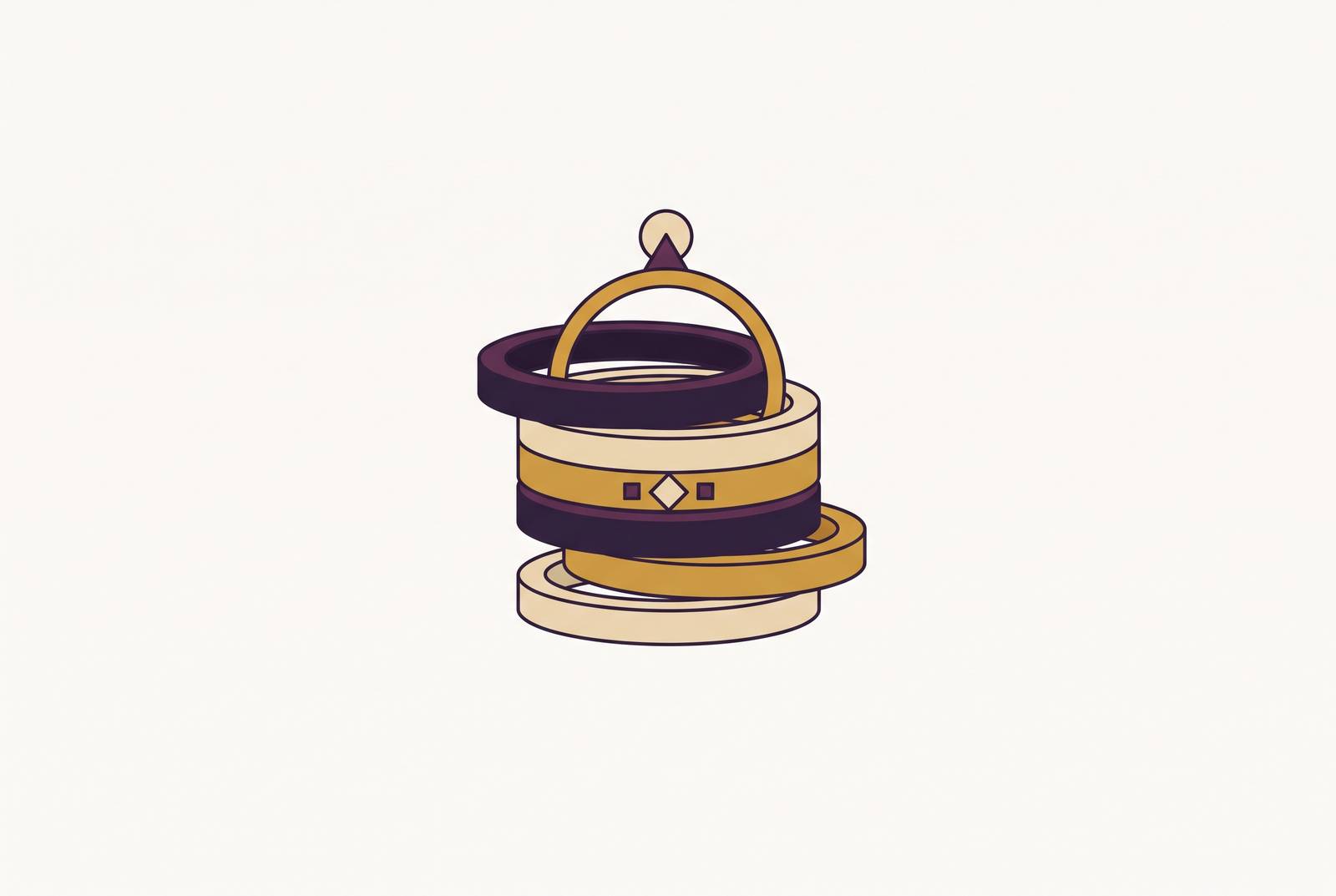
A successful set depends on how each band’s shape, width, metal, finish, and stones work with its neighbors. The design work starts before the first sketch and reaches beyond the wedding day, with room for the collection the customer has yet to buy.
Why stackable bands have become the default bridal jewelry format
Stacking has moved from an optional styling choice to the primary way wedding bands are purchased and worn. The wedding band now earns deliberate attention for daily comfort, lasting appeal, and future layering rather than serving as the engagement ring’s understudy. West Country Goldsmiths describes 2026’s dominant direction as “wearable individuality: rings that feel personal, practical and designed around real life rather than chosen only because they are fashionable”. That changes what the designer needs to deliver.
Brax Jewelers describes customers as “building collections that grow over time”, with anniversary bands, milestone pieces, and new layers joining the original ring. The first band therefore becomes a foundation. If it cannot accommodate those additions, the buyer inherits a fit problem and the brand gains an obstacle to repeat business.
Why designing a band in isolation is the most common and costly mistake
A band can be lovely alone and troublesome in company. An engagement ring with a large center stone or unusual basket can leave a straight wedding band sitting away from it or pressing against it. West Country Goldsmiths advises trying the wedding ring with the engagement ring because setting height, shoulders, and stone shape determine what can sit beside it.
Widths, finishes, and stone arrangements chosen separately can turn a stack into a committee with no chair. More seriously, rings of mismatched hardness can scratch and erode each other where they touch during daily wear. A good-looking photograph of the rings leaves both problems unsolved.
Before drawing the individual band, assess the engagement ring first, then consider the space, proportions, and contact surfaces available to the rest of the stack. Shape must come before surface decoration because the pieces need compatible shapes to share that space at all.
Profile and contour: designing the band's shape around the engagement ring's geometry
Before specifying a profile, document the engagement ring’s center-stone height, shoulder profile, and shank width. Those three measurements show how much room there is and where the rings are likely to clash. A straight band works with a low, flat engagement-ring profile that has modest shoulders, where the rings can sit flush without pressing against each other. A straight line on the sketch is useful only if there is room for it on the hand.
Where a raised center stone, projecting shoulders, or pronounced basket interrupts that line, a curved, wishbone, or V-shaped chevron band can close the gap. Brax identifies chevron and V-shaped bands as a 2026 favorite because the contour frames and cradles the engagement ring while emphasizing its center stone. Here, contour solves a spatial problem before it becomes a decorative choice. The curve has a job beyond looking graceful.
Crossover and open-band profiles also bring negative space into play. An opening can give the design movement and lightness, but the gap also becomes part of the stack’s composition. Plan the bands beside that opening with the gap as part of the design. Otherwise, the next ring can disrupt the very feature that made the first one appealing.
Width and visual rhythm across the stack
Once the profiles fit, width establishes the hierarchy. Identically wide bands create repetition, while deliberate contrast gives the eye a focal point and supporting elements. A 2mm accent band beside a 4mm centerpiece lets the wider piece lead while the narrow band still shows. Brax describes wide bands as bold pieces designed to stand alone, which explains their usefulness as anchors within a larger stack.
The narrower bands then provide rhythm around that anchor. Their role is not simply to fill whatever space remains, but to make the relationship between the larger pieces readable.
That visual plan must still work on the hand. West Country Goldsmiths advises comparing widths in person because a 2mm, 3mm, 4mm, or 5mm band can feel very different, and combining bands changes the experience again. Total width is a separate constraint from any individual measurement. More bands at greater widths require a longer finger or a different proportion strategy to remain comfortable.
Metal, finish, and the structural logic of what rings can touch
Harder metals can mark softer ones, as platinum against yellow gold can mark the gold over time. For rings intended to stay in contact, choose comparable hardness or position the softer band where contact friction is lowest. This decision belongs before manufacture. West Country Goldsmiths treats daily contact as a practical reason to choose metals with wear in mind.
Black Pearl of Queens identifies mid-karat gold as a practical choice for pavé-set twisted and slim bands because it provides enough rigidity to hold stones securely. Mixed-metal and two-tone designs remain valid ways to coordinate across a jewelry wardrobe, but their visual versatility does not remove the need to consider contact.
Finish controls both separation and visible aging. A high-polish band beside a matte or textured one lets each ring remain distinct, while hammered, brushed, etched, and matte surfaces hide the micro-scratches caused by neighboring rings better than high polish. Texture is doing more than adding character. For white-gold sets, also raise the rhodium-plating maintenance issue with clients, since replating one ring but not its neighbors can create a visible color mismatch.
Stone placement, cut contrast, and setting logic within a stack
High-set stones and prominent prongs can catch on or scratch adjacent bands. Pavé stones with unprotected edges are especially vulnerable to damage from neighboring rings, so stone height must be planned across the set. Clearance comes before sparkle in this decision. Black Pearl of Queens identifies smooth interior profiles and secure pavé without sharp edges as essential to everyday comfort, a requirement that becomes more pressing when several rings sit together.
Channel and bezel settings can protect stones in a stack. Channel settings hold them between metal edges to make a smooth line, while bezels frame them in metal. The setting is part of the stack’s contact geometry.
Once that geometry works, the designer can play with cut contrast. A round-brilliant band paired with emerald or baguette step cuts can look like pieces chosen to build a collection, with different cuts in place of a uniform match. Even pavé spacing and clean alignment along curves remain important, especially when another pavé band provides an immediate comparison. Variety does not excuse uneven execution.
Coverage then determines where the eye rests. A plain or textured band provides breathing room between diamond-set pieces, while sapphires, emeralds, rubies, or black diamonds can serve as anchors or accents. Plan the distribution of stones across the whole stack so that bare metal, diamonds, and color each have a deliberate role.
Designing for the stack's future — pieces that don't exist yet
The first band sets constraints for every later purchase. Its width uses part of the available finger space, its profile limits neighboring shapes, and its metal and finish establish a palette that future pieces must address. A closed composition can therefore resist the very additions the customer wants to make. Leave room for change from the beginning. That means preserving space in the width budget, finish range, and stone strategy.
For a foundational wedding band, document the stack parameters, including the available finger width after placement, finish register, metal hardness, and stone style. These become working constraints for later additions. Twisted and sculptural bands can help arrange those additions because their dimensional form sets plain bands apart and softens the change from one ring to the next around an engagement ring. Black Pearl of Queens identifies twisted diamond bands as useful stack anchors for this reason.
The milestone model makes that planning concrete. A plain wedding band now, a diamond eternity band at five years, and a colored stone band at ten require room for later setting heights and stone profiles. Before finalizing a band’s dimensions, sketch the anticipated maximum stack with two or three future additions placed notionally. The aim is to make the design hospitable to the customer’s future self.
How parametric and AI-powered design tools make systematic stack design practical to execute
Relational design becomes difficult to execute when every band lives in a separate static CAD file. A change to finger size, stone dimensions, or one profile means revisiting the other files manually. Parametric design instead allows a variable to change and the model to recalculate automatically. A client’s request to widen the anchor band should not become a sentence to rebuild three models.
AI-powered tools can extend that workflow by generating an initial production-ready file from a sketch or prompt, then supporting variations. A frozen mesh does not offer the same ability to resize, reshape, and adapt a band as an editable parametric model. For a collection expected to grow, editability is part of the design requirement.
Production readiness needs an equally plain test. If a file requires manual geometry repair before casting, it is not ready for production, however persuasive its render looks. Every configuration in a well-built system should produce a file the manufacturer can use without intervention. The tools earn their place by making changes manageable while preserving the relationships already established through profile, width, material, and setting decisions.
Translating a stack design system into a product line customers can configure and buy
A customer considering another band needs to see how it works with the rings already owned. A product page showing only an isolated ring withholds the relationship that makes a stacking band worth buying.
A configurator built on a parametric engine can let customers change metal, width, finish, and stone style across a proposed stack in real time. Each configuration should also output a production-ready file, connecting the choice on screen directly to manufacture. That capability depends on the design intelligence built into the system. A menu of options alone is not enough.
Made-to-order production suits the breadth of possible combinations, provided the purchase experience distinguishes in-stock configurations from those with lead times. Visual content should demonstrate that breadth through compositions, showing a plain band with the foundational piece, then a diamond eternity band, then a colored stone accent.