Choosing a Metal for a Custom Engagement Ring
Metal choice determines durability, maintenance costs, and how your ring will wear over a lifetime.
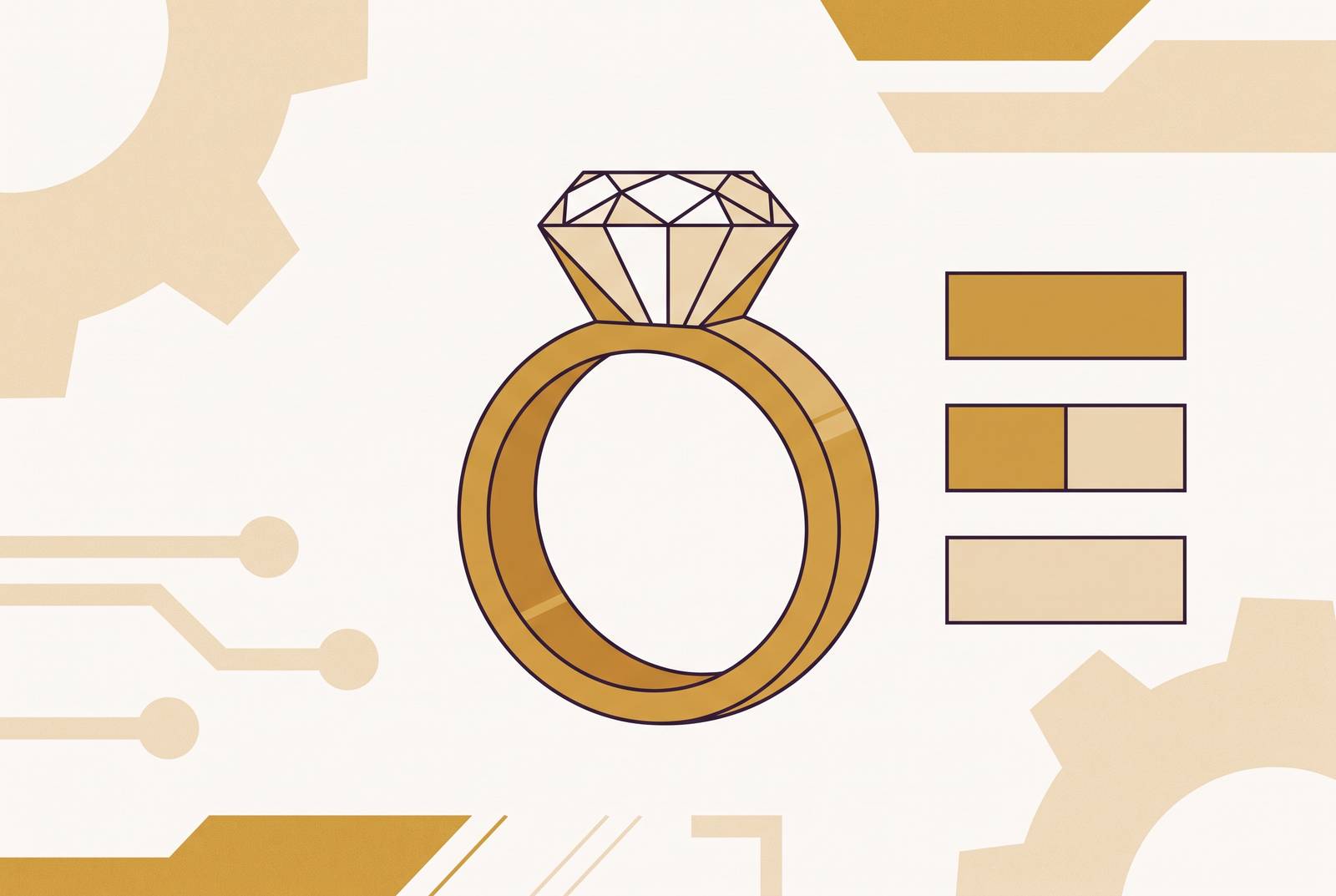
Choosing a metal for a custom engagement ring means choosing how it will wear, hold its stone, feel against skin, and cost over time. Choose the metal that fits the wearer’s life before the rest of the design takes shape.
Why metal choice is the foundational decision in a custom engagement ring
A prong has to hold a stone as well as look convincing in a rendering. Its dimensions depend on the metal, as do the band’s wall thickness, the manufacturing method, and the ring’s base cost. Those constraints belong at the start of a custom project because correcting them later can mean revising work already done. Treating metal as a final color choice is rather like choosing a building material after drawing the house.
The stakes grow with daily wear. A custom engagement ring is typically intended to be worn every day for life, so maintenance demands and differences in stone security accumulate over decades.
What platinum actually does differently from other metals
When platinum scratches, metal moves to the side. This displacement preserves the ring’s mass, so its prongs do not thin and weaken in the same way as gold-alloy prongs. That is the substance behind the durability claim, particularly when a ring must keep a stone secure through years of daily wear.
The distinction also explains why a visible scratch is not the whole durability story. Platinum can take on a soft matte finish called a patina and still keep the metal that supports the setting. Some buyers like that surface, while others prefer a brighter finish. A ring can therefore look more worn without having lost material in the way another metal would.
Platinum is also naturally white throughout its mass and needs no rhodium plating to maintain that color. Its purchase price, however, can be substantially higher than that of an equivalent white gold piece. The metals therefore differ in ownership costs and wear characteristics.
White gold's real cost structure and the rhodium maintenance cycle
White gold starts with yellow gold alloyed with white metals, which are usually nickel or palladium. Rhodium plating supplies its bright white finish. As that surface wears, the warmer tone beneath it starts to show, so the ring needs replating from time to time to keep its original look. The lower purchase price comes with a maintenance cycle.
How often that cycle repeats depends on skin chemistry, how the ring is worn, and how it is designed. It brings both a service bill and the inconvenience of jeweler visits. White gold can still be a good choice, but both costs need to be weighed against the extra money paid upfront for platinum.
A buyer who replats every two to three years instead of every year may never spend enough to make up the gap in the starting prices. Over a decade or more, however, prong longevity becomes a separate consideration from surface upkeep. For active wearers or buyers who choose large center stones, keeping the stone secure matters alongside how much replating will cost.
Palladium as the overlooked middle option
The white-metal choice does not end with platinum and white gold. Palladium, including Pd950, is naturally white, hypoallergenic, and needs no rhodium plating. It costs less than platinum and is significantly lighter, which can feel comfortable to one wearer and less substantial to another. Weight is a matter of personal preference here.
Palladium’s limitations are less visible at purchase. It is harder to find among retail jewelers, and future resizing or repairs may present challenges depending on the bench jeweler doing the work. Scratch vulnerability and the potential for micro-pitting also give it a different long-term surface appearance from platinum. It solves white gold’s plating problem, but it is not platinum wearing a discount sticker.
Yellow and rose gold: what karat actually controls
With yellow and rose gold, karat is more useful as a composition specification than a prestige score. Pure gold is too soft for a ring worn daily, so engagement ring gold is alloyed with other metals. Gold with a higher karat has a greater share of pure gold, while gold with a lower karat has more alloy. That balance affects hardness, durability, color, and skin compatibility.
Lower-karat yellow gold is usually harder and more scratch-resistant than higher-karat yellow gold. Higher-karat gold has a richer color. For an active wearer, the harder alloy may be the more useful specification.
The copper that produces its color also hardens it, making lower-karat rose gold harder and more durable than yellow gold of the same karat, though nickel-based white gold is typically harder still. Rose gold also needs no plating to maintain its color. For sensitive skin, however, karat and the metals in the alloy matter, because what is often called a gold allergy is typically a reaction to nickel. Buyers who know they have sensitivities should ask which metals are in the alloy.
How skin sensitivity and lifestyle eliminate options before aesthetics enter the picture
Nickel allergy is the most common metal sensitivity among jewelry wearers, and nickel-alloyed white gold is a frequent trigger. For a buyer with that allergy, the choices are platinum, palladium, and nickel-free gold alloys.
Daily habits narrow the field further. Working with the hands and exercising regularly can accelerate wear on softer metals and put more stress on prongs. Platinum’s prong durability matters in that setting, while lower-karat gold generally offers more hardness than higher-karat gold. A low-profile setting in a harder metal is often the practical choice for an active wearer, and a custom design allows that combination to be specified precisely.
Chemical exposure adds another constraint that hardness alone cannot predict. Chlorine and other chemicals can degrade gold alloys over time, particularly at lower karats. Platinum is more chemically resistant, which matters for wearers exposed to cleaning products or chlorinated pools.
How metal choice propagates into CAD geometry and production files
Once the wearer’s needs establish the material, that choice has to reach the CAD model. Minimum prong diameter, wall thickness, and setting depth depend on what the metal can physically support. A prong designed for one material cannot simply be assumed suitable for another because the screen now shows a different color.
In a parametric design system, metal is ideally an input that recalculates those dimensions automatically. Diatech Studio’s 2026 guide describes Technicals mode as allowing advanced users to set stone dimensions, prong configuration, and metal weight targets before generating a matching design. This puts the constraints before the finished shape. It also avoids treating the material as a note for a CAD technician to reconcile afterward.
For buyers, the practical question is whether a configurator’s CAD output accounts for metal-specific tolerances. A tool that only changes color supplies a visualization. Before casting, the file must pass checks for watertightness, minimum wall thickness, and scale verification, among others. Resolving mismatches during design is faster and cheaper than discovering them at the foundry, where a handsome preview has very little bargaining power.
How metal selection drives dynamic pricing in a custom ring configurator
The same material input must also reach the price calculation. Gold, platinum, and palladium trade on commodity markets, and their spot prices can shift meaningfully between an inquiry and casting. A metal price that stays fixed can be wrong by the time production starts. In custom ring commerce, metal is a live cost variable rather than a permanent surcharge attached to a color.
Weight complicates the calculation further. A yellow gold band and a platinum band with the same width and finger size do not have the same metal weight. Karat, alloy density, and geometry all affect how much material the ring requires. To get the price right, the weight needs to be worked out from the CAD model.
A configurator must bring those inputs together as the buyer changes the metal, purity, size, or stones. For the buyer, dynamic pricing makes the current cost of the selected design visible. For the seller, it supports accurate quotes and protects margins as specifications change. This is the basic work of putting together a quote, even if the interface makes it look like a small number politely refreshing itself.
Metal choice and its effect on product photography and digital presentation
Different metals also create different photographic demands. Polished metal reflects what is around it, so taking a photograph of a ring can feel like asking a tiny mirror to sit for a portrait. A brand offering several metals in the same setting needs images that represent those variants.
Scalio’s AI photography tools can generate the same design in different metal colors, including yellow gold, rose gold, and silver, from a single source shot. For a custom ring business, variant generation can reduce the need for a separate shoot for every option. It can also help a buyer compare the appearance of a setting before committing to a metal. AI’s useful role here is staging and scaling from a clean studio photograph of the finished piece.
A convincing color variant helps the buyer see the choice, while the CAD model and price calculation must still account for what that choice changes physically.
Applying the framework: how to match metal to the specific buyer
Start with skin sensitivity, because it can determine which alloys are suitable immediately. A known nickel allergy puts platinum, palladium, and nickel-free gold alloys in contention, while excluding nickel-alloyed white gold and some rose gold blends. Active lifestyles and large center stones favor platinum’s prong durability, while lower-activity wearers choosing smaller stones have more flexibility.
Platinum or rose gold suits someone who wants to avoid repeated plating visits, though buyers still need to understand how platinum’s patina will look. White gold is still a good choice for someone who is happy to pay less at the start and have rhodium plating done from time to time. Palladium offers another naturally white, plating-free route, with serviceability and surface wear as its trade-offs.
White or yellow gold can offer better value over a short horizon without sacrificing beauty. For long ownership with heirloom intent, platinum’s durability and mass retention justify the premium for many buyers.
This process is especially useful in custom design because the buyer can choose the metal, karat, prong style, and band width. Those choices are an opportunity, but they also need to agree with one another. A parametric AI-powered platform that updates geometry, prong dimensions, and pricing when the metal changes can make that agreement visible. An informed metal choice made early is what makes the rest of the design process straightforward.