Pricing Strategy for Custom and Configured Jewelry Online
Flat markups fail on configured jewelry; each cost layer needs its own pricing logic.

Pricing configured jewelry means stacking a bunch of decisions on top of each other, one per cost layer. Most brands try to answer all of them with a single markup number, and that number is usually where the trouble starts.
Here's the instinct almost everyone starts with: pick a multiple (2x, 2.5x, whatever the last shop teacher recommended), slap it on cost, call it a day. That's fine if you sell one ring in one metal, but it falls apart the second you sell that ring in fourteen karat yellow, eighteen karat white, and platinum, with three stone grades and an engraving option on top. Now you've got a dozen cost structures wearing one price like a costume.
Flat markup on a "starting at" price does two things, and both hurt. It leaves money on the table when someone builds the loaded version, and it eats your margin on the simple one, because the multiple that works for a plain gold band isn't close to right for a diamond pavé setting. A brand that can't price confidently across every SKU variant ends up overcharging the easy configs or bleeding quietly on the hard ones, usually both, and neither shows up as one red line in your P&L. Slowly, across a thousand orders, the damage builds, and by the time someone catches it, a full year of sales data is already built on the wrong number.
A better setup gives each configuration variable — metal, stone, labor, overhead — its own cost logic, all feeding into one live output price. Demand for customized jewelry has climbed hard worldwide, and online jewelry sales are on track to hit $85.7 billion by 2026. Brands that can't price configured products right at scale are just handing that growth to whoever can.
The four cost layers every configured jewelry price must account for
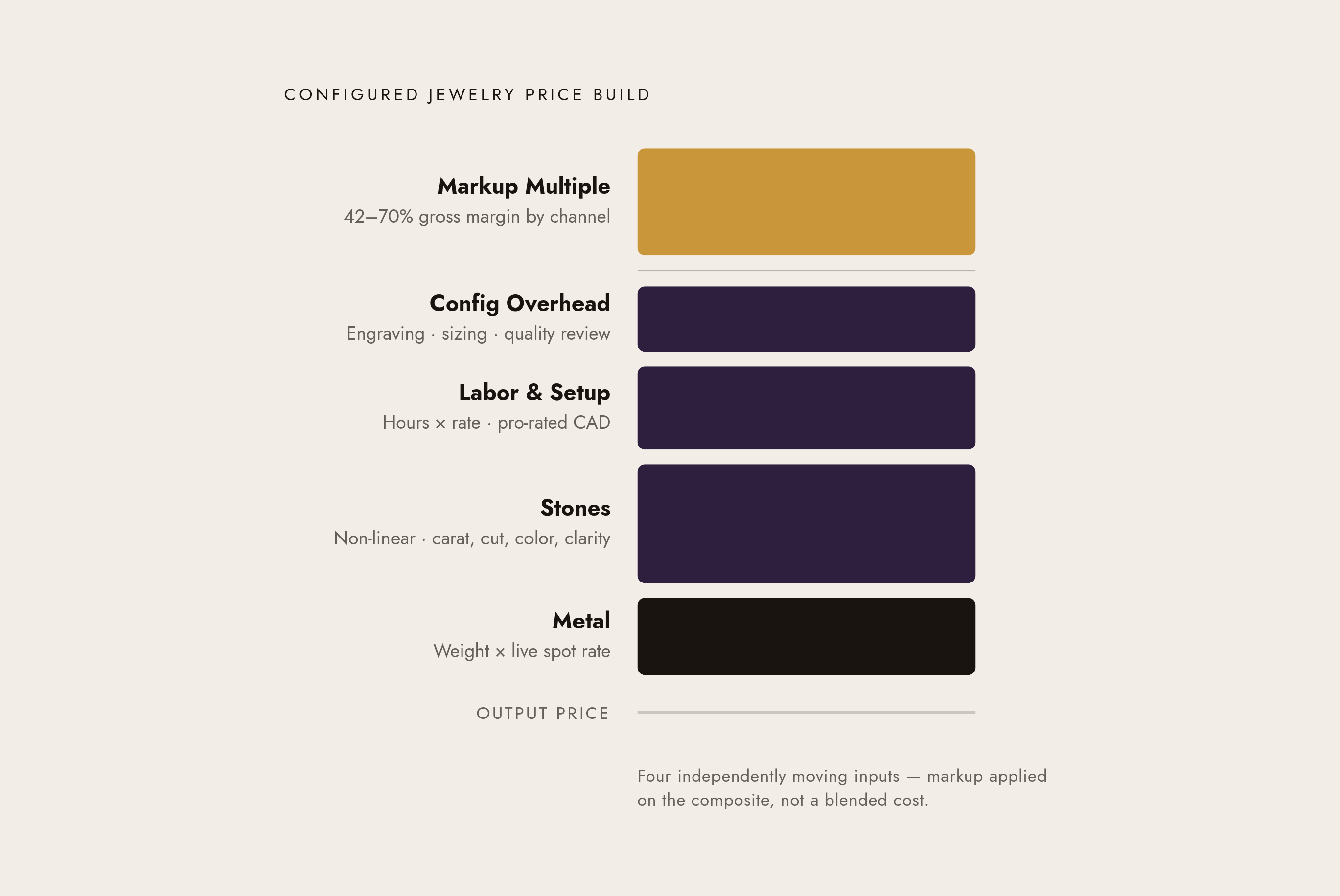
Every cost moves differently when a customer changes their configuration, and blending them into one number is where the errors start.
Metal. Simple on paper: it's commodity-priced and weight-dependent, so take the current gold price per gram, multiply by the finished weight, done. That's simple math, until gold decides to have a personality (more on that in a minute).
Stones. A 0.5 carat stone and a 1.0 carat stone aren't twice the price, because cut, color, and clarity premiums stack on top of size, and a small jump in carat weight can mean a price jump with no proportion to it at all. The ground also shifted under the whole category: lab-grown diamonds now make up more than half of engagement ring center stones sold in the U.S. as of 2024. A brand still pricing off a natural-diamond-only model is building on the wrong floor and doesn't know it yet.
Labor and production time. A stamped, simple piece barely carries labor cost worth mentioning, while hand-set stones and engraving are where the hours pile up. A decent baseline: take materials plus packaging, multiply by your markup, then add pro-rated hourly labor on top, in that order, because labor scales with how fiddly the piece is, not with how expensive the materials are. CAD and setup time cost real money too, even though the customer never sees it happen, so spread that across the number of units you expect to sell of a given design instead of pretending it's free.
Configuration-specific overhead. Engraving, custom sizing, mixed-metal builds each add a step, and production floors bill those steps differently. There's also the quality review before a complex configuration goes to manufacturing, usually inside a 24 to 48 hour window, and that review takes a person's actual time. Price it in instead of burying it in overhead where nobody bothers to account for it.
Then there's the layer with nothing to do with materials at all: customer acquisition cost. DTC fine jewelry brands spend real money getting a customer to the site, and margin has to be wide enough that the lifetime value of that customer beats what it cost to reach them. One quiet offset: personalized pieces come back less, and lower return rates on custom configs are real savings that justify a healthier margin on those SKUs.
How metal price volatility rewrites the floor price for every configuration
Gold spot price in mid-2026 sat at a historically elevated level per ounce, well above the 2025 average. If your price sheet was built on 2024 numbers, you're pricing an entirely different metal than the one you're actually buying.
Silver hasn't been gentler. Analyst forecasts for the 2026 LBMA survey put the estimate at roughly double the 2025 actual, which is a different market, not a small drift.
What this does to your "starting at" price is blunt: the old entry point for fine jewelry has moved up, meaningfully, and any brand that hasn't updated its floor is either running thinner margins than it thinks or already selling some SKUs at a loss without realizing it.
A bigger spreadsheet won't fix this. Metal cost in a configured price has to be a live variable, pulled from a current rate, not something someone typed in last quarter and forgot about. Practically, that means the same ring design in 14k yellow gold, 18k white gold, and platinum needs three separate live cost inputs, each updating on its own clock, because gold and platinum have never moved together and aren't about to start.
This hits DTC brands hardest. Most target gross margins somewhere in the 50 to 70% range, and that margin is what funds customer acquisition. Commodity drift that isn't reflected in the price doesn't just shrink margin on paper; it eats the fuel the whole growth model runs on. At any real scale, keeping prices accurate across a big variant set as spot prices move takes a pricing engine that pulls live rates. Manual updates, no matter how diligent someone is about them, can't keep pace.
Building the pricing formula for a configured product
Laid out plainly: live metal cost at the weight for this configuration, plus stone cost at grade, plus labor hours times rate, plus configuration-specific overhead, equals total cost. Apply your markup multiple to that, and you've got your output price.
The markup multiple isn't one number. It depends on channel and product type, and Jewelry retail and ecommerce generally targets a gross margin between 42 and 47%, with high-performing direct-to-consumer brands reaching 50 to 70%. Custom and made-to-order work commands a higher multiple, partly because return risk is lower and partly because personalization carries more perceived value; personalization segments often see a real lift in average order value over standard SKUs. Wholesale needs its own multiple, set on purpose, lower than DTC. Leave it unset and a wholesale price can accidentally undercut your own direct channel, which is a strange way to lose a fight against yourself.
The most common math error: one markup multiple across the whole cost stack when stone cost is doing most of the work. The multiple that fits a plain gold band will wreck your margin on a diamond pavé setting, because you're running the same percentage against a wildly different cost base. Some brands treat stone cost as a pass-through, marked up thin, and apply the full jewelry markup only to metal and labor. Model both ways against your target gross margin before you pick one.
For a sanity check, look at what public companies actually report. Brilliant Earth posted a gross margin of 57.5% in fiscal 2025, while Signet came in at 39.5% for fiscal 2026. Neither number is right or wrong on its own, but knowing where established players land tells you whether your formula's output makes sense or is off in its own world somewhere.
Last piece: set a floor. Every configuration needs a minimum price the formula can't go below, no matter what the inputs say. Thin bands, tiny stones, and edge cases where the math technically works but the output is a loss all need catching before they turn into real orders you'll regret.
What a dynamic pricing engine does that a spreadsheet cannot
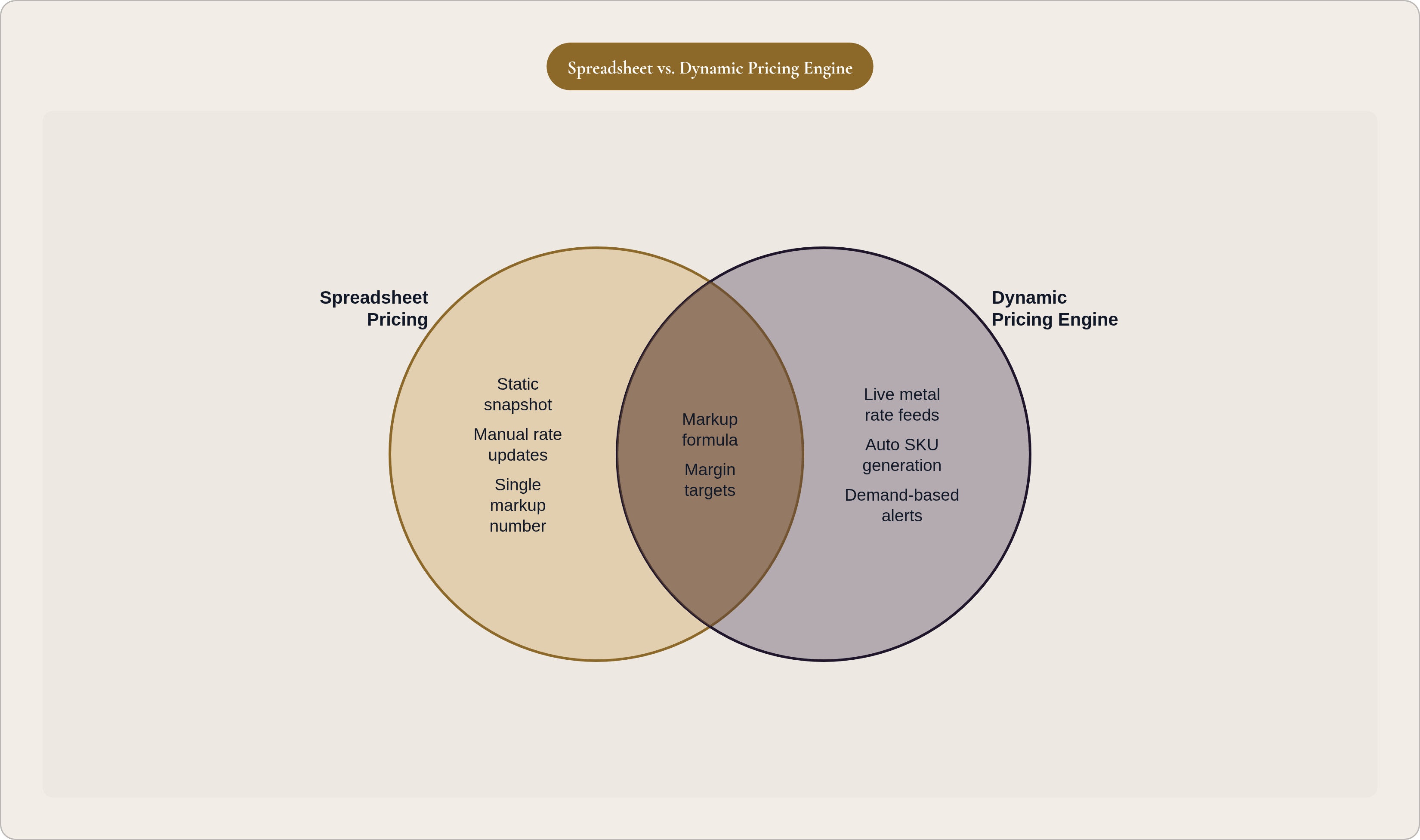
A spreadsheet captures a single moment, while a pricing engine tracks a live feed.
The engine pulls current metal and stone rates, applies the right formula per configuration, plugs into your discount and tax logic, and reflects all of it across the whole catalog instantly, not the next time someone remembers to open the file.
The trick that keeps this from turning into a mess: instead of storing every single variant (every metal, every stone grade, every size) as its own product record, master templates reference shared price tables. Update the table once, every configuration built on it updates with it, and new combinations get generated on demand instead of bloating your SKU count one by one.
That SKU count matters more than you'd guess, since platforms like Google Shopping and Amazon require a unique SKU per variation. Generating those on demand at the configurator level solves it without someone on your team manually duplicating listings every time a new stone tier shows up.
Skip the automation and here's what breaks: a brand offering dozens of metal, stone, and size combinations faces a manual update job every time commodity prices move, which, as covered above, is often. That either erodes margin quietly or leaves your storefront quoting numbers nobody can actually honor. Pencil's platform syncs metal prices in real time directly into configured prices, so the number on screen tracks the commodity market instead of trailing behind it by a week or a quarter, depending on who remembered to check.
How the configurator turns the pricing engine into a customer experience
On the customer side, it comes down to one mechanic: every choice, metal type, stone grade, engraving, size, updates the price on screen right then. The customer sees exactly what each decision costs, in real time, no guessing involved.
That transparency does real work. It cuts support questions, it reduces order errors, and it builds a kind of ownership over the piece that tends to lower return rates on custom orders, since the customer built the thing choice by choice and watched the price move with them the whole way.
A well-built configurator doubles as an upsell tool too, if the flow is sequenced right. Eighteen karat instead of fourteen, a bigger stone, added engraving, each shown with the price difference right there at the moment of choosing. That's a good chunk of why personalization tends to command a real premium in average order value over standard products.
None of it matters if it doesn't work on a phone, and over 60% of online jewelry transactions happen on mobile, so flawless pricing logic paired with a clunky touchscreen captures none of the upside it was built for.
There's a data layer here worth paying attention to. Which configurations do customers build but never buy? Which upgrades do they take, and exactly where do they drop out of the flow? That behavior feeds straight back into pricing and merchandising, and it's information a static price list simply can't produce.
Pencil's configurator goes a step further and produces production-ready CAD at the moment of configuration, so the price a customer sees ties to a real file that can go straight to manufacturing. That closes a gap between what got sold and what actually gets made, a gap that causes real headaches when it's left open. Complex configurations still get a human review before manufacturing commits — typically inside a 24 to 48 hour window — and that review time costs real money, so it belongs back in the overhead layer from earlier, not treated as a freebie somebody forgot to bill for.
Setting prices across tiers — entry, mid, and custom bespoke — without undercutting yourself
Three different jobs call for three different pricing approaches. Configured standard products, where the customer picks from a defined menu, run on formula, automated by the engine, with a published price. Semi-custom, where someone modifies a base design, uses the same formula logic plus a custom-work surcharge. Fully bespoke, design-from-scratch work, gets quoted individually, anchored to a floor set by whatever operating margin your custom design business actually needs to survive.
That bespoke tier deserves its own attention. It's a small share of total revenue that carries outsized margin, and a bespoke engagement ring, priced high and built one at a time, runs on a margin structure standard configured products rarely touch.
Watch the tiering trap: price entry configs too low to "drive volume" and you create a ceiling effect where the mid-tier suddenly looks expensive by comparison, even when it's fairly priced. The entry floor gets set by cost, full stop, not by whatever the shop down the street happens to be charging that week.
Keep the channel gap disciplined too. High-performing DTC brands reach that 50 to 70% gross margin range, and that headroom is what funds acquisition, while wholesale runs on a lower multiple by design. Structure the tiers so a wholesale buyer can never quietly undercut your own direct price. That's a leak that's easy to create by accident and hard to notice until a customer points it out to your face.
Buy Now Pay Later works best as a tier-level tool, not a blanket feature. It solves sticker shock, and sticker shock mostly shows up in the mid and bespoke tiers, so offer it above a price threshold instead of slapping it across the whole catalog.
And on lab-grown diamonds: given that they now account for more than half of U.S. engagement ring center stones sold, treat lab-grown as its own named tier with its own price logic, not a quiet swap buried inside the same formula as natural stones. Being upfront about that choice drives conversion, and it costs nothing in margin.
Communicating configured prices on the product page
"Starting at $X" is technically true and practically useless. A configured product has a price range, and the honest way to show it is a number that updates live as the customer makes each choice, not a floor number that quietly stops being accurate the moment they touch an option.
Better: show the cost delta at each step, framing each addition clearly, like "a clear dollar amount for 18k gold" or "a clear dollar amount for SI1 clarity." Framing each choice as an addition to a base price is easier to accept psychologically than listing five separate final prices and asking someone to compare them cold in their head.
Trust signals earn the price too. Certification, material provenance, a realistic production timeline, and a clear link between what the configurator shows and the actual piece that gets made all justify the number on screen at the exact moment someone's deciding whether to hit buy.
One thing the page should never do is hide a configuration-driven price change until checkout. Late price reveals are one of the biggest reasons carts get abandoned, and the whole point of a live pricing engine is making sure that never happens in the first place.
For brands running on a platform like Pencil, where the configuration output is an actual production-ready CAD file, there's a specific trust signal worth spelling out: the price shown corresponds to an exact, makeable piece, not a rendering someone hopes looks close enough once it's cast. Configurators built only as visualization tools dressed up to look like manufacturing tools can't make that claim.
Reviews help more than people give them credit for, especially tied to the specific configuration purchased rather than a generic star rating floating with no context. Seeing that someone bought this exact metal and stone combination, at this exact price, and got what the screen promised, does more for the next buyer's confidence than five stars ever will on their own.
Maintaining margin discipline as the product catalog scales
More configurations means more ways for pricing to drift out of line quietly. Every metal price update, every new stone tier added to the catalog, is a fresh chance for some combination to slip below where it should sit, and nobody notices until the numbers at quarter end don't add up the way they're supposed to.
The pricing engine needs ongoing upkeep, not a one-time build. Scheduled rate reviews, formula checks whenever a major input shifts, and alerts that fire the moment a configuration's output price drops below its floor all keep the system honest.
This is exactly where the master-template approach earns its keep. Shared price tables and configurations built on demand keep the catalog manageable as it grows. Brands that instead build a separate product record for every variant find pricing discipline collapses under its own weight; nobody can check a thousand individual line items by hand, so eventually nobody does, and the errors just sit there quietly compounding.
Certain events call for a full formula review, not a quick patch: a sustained commodity move like the gold run of 2025 to 2026, a new material tier entering the catalog, or a shift in channel mix, say adding wholesale or listing on a new marketplace. Each one changes the assumptions the formula was built on, and patching the output without revisiting the formula just delays the next problem to a worse day.
What's actually at stake is the margin profile underneath all of it. A well-run jewelry e-commerce brand generally needs a net margin in the 15 to 30% range, meaning gross margin has to hold somewhere between 40 and 60% once SG&A is factored in. Pricing discipline at the individual configuration level is the mechanism that keeps those ratios intact while costs move underneath you, and costs always move, a fact that never stops shaping the math.
Get the setup right and something changes: adding a new metal, a new stone tier, or a new configurator option stops being a guessing game, because you already know what the output price will be before it launches. Speed to market on new configurations turns into a real edge, instead of the risk it is for everyone still pricing off last quarter's spreadsheet.