SEO Architecture for Jewelry Configurator Pages and Custom Product URLs
Prevent index bloat and crawl waste by choosing which jewelry configurator URLs deserve to rank.

Jewelry configurators break SEO in a way regular product pages don't. Click through metal, stone, cut, and carat options and the thing spits out a fresh URL, or a fresh page state, for every single combination. One ring can live at fifty different addresses at once, and Google has to figure out which one, if any, deserves to rank. Get the architecture wrong and you either flood the index with thin lookalike pages or hide your best configurations from search entirely. This piece walks through how to dodge both traps.
Custom jewelry is a multibillion-dollar market as of 2025, heading toward $104.89 billion by 2032. More brands bolt configurators onto their sites every year chasing that growth, and most of them inherit the same architecture headache without noticing until rankings start sliding.
Three things tend to go wrong, and I've seen all three on the same site more than once. Duplicate content piles up when a dozen URLs show basically the same ring with nothing for Google to actually judge between them. Crawl budget gets burned on parameter combos nobody searches for, instead of the category and product pages that actually matter. And index bloat creeps in quietly: thousands of auto-generated variant pages sit in Google's index, diluting the site's authority, making it harder for the pages that deserve to rank to do it.
JavaScript-heavy configurators flip the problem on its head. Click through metal and stone options and if the URL never updates, crawlers never see those variants at all. So you end up with invisibility on one end and proliferation on the other, sometimes on the same site, sometimes in the same week of a crawl log. None of this means ripping out the configurator or hiding behind static pages only. It means someone, somewhere, has to decide on purpose which URLs exist, which get crawled, and which get indexed.
How Google actually crawls dynamic and parameter-driven pages
Google doesn't crawl and render a page in one motion. It fetches the HTML first, then queues the page for JavaScript rendering separately, sometimes hours later, sometimes days. That gap trips up more sites than people expect.
Google's own documentation on faceted navigation says crawling faceted URLs can eat huge amounts of computing resources, just because of how many URL and rendering combinations pile up. And crawl budget isn't a bottomless well. Google hands out crawl allocation based on a site's authority, server speed, and how useful past crawls turned out to be. Burn that budget on?metal=rose-gold&stone=oval variants, and your real product and category pages get crawled less. Google's guidance here is blunt: if a faceted URL doesn't need to be indexed, stop it from being crawled in the first place. Bots wandering through filtered results costs server resources for little or no payoff, and nobody's handing out a refund on that.
Configurator URLs generally fall into two camps, and Google treats them completely differently. Query-parameter URLs, like?metal=rose-gold&stone=oval, are crawlable by default and get indexed unless someone tells Google otherwise. These are the main source of bloat. Hash-fragment URLs, like #metal=rose-gold, work differently: Google ignores everything after the # symbol. That quirk is actually useful. Hash-based state changes stay invisible to the crawler, which is exactly what you want for configurator interactions that should never turn into index entries.
Here's where it gets messy for JavaScript-built configurators. If a filter change only updates the DOM, without touching the URL through the browser's History API (pushState), the crawler sees one static base page and nothing else. Every configured variant, including the ones people are genuinely searching for, stays invisible. Server-side rendering handles this more reliably than client-side rendering, since the page shows up fully formed on first fetch instead of waiting on a rendering queue that may or may not run on schedule. Google's JavaScript handling has improved over the years, sure, but "improved" isn't "guaranteed." Build for the crawler sitting in front of you, not the one you're hoping shows up.
Deciding which configurator URL combinations deserve to exist as pages
Not every filter combination earns a page. The real question is dumb-simple: does anyone search for this specific combination outside your own site navigation, or is it just something a shopper clicked into once?
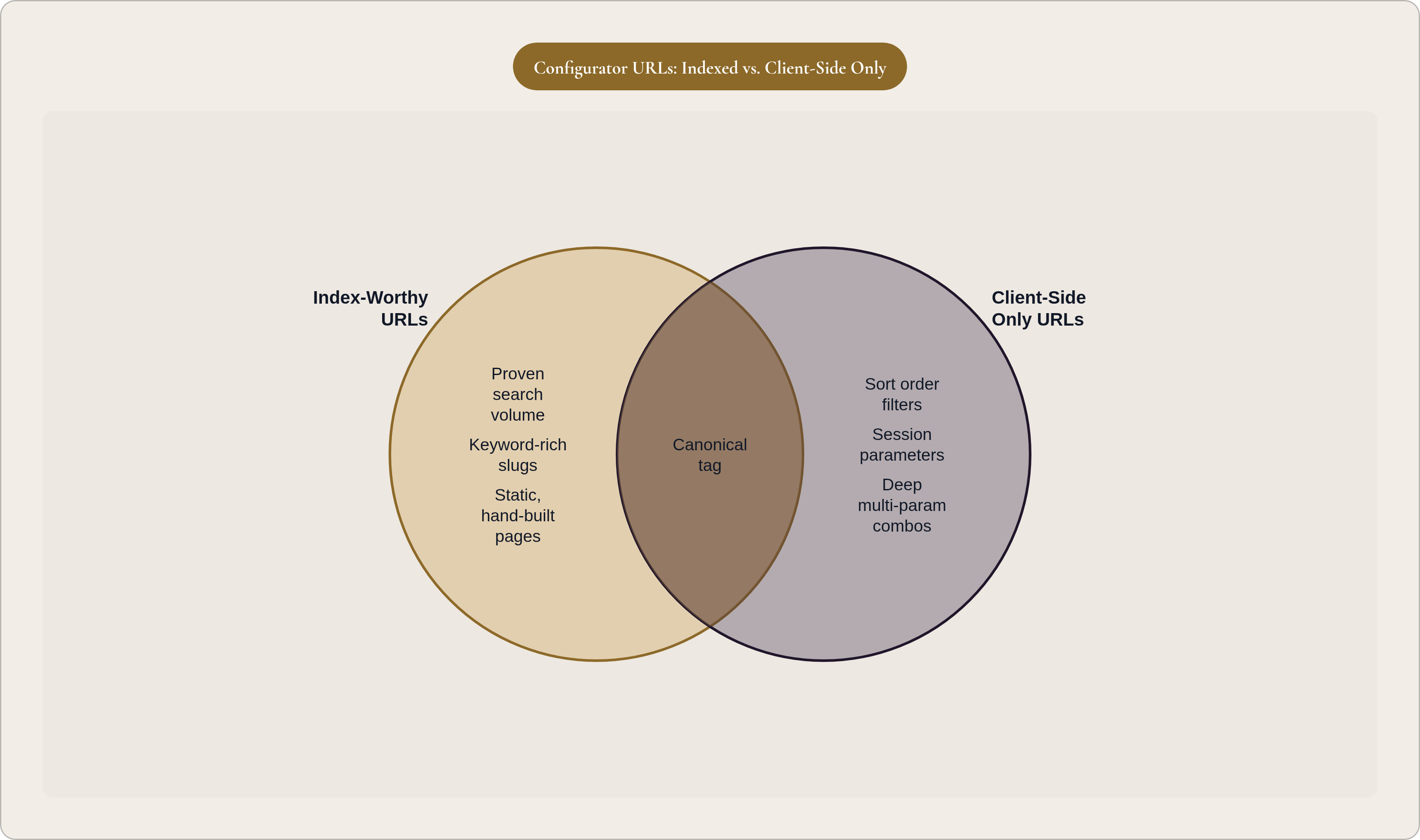
Rule of thumb: combinations tied to real search demand get a static, crawlable page. Combinations that only exist because someone's clicking around your configurator stay client-side, no indexable URL, ever. A combination earns indexing when it has proven search volume (think "14k rose gold oval engagement ring" or "sapphire halo ring white gold"), enough products behind it to avoid feeling thin, and intent distinct enough that it isn't just a rehash of the parent category page.
On the flip side, some things should never get their own crawlable URL. Sort orders like price low-to-high don't deserve one. Neither do availability filters like in-stock or ships-in-five-days, deep multi-parameter combos nobody's searching for (the combinatorial explosion zone), or subjective filters with zero keyword equivalent behind them.
Jewelry searches cluster around a handful of patterns worth building pages for: metal type paired with ring style (rose gold solitaire engagement ring), stone type paired with cut (oval diamond engagement ring, sapphire cushion cut), style category paired with metal (yellow gold halo ring). Those carry real demand.
Run the math on variant depth and the scale of the problem shows up fast. Five metals, six cuts, four stone types, three carat bands. That's 360 possible combinations off one product line, and the overwhelming majority pull zero search volume. Build pages for all 360 and you've built 340-plus thin pages that exist purely to eat crawl budget for breakfast.
Figuring out which combinations clear the bar isn't guesswork, though it sometimes gets treated that way. Keyword research shows the actual query patterns people type into Google. Search Console data shows which parameter URLs are already picking up impressions, quietly, on their own. Crawl analysis shows exactly which parameter URLs Googlebot is currently wasting time on, which is often the fastest way to find where the bleeding's coming from.
A URL hierarchy for jewelry configurator pages that balances crawlability and depth
The fix is a strict four-tier hierarchy, with clear rules at each level for what's crawlable, what's canonical, and what stays client-side only. Think of it less like a taxonomy and more like a bouncer at a club: most combinations don't get past the rope.
Tier one is category pages, like /engagement-rings/. Fully crawlable, linked from main navigation, no parameters hanging off it. Top of the indexable tree.
Tier two covers high-value subcategory and filter pages, like /engagement-rings/rose-gold/ or /engagement-rings/oval-cut/. These are static pages, built by hand (or at least built on purpose) for combinations with proven search demand, carrying their own descriptive content. The configurator doesn't spin these up on the fly.
Tier three is the individual product page, something like /engagement-rings/oval-halo-rose-gold-diamond-ring/. Fully indexed, keyword-rich slug, the canonical home for every configurator state that maps back to this base product.
Tier four is the configurator state URL itself, something like /configure/oval-halo-ring/?metal=rose-gold&stone=oval-diamond&carat=1.5. These canonicalize back to the Tier 3 PDP, or get handled through a hash fragment. They never get independently indexed. Full stop, no exceptions, don't even try.
Slug construction for tiers two and three follows a few rules that aren't up for debate. Use hyphens, never underscores or encoded characters. Bake in the keyword combination that matches real search demand, since the slug itself works as a ranking signal and not just a filing label. Keep slugs stable once they're live; changing them later means redirects, and redirects mean lost link equity, so get the structure right before launch instead of scrambling after. Skip database-ID slugs like /product/48291?session=abc, which tell search engines and shoppers absolutely nothing.
Migrations are where all this gets expensive fast, if it's ignored. Every legacy collection, filter, and product URL needs a mapped equivalent on the new site. Rankings for specific jewelry queries build up slowly, over months or years of grinding, and a missed redirect can wipe that out in a single migration. There's no reliable undo button once that equity is gone.
Shoppers need to bookmark or share a specific configuration too, which means URL state has to update through pushState on the client side. The canonical tag then makes sure that shared, bookmarked URL still funnels authority back to the Tier 3 PDP instead of splintering it across a dozen parameter variants.
One wrinkle specific to jewelry: some configurators output production-grade CAD from the configurations a shopper builds. The configured state isn't just a picture on a screen, it's a manufacturable product. The Tier 3 page representing that configuration should reflect that level of specificity in its actual content, not bury it in the URL string and hope someone notices.
Canonical tags, robots directives, and noindex — which control to use where
Three separate tools exist for this, each doing a distinct job. Mix them up and you create a new problem instead of fixing the old one, which happens more often than anyone wants to admit.
The rel=canonical tag tells Google which URL gets credit when several URLs show similar content. Configurator parameter URLs should canonical back to the base PDP. That pools link equity in one place instead of splitting ranking signals across a dozen near-duplicate URLs.
The noindex meta tag allows crawling but blocks indexing. Good fit for parameter URLs with real value for users, like sharing a specific configuration, but no business showing up as a standalone search result.
A robots.txt disallow blocks crawling outright. Save it for combinations with zero UX value and zero index value: internal sort orders, session parameters, that kind of clutter. Don't use it on pages that still need their canonical signal read, because Google can't process a canonical tag on a page it was never allowed to crawl in the first place.
That's the single most common mistake I run into: blocking a URL in robots.txt while also slapping a canonical tag on it. The canonical never gets read, the signal never lands where it's supposed to, and the page just sits there orphaned, doing nothing for anyone.
Practically, every configuration URL should carry a canonical pointing to its base PDP, and the PDP itself should carry a self-referencing canonical. These tags need to live in the <head> of the rendered HTML from the start, not get bolted on late by JavaScript, since that kind of late injection doesn't always get picked up reliably.
Tier 2 filter pages are the exception to the canonical-up rule. A page like /engagement-rings/oval-cut/, if it has its own real search demand, should self-canonicalize rather than point back up to the parent category, because it's meant to stand and rank on its own.
Index bloat isn't only a crawl-budget headache either. Thin, auto-generated pages sitting in the index can actively drag down rankings for the pages that should be winning. Periodic audits through Search Console's coverage reports catch parameter URLs that slipped through and need a noindex or canonical fix applied after the fact. Google's gotten smarter about faceted URLs over time, sure, but large jewelry sites still run into ranking trouble from uncontrolled parameters. The fixes above don't go out of style just because the algorithm got better.
Structured data and on-page signals that make indexed configurator pages competitive
Getting the URL structure right just clears the entry exam. The pages that make it into the index still have to earn rankings with content and markup that actually competes, and this is where a lot of sites quietly run out of steam.
Product schema belongs on every PDP and configurator landing page: name, description, offers (price, availability, currency), image. That markup feeds Google Shopping results, rich snippets, and increasingly the AI shopping tools pulling product data straight from structured feeds. Where reviews exist, aggregateRating markup pulls star ratings into search results, and those stars measurably lift click-through on jewelry searches specifically, more than most category pages see. For pages showing off a range of configuration options, hasVariant or variesBy properties tell crawlers about the full range available without needing a separately indexed page for each one.
There's a dual-audience reality setting in for 2025 and beyond. Well-built jewelry sites now need to satisfy two different readers at once: Google's traditional crawler, which wants a lean, canonical-controlled structure, and the newer AI shopping layer (Google AI Overviews, ChatGPT Shopping, Perplexity), which pulls straight from structured product feeds. Thorough metadata pays off for that AI layer even on URLs that never get independently indexed by traditional search, which is a strange thing to build for but here we are.
Content still has to do real work at tier two and tier three, or the thin-page trap catches you anyway. That means unique descriptive copy written for the specific style or configuration, not boilerplate lifted from the parent category page. It means configurator-specific detail: material specs, what customization options actually exist, and where relevant, notes on the production process, especially when the configured output is headed straight into manufacturing-grade CAD. And it means writing toward buying intent: what actually sets a given metal-stone-cut combination apart, how it tends to photograph, typical lead times for a custom order.
Images matter here too, and get skipped constantly. Dynamically rendered product shots need real descriptive alt text, not a string pulled straight from a filename like IMG_4021.jpg. Where 3D renders are in play, standard image SEO rules still apply, since Google indexes rendered product images and surfaces them in image search for jewelry queries. Structure gets a configurator page into the index. Content decides whether it actually ranks once it's there.
Crawl budget management across a large jewelry catalog with configurator depth
Crawl budget turns into a real constraint at scale. A brand running hundreds of base products through a configurator that spins out variants for each one is dealing with a compounding problem that small-catalog sites just never hit, because the math doesn't get ugly until the catalog does.
Sitemaps should work as a priority signal, not a dumping ground for every URL that technically exists somewhere on the server. XML sitemaps should list only canonical, indexable pages: tier one categories, tier two filter pages with real search demand, tier three PDPs. Parameter URLs and configurator state URLs never belong in the sitemap, even if they're technically live and clickable. Including them tells Googlebot to go spend time on pages nobody wants ranked, which defeats the entire point of having a sitemap.
Internal linking needs the same discipline, and this is the part teams forget most often. Navigation menus, breadcrumbs, cross-links across the site should always point to canonical URLs, never to a parameter variant generated mid-session by someone clicking through the configurator. This matters more than it sounds like it should, because internal links are one of the main ways parameter URLs get crawled anyway, even after robots.txt blocks them and noindex tags them. Crawlers follow links wherever they lead, sitemap instructions or not. Filter sidebars and configurator UI need to be built with that in mind from day one, not patched later once Search Console starts flagging thousands of stray parameter URLs nobody meant to publish in the first place.