Managing 5 Million Jewelry Combinations Without Inventory Overhead
Parametric design lets jewelers offer millions of customized pieces without building inventory.

Jewelry retail has always run on a math problem with no good answer: stock enough combinations to feel personal, but not so many you're buried in unsold rings. Parametric design skips the whole equation. You stop storing finished pieces and start storing rules, and the rules build the piece the moment someone hits "order."
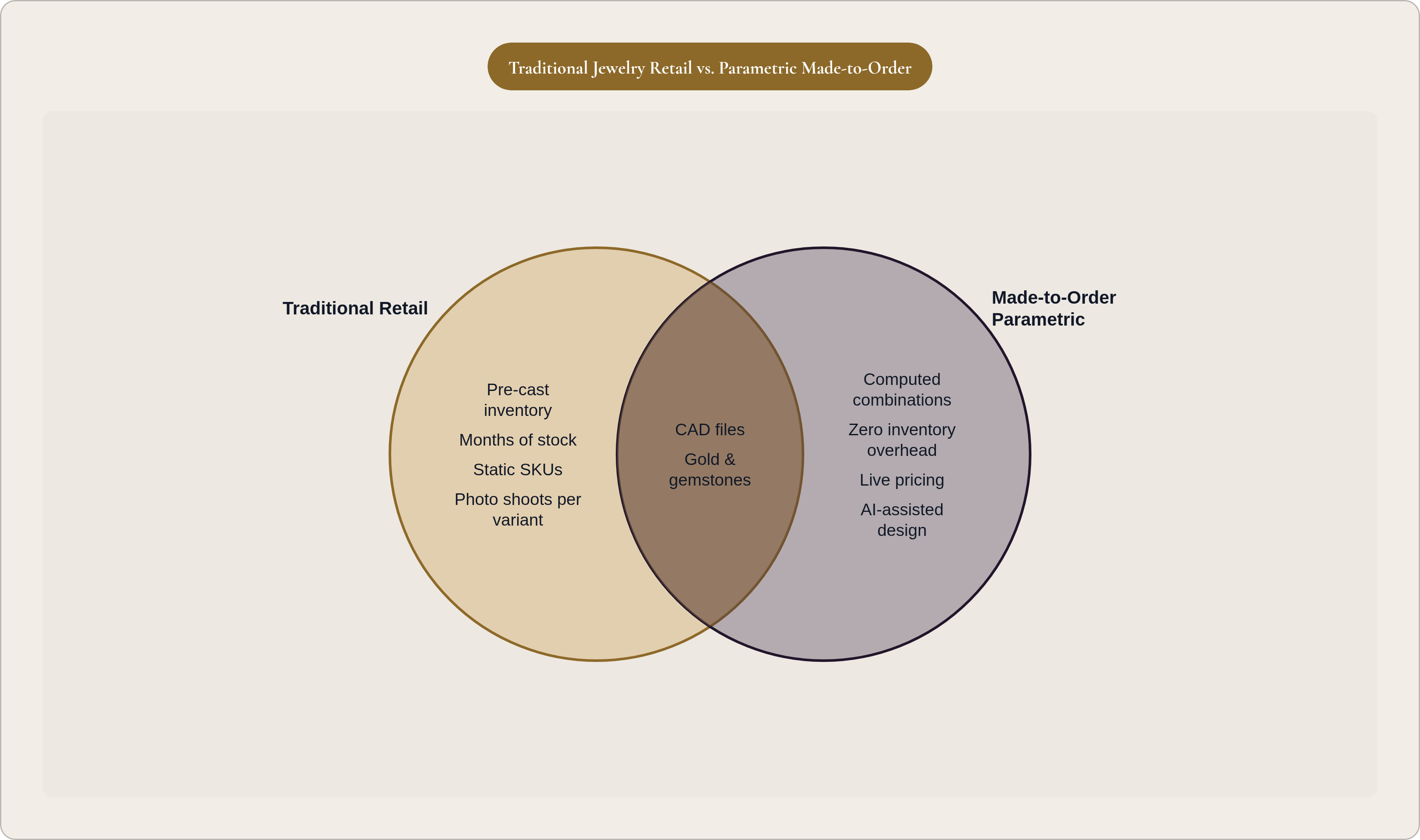
The old model is simple, and simple doesn't mean easy. You cast the rings, photograph the rings, warehouse the rings, and hope they sell before the gold price moves or the trend dies. Then customers started asking for actual choices: their own metal, their own stone, their own size. Three metals times five stone types times four sizes is already dozens of versions of one design. Run that across a real catalog and you land at hundreds of thousands of combinations, each one wanting its own listing, its own photo, its own shelf space that doesn't exist. Even the software wasn't built for it. Shopify caps you at 100 variants per product, which sounds like a technical footnote until you're the jeweler who just hit it on a Tuesday afternoon trying to add a new ring size.
Then there's the money, which is really what keeps owners up at night. Traditional jewelers carry months of stock at any given time. That's capital sitting in a display case doing nothing, waiting for a stranger to walk in and want exactly that ring in exactly that size. Made-to-order brands avoid that problem, mostly because they never bought the inventory to begin with. Cash that would've been locked in a safe goes toward design and marketing instead.
The question has shifted from how to store more combinations to how to stop storing them at all. That's a different kind of question, and it redefines what a jewelry product even is.
What a parametric jewelry design actually is
A parametric jewelry model is a set of relationships, closer to a recipe than a finished cake, rather than a single object sitting in a file somewhere.
Finger size, stone diameter, prong count, band width, metal type: each one is a parameter. Change one, and the geometry updates on its own, the same way editing one cell in a spreadsheet ripples through every formula tied to it.
Nobody redraws a ring by hand for a new size anymore. The model just recalculates. Swap a stone from 6mm to 8mm and the system resizes the setting, shifts the prongs, and figures out how much metal the new piece actually needs, rather than pasting in a bigger picture. What comes out the other end is a production-grade CAD file, ready for a caster.
Compare that to the old way. A static model is one file, one product, and any variation means a designer sits down and rebuilds it by hand. Template libraries speed that up a little, but you're stuck with whatever templates already exist. Parametric design solves both problems at once: combinations get computed on demand instead of pulled off a shelf.
"Production-ready" carries more weight than it sounds like it should. Plenty of rendering software throws up a pretty picture, and a pretty picture is not the same as a file a manufacturer can cast. A parametric model built for manufacturing has tolerances baked in from the start: wall thickness, stone seat geometry, the physical limits that decide whether a piece survives casting or comes out cracked. A design that can't go straight to a manufacturer is a sketch with good lighting, not a finished product.
Tools like MatrixGold or Rhino with Grasshopper let designers build this kind of logic by hand, and they're genuinely capable. But every new design family means real expertise and a lot of manual setup from scratch. Pencil builds that logic into the system itself, easing the burden on designers who would otherwise reinvent the wheel every time they want to launch something new. That's a real gap in how fast someone can move, not a small one.
How millions of combinations get made without a single pre-built SKU
The mechanic underneath all of this is combination as computation, not retrieval.
A customer picks yellow gold, an oval sapphire, size 7. The system computes that exact configuration on the spot, geometry, weight, price, all of it, straight from the parametric model, without searching a database for a SKU that happens to match, because there is no such SKU waiting around.
The guardrail is manufacturability validation. Every combination gets checked against rules that keep things physically sane: no stone too big for its setting, no wall too thin to survive casting, no prong arrangement that can't hold the gem shape someone picked. Customers can only land on combinations that actually work, because the system itself does the quality check. Pencil pairs more than five million customization options with this kind of validation running in the background, so anything that reaches checkout is castable by design, not by luck.
SKUs still exist. They just stop being permanent fixtures. A configuration doesn't live in the catalog forever; when an order comes in, the system encodes that specific setup into a SKU for order management or a marketplace feed. The internal catalog stays small. Fulfillment still gets everything it needs, just later than it used to.
Pricing rides the same rails. Metal weight, stone type, stone size, setting complexity, all of it feeds a pricing model that updates live as someone clicks through options. There's no email back-and-forth, no "contact us for a quote" dead end. The customer sees a real number before committing to anything, something that used to require walking into a store and just asking.
Add it up and Pencil surfaces more than five million combinations across rings, necklaces, bracelets, and earrings, each one backed by the same validation and the same production-ready output.
What the customer actually experiences inside a parametric configurator
For the customer, the configurator replaces the product page. Instead of scrolling a gallery of fixed options, they're touching a live model that updates as they change things. 3D visualization, and increasingly AR try-on, does the job that used to require photographing every single variant by hand.
Price moves alongside their choices. No guessing, no waiting on a quote. That transparency is what gets someone comfortable enough to actually check out.
The clever part is what never shows up. Invalid combinations just don't appear as options, so nobody hits a wall, they get steered around it without noticing. If a stone shape only pairs with certain settings, that logic shows up naturally in the interface instead of barking at them as an error message.
There's a second layer running underneath that has nothing to do with the sale itself: data. Every click is a signal. Which options people explore, where they abandon the flow, which combinations actually convert. That feeds collection planning, informs inventory calls for physical stores, sharpens ad targeting. The configurator ends up doing market research nobody had to schedule.
AI adds one more piece. Someone with no idea what they want can talk to an agent about the occasion, the style, the budget, and get handed a starting point instead of a blank screen. "Something simple for my sister's graduation" turns into a design to tweak, not an empty tool to stare at blankly. Worth noting: AI generating a nice-looking image is a different problem than AI generating manufacturable geometry, and mixing the two up is the difference between a toy and something you can actually sell someone.
Brands using pre-built design files and existing parametric logic can go live in weeks, not months. The barrier here sits a lot lower than most people assume.
Why made-to-order is the natural business model here, not a workaround
Once design gets computed at checkout, made-to-order isn't a philosophy anymore. It's just the obvious way to run things. Nothing sits around waiting to be pre-produced. Manufacturing starts because an order landed, not because a forecast guessed it might.
Call it jewelry's version of just-in-time manufacturing: demand pulls production instead of a prediction pushing it out ahead of time.
The money backs this up. Traditional retailers hold months of stock, capital tied up in pieces that may or may not sell. Made-to-order brands turn inventory over much faster, since the product doesn't physically exist until someone's already paid for it. That difference alone tends to produce meaningfully higher gross margins for asset-light, made-to-order jewelry businesses versus mall retailers carrying heavy stock. It's structural, not a pricing gimmick you can copy for a weekend sale.
It also changes what it costs to start a jewelry business. Traditional retail means a big upfront spend just to build a collection worth putting on a shelf. A parametric, made-to-order setup launches with design files and platform access instead, so the money goes toward building a brand and finding customers, not filling a warehouse nobody's walked into yet.
Customization tends to lift spend, too. Custom and configured pieces generally run higher average order values than off-the-rack catalog buys. Makes sense: someone who just spent twenty minutes designing a ring has already talked themselves into buying it. Pair that higher spend with close-to-zero inventory overhead and the whole math of the business shifts underneath it.
The trade-off is time. Custom orders take weeks, not days, and that only works if the customer knows the deal going in. Most people building a custom ring already expect the wait. It's baked into the fantasy of getting something made just for them, not an unwelcome surprise at checkout.
How a configuration becomes a physical piece: the production chain
Configuration to CAD file to print or prototype to cast to finish to ship. That's the chain. A customer locks in their choices, and the platform spits out a CAD file built to those exact parameters. That file goes straight to a printer or casting facility, with no manual redraw and no translation step where someone's hand introduces an error that wasn't there five minutes ago.
3D printing bridges the digital file and the physical object. SLA (stereolithography) makes ultra-fine resin models suited to intricate settings and delicate detail work. DLP (digital light processing) runs faster and gets used more for higher-volume runs. Direct wax printing skips the resin step and outputs a wax-compatible model that feeds straight into investment casting.
CAD paired with 3D printing shrinks production time hugely compared to old-school handcraft methods. That's the whole reason the clock can start the second an order confirms, instead of sitting in a queue until a bench jeweler gets around to it.
The same file opens up the world, too. A CAD file travels to a manufacturer in India, Thailand, Italy, wherever the right partner happens to sit, because the design moves as data, not as a physical sample that needs shipping and customs paperwork. Brands can work through Pencil's manufacturer network or export files for their own production partners. The file is the product now, and it works wherever the brand's relationships already exist.
There's a quality benefit hiding in here too, easy to miss if you're not looking for it. Because the parametric model enforces manufacturability the moment someone configures a piece, the file that reaches the manufacturer already meets production tolerances. Most quality control problems caused by design errors get caught before manufacturing even starts. A design that needs a redo after the order's confirmed means a delay, an added cost, and a customer who just wanted their ring and now waits longer for it.
Building a jewelry business that's actually built to scale
For an independent designer, this setup strips out most of the traditional startup cost. No design team required, since parametric templates and AI-assisted tools handle the geometry while the designer focuses on creative direction and actually talking to customers. No inventory investment either, since the catalog is a set of files, not a case full of cast pieces sitting under glass. A configurator on a direct-to-consumer site is the whole showroom, open at 2am with nobody standing behind the counter.
Growth doesn't demand headcount at the same pace, either. A new design means a new parametric template, not another photo shoot or another stock order sitting in a warehouse somewhere. Expanding into new metals, new stone types, new size ranges is a parameter update, not a rebuild of the whole product line. And the configurator handles most of the customer conversation on its own, with AI agents answering questions and guiding people toward a purchase without a sales team fielding every message that comes in at 11pm on a Sunday.
Big brands hit this same combinatorial wall, just at a bigger scale, and the fix works the same regardless of size. Headless API access lets enterprise teams drop the configuration engine straight into an existing commerce stack: a brand app, even an in-store kiosk. All that behavioral data from customer interactions turns into a layer of product intelligence feeding the whole merchandising operation, not just one line.
Pencil serves both ends of that spectrum, independent designers and global brands, on the same parametric engine, with more than five million combination options and a direct line into manufacturer networks.
Inventory used to be the moat. Whoever could stock the most options won the floor space and the customer walking through the door. The system itself is the moat now, and the brand that can configure anything and manufacture it correctly is the one that wins the customer.