Direct Metal Laser Sintering vs Lost-Wax Casting for Custom Jewelry
DMLS offers geometric freedom that casting cannot; casting wins on cost and speed at volume.
Both processes start in the same place: a digital file. That's roughly where the similarity ends, and the divergence matters more than most brand owners realize until they're already committed to one path.
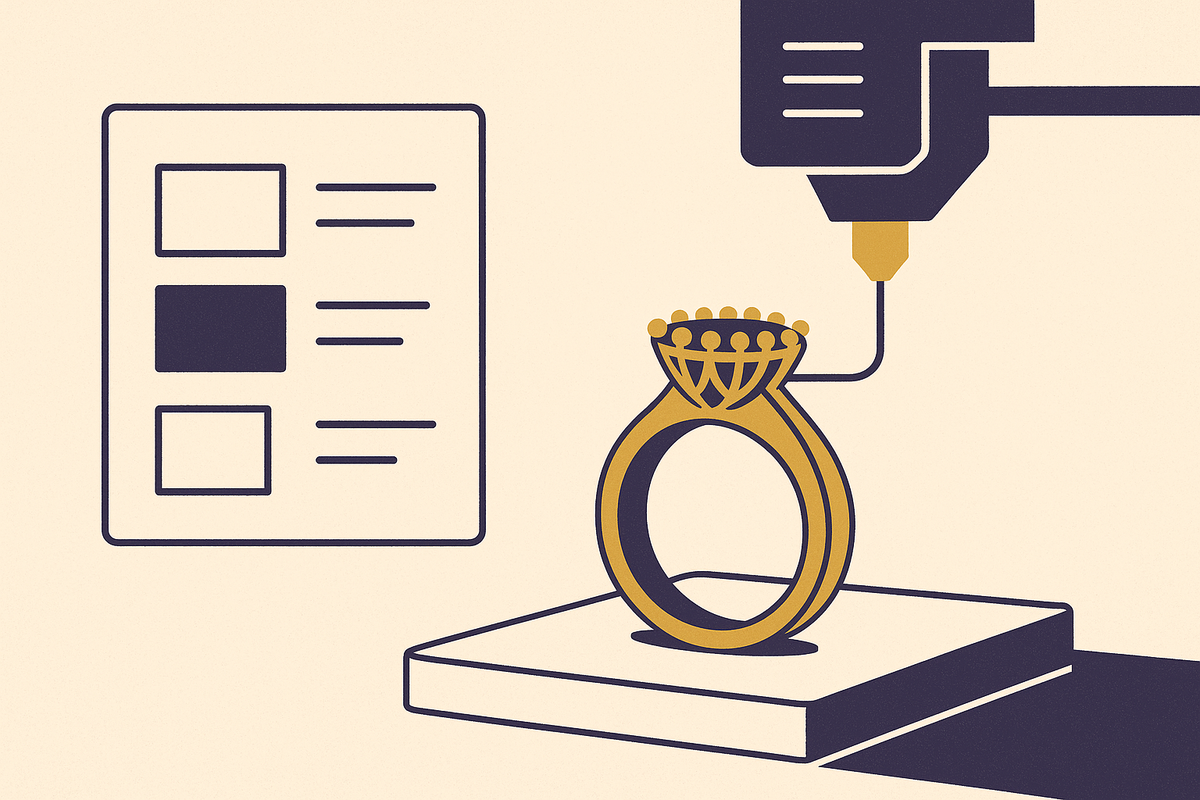
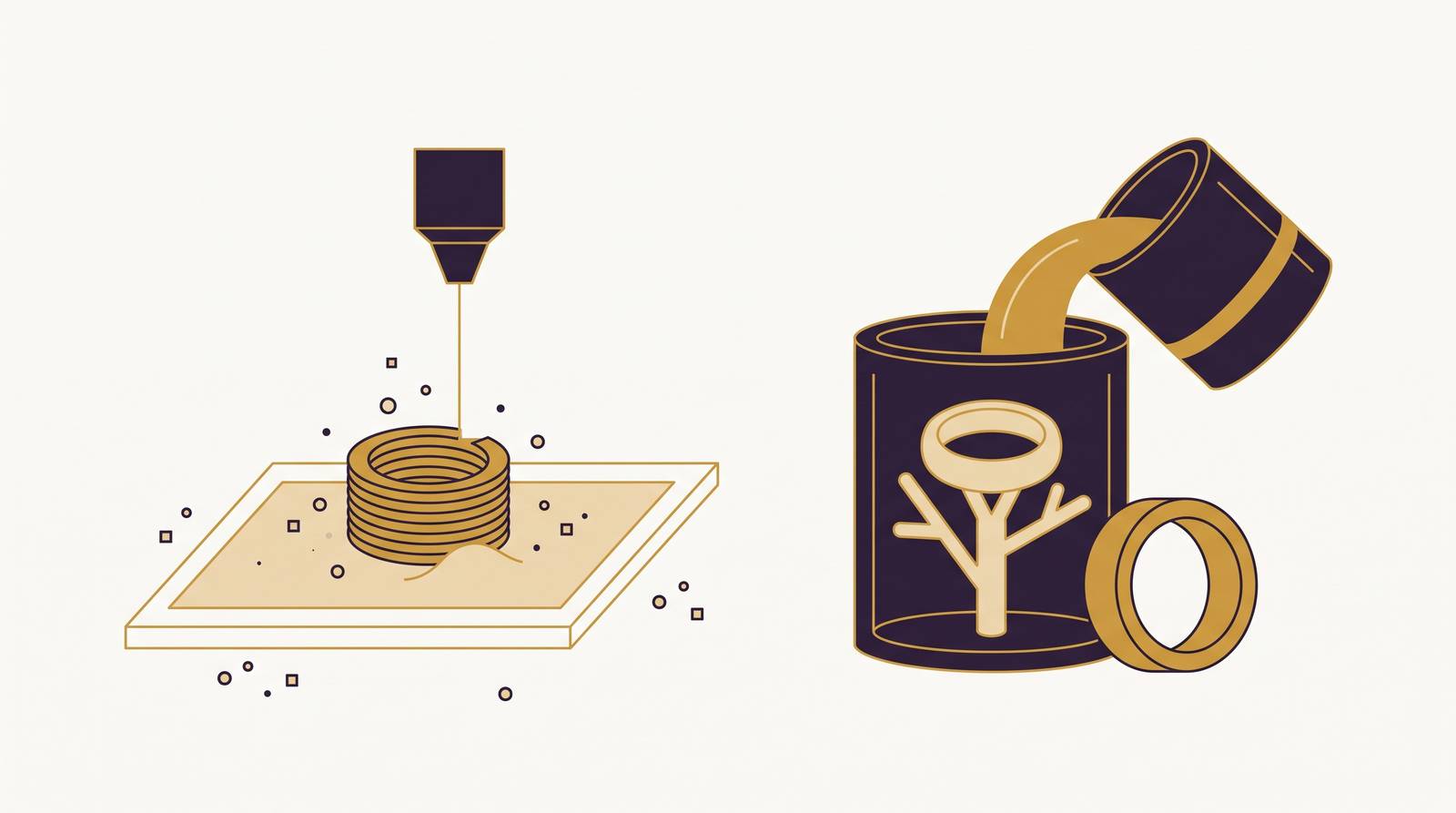
DMLS uses a high-powered laser to selectively melt and fuse metal powder, layer by layer, building the finished piece directly in metal. The powder is atomized precious metal. Gold, silver, platinum alloys, ground to particles between 15 and 45 microns so the sintering behavior stays consistent. There's no mold. The geometry exists only as data until the laser fires.
Lost-wax casting takes a detour through an intermediate form. A wax or castable-resin model is built first, encased in ceramic slurry, then fired in a furnace somewhere between 800 and several hundred degrees Celsius above that to evacuate the wax. Molten metal gets poured into the cavity left behind. The most common version today is a 3D-printed resin model fed into traditional investment casting. This is actually how the vast majority of what gets called "3D-printed jewelry" is made. Worth knowing before you take that claim at face value.
A few sub-categories worth tracking:
- Wax-native printers (like Solidscape or 3D Systems models) produce models that behave identically to hand-carved wax. Considered the gold standard for casting compatibility, though they're fragile. Handle one carelessly and you will learn that lesson on a deadline.
- Castable resins (Formlabs Castable Wax 40, B9Creations Cast, EnvisionTEC Easy Cast 2.0) must burn out completely during firing. Zero ash content is the benchmark. Any residue contaminates the metal, and contaminated metal is an expensive way to figure out your resin wasn't ready.
The practical distinction that matters immediately: DMLS output is metal from the start. Casting output is metal only after you've consumed the wax or resin in between. That extra lap through an intermediate form is where most of the differences in cost, speed, geometry, and finish actually live.
What Each Process Can and Cannot Do With Complex Geometry
Lost-wax casting is not as geometrically limited as people sometimes assume. Fine filigree, deep undercuts, layered openwork. All achievable. What casting genuinely cannot do is release geometry that traps the mold. Internal channels, hollow lattice structures, interlocked moving parts. If a cavity can't be demolded or the wax can't flow out, casting can't make it. Draft angles are a real constraint. Mold release is a real constraint. These aren't obscure edge cases. They show up in ambitious commercial designs more often than anyone budgets for.
What casting is very good at is repeatability. Assemble a large number of wax models onto a single casting tree, fire and pour them together, spread the furnace time and labor across the batch. For a finalized ring design going into a bridal collection, that's a meaningful economic advantage and one that compounds fast at volume.
DMLS removes the mold constraint entirely:
- Internal channels? Fine.
- Lattice infill structures? Fine.
- Moving assemblies printed in place without any post-assembly step? Also fine.
- Two interlocking components printed simultaneously? Yes, this is a real thing people actually do.
Wall thickness can go thinner than cast equivalents. Geometric freedom is genuinely wider.
That said, for most commercial jewelry — rings, pendants, earrings with conventional geometry — lost-wax casting covers the design space comfortably. DMLS's geometric freedom only becomes decisive when the design genuinely cannot be demolded. It's a powerful capability that most pieces never need.
The question to ask is simple: does this piece require geometry that a mold cannot release? If yes, DMLS. If no, casting is rarely the bottleneck.
The Real Cost Gap Between DMLS and Lost-Wax, and What Drives It
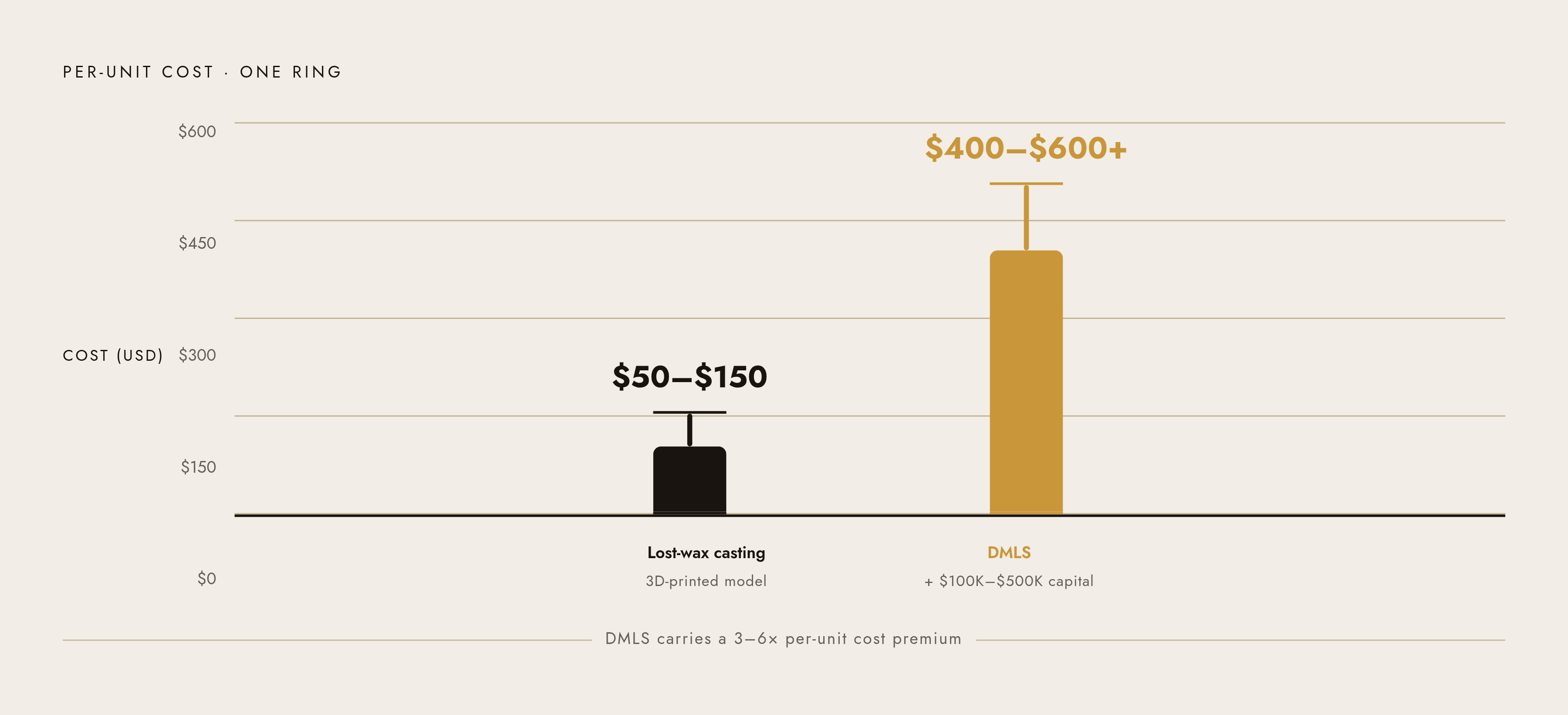
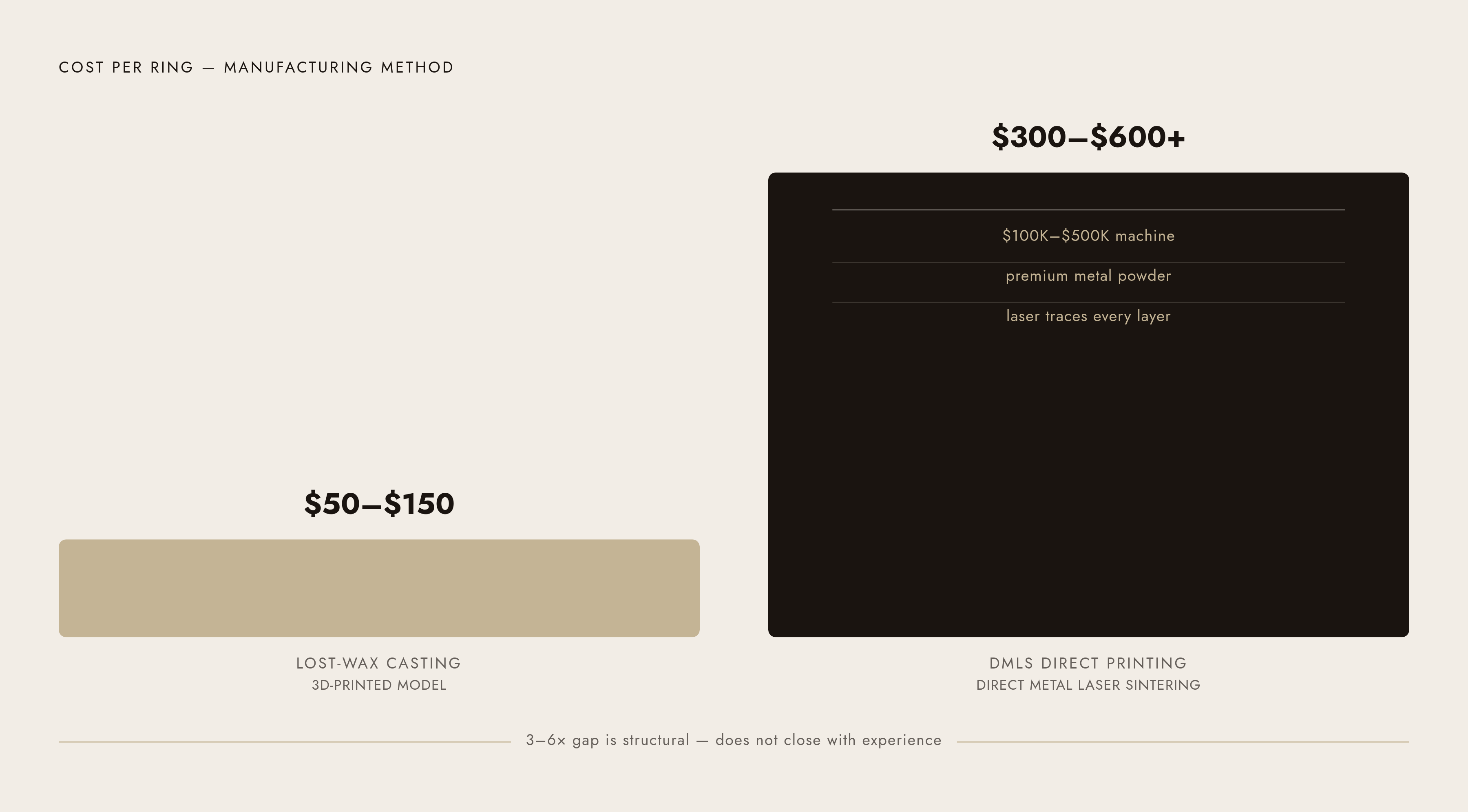
The numbers here are not subtle.
- A single ring printed directly in gold via DMLS: typically several hundred dollars or more in material and machine time.
- The same piece via lost-wax casting from a 3D-printed model: typically $50 to $150.
That gap is structural. It doesn't close just because you get better at DMLS.
DMLS machines run from $100,000 to over $500,000 in capital cost. That amortization is baked into every part that comes out. Precious metal powder costs more than cast grain or shot. And the laser traces every cross-section of every piece in the build chamber, which is inherently slow.
Casting's economics favor volume. Once a tree is assembled, many pieces fire and pour together. The cost of furnace time and labor spreads across the batch, which is why per-unit cost drops fast as quantity climbs.
DMLS's economics favor uniqueness. Each piece in a build can be geometrically different with no added setup cost. The machine doesn't care whether all ten rings in a build are identical or completely different from each other. That indifference to design variation is its core economic advantage at low quantities — and it's the reason DMLS makes sense for bespoke work even when the per-unit cost stings.
One more cost that surprises smaller operations: the CAD conversion step. Moving from a 2D concept sketch to a manufacturing-ready 3D file can run anywhere from $500 to $2,000 per design. That cost sits upstream of both methods and hits you regardless of which one you choose.
Surface Finish, Density, and What Post-Processing Is Actually Required
This is where the claims on both sides tend to get creative. Here's what's actually true.
Lost-wax casting has historically produced better surface finish straight from the mold. The ceramic shell captures fine detail well, and the cast surface requires less mechanical intervention before polishing. The known risk is porosity. Tiny air pockets can form inside the metal during solidification, compromising strength and, over time, causing cracks. Manageable with good casting practice. But it's a real variable, and it surfaces at the worst possible moment.
DMLS as-built surface finish is rough. Not rough in a casual sense. Rough in a technical sense. Ra values in the range of 10 to 25 microns, caused by partially fused powder particles adhering to the exterior walls. Support structures have to come off. Witness marks have to be blended. Surface refinement is required before a piece is retail-ready or suitable for stone setting. If someone quotes you a DMLS price that doesn't include post-processing, ask what the all-in number looks like before you agree to anything.
Where DMLS wins clearly is internal density. Layer-by-layer fusion produces a dense microstructure with minimal porosity. Laser-based DMLS (sometimes called SLM) achieves 99%-plus density. Binder jetting, an alternative to laser sintering, typically lands at 95 to 98% and also introduces 15 to 20% shrinkage that has to be compensated in the digital model before you build. After proper heat treatment, DMLS precious metals meet or exceed cast mechanical properties.
The net read: lost-wax wins on out-of-mold finish. DMLS wins on internal density and structural integrity. Both require skilled post-processing to hit retail quality. Neither process hands you a finished piece.
Prototyping Speed and Design Iteration Under Each Method
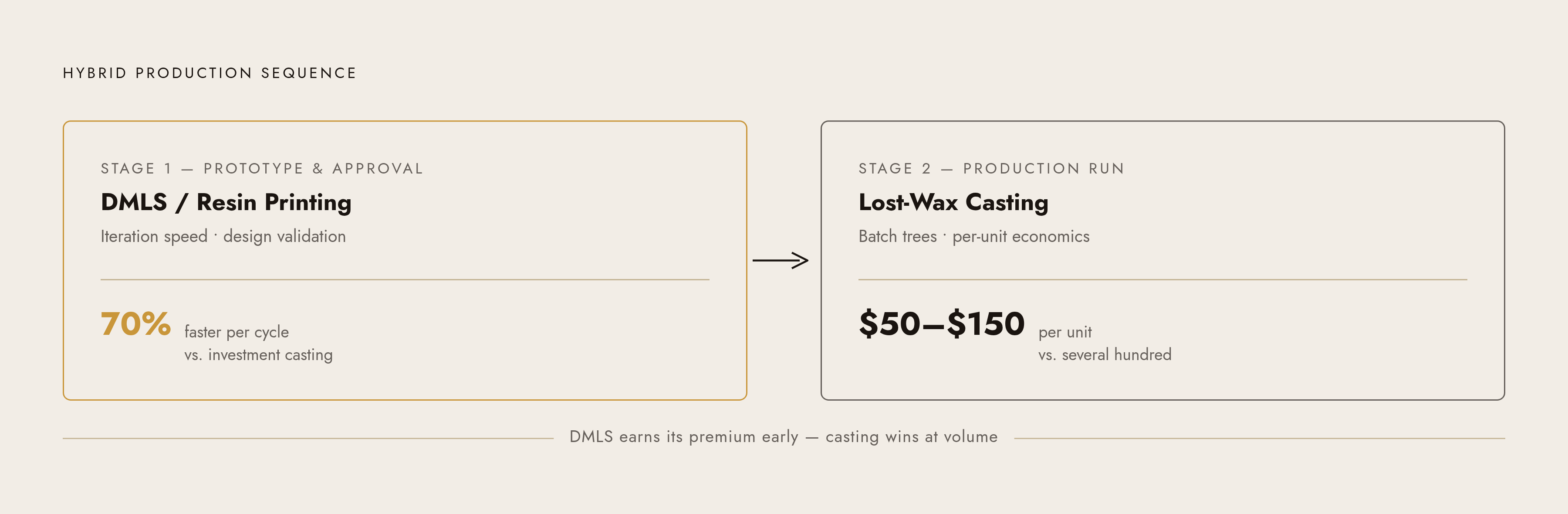
This is where DMLS earns its premium, at least early in a design's life.
The lost-wax iteration cycle goes like this: update the CAD file, reprint the wax or resin model, invest it, fire it, cast it, polish it. That's multiple days minimum per round. If a client comes back with feedback on a bespoke engagement ring and needs to see a revised version, you're looking at days of turnaround per change. Lost-wax casting is a process where time disappears almost as completely as the wax does.
DMLS compresses that cycle significantly. The design change is made in CAD, the part is reprinted directly in metal in hours. No mold, no investment material, no casting cycle. Manufacturing firms testing iteration speed on titanium parts have found that 3D printing can cut prototype time by roughly 70% compared to investment casting. Jewelry applications track similarly.
For bespoke bridal commissions or one-of-a-kind client work, fast iteration is often worth the DMLS premium by itself.
For production runs where the design is already finalized and validated, the iteration advantage becomes irrelevant. Volume and cost per piece take over as the deciding variables, and casting wins that argument handily.
Treating the two methods as mutually exclusive is where brands leave real money and time on the table. DMLS's prototyping advantage is most valuable early in a design's life. Once validated, switching to casting for production is a rational and common choice.
Which Production Volumes and Business Models Each Method Actually Fits
DMLS fits best when:
- Each piece is unique or near-unique. The machine's indifference to design variation is a genuine economic advantage at low volumes.
- The design requires internal geometry, lattice structures, or interlocked components that casting physically cannot release.
- Prototype iteration speed matters more than per-unit material cost. Bespoke commissions, design validation runs, anything where client approval cycles are part of the process.
- The brand narrative centers on structural innovation or technological distinction that the manufacturing process itself actually supports.
Lost-wax casting fits best when:
- Volume is moderate to high and the design is finalized. Casting trees spread cost efficiently and reward consistency.
- Out-of-process surface finish is a priority and post-processing labor is a real constraint.
- The geometry is achievable with draft angles and mold release, which covers the large majority of commercial jewelry.
- Per-unit cost discipline is essential. Wholesale lines, bridal collections, branded SKUs running in any meaningful quantity.
The hybrid approach is increasingly standard practice among serious studios. DMLS or resin printing for prototyping and client approval, then lost-wax casting for production runs. This isn't a compromise. It's using each method at the stage where it actually has the advantage.
The custom jewelry services market sits at around $3.95 billion in 2025, growing at roughly 8.9% annually. Independent studios, direct-to-consumer brands, and larger houses each map differently to these two methods, which is exactly why no single default answer ever works across the industry.
How the Digital File Connects Both Methods to What Gets Made
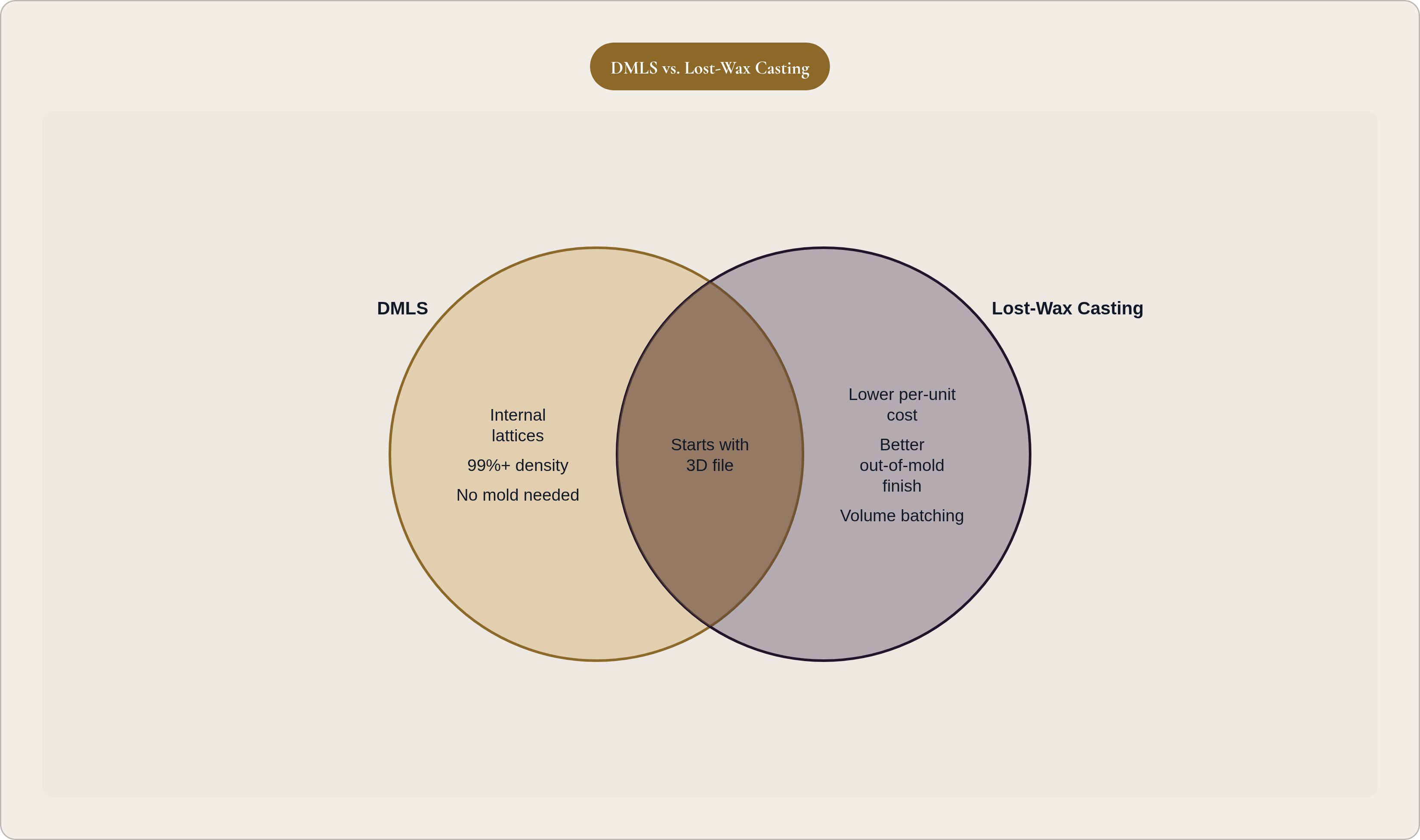
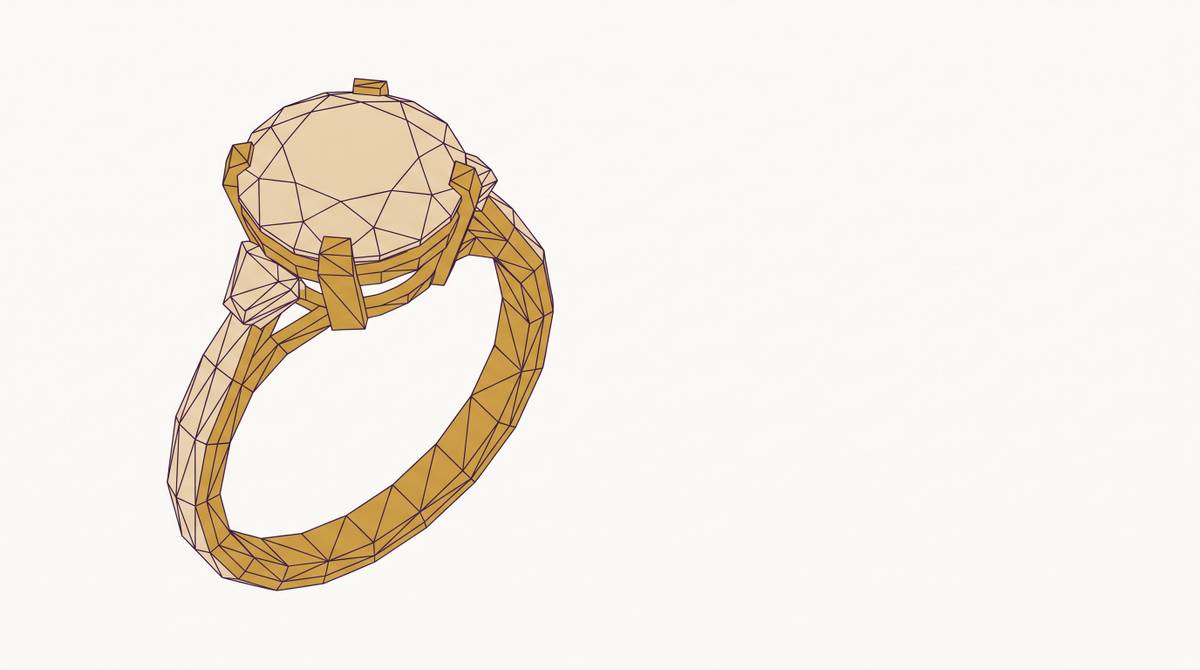
Both DMLS and lost-wax casting begin with the same input: a 3D digital model, typically exported as an STL file. That file is where everything either goes right or falls apart before anyone touches metal.
A model with incorrect wall thickness, unsupported geometry, or unconsidered shrinkage will fail in either process. The quality and manufacturing-readiness of the file determines everything downstream. This is not a minor technical detail. It's the foundation, and it's frequently where brands lose time and money without understanding why.
Traditional CAD software takes years to learn proficiently. Two to five years to be useful, longer to be fast. That learning curve has historically meant most custom jewelry brands depend on a small pool of specialized operators. When that operator is busy or unavailable, the whole pipeline waits. Most brand owners don't notice this fragility until it becomes a crisis.
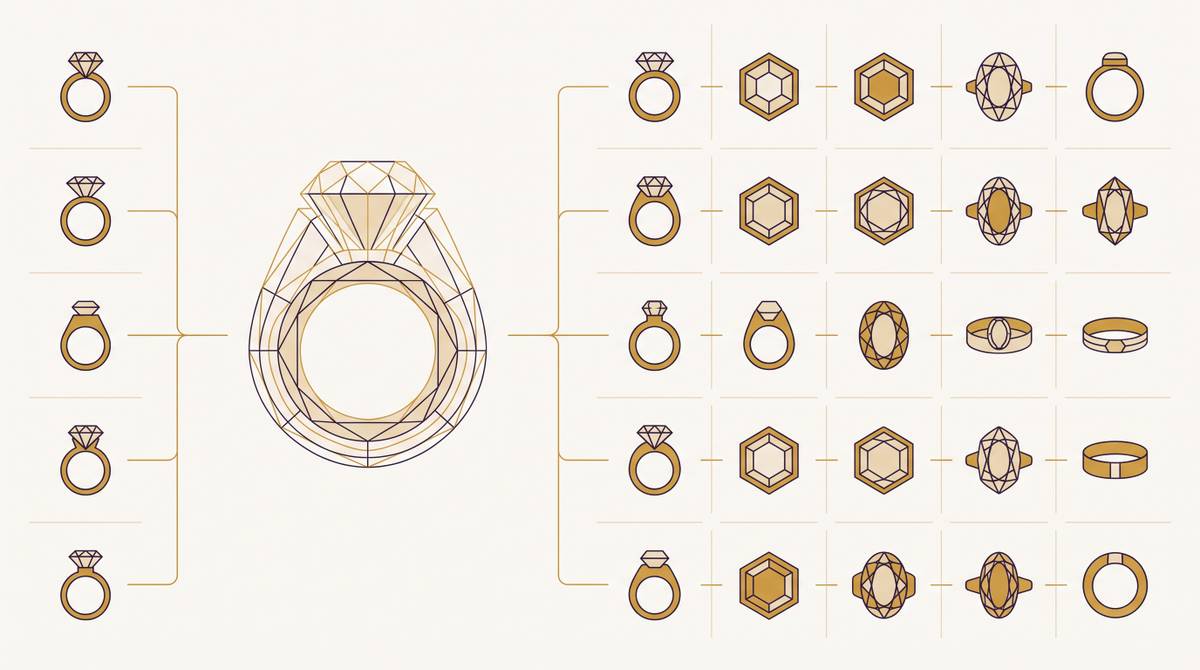
The deeper structural issue is the 2D-to-3D gap. Brands conceptualize in 2D. Customers browse in 2D. Both manufacturing methods require a validated 3D file to operate. The $500 to $2,000 CAD conversion cost mentioned earlier is what you pay when that gap isn't solved upstream.
One more thing worth flagging: a file optimized for casting (correct draft angles, wall thickness, sprue placement) is different from a file optimized for DMLS (support structures, build orientation, powder removal channels). If you're running a hybrid workflow, you need either a platform or a CAD operator who understands both endpoints and can output the right file specification for each without rebuilding the model from scratch. Rebuilding from scratch is expensive and slow, and it tends to introduce inconsistencies between what the client approved and what actually gets made.
Where AI-Assisted Design Platforms Fit Into Both Manufacturing Paths
The AI jewelry design landscape splits into three categories, and only one of them actually closes the loop to manufacturing.
- 2D image generators (Midjourney, DALL-E): useful for ideation. GIA's Gems & Gemology even coined the term "AIdeation" for this use case in their Fall 2024 issue. These tools produce no manufacturing geometry. A separate CAD step is still required after.
- General AI assistants: helpful for text-based workflows, not for producing buildable geometry.
- 3D-native design platforms: the only category that outputs STL files ready for either DMLS build prep or casting model production. The only category that actually connects concept to manufacturing without an extra conversion step in between.
The choice of design platform, like the choice of manufacturing method, is an upstream decision with downstream consequences. Picking the wrong one doesn't just make life harder. It adds cost and delay to every single order that moves through the pipeline.
Matching Manufacturing Method to Design Goals: A Practical Decision Framework
There's no universal answer. The right process depends on what you're making, how many, and what the piece actually needs to do.
A few questions worth running through before committing:
Does the design require geometry a mold cannot release? Internal channels, interlocked components, hollow lattice. If yes, DMLS is necessary regardless of cost. Casting physically cannot solve it.
Is this a prototype or a production run? A prototype favors DMLS for speed. A production run favors casting economics. Which stage you're in changes the math completely.
What's the per-unit cost ceiling? At $300 to $800 for DMLS versus $50 to $150 for casting, the gap compounds fast as volume grows. Running the actual numbers for your specific piece and quantity is worth doing before you assume either method is affordable or unaffordable.
How important is surface finish out of process? Casting wins here. DMLS requires more post-processing investment before it's retail-ready.
Is structural density or internal strength a specification? DMLS's 99%-plus density and minimal porosity give it a real advantage for technically demanding pieces.
For custom-first brands, the hybrid model is increasingly the default. DMLS or resin printing for client-approval prototypes. Casting for repeatable production. Not either/or. A sequence that uses each method where it actually earns its place.
Manufacturing method is a downstream consequence of upstream decisions. Design complexity, business model, volume targets, and the quality of the digital file all constrain or enable what's possible. Get those upstream decisions right and the manufacturing choice follows on its own.