AI Design Iteration vs Traditional CAD Revision Cycles in Jewelry
AI visualization cuts design revision cycles but still requires CAD for manufacturing specs.

Most people outside the jewelry industry have no idea how long a custom piece actually takes. It is like watching someone build a ship in a bottle — the finished thing looks effortless until you realize every piece had to fit through the same narrow opening, in order, with no room for error. Once you see the timeline laid out, it makes sense. But that first look usually lands with a quiet "oh, that's a lot."
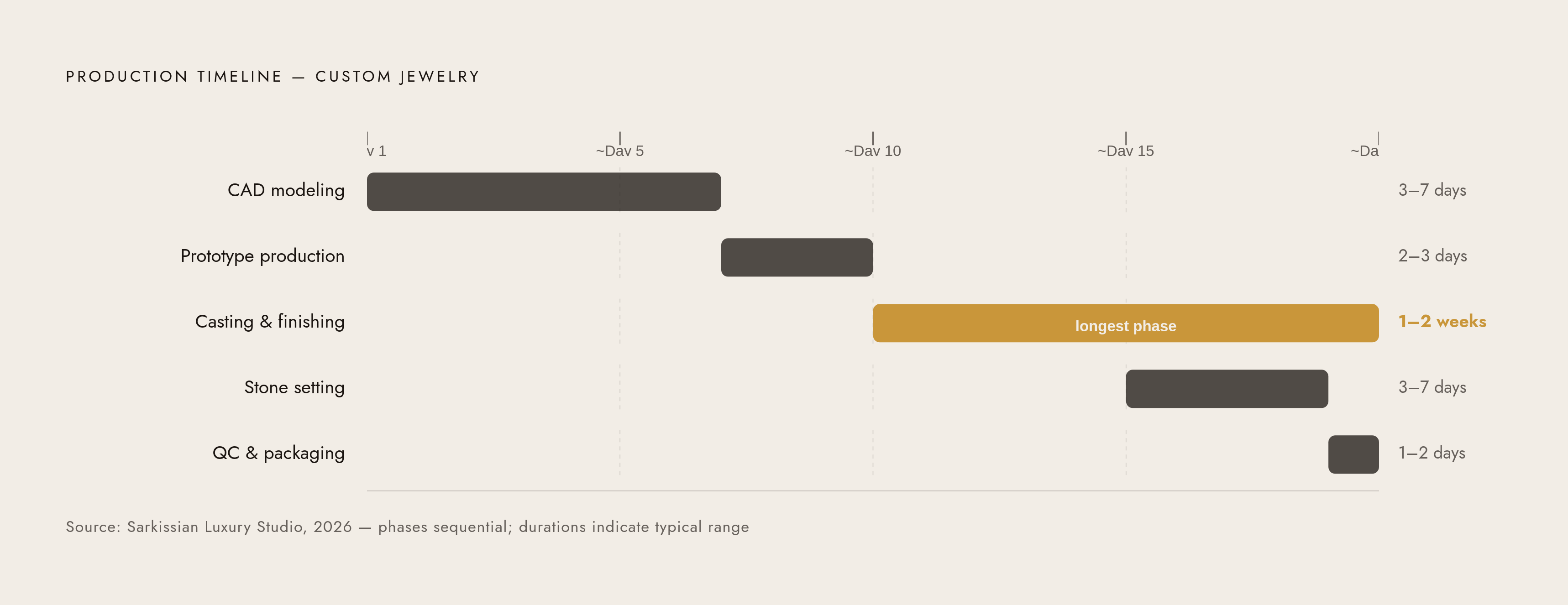
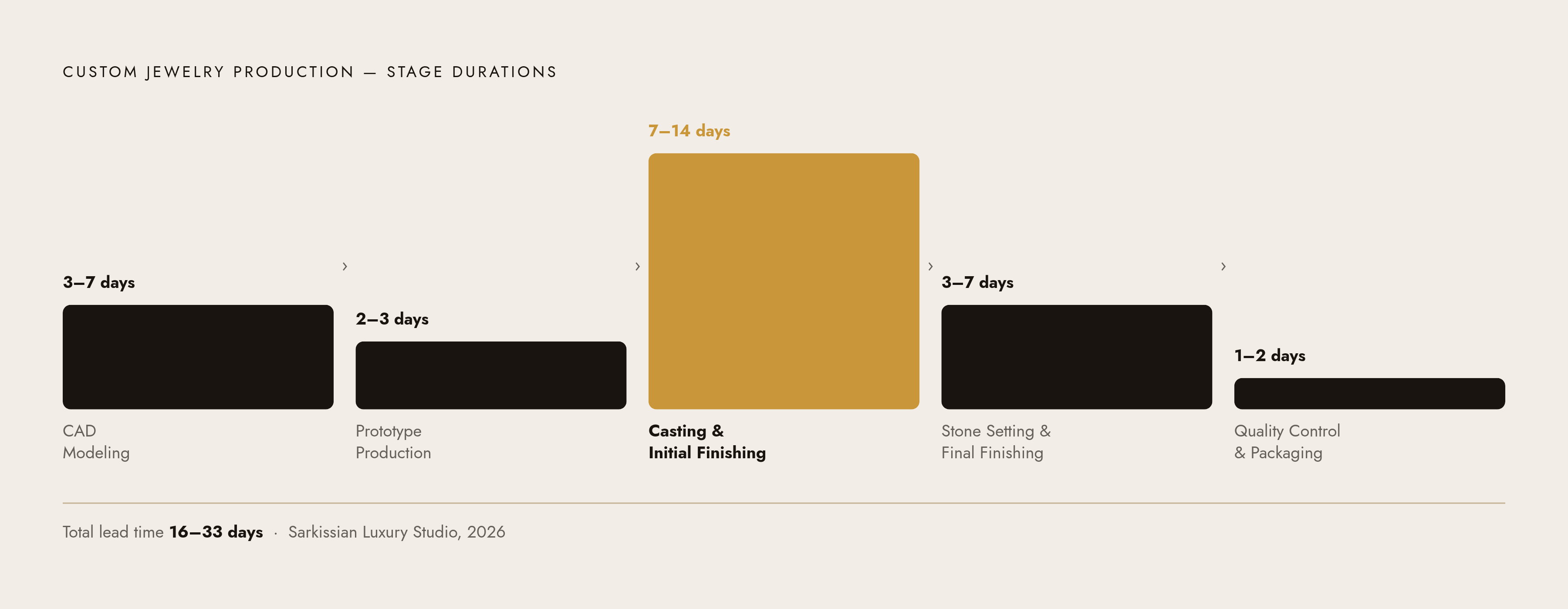
According to Sarkissian Luxury Studio (2026), a standard custom piece moves through these stages:
- CAD modeling: 3–7 days, depending on complexity and revision rounds
- Prototype production: 2–3 days
- Casting and initial finishing: 1–2 weeks
- Stone setting and final finishing: 3–7 days
- Quality control and packaging: 1–2 days
That is a serious runway before anything reaches a customer's hands. And most of that time is not wasted by slow people. It is just baked into how the process works.
Why Revision Rounds Hurt So Much
Client review happens after rendering. So when a client says "can we make the band a little thinner?" or "what if we tried a princess cut?", the designer does not tweak a slider and move on. They go back to the modeling stage. Real rework, not a quick fix.
Errors at the CAD stage are also invisible until much later. A miscalculated prong tolerance does not show up until the prototype returns from the printer. Sometimes it shows up at casting. By then, material has been spent and days have passed. That is the part that quietly kills project timelines.
Why the Physical Prototype Is Not Optional
The 3D-printed prototype is not a formality. It is the step where proportions, stone fit, and structural integrity get confirmed in the real world. Rendering catches a lot, but not everything. You genuinely need to hold the object before you can be certain.
Each prototype round runs 2–3 days minimum, plus materials. If a client requests changes after seeing it, that clock resets. Not dramatically, but enough to feel it.
What Traditional CAD Actually Gets Right
A well-built CAD model produces an STL file that drives 3D printing, mold creation, casting, and stone setting without anything getting lost between steps. The CAD file is the single source of truth for the entire downstream process. That precision is the point. It is not a limitation to design around, it is the whole reason the workflow exists.
Where Parametric Modeling Already Closed Part of the Gap
Before AI entered the picture, parametric modeling was already making iteration meaningfully faster. Worth understanding what changed here, because it sets up exactly where AI picks up.
What Parametric Means in Practice
A parametric model encodes design intent as adjustable variables instead of fixed geometry. Shank width, stone size, prong count. Modify one parameter and the whole model updates. You are not rebuilding from scratch every time a client changes their mind about stone shape.
MatrixGold uses a dynamic history system that tracks every design step. Any stage can be modified without restarting the whole model.
Some platforms have pushed this further. Jewelry CAD Dream (JCD) has a proprietary feature history system capable of running models with 500 or more gemstones. Think multi-row choker colliers. Critical parameters can be surfaced to an input panel so clients or end users configure options directly. That is parametric design edging toward configurator logic, which matters more than it sounds.
Where Parametric CAD Hits Its Ceiling
Parametric tools are excellent for variation within a defined design family. Less useful for exploring genuinely different concepts from scratch.
If you want to explore five distinct ring architectures, you are still building five models. The parametric efficiency kicks in once a model exists. Getting to that first model still costs real time. That upstream problem is exactly what AI changes.
What AI Actually Does to the Iteration Cycle, and What It Still Cannot Do
Where the Friction Goes Away
AI rendering engines can update 3D models based on user inputs in milliseconds (Tashvi AI, 2025, citing GstarCAD). A client interaction that used to generate a revision request now generates a real-time visual update. That is a fundamentally different experience for both the designer and the client.
The input formats are broader too. Designers can work from text prompts, image references, sketches, or voice commands. Concepts that used to require manual CAD interpretation before anyone could visualize them can now generate multiple directions in one session.
Generative design algorithms can also run through large numbers of digital options before any prototype is made. The designer identifies the most promising directions before committing CAD time to any of them.
Why Low-Cost Early Iteration Compounds
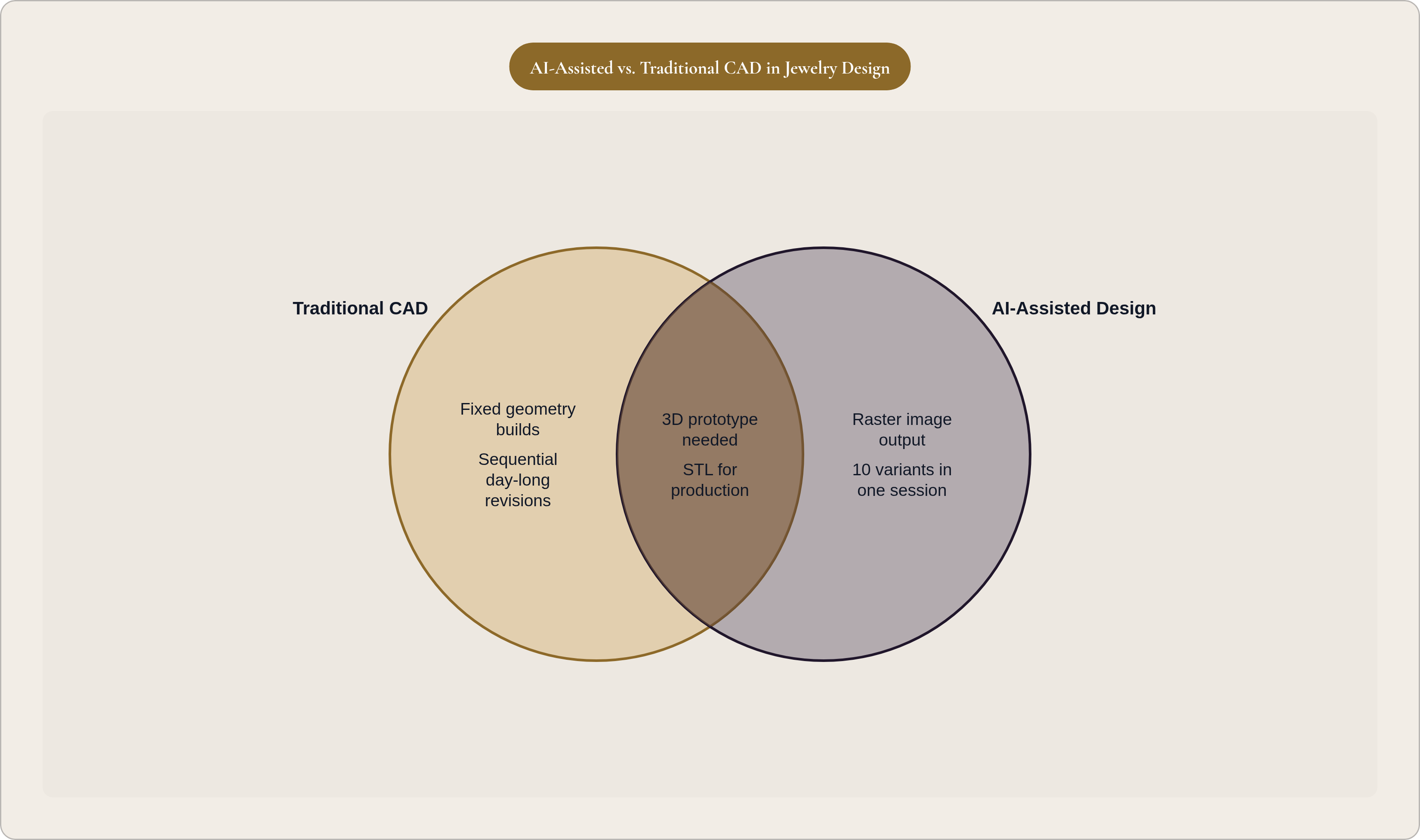
In a traditional CAD workflow, exploring three design directions means building three models. Sequential days of work.
With AI concept generation, exploring ten directions in a single session is practical. The designer selects the strongest candidates before touching CAD.
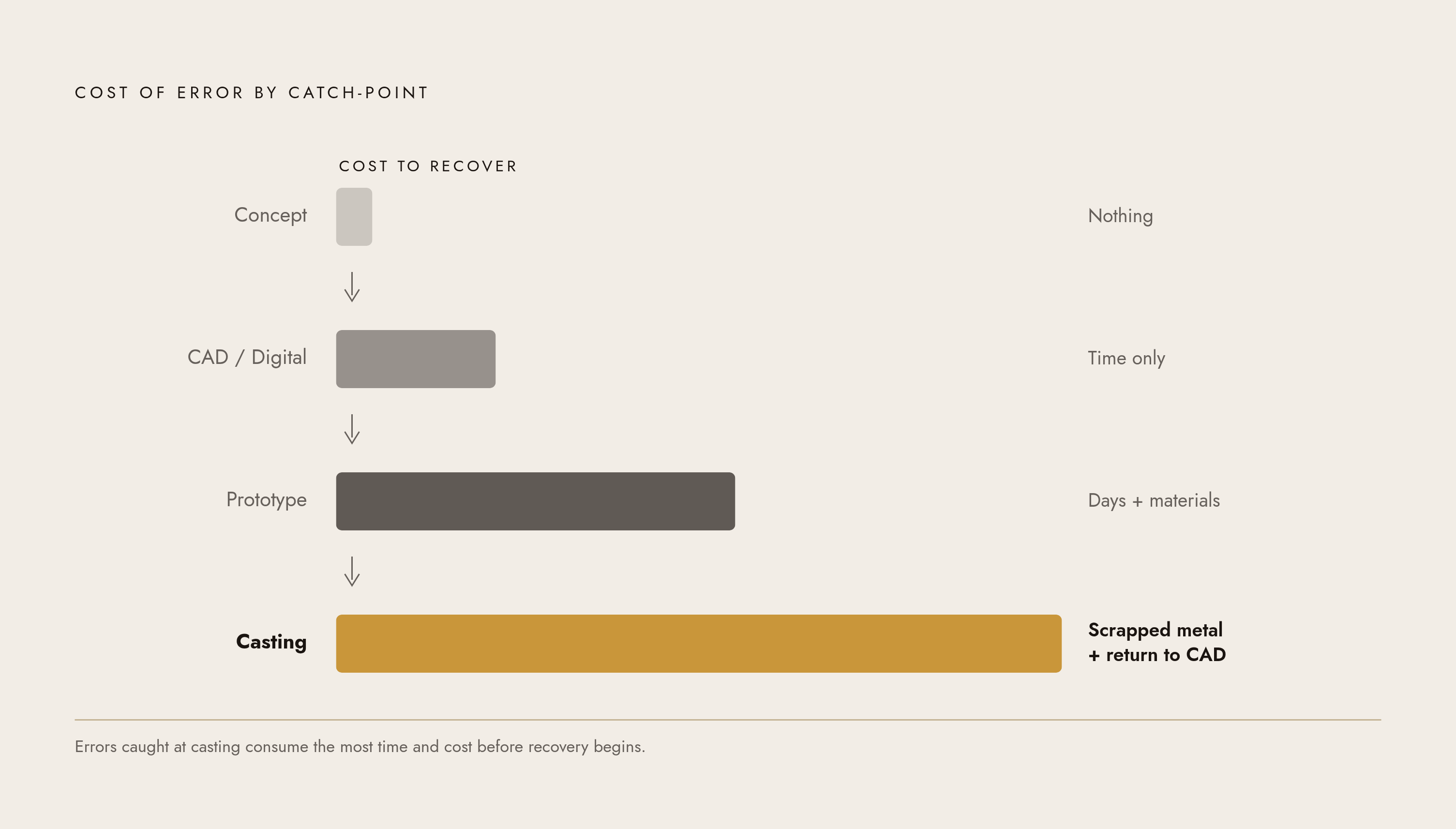
Problems caught at the concept stage cost nothing to fix. Problems caught at the prototype stage cost days and materials. Problems caught at casting cost significantly more. Moving discovery earlier does not just save time at one step. It removes cost from every step that follows.
The Hard Limit That Is Real
There is a lot of hype in this space that glosses over something important, so here it is plainly.
Generative AI produces raster images. Pixels. They carry no pattern data, no manufacturing specifications, no tolerance information. A Midjourney image cannot be sent to a factory. There is no STL file, no dimensions, no casting specification.
A GIA researcher's Fall 2024 evaluation of tools including Midjourney and DALL-E documented both the creative potential and the failure modes: hallucinated compositions, structurally impossible geometries, and intellectual property concerns.
The AI-to-CAD handoff has not been eliminated. What changes is how much gets resolved before that handoff happens. That is still a significant operational gain, even with the limitation on the table.
Purpose-Built vs. Generic Tools
Generic image generators produce inspiration, not specifications. Useful for creative exploration and client-facing direction-setting before anyone opens a CAD file. But that is where their usefulness ends in a production context.
Platforms built specifically for jewelry production maintain the connection between visual output and parametric CAD. Configurations stay linked to manufacturing-ready files. The difference between a tool that accelerates creative exploration and one that actually closes the loop to production is not subtle. It shows up at every handoff.
The IP Risk Worth Flagging
The CIBJO Ethics Commission (2026) notes that existing intellectual property law is struggling to keep pace with AI-generated jewelry designs. The legal distinction between AI-assisted (where a human remains the creative decision-maker) and AI-generated (where the system determines the expressive result) is both legally and commercially meaningful.
Brands building on AI workflows should establish internal documentation practices. CIBJO recommends this explicitly given the current lack of regulatory clarity. Not a reason to avoid the tools. A reason to keep basic records of what decisions were made by whom and when.
Where the Time Gap Is Largest: Concept to First Production-Ready File
The real difference between AI-assisted and traditional CAD workflows is not in casting or finishing. It is in the stretch between "we have an idea" and "we have a file ready for production."
What Traditional CAD Costs Before Modeling Even Starts
CAD modeling takes 3–7 days. But that clock does not start when a client says "I want a ring." It starts when the concept is defined enough to model. Pre-CAD work, including sketches, client alignment, and direction approval, adds time that rarely shows up on anyone's official project timeline.
A revision request after client review can restart a meaningful portion of this phase. Not all of it, but enough to notice on the calendar.
What AI Compresses in This Window
AI-assisted workflows move concept generation from days to hours, sometimes less. Clients can react to realistic visuals before any CAD work is committed. When a design finally enters CAD, it arrives more defined. More directions were already explored and eliminated upstream, so fewer revision loops are waiting on the other side.
The "five minutes to first design" benchmark some platforms advertise is meaningful not because the first output is final, but because it shifts when problems get discovered. A designer who generates ten variants in an hour is catching structural and aesthetic problems before they become CAD rework. The total time saved is not one large step. It is a collection of smaller steps that simply stop happening.
What This Means Without a Dedicated CAD Specialist
In a traditional workflow, a skilled CAD operator is required at every stage. When that person is the bottleneck, delays stack up across the whole calendar.
AI-assisted platforms allow non-CAD designers, merchandisers, or business owners to participate meaningfully in early iteration without ever opening a CAD file. The decision of when to bring in a CAD specialist shifts from "at the very beginning" to "when the concept is production-bound." For small teams, that shift has real operational value. It turns one person's skill into a resource you deploy later, not one you tie up from the first conversation.
How Faster Iteration Connects to Fewer Manufacturing Errors and Lower Rework Costs
The Propagation Problem
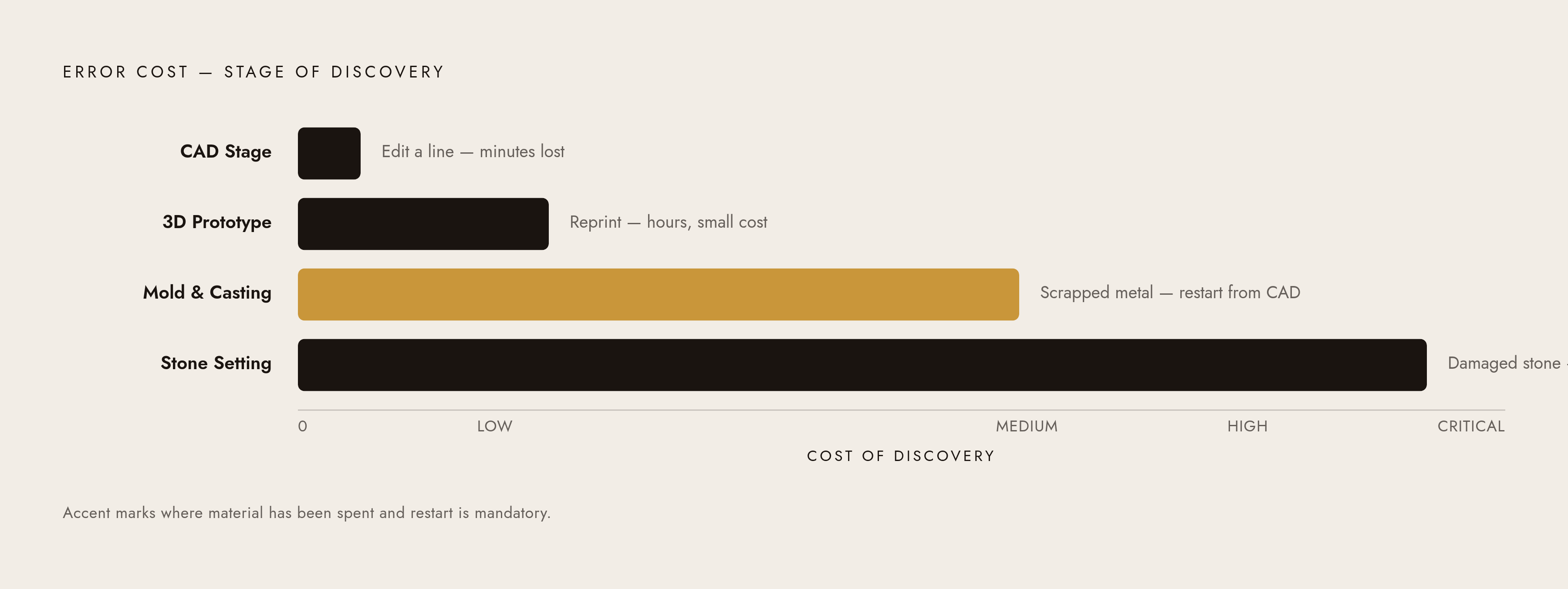
An error introduced at the CAD stage does not stay at the CAD stage. It travels forward through 3D printing, mold creation, casting, and stone setting. Each subsequent step adds cost before the error finally surfaces.
A tolerance problem discovered at casting means scrapped metal, lost time, and a return to the CAD file. The later an error appears, the more of the production timeline gets consumed before recovery can even begin. That is not a dramatic, obvious failure. It is the kind of thing that just quietly makes every project cost a little more than it should.
More Iterations Mean More Error-Catching Opportunities
AI-assisted workflows surface proportion problems, stone fit issues, and structural weaknesses in the digital stage, before wax, resin, or metal enters the picture.
A designer who runs ten concept variants before committing to one has stress-tested more failure modes. Not because they went looking for failures specifically, but because exploring more options naturally exposes more edge cases. More surface area for problems to show up early, when fixing them costs nothing.
Material Efficiency as a Downstream Benefit
Generative design algorithms can be configured to optimize for material efficiency. Reducing gold weight without compromising structural integrity, for instance. Manual CAD iteration rarely reaches this kind of optimization because it requires evaluating many options against a constraint simultaneously. That is exactly what generative algorithms are built to do, and it is one of the more underappreciated practical benefits.
The Physical Prototype Still Matters
The 3D-printed prototype does not disappear in an AI-assisted workflow. It just plays a narrower role. It becomes a final validation step rather than a primary discovery mechanism.
Fewer prototype rounds are needed because more has already been resolved digitally. Lower material cost, less shipping time, fewer days waiting for a physical object before the next decision can be made.
How the Iteration Gap Shapes What a Jewelry Brand Can Actually Offer
The Demand Problem Is Already Here
A 47% global rise in customized jewelry demand (Business Research Insights, 2025) does not just mean more customers asking for something special. It means more SKU combinations, more design configurations, more variant management across the board. A traditional CAD workflow that takes 3–7 days per design variant cannot keep pace with a product catalog that needs hundreds of combinations.
Parametric Design as the Foundation of Scalable Customization
When a design is built parametrically, with metal type, stone size, and band width as adjustable variables, each combination does not require a separate CAD file. Those same parameters can be surfaced to a customer-facing configurator without remodeling anything.
The design team's iteration work and the customer's configuration experience share the same underlying structure. That is what makes customization scalable rather than just theoretically possible.
What Cheap Iteration Unlocks at the Catalog Level
When iteration is low-cost, some things become practical that were not before:
- Broader catalogs because more design directions were explored before launch
- Trend-responsive design because a new concept can move from idea to production-ready file in days rather than weeks
- Made-to-order models because the design-to-manufacturing path is short enough to quote delivery times with confidence
The Independent Designer Advantage
Large brands have historically absorbed slow iteration costs through dedicated design teams and long product development calendars. They waited.
AI iteration tools lower the barrier for independent designers and boutique brands to offer comparable configurability without equivalent staffing. More than half of all online jewelry buyers in the U.S. are under 35 (YouGov, 2026), a cohort that expects personalization and fast turnaround, and that expectation does not scale down based on the size of the brand they are buying from. The designer working alone or with a small team gets the biggest relative gain here. That is not a small thing.
Why the Gap Between AI and Traditional CAD Iteration Will Widen, Not Stabilize
The AI-generated 3D asset market was estimated at USD 1.63 billion in 2024 and is projected to reach USD 9.24 billion by 2032, at roughly 24% annual growth (SNS Insider, cited by Tashvi AI, 2025). That scale of investment does not produce incremental improvements. It produces category shifts.
The Development to Watch Most Closely
The biggest limiting factor right now is the gap between raster image output and production-ready 3D files. AI generates inspiration well. It does not yet generate STL files that go directly to a manufacturer.
That gap is closing. The platforms investing in bridging AI concept output to parametric CAD structures are the ones worth watching. When that connection becomes reliable and fast, the remaining handoff friction disappears and the concept-to-production timeline compresses further.
Why This Does Not Plateau
Traditional CAD revision cycles are largely at their ceiling. The tools are mature, the workflows are optimized, and the incremental gains left on the table are small.
AI-assisted design is nowhere near that ceiling. The models are improving. The integrations with production tooling are deepening. Industry-specific training data is growing. The tools available in two or three years will differ meaningfully from what exists today.
Brands and designers who build AI-assisted iteration into their workflows now are not just faster today. They are on a curve that keeps steepening, while the traditional CAD revision cycle sits largely where it already is. Precision, documented history, and production-grade output still matter at the end of every process. But the path that leads there is changing. It is faster, cheaper, and more exploratory than anything that came before it.