Replacing a CAD Outsourcing Workflow with an In-House AI Design System
Immediate revisions and real-time client decisions replace weeks of waiting and revision fees.

The default position for most small jewelry brands was never really a choice; it was a workaround. Traditional CAD software requires years of training to reach production competence, and the upfront cost of an on-premise setup (software licenses, a capable workstation, the whole stack) created a real capital hurdle that most early-stage brands simply couldn't clear. Outsourcing filled that gap. It made sense at the time. The problem is that most brands never revisited the decision. They just kept doing it; and the costs that weren't visible on day one have been quietly compounding ever since — like interest on a loan nobody remembers taking out. Replacing that workflow with an in-house AI design system isn't just a cost decision; it's a control decision. This piece maps exactly what changes operationally when revision cycles, turnaround times, and production-readiness move inside the business.
What Outsourcing Actually Costs Once Revision Cycles Are Counted
Per-file pricing looks clean on a rate sheet; it gets messy the moment you need a change.
Every revision request restarts the clock and adds a charge. A three-round revision cycle on a single design doesn't cost three times the original file fee. It costs the fee, plus the revision fees, plus the elapsed time at each round. And the customer is waiting through all of it.
A simple custom ring can take two to four weeks from sketch to final polish in a traditional pipeline. Outsourced CAD revisions compound that delay at every iteration. You're not just paying more; you're losing time you can't get back, especially against a launch window or a custom order with a deadline attached. It's like trying to win a race by sending your shoes out for repairs after every lap.
There's also the communication layer. Translating creative intent across an asynchronous external handoff is genuinely hard. Brief quality, interpretation gaps, version control across email chains. The outside team delivers a file that looks correct and still fails at casting because wall thickness was off, stone seat tolerances weren't specified clearly, prong geometry got interpreted differently than intended. That error doesn't show up until the physical sample comes back. Then you write a new brief, wait again, and pay again.
For brands using 2D AI concept tools, there's an additional hit. Platforms that generate images rather than 3D files require a separate CAD conversion step before anything is manufacturable. That step typically runs between $500 and $2,000 per file and sits on top of whatever revision fees you've already paid. It's not optional; it's mandatory. And it means you're funding two workflows instead of one.
The soft costs are real too:
- Design decisions delayed pending file turnaround
- Launch windows missed because the file wasn't ready in time
- A sales team that can't quote custom work confidently because they don't control the timeline
Every revision handed off is a decision point the brand no longer owns in real time. That's the part that rarely shows up in the line-item analysis, and it's the part that matters most as volume grows.
How In-House AI Design Systems Restructure the Revision Cycle
The structural shift is this: revision stops being a handoff event and becomes an immediate, iterative act performed by someone inside the business.
That sounds simple; the implications are not.
AI-powered design platforms built for jewelry are designed for immediate productivity regardless of technical background. The two-to-five year training barrier that made outsourcing rational in the first place dissolves as a gating condition. According to GIA's Gems & Gemology (Fall 2024), rapidly generating ideas from a starting point is already the most common AI use case in jewelry design. The term "AIdeation" is being used in the industry to describe exactly this mode: generating multiple design iterations from a single prompt in minutes, not days.
What that means operationally is that a merchandising manager or a designer without any CAD background can run revision loops internally, respond to a client in the same conversation, and reach manufacturing-ready output the same day.
The specific mechanism worth understanding is parametric adjustment. When a customer wants a different finger size, a different stone, a different band width, or a different metal, a parametric model adjusts to reflect that input while maintaining proportions. You're not redrawing; you're changing a parameter. The design updates. The file stays valid. Why did the jeweler break up with the old software? Because every time she asked for a small change, it gave her the cold shoulder and a three-day wait.
This is meaningfully different from the old-model answer to the same problem, which was "hire a CAD person." Hiring a CAD person gives you one more person who can touch the design. In-house AI restructures who can touch the design and when. That's not the same thing.
Speed becomes a competitive variable here, not just an efficiency metric. Being able to quote and configure custom work in a client-facing session changes the sales dynamic entirely. You're not telling a customer "I'll get back to you in a few days." You're showing them options in real time.
The Production-Readiness Requirement That Most AI Tools Skip
This is the distinction that matters most, and it's the one that gets glossed over in most comparisons.
There are two categories of AI tools in jewelry design right now. Image generators that produce visually compelling jewelry imagery. And 3D-native AI platforms that output production files directly.
Image generators (Midjourney, DALL-E, and similar tools) have no understanding of jewelry construction or manufacturing feasibility. A bezel setting renders as a prong setting. Pavé geometry is structurally impossible to produce. The image looks great. It cannot be cast. It is not a design file; it is a picture — a beautiful picture of a ring that will never exist.
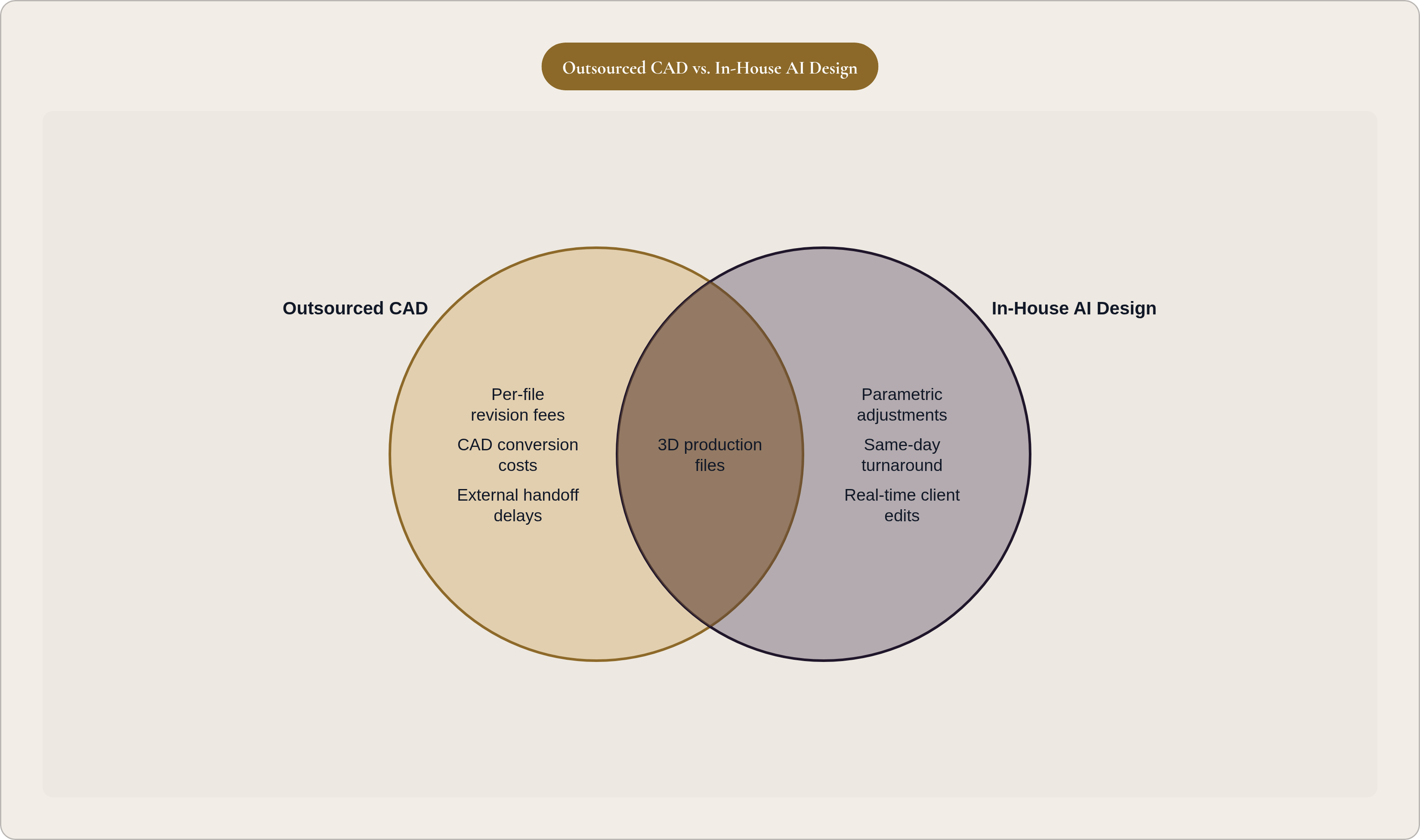
Only 3D-native design platforms create direct manufacturing files (STL, 3DM, OBJ). Everything else requires a separate CAD conversion step before anything can go to production. That conversion step reintroduces the $500 to $2,000 bottleneck and a new external handoff. If you've moved to an image generator to cut costs and still need a conversion step every time, you've moved concept work inside the business while leaving the manufacturing gap exactly where it was.
Production-ready means specific things:
- Correct wall thickness
- Properly dimensioned stone seats
- Prong geometry with enough material to hold under wear
- Castability confirmed before the file leaves the design environment
- Tolerances validated, not assumed
The standard production pipeline runs: CAD model with verified specs, then STL export, then resin 3D print or casting tree, then cast piece, then scan comparison against the digital master to catch shrinkage or warping. An in-house AI system that stops at visualization doesn't close that loop; it just moves the visualization step inside the building.
The test for any platform you're evaluating is straightforward. Does a configuration output a production-grade CAD file, or does it output an image? Those are different products. One of them is a design tool; the other is a mood board generator with a price tag attached.
What Changes Operationally Across the Four Workflow Stages When the Switch Is Made
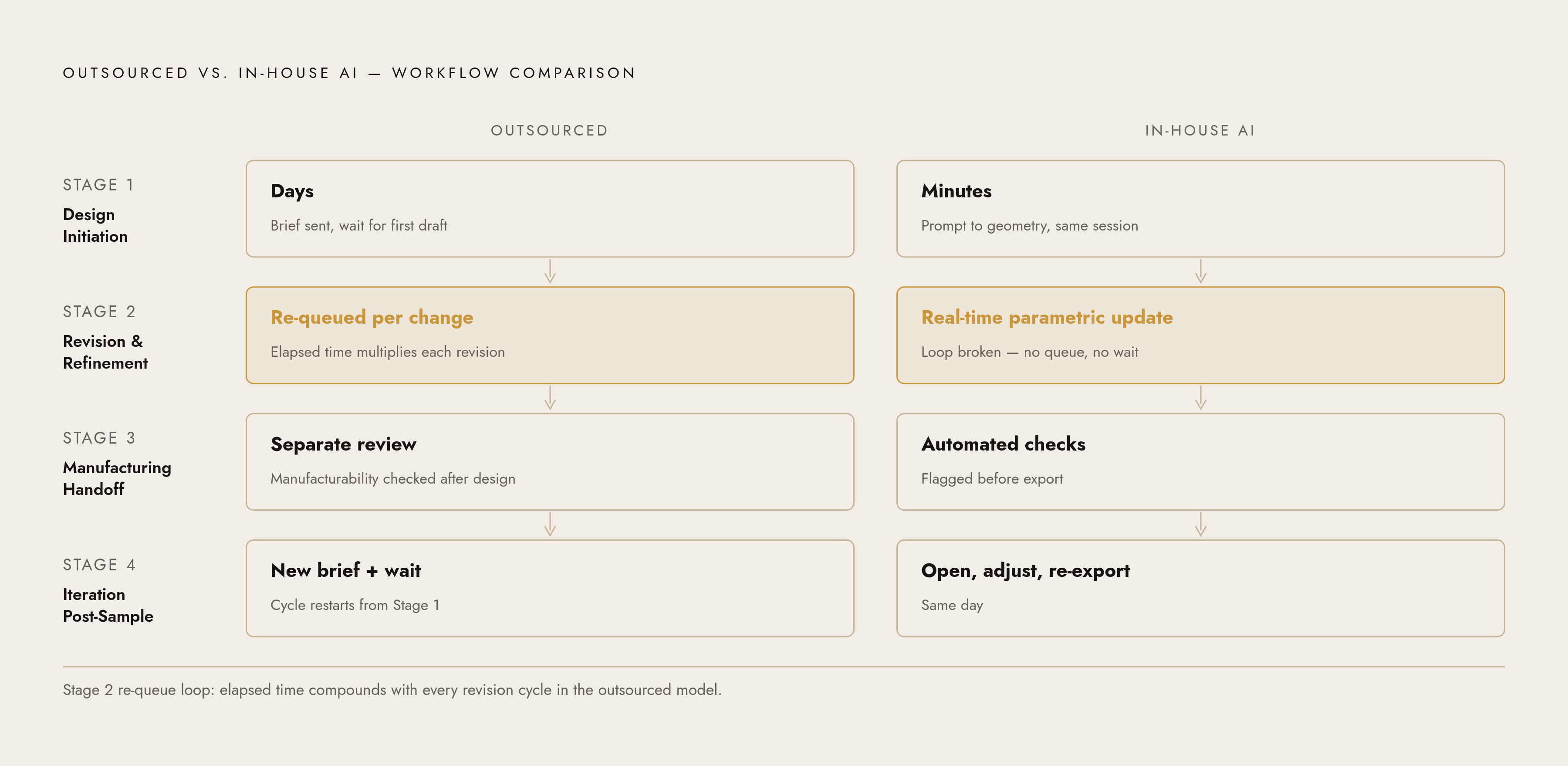
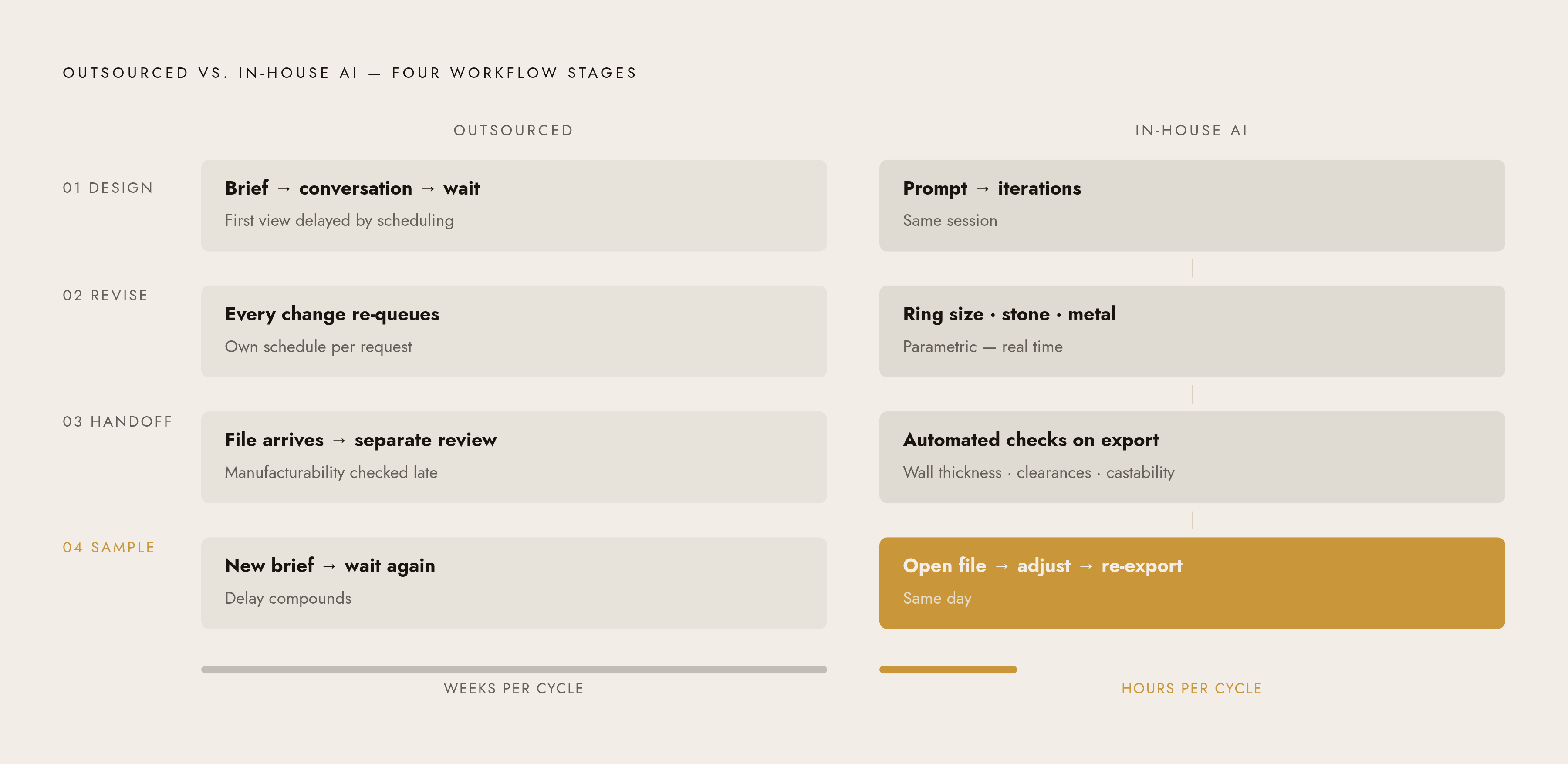
The efficiency gain isn't concentrated at one point in the process. It compounds across every stage.
Stage 1: Design Initiation. The outsourced model requires a written brief, an interpretation conversation, and a waiting period before you see anything. The in-house AI model starts with a prompt and produces initial iterations in the same session. The time between "I have an idea" and "I can see the idea" collapses from days to minutes.
Stage 2: Revision and Refinement. The outsourced model re-queues every change. Ring size input, stone swap, metal change: each one goes into a queue and comes back on its own schedule. The in-house parametric model resolves those changes in real time. A customer sitting across from you can see the ring they described, updated, before they leave.
Stage 3: Manufacturing Handoff. Outsourced files often arrive requiring a separate manufacturability review. An in-house 3D-native platform with automated checks (wall thickness, stone clearances, castability) validates before export. The file arrives at the caster already confirmed. The caster isn't your quality check; the platform is.
Stage 4: Iteration Post-Sample. When a physical sample comes back and needs adjustment, the outsourced model means writing a new brief and waiting; the in-house model means opening the parametric file, making the adjustment from the sample review directly, and re-exporting. Same day.
The compounded effect across all four stages is not just "faster at each point." It's fewer total elapsed days across the full cycle. For brands managing seasonal deadlines or custom order volume, that's the number that matters.
There's also an organizational implication worth naming plainly. The staffing question shifts from "do we have a CAD person" to "who in the existing team runs this platform." For small and mid-size brands, that's a meaningful change. The custom jewelry services market is growing from $3.95 billion in 2025 to a projected $5.97 billion by 2030, at an 8.5% CAGR through 2026 to 2030. Brands that can handle revision-heavy custom work in-house are structurally better positioned to capture that volume than brands still routing every change through an external queue.
How the Cost Equation Actually Compares Once the Full Picture Is Drawn
Cloud-based AI design platform subscriptions run roughly $20 to $200 per month. No hardware investment. No per-file revision charges. Five years at the higher end of that range comes to $12,000 total, with automatic updates and no workstation overhead. That approaches cost parity with on-premise setups that carry a $10,000 five-year total when you count the software license, workstation, and periodic upgrades.
The outsourcing comparison requires adding:
- Per-file fees for every new design
- Per-revision fees for every change
- The $500 to $2,000 CAD conversion charge for every file generated by a 2D AI tool
- The cost of delayed launches
- The cost of missed custom orders when turnaround time exceeded the customer's patience
The honest version of this: at low design volume, outsourcing can still be cheaper in pure cash terms. That's true. The threshold where in-house wins shifts depending on how frequently you revise and how much custom order volume you're handling. This isn't a universal argument that outsourcing is always more expensive; it's an argument that once you account for the full cost, the gap closes faster than most brands think.
The non-cash cost that tips the decision is turnaround time. A brand that can respond to a custom request in a single client session versus a brand that needs three days has a different sales capability. That difference isn't an efficiency metric; it's a conversion metric. About 60% of consumers prefer custom jewelry services driven by individuality and self-expression. For brands operating in that segment, revision speed is directly connected to how many of those conversations end in a sale.
The real comparison is not "outsourcing cost versus platform subscription." It's "total cost of a revision-heavy workflow outsourced versus total cost of the same workflow brought in-house with AI." When you run that comparison honestly, including all the revision cycles, conversion fees, and elapsed time, the math looks different than the rate sheet suggests.
What the Transition Actually Requires to Execute
The entry requirement is lower than most brands assume. That's not a sales pitch; it's just what happens when the training barrier is removed as a gating condition. The harder part of this transition is workflow adoption, not technical skill acquisition.
Before switching, audit the actual numbers:
- Current revision volume per month
- Average turnaround time per revision
- Number of designs that required a CAD conversion step
- How many products launched late because of file delays
Those numbers tell you where your actual exposure is. They also tell you how quickly the platform pays for itself once the workflow moves in-house.
The transition doesn't have to be all-or-nothing. Many brands run in-house AI for new development and existing SKU revisions while winding down outsourcing incrementally as internal capability builds. That's a reasonable path. You don't have to cancel every external relationship on day one.
The leverage point in the long run is the parametric catalog. Building a library of adjustable base models in-house means variation generation approaches zero marginal cost over time. The first design in a family takes the most effort; the fifth variation of that design takes almost none.
A few practical things to confirm before committing to a platform:
- Do your casting or 3D printing partners accept the output formats directly (STL, 3DM)? The production chain has to close end-to-end. If the file format requires conversion at the manufacturing stage, you've preserved an external dependency at a different point in the workflow.
- Who inside the business owns this? Someone becomes the design owner. That's a capability gain, but it's also a new responsibility that needs to be staffed and managed, not just assumed.
The underlying decision is not whether AI design tools work. They work. The decision is whether the brand wants to own the revision cycle or continue renting access to it from an external team. For brands at low design volume with simple, stable catalogs, renting is probably still fine; for everyone else managing revision-heavy work, growing custom order volume, or trying to compete on responsiveness, the math has moved. The workaround that made sense ten years ago is now the thing slowing you down.