Parametric vs Static CAD in Jewelry Design — What the Difference Means in Practice
Parametric CAD handles revisions and collections; static CAD suits one-off pieces.

Here's a situation that plays out constantly in studios: a client loves a ring but wants it a half size up and the center stone just a touch smaller. In a parametric workflow, that's two number changes. The model rebuilds itself. You're back to whatever you were doing before the email came in.
In a static workflow, you're back in the geometry. Manually reworking every surface the change touched. No automatic propagation. Just you, chasing down every dimension that shifted because you moved one thing, hoping you caught them all.
Parametric modeling encodes geometry as a sequence of editable steps. Change a parameter, and the model follows. The construction history is the model. Static modeling works differently: you sculpt the shape, and when you're done, the model is just its current form. It has no memory of how it got there. Which is fine, until someone asks you to change something.
The practical dividing line is this: a parametric model can be re-run. A static model has to be re-worked. A static model is like a sandcastle — beautiful when finished, but the moment the tide of client feedback rolls in, you're rebuilding from the beach up.
Revision-heavy work is where this difference actually hurts. Client-driven custom design, bridal, made-to-order. Any job where specs shift mid-process. Each revision round in a static workflow is a fresh time cost with no shortcut. Do ten revisions in a busy month instead of one, and the math starts adding up in ways that stop feeling abstract pretty quickly.
Resizing a Collection Is Where the Compounding Kicks In
Single-piece resizing is a nuisance in static CAD. Resizing a collection family is a structural problem.
Every size variant has to be rebuilt or manually adjusted per piece. And with each manual re-work, proportional accuracy is at risk. Prong height, wall thickness, stone seat depth. These are precision relationships. They don't scale gracefully by hand, no matter how careful you are. I've watched careful people make the same small proportional error across twelve variants and not catch it until casting.
Parametric logic makes the most sense when the same shank family, halo structure, or decorative pattern appears across a collection. You build the logic once. Then you generate every size variant from that definition. Rhino's Grasshopper plugin handles this well: adjust the base parameter and the entire pattern scales mathematically without losing proportion. No eyeballing. No fudging.
MatrixGold takes a similar approach with parametric history and dynamic templates. It's built specifically for this kind of volume on standard jewelry types: engagement rings, wedding bands, pendants. The builders and parametric components exist to accelerate production when designs fit within proven patterns.
The compounding effect is real. The more a collection shares underlying geometry logic, the higher the return on building it parametrically. A line with twenty SKUs that each come in eight sizes? At that point parametric isn't a nice-to-have. It's the only path that doesn't quietly grind your team down over time.
One-off sculptural commissions don't share that logic, and static modeling stays faster for those. But that's a different section.
Customization at Scale Is a CAD Architecture Problem, Not a Website Problem
There's a misconception worth getting out of the way early. Offering customers a choice of metal, stone size, or engraving looks like a frontend design problem. It isn't. It's a CAD architecture problem.
Each valid customer selection has to produce a geometrically correct, manufacturable output. A static model can represent one configuration. A parametric model can generate thousands.
Configurators use rule-based logic to prevent invalid combinations, but that guardrail only exists because the underlying CAD model has manufacturing constraints encoded into it. The interface is the face. The parametric model is the brain. You can build a beautiful configurator on top of a static model and it will look great right up until someone selects an option that produces geometry that can't be cast.
Dynamic pricing works the same way. When a customer changes stone type, metal weight, or ring size and the price updates in real time, that's only possible when those variables are live parameters in the model. Not fixed geometry. You can't tie a pricing formula to geometry that doesn't know it's a variable.
The scale of demand makes this relevant for more studios than you'd expect. A significant and growing share of consumers are seeking personalized jewelry, and a majority of couples now choose customized engagement rings over off-the-shelf designs. That volume of demand only works if the design system behind it is parametric. Manual custom work per order doesn't reach those numbers without a team that genuinely never sleeps.
Highly custom one-off work is the legitimate exception. For a single sculptural commission, direct modeling is faster and easier to walk through with a client. The issue isn't that static models are wrong for every job. The issue is that they have no mechanism for scaling.
The Physical Pipeline Has No Patience for Geometry Problems
The production path looks like this: CAD model, STL or OBJ export, resin or wax 3D print, lost-wax casting, finishing. Every step downstream depends on the CAD model being geometrically sound before anything gets exported. Skipping the verification step doesn't save time. It moves the problem somewhere more expensive.
The pre-export checklist that any production-serious operation knows:
- Wall thickness. No areas thin enough to break in casting.
- Stone seats. Prong, bezel, and channel sizes matched to actual gemstone measurements.
- Clean geometry. No naked edges, bad booleans, or non-manifold areas.
- Clearances confirmed. Ring size, pendant length, chain holes all verified.
Parametric models have a real advantage here because manufacturing constraints can be encoded as parameters. Minimum wall thickness, stone seat tolerances, prong heights. These become rules the model enforces automatically, not line items a designer manually audits on every new variant. The check happens at build time rather than at export time.
A static model has no equivalent mechanism. Every variant gets checked from scratch. Every time. Which is manageable until you have forty variants and a deadline and someone on your team is tired.
Errors caught at the digital stage cost nothing to fix. Errors caught after casting mean losing expensive metal and starting over. The distance between a design that looks beautiful on screen and one that goes straight to manufacturing is exactly where static workflows come apart. Catching a geometry error after casting is a lot like finding a typo after you've already mailed ten thousand invitations — technically fixable, but nobody's happy about it.
Where Static Modeling Still Belongs and Why Forcing Parametric Logic on the Wrong Work Backfires
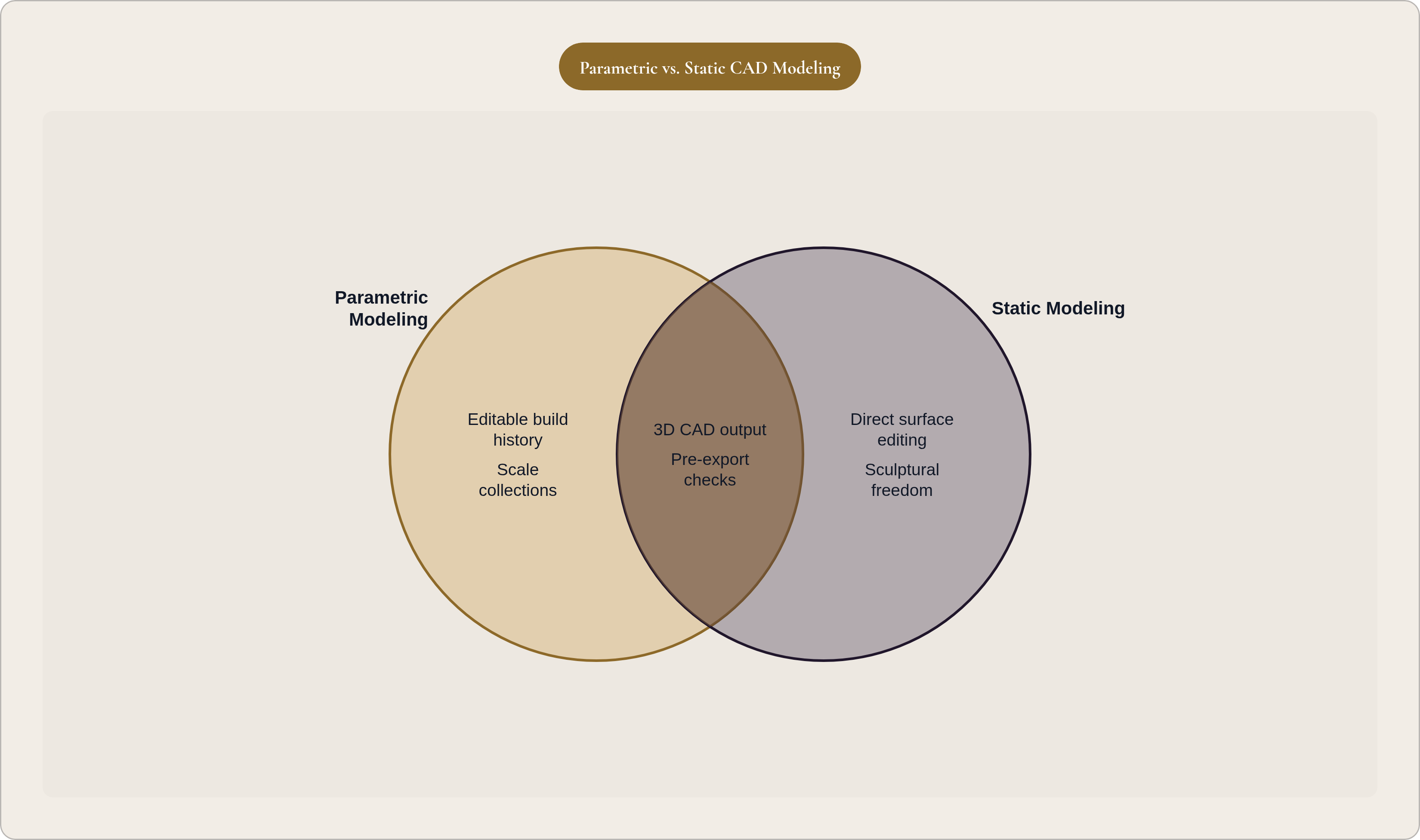
Forcing parametric logic onto the wrong work creates its own mess, and it's worth being direct about this.
Static direct modeling is faster for organic, sculptural, and one-of-a-kind forms where the geometry doesn't repeat and no variant family is planned. Pushing and pulling surfaces directly is quicker than constructing parametric relationships that will never be reused. Rhino without Grasshopper is a reasonable example: best for designers creating unique pieces who want maximum creative freedom without the overhead of building definitions that serve no future purpose.
3Design acknowledges this openly by combining parametric and direct modeling in a single interface. That's not a compromise. That's an honest reflection of how real design operations actually work, which is rarely purely one thing or the other.
Building parametric definitions for a design that will never be resized or varied adds complexity with no payoff. The extra structure isn't leverage. It's friction you built yourself. I've seen studios spend two days parametrically rigging a custom commission that went nowhere near production, and the time sink was genuinely painful to watch.
So the question isn't which approach is better in the abstract. It's which is better for this design, this volume, this product type, and this level of customization ambition. Answer those honestly and you usually already know.
AI Is Lowering the Entry Cost, Not Replacing the Underlying Knowledge
Traditional parametric CAD required years of training to use effectively. That kept it out of reach for small studios and independent designers for a long time. Rhino and MatrixGold required real specialized expertise, and there was no shortcut around that. You either had the hours invested or you didn't.
AI isn't replacing parametric CAD. It's removing the bottleneck that stood between a designer and parametric output.
Tools like FormaNova let users describe a jewelry design in plain language and receive a 3D CAD model in minutes. Concept to manufacturable model without spending two days in front of a screen. The important caveat, though: AI handles the concept and interpretation phase, not the precision CAD finishing phase. The parametric logic still needs to be correct. You get there faster now, but you still have to get there.
The practical workflow shift looks like this: iterate through AI-generated concepts before selecting one for precision CAD finishing. More output, better selection, without rebuilding from scratch each time. The exploration phase gets cheaper, which makes the investment in the parametric finishing phase easier to justify.
MatrixGold 4.0 frames this well: the value of jewelry CAD isn't defined by the number of tools available but by how well those tools support the way designers actually work. Design, material decisions, and production insights in one continuous pipeline from concept to manufacturing. The workflow alignment is the product.
The studios getting the most out of this right now are the ones who've replaced disconnected steps (emailing renders, pricing in spreadsheets, sending files through WhatsApp) with a single workflow that runs from brief to buyer. AI is accelerating that consolidation. The parametric foundation still has to be there for any of it to hold together.
Choosing the Right Approach for Your Specific Operation
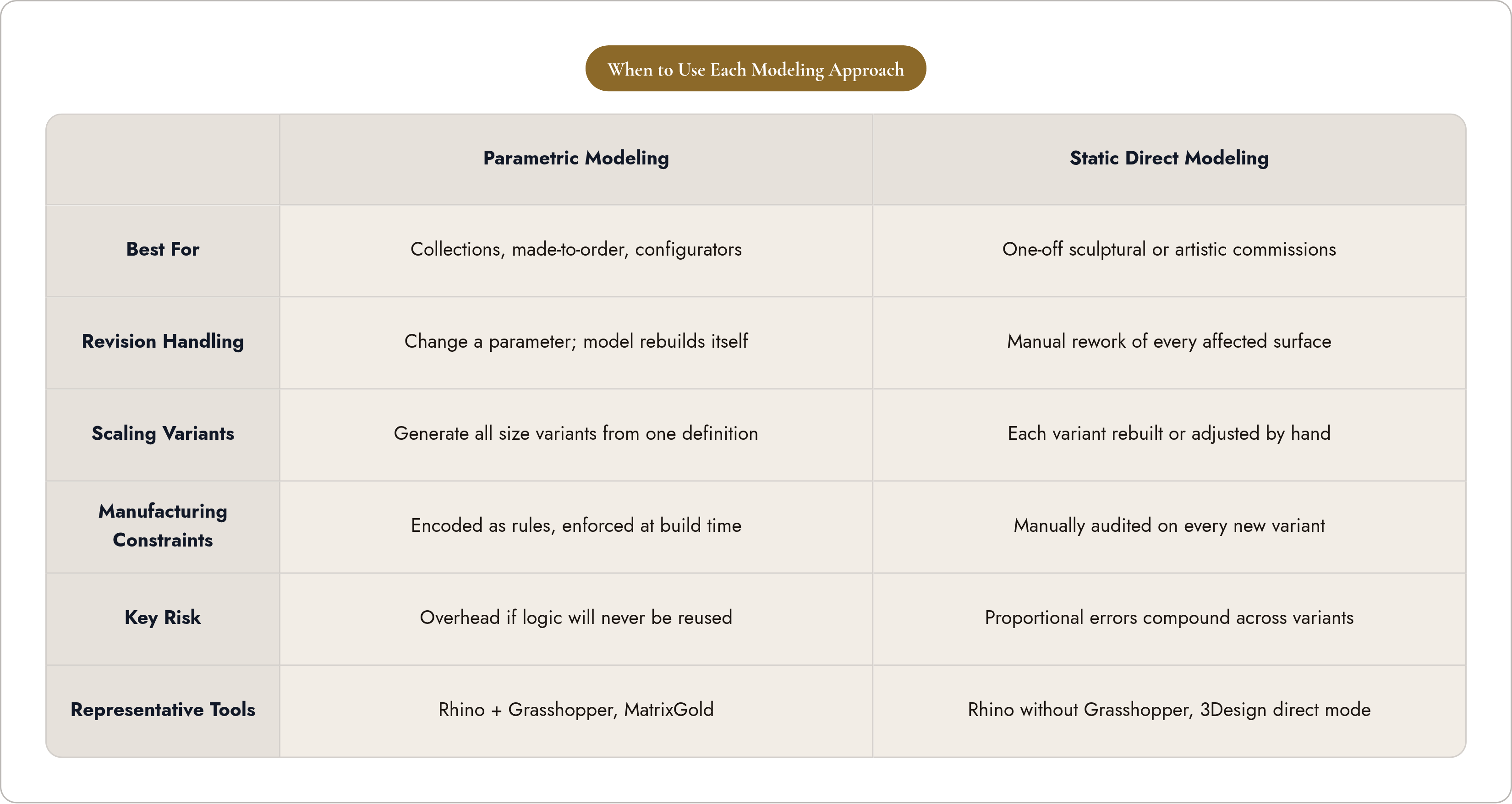
The decision usually comes down to four things: design volume, product type, customization ambition, and manufacturing pipeline. Each one points toward or away from parametric architecture, and taken together they give you a pretty clear answer.
Conditions that favor parametric:
- Repeatable design logic across a collection. Shank families, halo structures, setting types that recur across SKUs.
- Made-to-order or custom business model where each order is a variant of an existing design.
- Customer-facing configurator where valid combinations need to be enforced and pricing updates dynamically.
- Volume production where manufacturing-ready output has to be consistent across hundreds of SKUs.
Conditions that favor static direct modeling:
- One-of-a-kind sculptural or artistic commissions with no planned variants.
- Small batch or single-piece work where the rebuild cost per revision is acceptable.
- Design exploration phases where creative freedom matters more than repeatability.
Mixed workflows aren't a fallback. They reflect how most real design operations actually run. Many studios use static modeling for concept exploration, then rebuild key designs parametrically once they enter the product line. AI tools increasingly handle the concept phase, which means the handoff to parametric CAD happens earlier and faster than it used to.
The underlying test is simple enough. If a design will need to become ten size variants, feed a configurator, and produce a production-ready file without manual correction each time, it needs parametric architecture from the start. Retrofitting parametric logic onto a static model later is harder than building it in from the beginning. Knowing that before you're three months into a product line is the whole point of thinking through the architecture first.