Bridal and Engagement Ring Customization as a Revenue Channel
Jewelers scaling custom bridal rings need production-ready systems, not just talented designers.

Bridal customization used to mean a jeweler across a table, sketching by hand, quoting a number nobody could quite explain, and hoping the finished ring matched whatever picture existed in the couple's head. That model still exists, but the businesses actually growing have moved past treating "custom" as a synonym for "improvised," and the ones still working that way are losing the category to the ones who don't.
The customized jewelry market is projected to grow from $36.98 billion in 2025 to $104.89 billion by 2032, a 16.06% annual rate that outpaces jewelry sales overall, and bridal sits on top of that growth because it's the most emotional, highest-dollar, most photographed purchase in the category. Here's the part most jewelers get wrong: they think scaling custom work means hiring more designers. The real answer is building a system that needs fewer of them, and the jewelers who haven't figured that out yet are the ones capped at six rings a year wondering why they can't grow.
What "scalable" bridal customization actually requires
Most jewelers who say they do "custom" are really doing one-offs. Every request starts from zero: no template, no set price, no promise on turnaround. That's fine for a boutique doing a handful of custom rings a year, but it falls apart the moment demand goes up, because there's no repeatable process behind the word "custom," just a talented person improvising under a deadline.
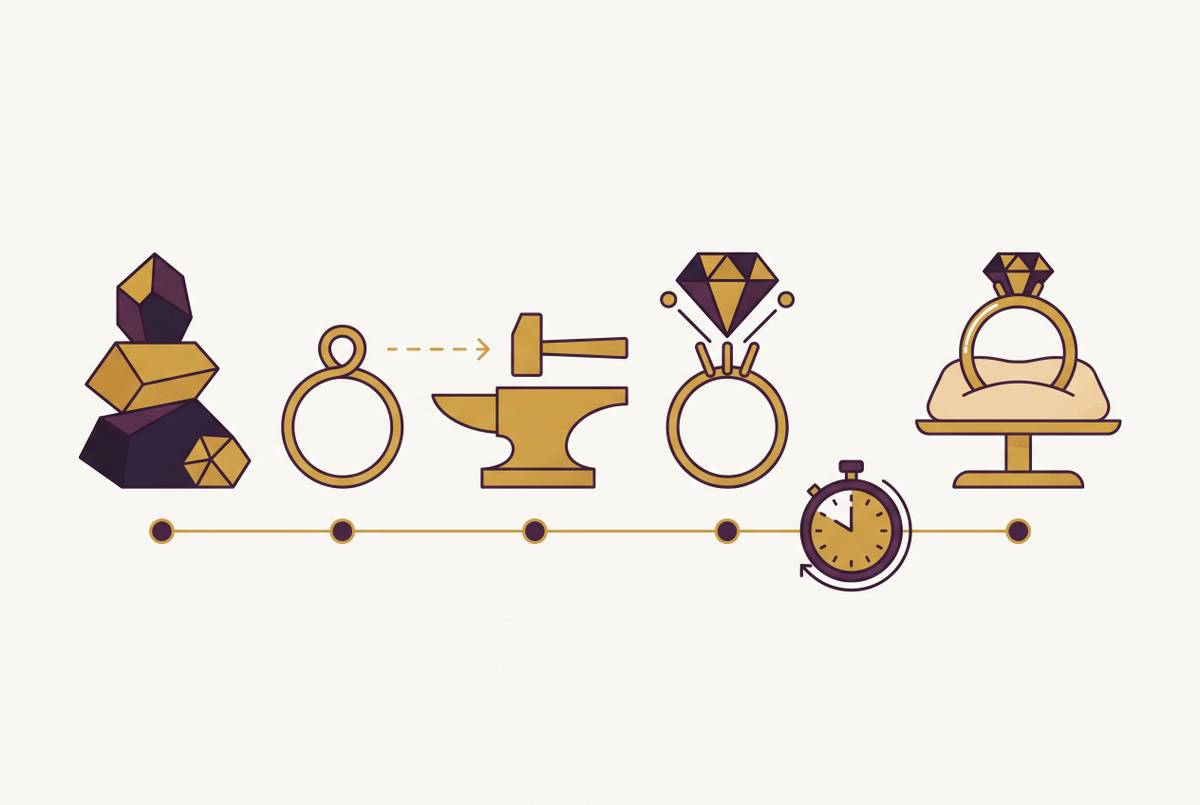
Turning it into an actual channel takes three things, in order. Configurability comes first: a defined menu of metals, stone shapes, settings, and engravings, so the customer picks from real options instead of describing a vibe to a sketch artist. Repeatability comes second: every order runs through the same production path, so nobody's reinventing the wheel per sale. Output fidelity is the third, and it's the one that quietly wrecks most setups: what the customer configures on screen has to be exactly what gets built, with no human sitting in between translating a pretty render into something a caster can use.
That third piece is where the whole thing breaks. A slick 3D visualization that still needs a designer to manually redraw it before it's manufacturable is a bottleneck wearing a nice outfit. The distinction that actually matters is visualization versus production-ready output. A configurator that just shows pictures is a sales gimmick; a configurator that outputs a CAD file ready to cast without redesign is a production line. Pick wrong, and the channel stays stuck at one designer, one order, one bottleneck, no matter how good the marketing looks on top of it.
How parametric design makes a defined option space manufacturable
Parametric modeling keeps the design logic in adjustable parameters instead of a fixed shape somebody drew once and filed away. Change the gemstone size or the shank width, and the whole model updates itself correctly, so nobody's redrawing prongs by hand at midnight.
Engagement rings have a lot of parts that depend on each other: head height, prong count, band width, stone diameter. Nudge one and the others have to shift, or the ring looks wrong or, worse, physically can't hold together. Parametric models bake those relationships in, so a customer can change five settings at once and the geometry still makes sense on the other end. Industry research backs this directly: parametric modeling lets designers build personalization and structural complexity into the same piece at once, which tracks with how much jewelry now functions as self-expression rather than something picked off a shelf.
The customer gets real range on sizes, metals, stones, and settings, and the system simply won't let them build something that can't be cast. Feasibility gets enforced automatically, not caught after the fact by someone squinting at a render. One Brooklyn-based brand using 3D-printed resin prototypes took development time from six months down to six weeks on the back of that same parametric logic, which is the kind of number that should make every shop still hand-carving wax models a little nervous.
Here's what matters for the business side of this: build one solid parametric template, and it sits underneath hundreds of orders without a single extra hour of CAD work. That template pays for itself every time someone hits "confirm."
Building the digital front end: what a bridal configurator needs to do
Online jewelry shoppers hesitate for one specific, fixable reason: they can't picture or customize the piece accurately before buying. That's the exact gap a configurator has to close, and most of them close it badly.
A configurator that does its job walks the customer through metal, then stone shape, then setting, then band profile, then engraving. It renders in 3D and updates instantly with every click, no spinner, no refresh, no "please wait while we generate your preview." It prices the build live instead of ending on a "contact us for a quote" button, which is a polite way of telling someone to abandon their cart. And it closes with a summary screen showing exactly what they're about to buy, matching what actually gets made downstream.
Mobile isn't optional here, and treating it as an afterthought is where a lot of these builds go wrong first. Watching a price update in real time next to an accurate render does something specific to hesitation: it turns it into commitment, fast. A good configurator kills the uncertainty that's otherwise killing the sale.
The piece most brands skip is wiring the configurator into the parametric CAD layer underneath it. Every option a customer sees on screen has to map to something a caster can actually build, not just a nice-looking screen state. A handful of platforms serve this space. Pencil Design, for instance, is built around jewelry configurators that output production-ready CAD files. Others, including Configurator.tech, each with different depths of CAD integration and e-commerce fit. AI-native platforms with built-in CAD output close that loop entirely, going straight from customer click to a production-ready file. The question worth asking before signing with any of them isn't about design flexibility or price point. It's this: does it hand over a file the caster can use, or a picture the caster has to redraw?
Pricing and margin logic for a customization channel
Custom bridal work commands a premium that has nothing to do with materials cost. It's emotional stakes, it's exclusivity, and it's the fact that a longer decision process makes people more attached to whatever they end up configuring. By the time someone's clicked through six choices, they're picturing the proposal, not comparison shopping on a competitor's site in another tab.
Pricing comes down to three real options: a flat custom fee, modular pricing (base ring plus a charge per upgrade), or fully dynamic pricing that recalculates on every parameter change. At any real scale, dynamic pricing stops being a choice and becomes the only option that survives contact with volume. Once a configurator offers dozens of combinations, manual quoting collapses under its own weight, and nobody's got time to price forty combinations by hand every morning before the shop opens.
Protecting margin means doing the math before launch, not after it. Every combination in the option set needs a cost attached in advance, material and labor both, mapped per parameter. Edge cases, an unusually large stone, a non-standard band width, get flagged for manual review instead of running through the automated price and coming out wrong on a high-value ring.
There's an order-value effect worth flagging too: customers who spend real time in a configurator tend to make more deliberate, higher-value choices, which raises commitment and order value at the same time. Bridal also has a built-in upsell path. A matching wedding band offered in the same session, engraving or stone upgrades prompted right inside the flow, anniversary and push-present reminders queued up after the sale closes; all of it rides on infrastructure that already exists. Once the parametric templates and pricing logic are built, every order after that carries close to zero incremental design cost. That's the actual margin story, separate from whatever number sits on the price tag.
From configuration to casting: the production path that makes custom orders fulfillable
The standard path runs CAD model to CAM file, then CNC milling or 3D printing, then lost-wax casting, then finishing. A lot of brands treat CAD and CAM as the same step, but they're not. CAD handles the shape and the look; CAM turns that data into instructions a machine can actually run. Skipping over that distinction is exactly where workflows go sideways.
The break point in most custom pipelines sits right there: a CAD file out of a configurator isn't automatically CAM-ready. Someone still has to check wall thickness, undercuts, and casting tolerances before it's safe to mill or print. 3D printing helps close that gap by letting a resin prototype get physically inspected for shape and fit before anything touches metal, catching expensive mistakes while they're still cheap ones. By 2025, 60% of professional jewelers were using 3D printing somewhere in their process, a number expected to clear 75% by the end of 2026. Direct metal printing (DMLS or SLM) exists for high-volume shops, but it needs capital most independent studios don't have sitting around waiting to be spent.
The accuracy holds up when the handoff is built right: one major luxury house running CNC machining for intricate gold settings hit 98% design accuracy, which is proof the production side delivers on what the digital side promises, as long as nothing gets lost in translation between them. Every manual touch between a customer's "confirm" click and the file landing at the casting partner is a cost, a delay, and a fidelity risk, stacked on top of the last one. Worth an honest count before scaling anything: how many human hands actually touch that file before it reaches the caster?
Staffing and operational structure for a bridal customization channel
The old assumption was that every custom order needed a senior designer on it, start to finish. That assumption capped how much custom work a shop could ever take on, because designers don't scale the way software does, and you can't spin up three more of them overnight the way you'd add server capacity.
Parametric tooling paired with AI moves the designer's job from executing every order to building and maintaining templates, then reviewing quality on the output. That's a one-time investment against many orders, not a cost that climbs in a straight line with sales. Three roles actually make this run. A template architect, fluent in parametric CAD, builds and maintains the ring template library without touching every order that comes through it. A customer experience lead manages the configurator journey, handles the odd edge case, and processes orders, no technical background required for the job. A production liaison checks CAD output before it goes to the casting partner, catching tolerance problems before they turn into returns and refunds.
Independent designers get a real break here, and this is the part the old guard tends to miss. AI-native platforms cut the template-building burden down enough that a small studio can start from a pre-built parametric library instead of building one from scratch over a lost year. Enterprise brands scale the same infrastructure differently, stacking on more templates, more SKUs, more configurator instances across channels, without headcount climbing at the same rate. A well-built parametric system connected to a working configurator can carry several times the order volume a traditional team managed, on the same design staff or smaller. A full design team stopped being the entry price for offering real bridal customization. It just used to look that way, and plenty of shops are still paying for a headcount they no longer need.
Marketing and positioning a bridal customization channel to the right buyers
The buyer here is mostly millennials and Gen Z, and they're the core audience for bridal customization specifically. A BriteCo survey of 2,000 Americans in October 2025 found that 86% of millennials say they're more likely to buy fine jewelry for themselves than wait around for it as a gift. That's a strong signal of self-directed purchase intent, and it changes what marketing to this group even looks like: nobody's waiting for a proposal to justify the spend.
This buyer expects to design and buy without an in-person consultation first. They want real-time clarity on price and timeline instead of vague promises about "getting back to you," and they want a shareable digital artifact, the actual 3D render of their ring, that they can post before they've even bought it. That shared render is free marketing. A customer showing off a configured design pre-purchase generates word-of-mouth at zero cost, so the sharing option belongs built into the configurator flow itself, not bolted on as an afterthought two years later when someone finally notices it's missing.
Content for this channel follows a clear arc: sketch or prompt, then rendered design, then finished piece, showing the whole build and earning trust along the way. Short walkthrough videos of the configurator in action lower the friction for first-time users who aren't sure how it works yet. Customer-designed pieces make good social proof too, framed as "designed by [customer name]" rather than "made by [brand]," which hands the credit to the person actually motivated to share it. Searches like "custom engagement ring" plus a city, or "design my own engagement ring," carry serious commercial intent, so the configurator page itself should be the landing page, not a contact form that makes someone wait for a callback that might come tomorrow. None of this lives online exclusively, either. A tablet-based configurator in a physical store serves the same customer who'd otherwise build the ring from a couch at home. Bridal is social by nature, and a ring people love gets shown off at the engagement party, at the wedding, in every post after, so the channel compounds on its own if the experience earns that reaction.
Metrics that tell you whether the channel is working
A revenue channel only counts as a channel if it's repeatable and predictable, and neither happens without tracking it on a dashboard somebody actually looks at every week.
On the configurator side, watch completion rate (what share of people who start actually submit an order or inquiry), the drop-off point (which exact step loses the most people, usually a UX problem or a pricing surprise), and time-to-configure. A longer session isn't automatically good news, since a confused customer looks a lot like an engaged one on a dashboard, but they're not the same person, and treating them the same gets the wrong lesson drawn from the data.
On revenue, compare average order value for custom pieces against ready-to-ship. That gap is the literal dollar value of the premium the channel commands. Track custom order volume as a share of total bridal revenue to see the channel maturing over time, and watch repeat and referral rates from custom bridal customers specifically, since that's the number that compounds without any extra ad spend behind it.
On production, track design-to-cast time (days from order submission to a file landing with the casting partner), revision rate (how often a configured file needs rework before it's production-ready, which is really a fidelity score on the configurator itself), and return or remake rate on custom orders. A high number there means something broke upstream, not at the finishing bench.
These three sets of numbers feed each other. If one stone-and-setting combination keeps generating revisions, that's not a fluke; it's a sign the parametric constraints on that option need tightening, or the option needs to come off the menu entirely. The brands treating bridal customization as a real channel, defined workflows, connected tooling, pricing that holds at volume, are the ones who keep winning the category. Everyone else is still sketching by hand, quoting a number nobody can explain, and hoping it fits.