Scaling from Independent Jewelry Designer to Small Brand on a Single Platform
One platform that grows with you beats rebuilding your entire system at every milestone.
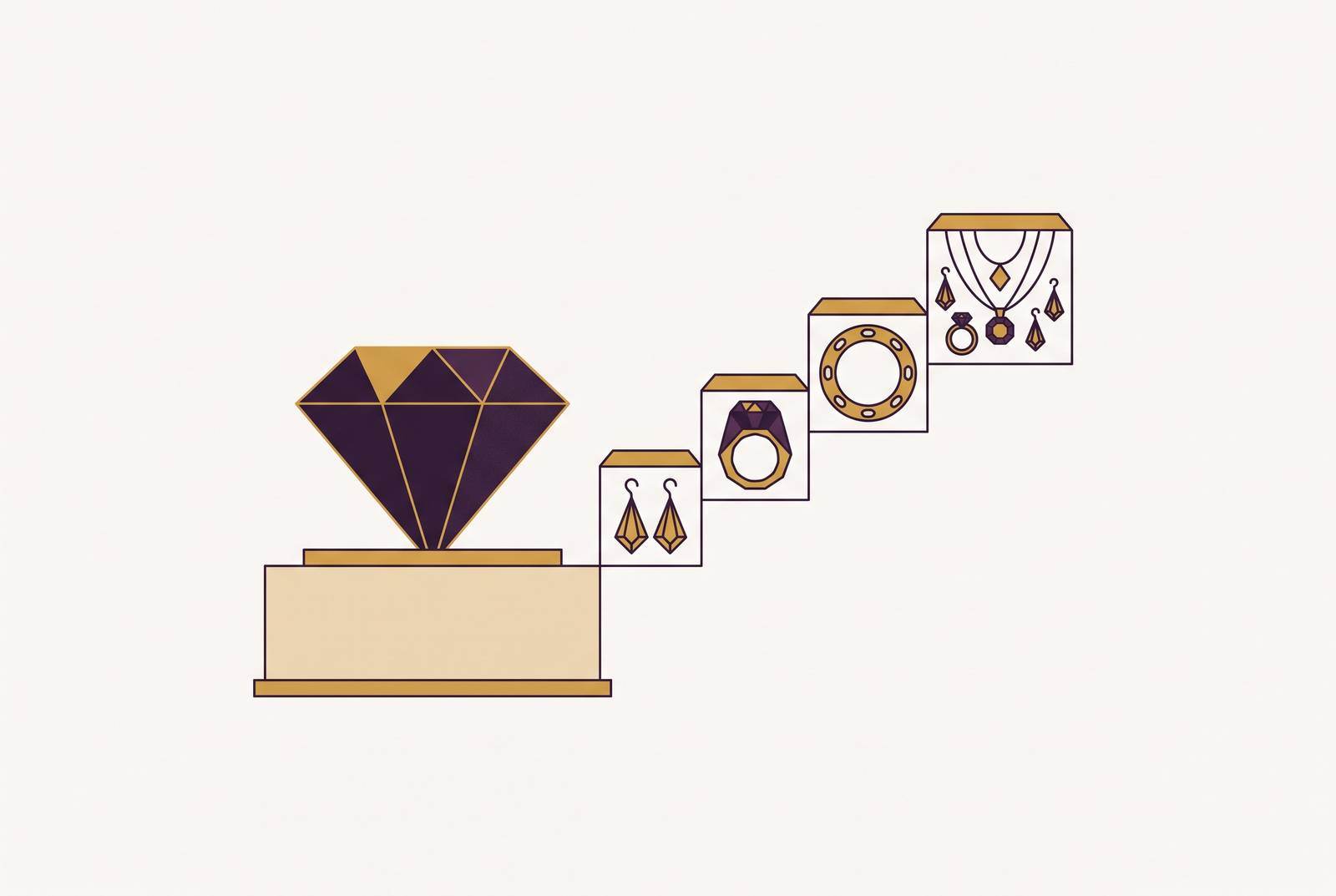
The jewelry market hit $242.79 billion in 2025 and is on track for $387.36 billion by 2034. Custom jewelry, the slice independent designers are best built to win, grows even faster: 6.5% a year against the market's 5.41%. That growth doesn't decide who actually makes it from solo designer to small brand, though. The deciding factor is whether the software underneath can grow up alongside the business, or snap the first time real demand shows up.
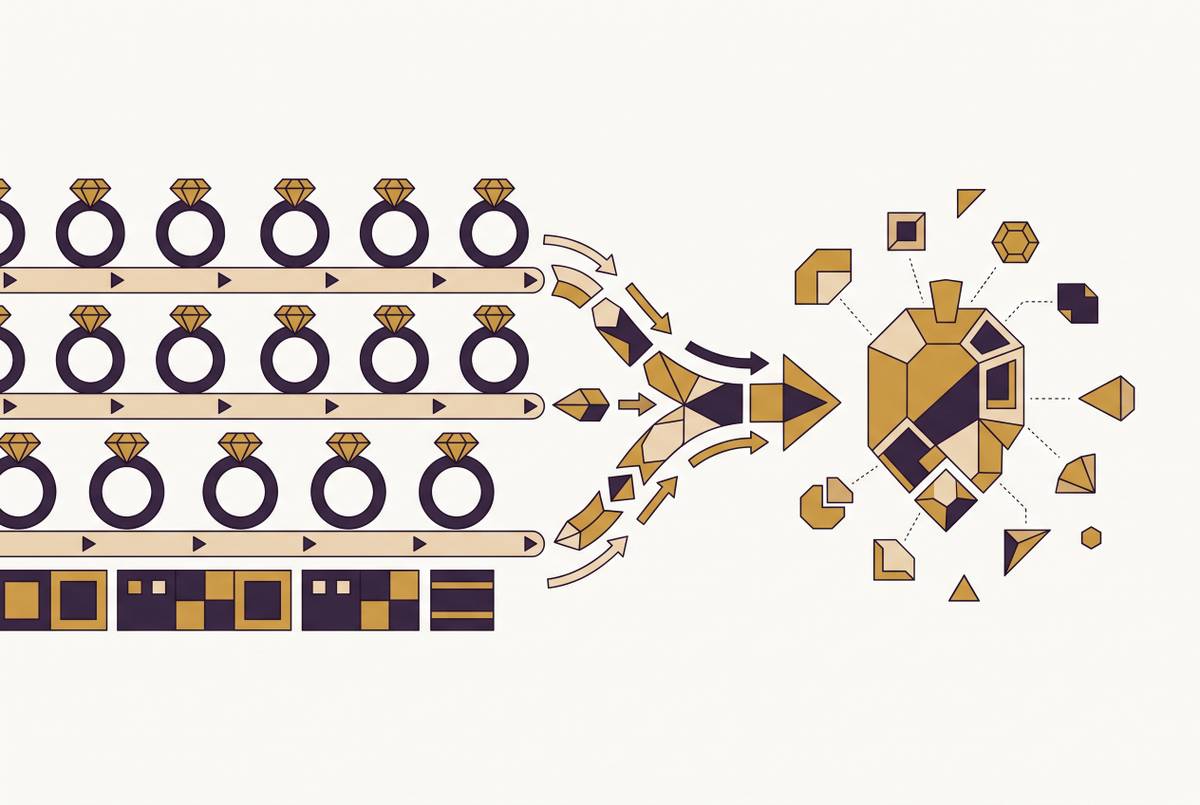
Designers rarely stall because customers stop showing up. They stall because their tools were built for one job and get asked to do three: a design tool made for solo sketching, a configurator bolted onto a website afterward, and a CAD file that needs a specialist to translate into something a caster can use. Three systems means three separate points where things break. Every milestone, a first wholesale order, a first online configurator, a first made-to-order SKU, ends up triggering a full workflow rebuild instead of feeling like the next step. Most designers assume the fix is a better tool at each stage, when the real fix is fewer tools, period.
What the transition from designer to small brand actually demands at each stage
Stage one is the solo designer. Fast ideation, one-off custom pieces, quoting done by hand, no real storefront to speak of. The need here is speed: getting from a concept in someone's head to a file a manufacturer can actually cast. Traditional CAD software has a punishing learning curve, so most designers at this stage hand modeling off to someone else. That handoff slows everything down and eats into margin on every single piece sold.
Stage two is the growing studio. Repeat SKUs start showing up, maybe a first contractor or employee gets hired, and clients start expecting to see options before they commit to buying. The need shifts toward a shared design library, pricing that doesn't change depending on who's quoting it, and a way to show customers choices without a live sales call every time. Visualization tools don't produce anything a factory can use, though, and CAD tools don't talk to whatever's running the storefront.
Stage three is the small brand. Multiple product lines, online sales, made-to-order as an actual revenue model, maybe wholesale or direct-to-consumer layered on top. The need becomes a configurator customers can run themselves, production-ready output for every combination they might pick, and pricing that updates as material costs shift. Enterprise configurator vendors build for brands with huge catalogs and month-long rollout timelines. Tools built for small studios usually can't output anything manufacturing-grade.
Here's what doesn't show up on anyone's budget spreadsheet: switching platforms at each stage doesn't just cost migration time. It costs design history, repricing work, retraining, and customer-facing downtime while the new system gets bolted in. Get this wrong and the business ends up rebuilding itself three separate times instead of scaling. A platform built to carry a business through all three stages has to handle design generation, parametric editing, customer-facing configuration, dynamic pricing, and production-ready file output, all without a software swap every time the business hits a new milestone.
How AI changes the design phase for a solo jeweler with no CAD background
GIA's Fall 2024 issue of Gems & Gemology flagged what it called "AIdeation," and the name fits better than most industry coinages do. The most common use of AI in jewelry design right now is fast idea generation: a few words of input, and a designer gets back dozens of variations on a concept that used to take days of sketching to explore. That's a week of creative labor compressed into a coffee break.
What makes this useful in practice is that the inputs aren't limited to text. Reference images, hand sketches, even voice commands can feed the same generative system, which matches how designers actually think instead of forcing them into a rigid CAD workflow built for engineers. For a solo designer, that means no need to commit to a direction before seeing it rendered. It means ideation that happens live in front of a client instead of as a separate deliverable days later, and variations at different price points pulled from one base concept instead of built from scratch each time.
The catch, and GIA's own evaluation is blunt about this, is that tools like Midjourney generate images with zero understanding of jewelry construction or manufacturing feasibility. Gorgeous for a mood board, dangerous as production intent: a prong that looks perfect in a rendered image might not have enough metal behind it to actually hold the stone. Nobody wants to explain to a customer why the ring in the photo and the ring in the box don't quite agree on physics.
That's the line that matters as a business scales: AI that generates pictures versus AI that generates geometry someone can cast. A solo designer chasing inspiration can live with the former, but a brand shipping physical rings to paying customers can't. Platforms built specifically for jewelry close that gap by pairing AI-assisted ideation with geometry that's already structurally sound, so the pretty picture and the buildable file are the same file, a few, such as Pencil Design, go further by outputting that file in production-ready CAD format directly from the design step.
Why parametric design is the structural requirement for a growing jewelry business
Parametric design, in plain terms, means every measurement in a 3D model stays saved and editable: stone size, prong count, band width, metal weight. Change one number, and the model updates instead of getting rebuilt from zero. That's standard workflow in tools like 3Design, and it's the difference between a design that only sells exactly as built and one that flexes to fit whoever's buying it.
Think about the multiplication that unlocks. One solid parametric ring can become dozens of sellable SKUs just by adjusting the inputs. A client asking "can you make it a little wider with a pear stone instead" stops being a redesign project and becomes a few parameter changes. A wholesale buyer gets the same base design tuned to their spec without anyone doing custom engineering from scratch each time.
Industry evaluations back this up: parametric capability is consistently cited as a core criterion when jewelry businesses evaluate CAD software, alongside 3D printing compatibility, component libraries, and client customization options. At the extreme end (think multi-row chokers with 500 or more gemstones set individually) specialized parametric systems like JCD become one of the few practical options. Build on parametric foundations from day one, and there's never a point where the design library has to get torn down just because a new product line showed up. Skip that foundation, and every product line past the first one costs the full rebuild again. This is the load-bearing wall of the entire business, not a nice-to-have feature buried in a spec sheet.
Turning parametric designs into a customer-facing configurator without adding a second platform
Online configurators used to be something only luxury houses bothered with. Today, they're one of the fastest-growing sales tools in jewelry, increasingly within reach for a small studio or a DTC shop on a modest budget. At their best, a configurator lets a customer click through metal, stone, and setting choices while the image updates live and the price recalculates automatically, no salesperson, no back-and-forth over email.
Here's where most current setups quietly fall apart: the configurator is just a front-end visual layer, disconnected from the CAD system underneath. A customer clicks through, places an order, and someone in the back office has to manually rebuild a CAD file that matches whatever the customer saw on screen. That's a bottleneck, and it gets worse as order volume grows, not better. Which works directly against the scaling a business is chasing in the first place.
The fix: parametric CAD-powered configurators generate the production file automatically from whatever the customer selected. What shows up on screen is already the geometry headed to manufacturing. One example of this integrated model on the market offers a parametric ring builder with over five million possible combinations across rings, earrings, necklaces, and bracelets, with manufacturability checks and live pricing built directly into the same system. Setup timelines for such integrated tools are generally modest compared to enterprise rollouts. Mobile accounts for over 60% of online jewelry transactions, so a configurator that isn't built mobile-first is behind before it even launches.
Production-ready output as the non-negotiable link between configuration and manufacturing
Here's the gap that quietly drains the most money out of small brands: a design the customer already approved gets handed off to a separate CAD specialist just to make it manufacturable. That doubles the labor on every order, opens the door to errors, and pushes delivery timelines out further than they need to go.
"Production-ready" has a real technical definition, not a vague one. It means STL files exported at 0.1mm chordal tolerance, angle deviation between 1 and 5 degrees, max edge length of 0.5mm, landing in a file size range of roughly 5 to 50MB that printers and casting workflows can handle without choking. It means shrinkage compensation, typically 13 to 20%, gets built into the geometry rather than eyeballed after the fact. It means the model accounts for wall thickness, prong strength, and stone seat dimensions, not just how the piece looks rendered on a screen.
This is what makes selling before manufacturing possible: a virtual listing can generate real orders before a single physical unit exists, which is exactly how a small brand competes on catalog breadth against bigger players without carrying warehouse inventory. The 3D printed jewelry sector is projected to hit $4.89 billion in 2026, growing at 17.3% a year, so the manufacturing infrastructure to support this is already mature and waiting. The test for any platform is simple: does every configuration a customer can build online produce a file the manufacturer can use without someone stepping in by hand? Fail that test, and the platform amounts to a visualization tool wearing a nicer label.
What a single-platform architecture actually looks like across the three stages of growth
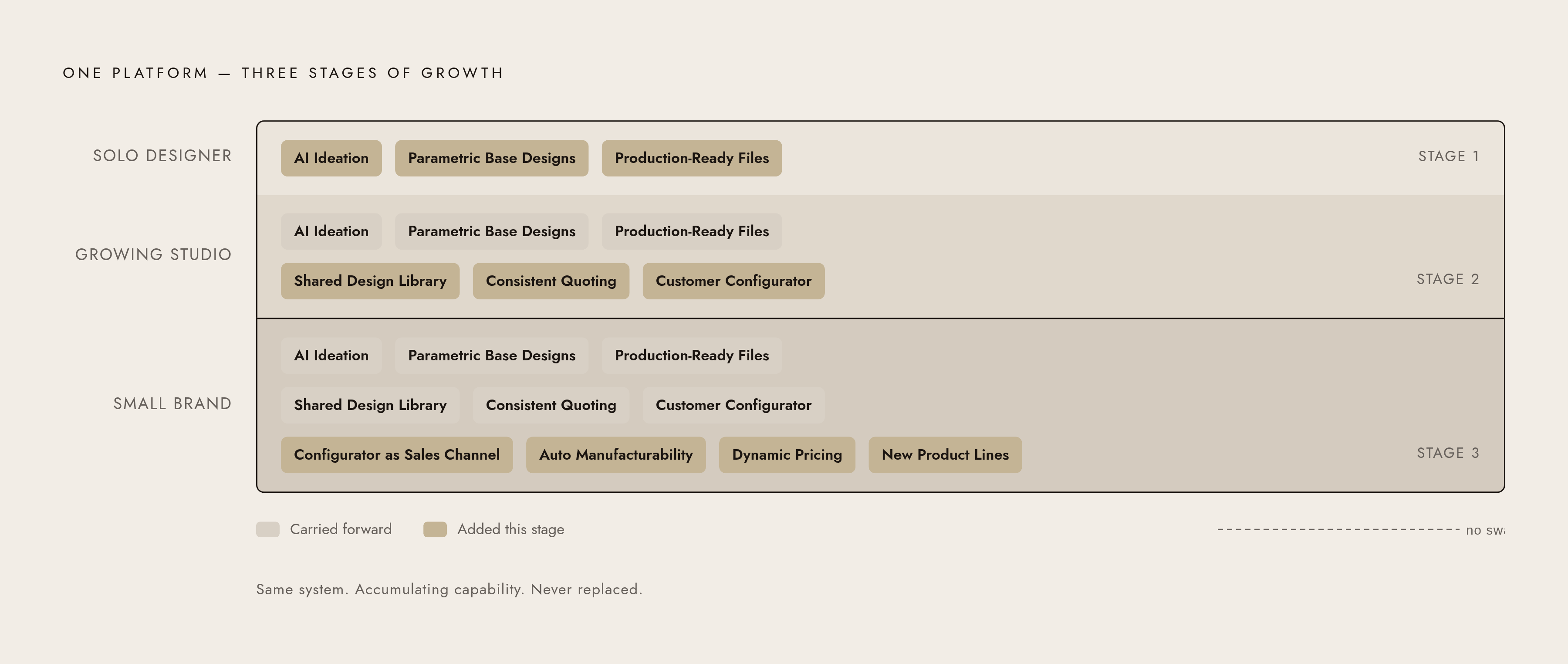
Picture the same system carrying a designer through all three stages, adding capability instead of getting replaced along the way.
At stage one, the solo designer uses AI ideation to generate concepts with no CAD training needed, builds parametric base designs once, and adjusts them per client without starting over each time. Production-ready files go straight to a casting partner, no specialist standing in the middle. Platform cost stays low, and everything built here carries forward instead of getting thrown out later.
At stage two, that same design library becomes a shared asset. Contractors work off the same parametric files instead of guessing at specs, and quoting stays consistent because the pricing logic lives inside the model itself, not in one person's head or a spreadsheet nobody else can read. The first configurator goes live, letting customers browse options before a consultation even happens, which cuts down on the endless back-and-forth over email.
At stage three, the configurator becomes the primary channel for made-to-order sales. Every configuration a customer builds automatically produces a manufacturable file, so the bottleneck doesn't grow just because order volume does. Dynamic pricing absorbs material cost swings without anyone manually repricing the whole catalog by hand, and new product lines get built as new parametric bases, not as excuses to buy new software or migrate everything all over again.
The structural point underneath all of it: the design library, the parametric logic, the configurator, and the manufacturing output work as one system, not four. Compare that to the fragmented path, where every milestone means a new tool purchase, a data migration, and weeks of attention spent on tooling instead of product and customers. That fragmented path looks less like scaling and more like treading water in a nicer pool.
How to evaluate whether a platform can actually carry you through all three stages
Four questions settle most of this before anyone signs anything. Does every configuration produce a file that's actually production-ready, or does it still need a CAD specialist to finish the job? Is the design architecture genuinely parametric, meaning a piece can be modified without rebuilding it from scratch? Does the configurator plug directly into the design layer, or is it a separate visual skin with a manual handoff hiding behind it? Does pricing update automatically from the parametric model, or is someone updating price tables by hand every time a configuration changes?
The current landscape sorts into a few honest categories, and most designers waste time in the wrong one. Image-generation AI, tools like Midjourney or DALL-E, is strong for ideation and social content but produces zero manufacturing geometry, which caps it firmly at stage one. Traditional CAD software, think Rhino-based tools, JCD, or 3Design, offers real parametric power but comes with a steep learning curve, isn't customer-facing, and needs a separate configurator bolted on. Standalone configurator platforms offer solid customer-facing design and plug into major e-commerce platforms, but the link back to manufacturing is usually manual, or missing entirely. Integrated parametric platforms, the ones built specifically for jewelry with AI-assisted design baked in, close the loop: design, configuration, and production-ready output living in one system, reachable without a CAD degree.
The custom jewelry market is projected to reach $28.90 billion by 2033, and brands that already have the design-to-manufacturing loop closed will hold a real cost and speed edge over the ones still stitching it together by hand. No platform nails every stage perfectly, and that's fine. The honest question is whether the gaps sit in things a designer can shrug off, or in the exact spots that turn into bottlenecks the moment volume picks up. For anyone mid-transition right now, the audit isn't complicated: does the current stack have a real plan for stage three, or is it quietly building toward one more migration down the road?