Enterprise Jewelry Brand Transition from Mass Production to Mass Customization
Jewelry brands must rebuild operations around customization, not just add a configurator.
The custom jewelry market hits $17.50 billion in 2025 and heads toward $28.90 billion by 2033. That's not the interesting part. The interesting part is that most enterprise jewelry brands are still built like factories from 1995, and factories don't bend well. Lab-grown diamonds now cover over 45% of US engagement ring sales, personalization is eating the fastest-growing slice of that shift, and a BriteCo survey from October 2025 found 80% of adults now buy fine jewelry for themselves rather than wait for a gift (86% for millennials). People aren't buying inventory anymore. They're buying a version of themselves, and the ring sitting in the case wasn't built with any particular self in mind.
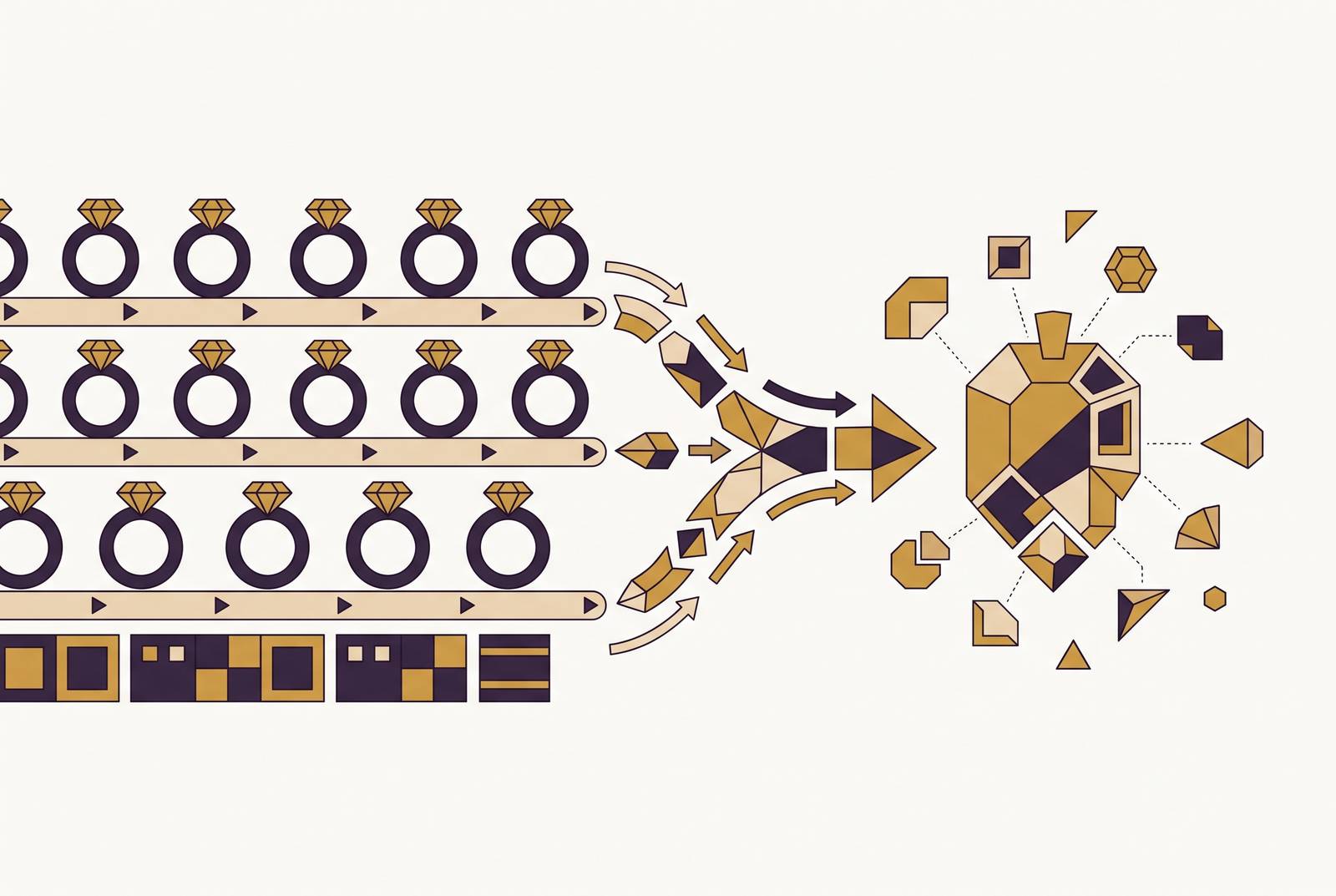
Most enterprise jewelry operations were built to kill variation, not produce it. Every workflow, every tool, every job description got tuned to make the same fifteen SKUs a million times over. Now customers want a million different rings, and the machine doing the math wasn't built for that math. Fixing it isn't a marketing project. It's a full operational rebuild that touches design, configuration, manufacturing, and org structure all at once, and treating it as a website update is the first mistake most brands make.
What mass customization actually requires from a jewelry operation
Mass production picks one design, copies it at volume, and kills any variation that creeps in. Mass customization flips that: instead of copying a design, the operation copies a process and lets variation run wild inside boundaries someone actually controls. Same factory floor, completely different rulebook.
Four layers have to move together, or the whole thing tips over. Design covers how pieces get made and how variation gets built in from the start, rather than bolted on after. Configuration covers how a customer or salesperson actually specifies which variant they want. The manufacturing handoff turns that specification into a production-ready file without a human quietly redoing the work by hand behind the scenes. Fulfillment tracks one-off orders and produces them without unit margins collapsing the moment nothing is identical anymore.
Most brands fail one of two ways, and the two failures look nothing alike from the outside. The first: a brand builds a slick customer-facing configurator, orders pour in, and the back end chokes because nobody touched the manufacturing handoff. That's a drive-through window bolted onto a kitchen that still cooks everything from scratch, one order at a time, with no line cooks working the grill.
The second failure is quieter but costs just as much. A brand automates design generation, feels very pleased with itself, and leaves quoting and approval fully manual. That's a Ferrari running on a bicycle chain: whatever speed the automation bought gets eaten by a person sitting in an inbox, approving quotes one at a time.
So here's the actual test, and it's blunt on purpose. Can a customer-picked variant go from selection to a production-ready file without a skilled designer touching it? If the answer is no, the system isn't built for scale, no matter how good the front end looks. Most brands never even ask this question. They ask "does the website look good," which is the wrong question wearing the right question's clothes.
Rebuilding the design layer with parametric and AI-powered tools
The old CAD workflow treats every custom order like a brand-new design project. A designer gets a brief, rebuilds or heavily edits a file, sends it out for approval. Multiply that by a few hundred orders a month, and the design team spends its days reinventing the wheel, one slightly different wheel at a time.
Parametric design fixes that by encoding variation as rules instead of fixed shapes. Pencil Design, an end-to-end jewelry design-to-production platform, is one example built around this output requirement. Change the ring size, and the shank width, stone seat depth, and prong height adjust on their own. MatrixGold shows the principle at work: it tracks every design step dynamically, so a designer tweaks one stage without rebuilding the whole model, and a size change ripples through the file automatically. The underlying math, NURBS-based modeling used in tools like Rhino and MatrixGold, lets curves get defined by formulas instead of hand-drawn geometry. Editing a 2mm radius to 2.5mm doesn't mean starting over from a blank screen.
AI-powered platforms push this further. A designer sets up the system once, and the AI outputs compliant variants straight from customer inputs, no file-rebuilding required. Design automation is already the biggest AI application in jewelry: roughly $370 million, about 28.5% of total AI-in-jewelry revenue in 2025, according to a market report from marketintelo.com. That software category is growing around 22.3% a year through 2034, the fastest-growing slice of the segment.
Platforms like Pencil push this to enterprise scale. Production-ready CAD designs get built without anyone needing traditional CAD skills, and every configuration outputs a file ready for casting. The design layer and the manufacturing handoff stop being two separate problems and collapse into one.
Enterprises still have real calls to make, and the biggest one gets skipped constantly: which dimensions should be parametric, ring size, metal type, stone count, versus which need a genuinely separate design file, like a structural silhouette change that isn't just a dial turn? Fewer, well-built design systems beat a warehouse of static files. System count matters more than most people assume, and someone has to own that system going forward, whether that's an internal team, the platform vendor, or some mix of both.
One distinction gets blurred constantly, and it shouldn't be. Generative image tools like Midjourney or DALL-E work fine for early concept sketches, but GIA noted in Gems & Gemology (Fall 2024) that these tools produce documented failure modes, including hallucinated compositions that can't go anywhere near a production line. Ideation and production readiness are different jobs, full stop. Conflating them is how someone ends up trying to cast a ring that physics doesn't support.
Encoding product logic into a configurator that the back end can actually fulfill
A configurator is only as trustworthy as the constraints baked into it. Let a customer pick options the factory can't deliver at the promised quality, and nobody built a configurator. They built a complaint generator with a nice interface.
A well-built one solves four problems at once: customers want fast, visual, interactive personalization; sales teams can't accurately quote complex multi-variable orders off the top of their heads; manufacturers get burned when orders arrive as inconsistent notes or verbal descriptions; and production data, CAD files, bills of materials, specs, needs to flow automatically instead of getting retyped by hand at every stage.
What separates an enterprise-grade setup from a cute widget on a product page comes down to a short list, and skipping any one item is usually why a launch stalls six months later. Headless API access means the configuration logic lives inside any storefront or in-store kiosk, not locked to one website. Real-time 3D preview has to render actual production geometry, not a marketing approximation that looks nothing like what gets cast. Back-end integration with ERP, CRM, and manufacturing systems means the order record and the production file are literally the same object, not two documents someone reconciles by hand at 6pm on a Friday. A rules engine has to block invalid combinations before they happen, so a customer physically cannot pick a stone that won't seat properly in the prong style they chose.
Platforms like Pencil offer custom parametric configurators with headless API access, letting brands build ring, pendant, and jewelry builders that surface configured variants directly on product pages. That's the actual architecture enterprise brands need. A static gallery with a "contact us to customize" button isn't a configurator. It's a suggestion box with extra steps.
Scope matters too. Which product lines get configured first? High-velocity, predictable-variation SKUs, engagement ring styles, stackable bands, are the obvious first candidates, well before anyone touches complex bespoke categories. None of it works without internal alignment, either. Merchandising defines the option set, design confirms every combination is actually manufacturable, and manufacturing signs off on lead times per configuration path before anything goes live. Skip any one of those three conversations, and the configurator launches with a landmine buried somewhere inside it.
Closing the loop from customer selection to production-ready file
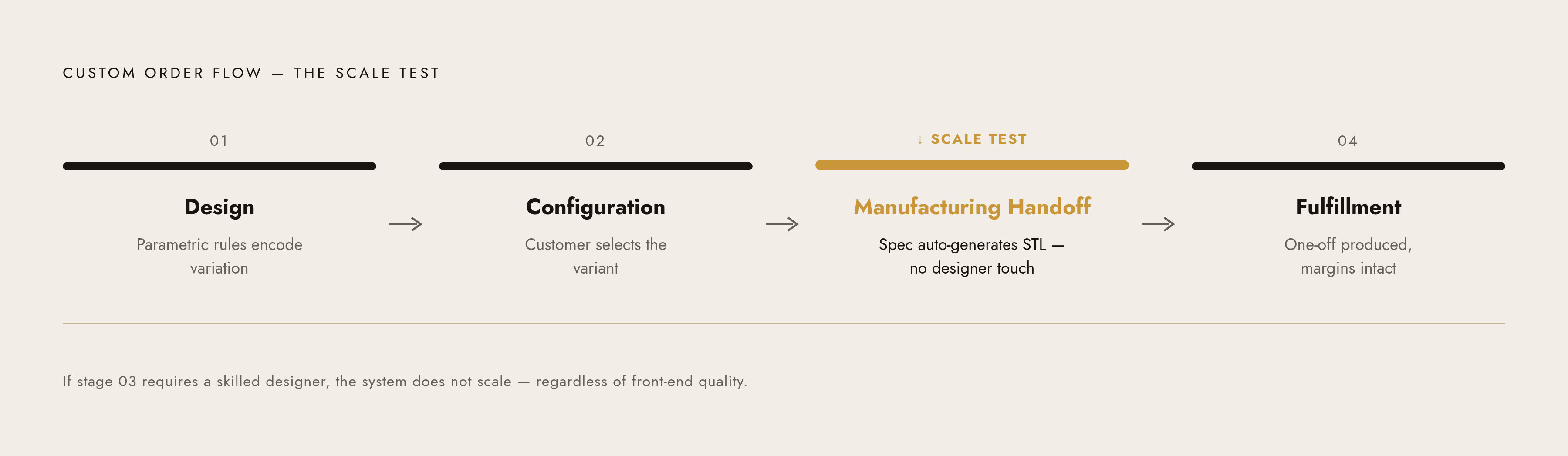
The whole manufacturing problem fits in one sentence: each order is effectively a unique product, but it has to move through production at close to batch-production speed and cost. Bespoke commission pricing on every order isn't customization. It's a different business wearing a customization costume.
The digital-to-physical path looks like this. A configured variant generates a production-grade CAD file (STL or equivalent) automatically from the parametric system. That file becomes a 3D-printed wax or resin pattern (SLA or similar), or goes straight to a CNC-machined mold. The pattern then runs through lost-wax casting and finishing.
3D printing matters here because every print job can be a completely different shape without retooling. The constraint shifts away from "can we tool for this" and lands squarely on "is the design file clean." A source from ifun3d.com describes a Brooklyn-based brand that cut development time from six months down to six weeks using 3D-printed resin prototypes for customizable stacking rings, and a major luxury house that hit 98% design accuracy using CNC machining on a limited-edition run.
None of that works without a strict dependency: every configuration a customer can select needs a matching valid CAD output. If the design system has gaps, or the configurator allows a combination that shouldn't exist, a human has to step in and fix the handoff by hand, and the entire economic case for mass customization falls apart right there. CAD accuracy also cuts down on wasted material and missed deadlines. Catching design errors on screen, before anything gets cast, beats catching them at the bench after the metal's already poured.
Manufacturing needs a seat at the table from day one of building the parametric system, not a phone call after the configurator's already scoped and half-built. Keep one test taped above every designer's desk: does every customer-selectable configuration output a file that can go straight to casting, no designer review required?
Restructuring the organization so customization scales without proportional headcount growth
Brands that treat mass customization as "more bespoke orders" respond by hiring more designers and more production coordinators to match volume. That's not scaling. That's running the old model faster and paying more for the privilege, and it's the most common trap in this whole transition.
When a parametric AI platform handles variant generation, the designer's job changes shape entirely. Instead of turning out one file per order, designers build and maintain the design system itself: the rules, the option sets, the combination constraints. Design review stops meaning "approve this one custom piece" and starts meaning "check the system periodically for edge cases that slipped through." A smaller design team ends up supporting a much bigger order volume, because the leverage lives in the system now, not in how many hands are on keyboards.
Sales and merchandising shift too. The configurator handles the first pass of specification, so the sales team's job moves from order-taking toward exception handling and high-value consultation, the stuff that actually needs a person. Real-time, accurate quoting straight from the configurator cuts down the back-and-forth on pricing and lead times that used to eat entire afternoons.
Manufacturing changes shape as well. The production queue goes digital-first: validated files show up instead of sketches or verbal briefs someone has to guess at. Quality control moves partly upstream into checking the design system itself, instead of living entirely at the bench where mistakes get expensive to fix.
AI agents built into the storefront can pick up a good chunk of customer service too, handling initial configuration sessions, answering product questions, and routing anything genuinely complicated to a human specialist. That workload usually scales right alongside customization volume, so anything that keeps it flat is doing real work.
For brands with large existing design teams, none of this means fewer designers overall. It means a different mix: fewer people cranking out one-off production CAD files, more people acting as design systems architects and platform operators. Same headcount, a very different set of job titles on the org chart.
Sequencing the transition so operations remain stable while the new model is built
None of this happens overnight, and it shouldn't. Brands still carry existing SKUs, mass-production obligations, and manufacturing relationships that can't get dropped mid-cycle while a new system gets built next door.
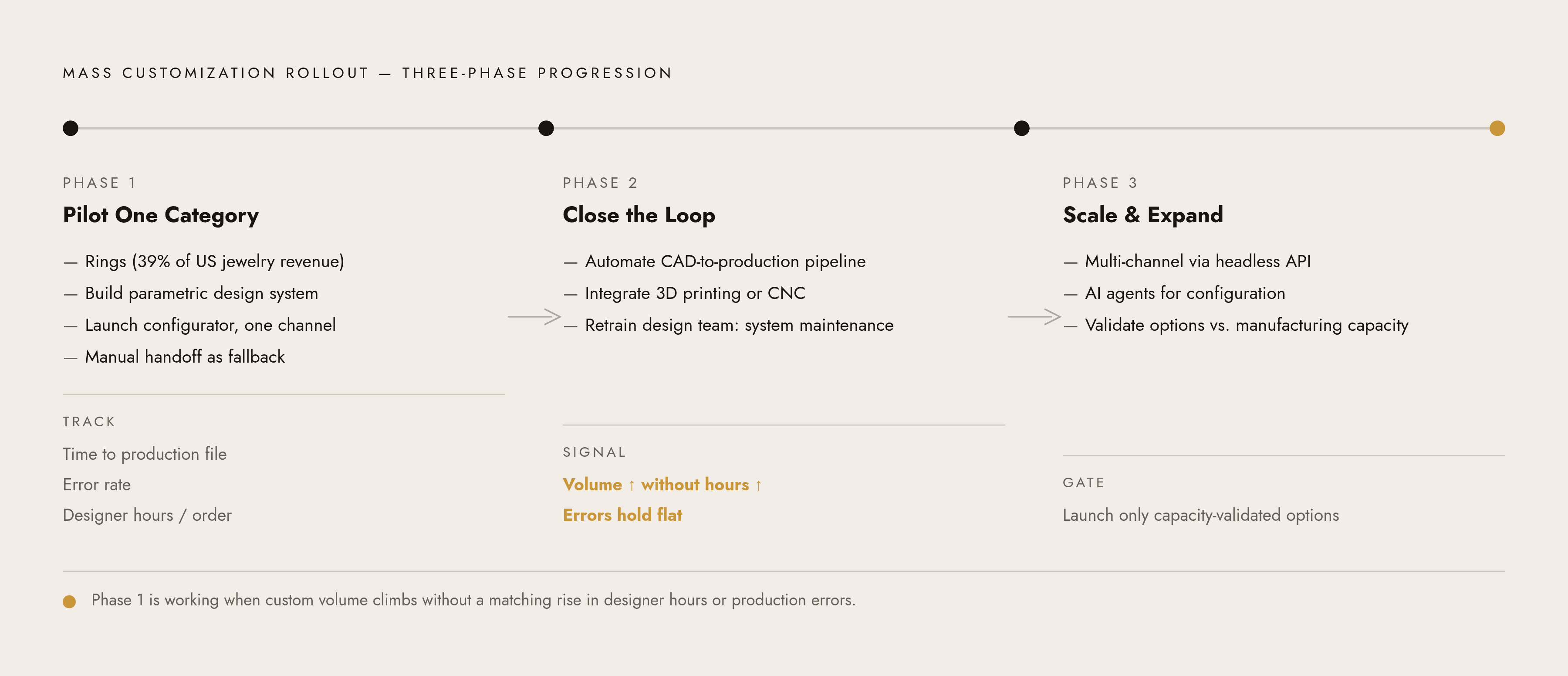
Phase one means picking one high-velocity, variation-friendly category to pilot. Engagement rings or stackable bands are the natural first candidates, given rings hold roughly 39.0% of US jewelry revenue in 2025. Build the parametric design system for that one category only, launch the configurator in a single channel (e-commerce, or one retail location), and keep manual manufacturing handoff as a fallback while measuring three things: time from customer configuration to production file, error rate, and design team hours per order.
Phase two closes the manufacturing handoff loop for that pilot category specifically. Automate the CAD-to-production pipeline for every configuration already validated, get 3D printing or CNC integration running for that category's production path, and start retraining the design team toward system maintenance instead of one-off file work.
Phase three expands the configurator to more channels and categories, using the operational model already proven in phases one and two. That means adding headless API deployment so wholesale partners, in-store kiosks, or other storefronts can plug in, bringing in AI agents for customer-facing configuration help at scale, and checking the option set against actual manufacturing capacity before every new category launch.
At each phase, the metric that matters isn't revenue from custom orders. It's designer hours per order, error rate at the manufacturing handoff, cycle time from customer selection to production file, and configurator abandonment rate. Here's the signal that phase one is working: custom order volume climbs without a matching climb in designer hours or production errors. If those two lines move together instead, the system isn't scaling, it's just getting bigger, and that distinction is worth losing sleep over.
Skipping the pilot entirely and trying to rebuild the whole catalog parametrically in one shot is the single most common mistake on this list, and arguably the costliest. That stalls out in the design layer while the business keeps running on the old model in the meantime, which means there are now two systems to maintain instead of one. Nobody wins that trade.
The AI in Jewelry Design market sits at $1.3 billion in 2025 and heads toward $6.8 billion by 2034, growing 18.7% a year. Brands building the operational plumbing now, the design systems, the configurators, the clean manufacturing handoffs, are the ones set up to absorb the next wave of tooling as it matures. Everyone else gets to retrofit twice.