Headless Commerce Architecture for Custom Jewelry Experiences
Headless architecture lets jewelry brands build real-time configurators that actually manufacture.

Online jewelry sales hit an estimated $76.2 billion in 2025. IceCartel puts 2026 at roughly $85.7 billion, which works out to about 13% growth a year. Growth like that is happening because customization stopped being a nice add-on and became the default: roughly 36% of online jewelry orders now include some kind of personalization, whether that's engraving, a made-to-order stone, or a custom setting.
This piece is about the plumbing underneath that shift. Headless commerce architecture is the setup that actually supports a real jewelry configurator, going well beyond a form with better lighting.
A jewelry configurator is a manufacturing spec generator wearing a 3D interface, and most commerce platforms were never built for that job. Nobody tells you this until you've tried to build one yourself, usually around week three, staring at a pricing bug that only shows up when someone picks a size 4.5 in white gold.
What monolithic platforms can't do once jewelry gets involved
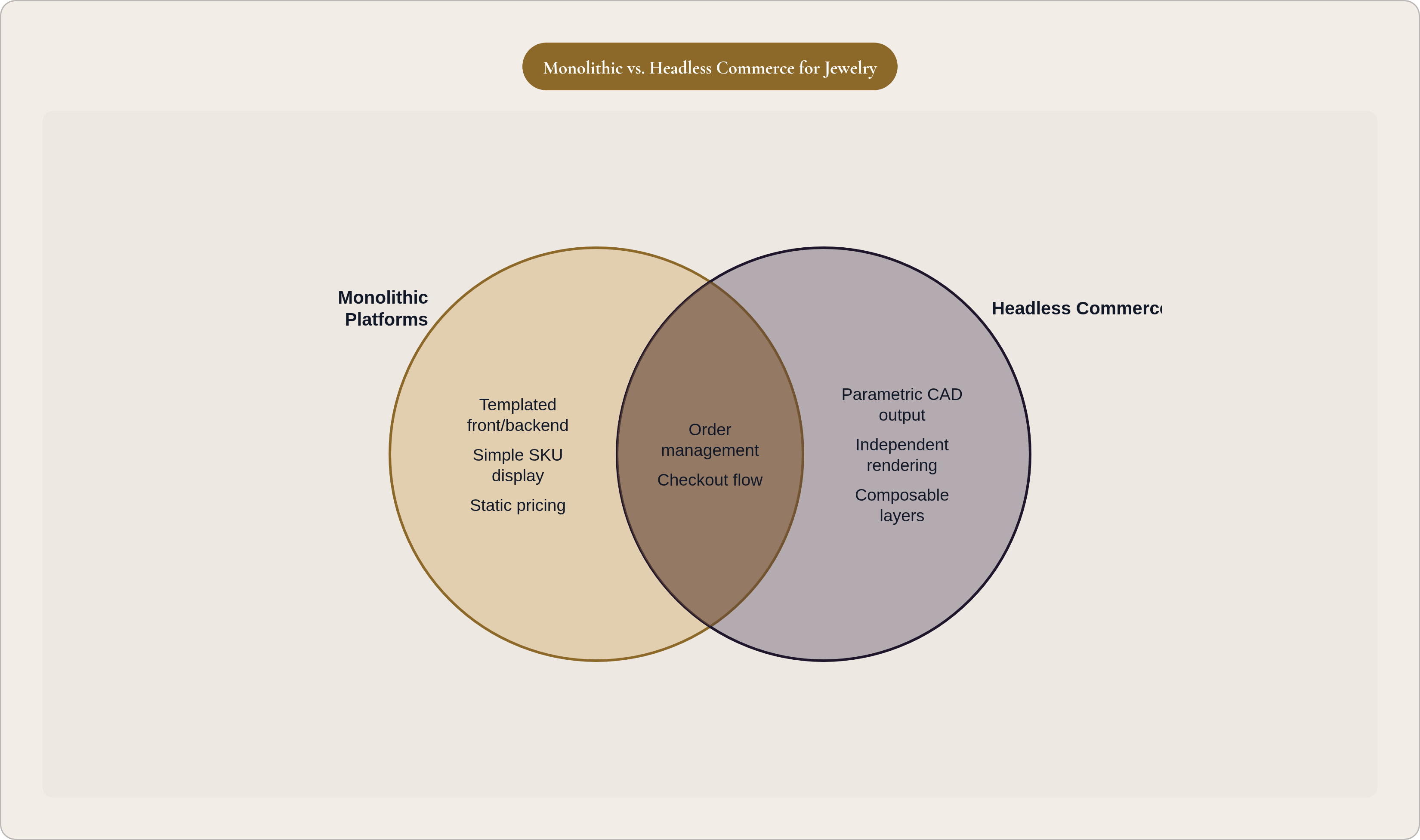
Monolithic platforms bolt the front end and back end together into one system. Touch one, you usually touch the other. Fine if you sell t-shirts in three colors. It falls apart fast when you're selling a ring where the customer picks metal, stone, setting, engraving, and size, and every single choice changes the geometry, the weight, and the price all at once.
Every new customization option has to squeeze through a templating system built for swapping product photos, not running casting logic. Real-time rendering, watching a ring update as you swap the stone color or bump the carat weight, puts real strain on a pipeline that was never asked to render anything live before. Speed matters more than people assume here, too: a one-second improvement in page load has been shown to lift conversion by 2%. Run that backward and a laggy configurator page starts looking like a slow leak in your sales funnel, one your marketing team is paying to patch every month without knowing it.
Pricing is its own headache. A configurator needs to recalculate cost as metal weight and stone grade shift in real time, and most monolithic setups can only fake that with a few workarounds duct-taped onto checkout.
The real problem shows up after checkout, though. What usually gets saved when a customer finishes configuring a ring is a handful of display attributes: "gold," "size 7," "sapphire." Rarely a spec a manufacturer can act on. The brand calls it a configurator, but the underlying data tells a different story: a form submission wearing nice photos. That gap between what's on screen and what's on the bench is the core reliability problem in made-to-order jewelry. It's also why nobody wants to be the one explaining to a bride why her "rose gold" ring showed up yellow.
How headless splits the experience from the engine underneath it
Headless breaks the job into three layers that don't need to know much about each other.
The frontend is what the customer sees and touches, built and shipped on its own in whatever framework the team likes. The API layer sits in the middle doing the real work: pricing rules, inventory checks, configuration state, all passed back and forth live. The backend handles business logic, order records, and connections to manufacturing systems, entirely separate from whatever's rendering in the browser.
Each layer swaps in or out without forcing a rebuild of the whole thing, held together by the APIs between them. For a jewelry configurator, that means the 3D rendering engine, the pricing calculator, and the configuration logic can all live up front, calling the backend only when they need something instead of on every click. A customer swaps in a bigger stone, watches the ring update, sees the price shift, and behind the scenes the backend logs a structured configuration object instead of a scribbled note. That object can feed straight into a CAD or manufacturing system, so the screen and the factory end up reading off the same file.
It also means a cart started on Instagram or at an in-store kiosk can follow the customer to web checkout without losing any data along the way. Paul Valentine is a decent real-world case. Before going headless, the brand had content scattered across 12 separate online stores. After switching (Shopify's Storefront API, Contentful, Nuxt/Vue.js), it runs over 24 regional storefronts off just two Shopify backends. Same brand, way less duplicated work.
Headless is already everywhere else. Jewelry just hasn't gotten the memo
Headless commerce isn't fringe anymore. The market was valued at $1.74 billion in 2025 and is projected to hit $7.16 billion by 2032, growing at 22.4% a year, which beats e-commerce growth overall. Sixty-four percent of enterprise companies already run some form of headless setup. Per the MACH Alliance, 92% of U.S. brands have adopted composable commerce in some form, and another 21% plan to roll it out within the year.
The payoff shows up in the numbers, too, if you like numbers. Businesses report an average 42% jump in conversion after going headless. Seventy-nine percent of headless users rate their scalability as strong, against 62% on traditional platforms. Nine out of ten companies say composable commerce meets or beats their ROI expectations, and 76% of brands say headless lets them tailor the digital experience to individual shoppers, per a 2024 BetterCommerce report.
Here's the catch, though. Most of that adoption comes from apparel, electronics, and beauty: categories where "customization" usually means picking a size or a color. Jewelry, which has arguably more to gain from this architecture than almost any other retail category, is still mostly running the old playbook. Everyone else moved to the fast lane. Jewelry's still on the shoulder, hazards on, wondering why the ring photos keep loading slow.
What it actually takes to build a jewelry configurator that works
Jewelry carries dimensions of customization other retail categories never deal with, and each one is a data problem before it's ever a display problem.
Metal type and karat aren't a color swap. They change weight, price, and how the piece can even be cast. Stone selection, cut, shape, carat, grade, carries its own seat geometry and pricing math. Ring size isn't a label either; changing it reshapes the shank, which affects wall thickness and total metal weight. Engraving has to respect the physical limits of how wide and deep the shank runs, or you've promised something the metal can't actually hold.
None of that gets caught after the order lands. It has to live inside the configuration logic itself:
- Minimum shank thickness, so rings don't crack during casting or resizing
- Prong depth and geometry, so stones seat and stay put
- Stone seat geometry, confirming the girdle fits the setting
- Wall tolerances, catching thin spots before they fail in 3D printing or lost-wax casting
The API layer has to carry all of this as a real structured spec, stone dimensions, metal weight, geometry constraints, rather than a set of pretty labels. That's the whole difference between a configurator that spits out "18k gold, size 7, round stone" as a customer note, and one that spits out a file a CAD system can chew on directly. It's an architecture decision, not a design decision, and treating it like the latter is how brands end up rebuilding their configurator eighteen months in.
There's a decent side effect here, too. Since CAD files can generate product renders before a single ring exists in inventory, a brand can build a full digital catalog and test what customers actually want before spending money on a production run.
Where parametric CAD meets the headless stack
Parametric design means the dimensions, stone counts, and metal weights in a CAD template are variables, not fixed numbers. Change an input, and the geometry updates on its own. This is the piece that turns a headless frontend into an actual configurator with real manufacturing logic behind it. Each customer's choices map to a parametric model that spits out valid, buildable geometry, not a SKU pulled off a shelf somewhere.
On the manufacturing side, a handful of tools do the heavy lifting. MatrixGold handles parametric prong settings, pavé layouts, channel settings, and shanks. Rhino, paired with Grasshopper and Drakon, is the go-to combination for repetitive parametric patterns, and it outputs STL files ready for printing or casting. Jewelry CAD Dream (JCD) is the heavyweight of the bunch, built to handle models with 500 or more gemstones without choking on itself.
The connection point is simple, even if the engineering behind it isn't. The customer finishes configuring in the headless frontend, the API hands off a structured spec, and the parametric model spits out a production-ready file on its own. No designer sitting down to rebuild the geometry by hand every time. Printing masters in-house instead of hand-carving molds also keeps detail consistent across every run, which matters a lot when "made-to-order" is supposed to mean the same thing twice.
Traditional CAD work takes 2 to 5 years of training and 2 to 12 weeks per design. A parametric template wired into a headless configurator collapses that to same-day, for anything inside the template's range. That shift changes what the business can promise customers, not just how fast it delivers on the old promise.
Where AI design tools actually fit, and where they don't
AI design tools for jewelry split into three camps: 2D generators, general-purpose AI assistants, and 3D-native platforms. Only the third group produces files the parametric pipeline can use. That distinction matters, because a pretty AI rendering that can't be cast is just an expensive screensaver, no matter how good it looks on Pinterest.
The real bottleneck AI is chipping away at is the jump from a 2D concept sketch to a manufacturing-ready 3D file, historically one of the slowest, most manual steps in the whole jewelry business. Tools like Diatech Studio's Technicals generate designs straight from exact stone, prong, and metal weight specs, so what's on screen is what actually gets built. That's the same data model a headless commerce API needs to carry anyway, so the fit isn't much of a stretch. Some platforms go further and check a generated design against current inventory and manufacturing limits automatically, closing the loop between what a customer picks and what the shop floor can actually deliver.
AI shows up differently depending on where you look in the stack. Up front, it drives real-time rendering, recommendations, and virtual try-on, made possible because the frontend stands on its own and can run heavy JavaScript without dragging the rest of the system down. At the API layer, AI-driven pricing and feasibility checks run as independent services the API calls out to. In the backend, AI handles inventory matching and production routing, invisible to the customer the entire time.
What headless actually costs you, in money and control
None of this is free, and nobody should pretend otherwise. Going headless means building a new architecture from scratch: frontend, API integrations, backend connections. Most existing teams don't have all those skills sitting around unused, so that means hiring, training, or bringing in outside help, and all three cost money and time.
Build it yourself, and you get full control over every interaction and every piece of data. You also get a long timeline, a bigger engineering bill, and the job of writing manufacturing validation logic from scratch, where a mistake doesn't mean a bug ticket. A mistake there means a defective ring shows up in a customer's mailbox.
Go composable instead, and platforms built specifically for jewelry already carry the parametric templates, configuration logic, and production-ready output, all reachable through an API from your headless frontend. That shrinks the engineering your team has to own by a wide margin. The tradeoff runs the other way: less control over the design engine itself, and more reliance on someone else's parametric library.
Most brands land somewhere in the middle. A frontend the brand owns outright, a jewelry-specific configuration and CAD layer handled by a specialized platform through an API, and a commodity backend like Shopify or BigCommerce doing the boring, necessary plumbing underneath all of it.
Picking that middle layer means asking a few blunt questions before signing anything. Does every configuration actually generate a production-ready CAD file, or does it stop at a nice picture? Are manufacturing rules like shank thickness and wall tolerance built into the configuration engine itself, or bolted on after the fact? Does the API hand off a real structured spec, or just display labels dressed up to look like one? Can the parametric library cover your whole catalog without custom CAD work every time you launch something new?
What the finished stack looks like once it's running
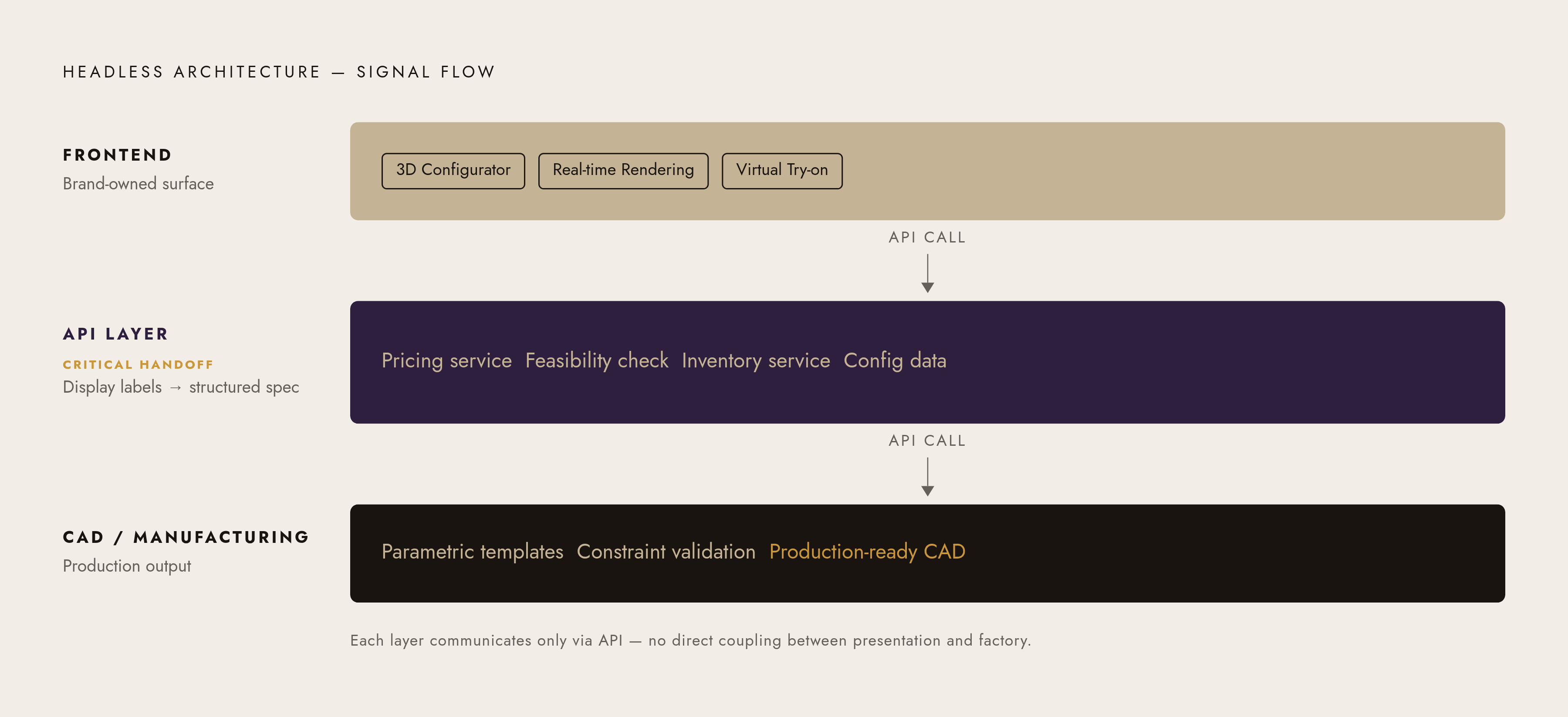
Put it together, and here's roughly what it looks like end to end.
The frontend is brand-owned, built in whatever framework fits (Next.js, Nuxt, or something custom), and hosts the 3D configurator, real-time rendering, virtual try-on, and whatever personalization logic the brand wants. It runs fast because it owns its rendering pipeline outright, tuned specifically for jewelry from the ground up.
The API layer carries structured configuration data, not display labels, and calls out independently to pricing, feasibility, and inventory services. Once a configuration is done, it routes straight to the CAD generation layer without anyone touching it by hand.
That jewelry configuration and CAD layer runs parametric templates mapped to every product in the catalog, checking manufacturing constraints on every change the customer makes, in real time, before anything reaches production. Three layers, three jobs, each one doing its part well instead of one platform straining to do all of it at once. That's really the whole pitch.