In-Store Jewelry Configurator Kiosks and Associate-Assisted Customization
Jewelry stores that combine kiosks with human expertise convert browsers into buyers.

People walk into a jewelry store carrying something heavier than their wallet. An engagement, an anniversary, a milestone birthday gift for a parent who's impossible to shop for. That emotional weight is exactly why kiosks can't replace the person behind the counter, but the right kiosk makes that person better at their job. This piece is about the second half of that sentence: how in-store configurator tools, when they're built right, hand associates more power instead of taking their job away.
Offline retail still owns the majority of jewelry sales in the U.S. in 2025, and it's not close. People want to hold the thing. They want to see how it catches light. But here's what a lot of store owners get wrong: customers rarely walk in already knowing what they want. They walk in with a feeling, a rough budget, and a date circled on a calendar. That fuzziness isn't a bug in the system. It's the entire opening for a good associate to do their job.
Drop a self-service kiosk into that gap without a human standing next to it, and you get exactly what you'd expect: someone poking at a touchscreen, feeling a little lost, and walking out without buying anything. Screens are bad at reading a hesitant face. The real question is how you use one to make the human conversation sharper, faster, and more confident, without ever pretending the screen can do the human's job for it.
What the customization market is actually signaling about shopper behavior
Cognitive Market Research pegs the global personalized jewelry market at $42.51 billion in 2024, growing at 8.60% a year through 2031. The Business Research Company sizes the custom jewelry service market, a narrower cut focused just on services rather than finished product, at $3.95 billion in 2025, rising to $4.3 billion in 2026 at 8.9% growth.
Numbers like that mean personalization has quietly become the baseline expectation, not the fancy upsell you offer to the customer who's already spent too much. Rings, especially engagement and wedding rings, make up the biggest slice of that customization pie, and it's not hard to see why: nothing sits on someone's hand for fifty years quite like a wedding band. Younger shoppers, millennials and Gen Z buyers especially, keep pushing toward jewelry tied to a specific memory or a specific version of themselves, rather than whatever their grandmother happened to pass down.
Put plainly: a store that only offers browse-and-buy, no path to customize, is bleeding out the exact customers who walk in with the most intent to spend. That's the pressure that makes configurator kiosks worth real investment, as infrastructure for the sales floor rather than a shiny toy for the showroom.
What a jewelry configurator kiosk actually does on the showroom floor
Start with the furniture. A racetrack or U-shaped kiosk layout keeps one associate within arm's reach of every case, with clean sightlines across the floor. That's a deliberate choice, meant to keep the conversation going rather than boxing the customer into a corner with a machine.
On the screen itself, customers flip through metal types, stone cuts, setting styles, engraving options, watching combinations change in real time before they commit to anything. Some of the newer RFID-enabled kiosks go a step further: a customer picks up a physical ring off the display, and the screen automatically pulls up matching stones, pricing, and close alternatives. No barcode scanning, no waiting on someone to look it up.
Here's the part that matters most for the associate: the kiosk is quietly building a preference profile before anyone says a word. Budget range, favorite stone shapes, metal color leanings. That data lands on the associate's tablet or point-of-sale screen, so when the human conversation starts, it doesn't start cold. Platforms like Priority's Product Configurator recalculate price on the fly as a customer swaps stone sizes or finishes, which kills the old "let me go check with my manager" moment dead.
That screen time works as a pre-briefing, setting up the actual conversation to be faster and sharper.
How Kendra Scott's Color Bar shows what associate-assisted customization looks like at scale
If you want proof this works at real scale, look at Kendra Scott's Color Bar, running since 2009. Customers pick from around 50 signature styles, then mix and match stones and metals on big touchscreens or iPads. The configuring is the fun part, and Kendra Scott built the whole retail moment around that.
Once the design's locked in, a Kendra Scott "setter" builds the piece right there, on the spot, in minutes. That associate isn't ringing up a sale. They're doing craft work in front of a customer who's watching every second of it. The Color Bar even doubles as a party venue, private events where every guest designs something and leaves wearing it. That's a configurator that turned into a hospitality product without anyone planning it that way on a whiteboard.
YR runs the technology behind the Color Bar, powering it across e-commerce, in-store kiosks, and brand events off one platform. The design a customer builds on the web carries the same bones as the one they'd build in-store.
What makes this work is restraint. It's semi-custom, not fully bespoke, which keeps every design inside the boundaries of what can actually get built on-site in a few minutes. Loose enough to feel personal, tight enough to be manufacturable. The associate role shifts from cashier to craftsperson, and that shift earns more respect from customers, plus more repeat visits. None of it happens, though, if the on-screen design doesn't connect straight through to something a setter can physically produce. A configurator that stops at a pretty picture buys you nothing here.
Why the associate's role expands, not shrinks, when a configurator is in the room
The fear is always the same: kiosks are going to replace the salesperson. The actual outcome runs the other direction. A good kiosk removes the boring slice of the job: looking up SKUs, running price math by hand, checking whether a stone size is in stock.
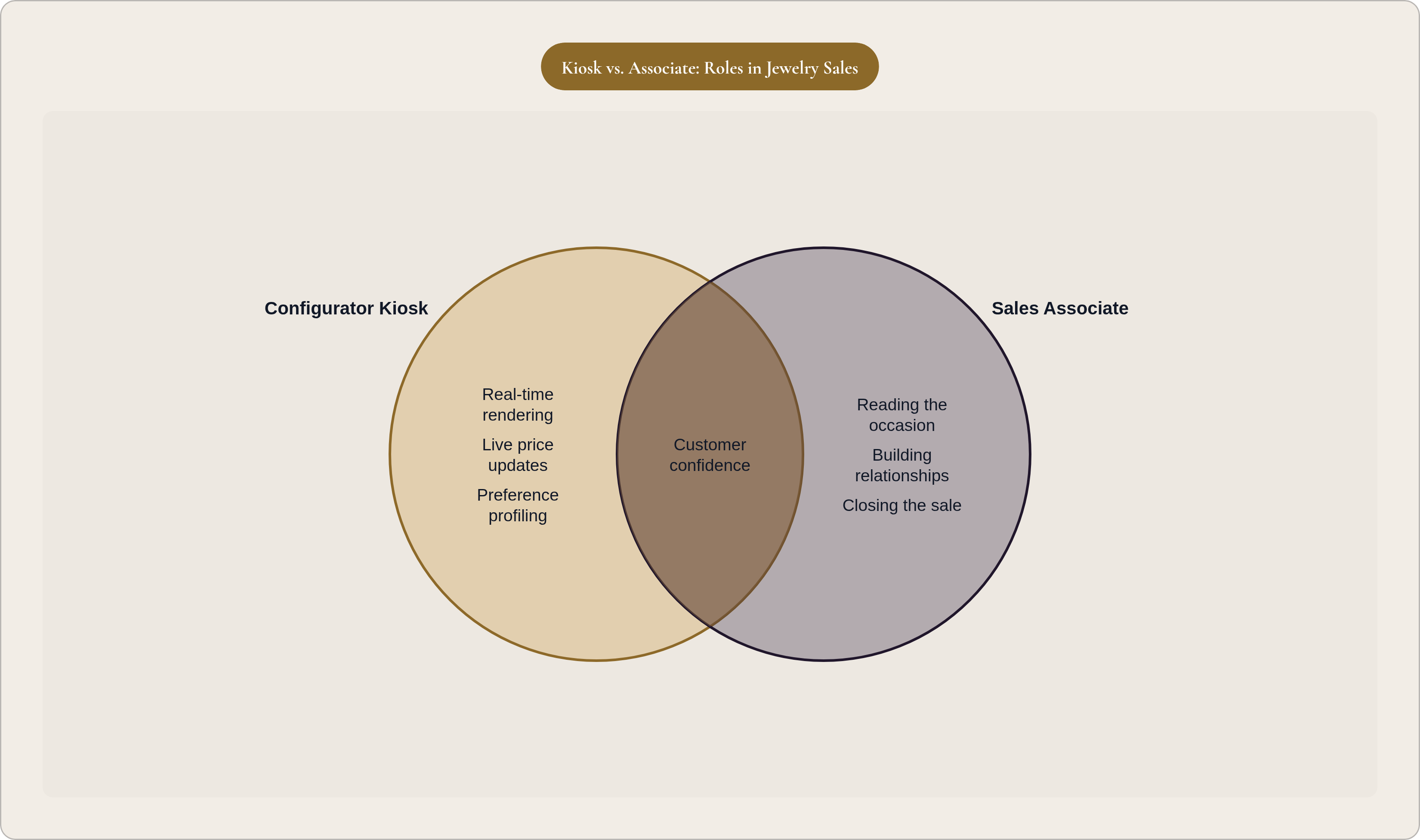
What associates get back is time. Time to focus on the part that actually needs a human: reading the occasion, offering advice that fits the moment, building the kind of relationship that turns a one-time buyer into someone who comes back for the anniversary gift three years later. A kiosk that's wired in right hands the associate a running profile, stated preferences, price range, styles already explored, so the associate steps into the middle of the story instead of starting from zero.
AI-driven customer service tools in jewelry are increasingly picking up the routine questions, stock checks, basic pricing, freeing staff to spend their energy where it counts: reading a nervous guy shopping for an engagement ring who has no idea what a princess cut is. The associate becomes a guide walking someone through the configuration, offering a perspective no catalog can. Their value is in narrowing the field, flagging what pairs well, and building the customer's confidence in a decision that, for a lot of these purchases, only happens once. That human layer carries real weight on a big-ticket purchase, and it's the reason the person drove to a store instead of clicking "buy" on a website at midnight.
What breaks when configuration data doesn't connect to production
Plenty of configurator setups fall apart right at the screen's edge. A customer picks their options, loves the render, and then the associate has to manually retype every spec into a separate CAD system, or snap a photo and text it to a bench jeweler and just hope it comes out right.
That gap between what's on the screen and what actually gets made is where custom orders go sideways: mixed-up specs, endless revision rounds, blown timelines, and finished pieces that don't match what the customer signed off on. Getting from a screen render to something a manufacturer can actually cut metal for takes more than a nice picture. Wall thickness, prong geometry, stone seat depth, sprue placement, castability, all of it has to already live inside the file.
A design that looks flawless on a touchscreen but can't go straight to a manufacturer amounts to a fancy picture with extra steps built in. And for the associate, a broken pipeline means the follow-up calls, the awkward "actually, the price changed" conversations, the apology emails about a delayed pickup date, all the stuff that quietly wrecks the trust the whole in-store experience was supposed to build in the first place. The real edge a configurator platform gives a brand runs deeper than the pretty interface: every choice a customer makes turns into a file a manufacturer can pick up and run with, no translation required.
How parametric and AI-powered platforms close the gap between configuration and manufacturing
Parametric design is the piece that makes this whole thing structurally possible. Every adjustment a customer makes, ring size, stone size, metal weight, prong count, has to flow correctly through the entire model without someone rebuilding the geometry by hand from scratch. Change the finger size, and the band thickness, prong length, and stone seat should all update on their own. That's a fundamentally different animal than a template-based configurator that's just swapping out flat visual assets.
3D-native platforms that plug straight into AI systems skip the old manual CAD conversion step entirely. The design exists as production-ready geometry from the moment someone finishes configuring, carrying real manufacturing data rather than just a picture that someone converts later. The pipeline runs in order: customer configures on screen, the system builds a parametric CAD model, automated checks confirm it's actually manufacturable (wall thickness, stone clearances, whether it'll cast cleanly), then it spits out a production file straight to the manufacturer.
Star Gems Inc.'s 2025 platform launch is a good real-world look at this: independent retailers can close a custom sale in-store with live rendering, instant pricing off a live pricing engine, and access to a large library of editable CAD files, no gap between the approved design and the thing that gets made. Omnichannel setups like YR show the same requirement from a different angle: a configuration built on a kiosk has to carry through to e-commerce, ERP, and order management without anyone re-typing it. The configuration data functions as the order itself.
Pencil Design runs on this exact logic. Every configuration outputs production-ready CAD from the start, connecting what a customer builds in a showroom or online straight to what a manufacturer opens on their end. No conversion step sitting in between, no detail lost in translation.
What brands need to evaluate when choosing an in-store configurator platform
The question worth asking isn't how sharp something looks on a touchscreen. It's whether every configuration this thing produces turns into a file a manufacturer can act on without someone stepping in to fix it first.
A few things worth checking before signing anything:
- Production-readiness. Does it output real CAD geometry, correct tolerances, stone seats, wall thicknesses, or just a render that looks nice in a demo?
- Parametric logic. Change one variable and does the whole model update on its own, or does an associate have to flag the change for a design team to fix later?
- Omnichannel consistency. Same product data on web, kiosk, and associate tablet, or three different systems quietly drifting apart from each other?
- Live pricing and system integration. Does the price update as the customer clicks, and does a finished configuration flow straight into order management and production scheduling without someone re-entering it by hand?
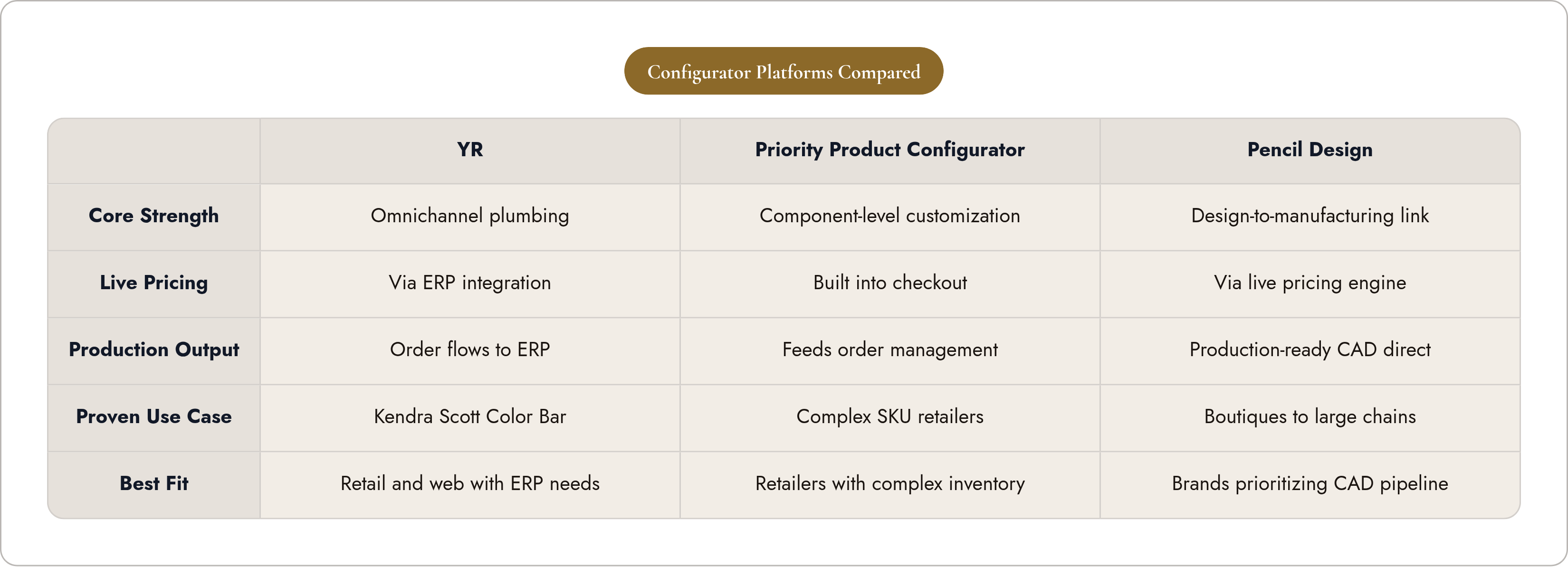
On the platform side: YR has strong omnichannel plumbing and a proven track record with Kendra Scott, a solid fit for brands running configuration across both retail and web with real ERP needs. Priority's Product Configurator handles component-level customization with live price recalculation and inventory tracking baked into checkout, useful for retailers juggling complicated SKU structures.
The best platform usually isn't the one with the longest feature list. It's the one where the fewest manual steps sit between the customer saying yes and the manufacturer getting the file.
How to train associates to lead the configuration conversation, not defer to the screen
Good technology alone won't save you here. An associate who treats the kiosk as a gimmick, or worse, a threat to their job security, will let it sit unused in ways that quietly cost the store real sales.
Associates need a clear picture of where they fit: they're the expert who reads and sharpens what the screen surfaces, actively guiding the customer rather than watching from the sidelines while clicks happen alone. Training needs to cover a few specific things. Reading configuration choices as signals, a stone color pick, a budget range, a setting style, and using those to steer the conversation somewhere useful. Knowing which builds can ship fast and which need more lead time, without killing the momentum of the sale mid-sentence. Using the screen to show alternatives ("let me pull up what this looks like with a cushion cut instead") rather than just nodding along with whatever the customer clicked first. And reading the room well enough to know when it's time to stop exploring and close the sale.
Stores that frame kiosk time as research before the real conversation, rather than a self-checkout line, see more of those configurations actually turn into sales. The Kendra Scott setter model says it all: watching someone build your ring by hand gives you a reason to stick around, and it makes the whole thing feel made specifically for you. Associates buy into a tool the moment it makes their job simpler instead of more complicated. A platform that hands them customer preference data, handles pricing automatically, and spits out production-ready specs does exactly that. It makes the associate look sharper, not replaceable.
The store floor as the front end of a production workflow, not just a sales environment
The brands actually getting this right are treating the showroom floor as the starting line of a production order, well beyond any simple display upgrade.
When a customer finishes configuring with an associate's help and the system spits out a production-ready file on the spot, the sale and the manufacturing brief happen in the same breath. No handoff, no lost-in-translation moment between what got approved and what gets built. That's the thing that turns custom jewelry from a slow, error-prone, margin-eating service into something that actually scales: the configurator handles the spec work, the associate handles the relationship, and the manufacturing pipeline gets a file it can run with immediately, no cleanup required.
The brands that put money into this, wiring configuration straight through CAD to production, can now offer lead times that look almost unfair next to competitors still working off hand-typed specs and emailed sketches. Offline retail's continued grip on jewelry revenue is the reason digital tools matter more here than almost anywhere else. The customer is standing right there, wallet out, emotionally ready to say yes. Every extra minute of friction between "I love this" and a confirmed order is a minute someone else gets to talk them out of it.