Localization and Currency Handling in Global Jewelry Configurators
Jewelry configurators need real-time currency and metal pricing to convert global sales.
Global jewelry sales crossed $342 billion in 2025. The online slice is racing toward $53 billion by next year, and cross-border e-commerce overall hit $1.14 trillion in 2024. Jewelry brands are already swimming in that water, whether they built a boat for it or not.
Most configurators still treat localization like an afterthought bolted on at checkout, the digital equivalent of slapping a currency converter on a page and calling it done. Fine for a cheap phone case. Falls apart fast on a high-value custom ring, right when a high-spending customer is deciding whether to hand you their credit card. For made-to-order jewelry, the configurator isn't a feature sitting next to the store. It is the store.
What "localization" actually means for a jewelry configurator, beyond swapping out button labels
Say "localization" to most people and they picture a translator finding the French word for "checkout." That's maybe a tenth of the job. I've watched teams ship a "localized" configurator that was really just Google Translate wearing a nice font, and it showed within a week: French customers hitting English error messages the second they tried an unusual stone-and-setting combo.
Language covers every string a shopper sees, not just menus: option names, metal labels, tooltips, and the warning that fires when someone tries to jam a 2-carat stone into a setting built for a 1-carat stone. Currency isn't just display, it's conversion tied to a metal price that never sits still. Units of measure means ring sizes, gram weights, and stone dimensions mapped across scales that don't line up neatly between countries. Regional rules cover hallmarking, purity notation, and materials that are perfectly normal in one country and flagged in another. Duty and tax need to show up during configuration, not as a checkout surprise. And payment expectations shift by city, not just by country, so what a shopper wants to see at the register in Seoul isn't what they want in Munich.
The upside is real when brands bother to get this right. Localized stores routinely see sales climb 25% to 70%, and shoppers convert more often when a site speaks their language, even at a higher price point. A brand doing $500,000 a year through an English-only configurator could plausibly add $125,000 to $350,000 just by adding German, French, and Spanish. Shopify's own guidance on this is blunt: localization is market-specific pricing and messaging working together, not word-for-word translation. On a purchase this considered, an English warning bleeding through on a French page doesn't just look careless. It kills the sale right there, mid-click.
Why jewelry pricing is structurally harder to localize than pricing a t-shirt
A t-shirt costs what it costs. Gold does not sit still, ever, and a configurator has to track it while converting currency at the exact same moment.
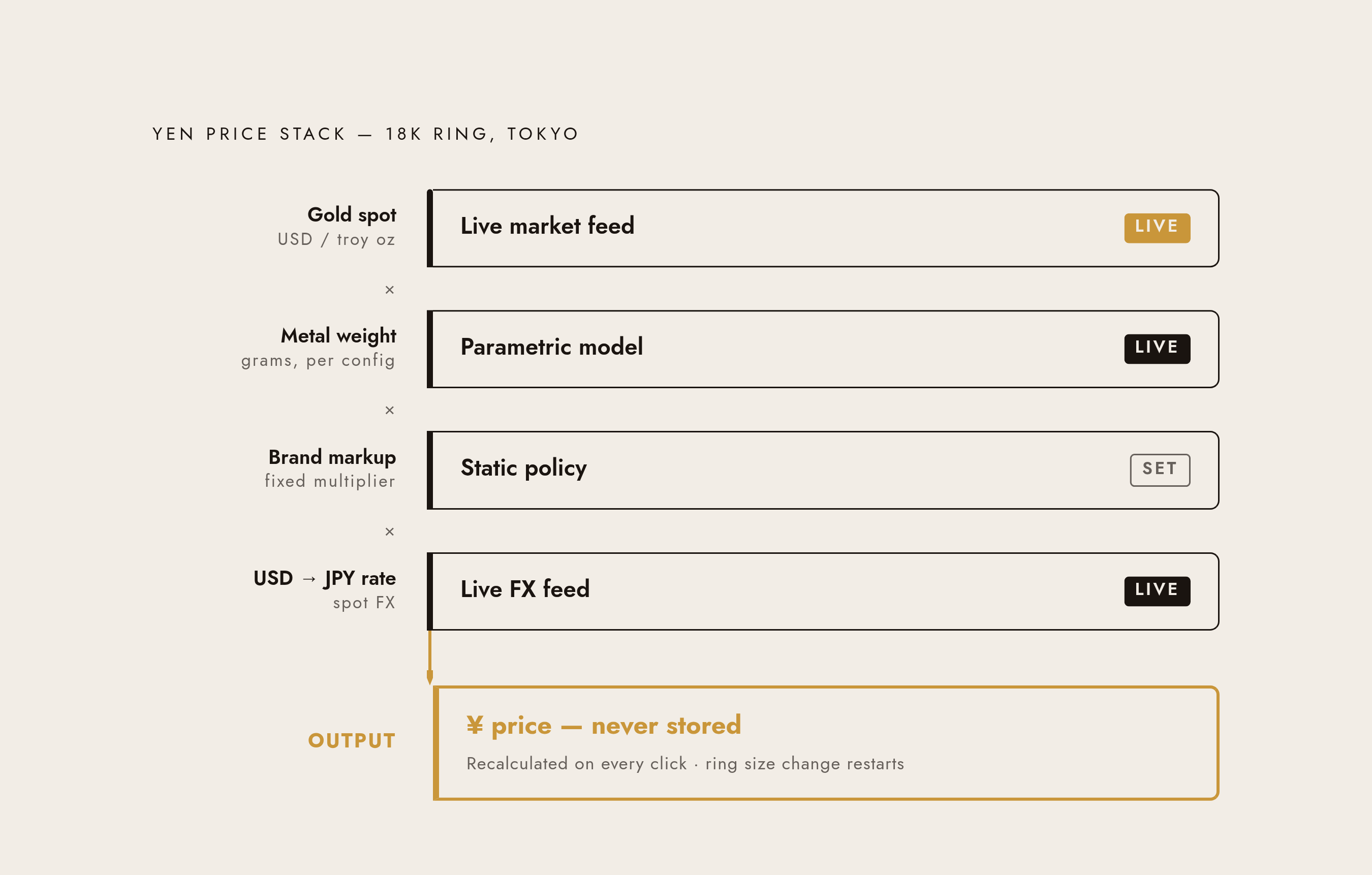
Take a shopper in Tokyo building an 18k ring. The yen price on their screen comes from four things stacked on top of each other: the live gold spot price, the exact metal weight in their specific configuration, the brand's markup, and the yen-to-dollar rate at that instant. Bump the ring size and the weight shifts. Wait five minutes and the spot price has already moved somewhere else. Nothing here holds still long enough to get comfortable, and the configurator has to reconcile all four pieces on every click.
Discounts complicate things further, because jewelry pricing is never one sticker number. It's the stone, the setting, and the metal weight, each with its own cost basis, added together. A system that only knows how to discount a total is going to botch the math the first time a promotion is supposed to apply to the diamond alone. Inventory splits the same way: some SKUs sit on a shelf at a fixed price, others are made to order with a price that floats until purchase, and mislabeling one as the other means a shopper thinks a six-week build is sitting in stock.
Purity conversion is where I've seen the real damage happen. The right way is deriving the 14k price from the 24k spot price on the fly. The wrong way is maintaining a separate, slowly rotting number for every karat across a catalog of thousands of SKUs. Gartner pegs the average cost of bad data quality at $12.9 million a year for an organization; for a jewelry brand juggling live metal prices across markets, that number stops being an abstraction and starts looking like next quarter's invoice.
How real-time metal price and currency APIs plug into a configurator's pricing engine
The fix is a pipeline, and it runs on every interaction, not once at page load: pull the live spot price, calculate weight off the parametric model, convert currency, then show the number.
Only four metals move in real jeweler volume: gold, silver, platinum, palladium. Each needs its own live feed. Gem Logic pulls fresh rates every five minutes, keeps a history of them, and rolls the updates into pricing on a schedule, with multi-currency support built in so a brand can hold cost in one currency and sell in another. The 14k number gets derived from the 24k spot automatically, so there's one source of truth instead of five numbers slowly drifting apart. Metals.Dev works at a similar scale with a 60-second data delay cap and a single API call covering precious metals, industrial metals, and currency conversion across more than 170 currencies.
The currency list gets long fast once a brand sells worldwide, past USD, EUR, GBP, and JPY into ZAR, BRL, ARS, IDR, MYR, AED, and VND. One WordPress plugin built for precious metals pricing covers exactly that spread, and the sheer length of that list tells you how wide the map really gets once you leave your home country.
One thing that matters more than it sounds: pricing has to recalculate server-side every time, never cached on the customer's device. A stale cached metal price sitting on a $4,000 quote isn't a rounding error. It's a liability with your company's name on it. And this isn't stuck in a slide deck somewhere, either. Star Gems Inc. launched an AI-powered custom jewelry platform in May 2025 with real-time rendering and instant pricing across tens of thousands of editable CAD files, running in production right now.
The unit-of-measure layer most configurators handle inconsistently across markets
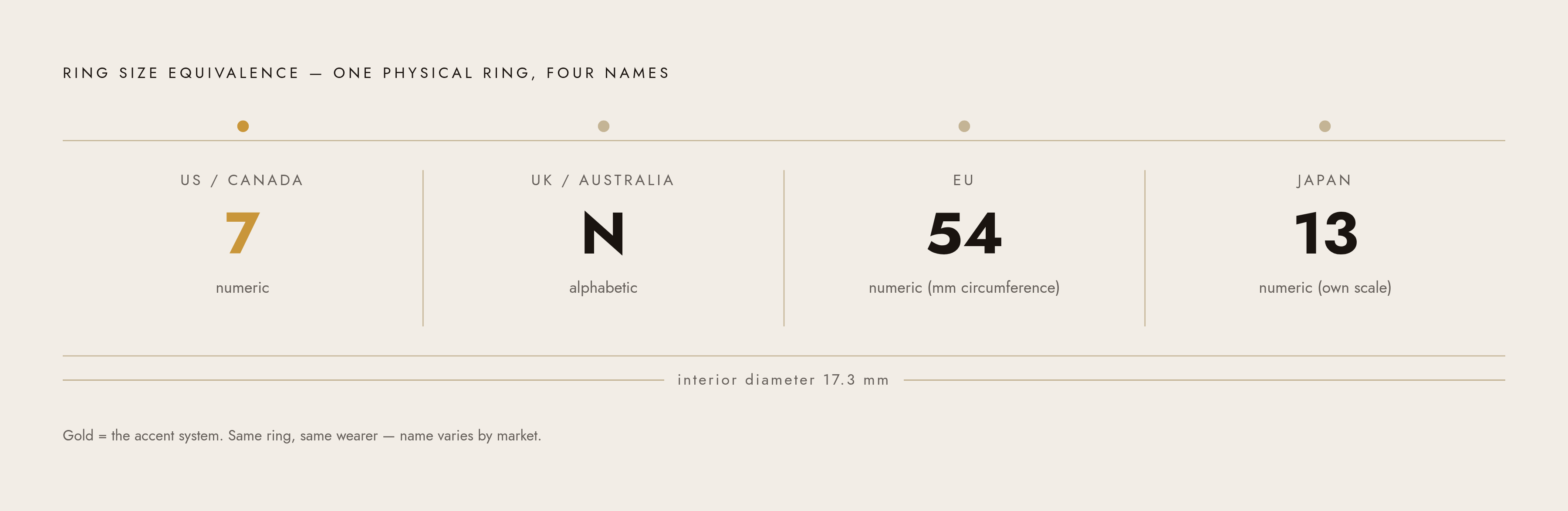
Ring sizing alone runs four regional systems at once. The US and Canada use numbers, the UK and Australia use letters, the EU has its own numerical scale that doesn't line up with the US one, and Japan runs its own numbers entirely. Someone picking "size 7" in Chicago and someone picking "N" in London might want nearly the same physical ring, and the configurator has to know that without being told.
Weight has its own quiet mess. Grams dominate most markets, pennyweights linger in US trade contexts, and troy ounces underpin spot pricing everywhere. The number a customer sees and the number that ships to manufacturing might need to live in entirely different units, even though they describe the exact same lump of metal. Stone dimensions split similarly, millimeters running production while customers think in carats, so the system has to track both and keep them glued together as someone tweaks a design.
Purity notation is its own regional puzzle: "14k" in the US, "585" across Europe, "56" in parts of Eastern Europe, all describing the identical alloy under three different labels.
Here's the failure that actually costs money: if unit conversion happens only on screen, and never makes it into the CAD file or the manufacturing order, then what the customer picked and what gets built are two different objects. Not a display bug. That's the configurator quietly failing at the only job it was hired to do. The fix lives inside the parametric model itself, not in a display-layer patch someone writes at 11pm before launch.
Regional product rules, hallmarking requirements, and restricted configurations by market
Hallmarking isn't optional in a lot of countries, and the rules don't match from one border to the next. The UK runs Assay Office marks. The EU has its own precious metal directives. India runs BIS hallmarking. The UAE has its own standard again. Each one dictates which purities are even legal to sell and how they get labeled.
For a configurator, that means some metal-and-purity combinations simply can't be selectable in certain markets, full stop, or they need a different label depending on where the shopper sits. That's a rules engine, not a translation job. Material restrictions go further: the EU limits nickel in anything touching skin, so a configurator serving European shoppers needs to flag or hide noncompliant alloys automatically, without someone manually checking every order that comes through.
Stone certification adds its own regional split, GIA carrying weight in the US premium market, IGI showing up more across parts of Asia, HRD common through Europe. Even price display is regulated in places: some markets require the tax-inclusive total at the configuration stage itself, others allow pre-tax pricing straight through checkout. Made-to-order lead times bring legal quirks too, since what counts as a binding order, and what cancellation rights apply, shifts by jurisdiction.
The workable answer is storing all of this as market-level data the configurator reads at the start of a session, rather than hard-coding it into product logic. Regulations change. Hard-coded rules turn into a maintenance headache every time one does, guaranteed.
How parametric design models make multi-market configuration technically possible
Without a parametric model, serving ten markets with different sizing scales, purity labels, and weight units means maintaining ten separate versions of every single product. That's not a scaling problem. That's SKU chaos with a spreadsheet attached.
A parametric model holds the design as a set of relationships instead of a fixed shape. Change the ring size, and the metal weight, setting proportions, and prong dimensions update on their own, all pulled from one source of truth. That's the only way a configurator shows a correctly priced, correctly sized, correctly labeled product to a shopper anywhere on earth, without a designer manually rebuilding the CAD file for every country on the list.
MatrixGold and the RhinoGold-Grasshopper combination already work this way: settings, shanks, and clasps adjust live, gem settings scale automatically when stone size changes, and libraries carry more than 15,000 preset gem cuts as ready parameters. 3Design runs on the same logic, gem settings scaling on the fly so the file heading to manufacturing always reflects the current design, not some earlier version someone saved three edits ago.
Tie that back to localization and the payoff is obvious. A shopper in Tokyo picks Japanese size 13. The model resolves that to the right interior diameter, recalculates metal volume in grams, hands the weight to the pricing engine, which applies the current spot price at the current yen rate. One model, one pass, done. A configurator built on static templates can show pretty pictures of options, sure, but it can't promise the thing on screen is actually buildable the way it's shown, in every market variant it claims to support.
Language handling at the configuration layer, not just the page level
Standard website translation covers the easy stuff, navigation, marketing copy, the footer nobody reads. A configurator asks for more, because most of its text isn't written by a person at all. It's assembled on the fly.
Take a string like "18k Yellow Gold, 4.2g." That gets built from live variables, and every piece needs to render correctly in the shopper's language, size label pulled from the right regional scale, price formatted the way that locale expects (a comma or a period as the decimal marker, the currency symbol before or after the digits). Configuration warnings carry just as much weight: "This combination isn't available," or "Minimum stone weight for this setting is 0.5 carats." Not decorative text. Decisions a customer needs to understand instantly, in their own language, or they close the tab.
BeeGraphy treats locale as a session-wide setting, detected from the browser or picked manually, that governs every string at once rather than flipping language page by page. Number formatting rides along with it: a four-figure sum formatted one way in Germany, another way in the US, a six-figure yen amount in Japan with no decimal at all. Get that wrong and the price reads like a typo, a bad look on anything north of four figures. Right-to-left languages like Arabic and Hebrew need the whole layout mirrored, not just the words swapped, and a configurator built only with left-to-right languages in mind will visibly break the first time it's asked to run in Arabic.
Moonglow shows prices in each shopper's home currency across its regional sites, which makes the point plainly: currency and language resolve together, as one decision, never as two systems bolted next to each other hoping nobody notices the seam. On the back end, a brand should be able to manage all this through a translation interface, not wait on a developer every time a new market gets added. That's the gap between adding a language over lunch and adding it after a sprint planning meeting three months out.
What a production-ready global configurator has to output, not just display
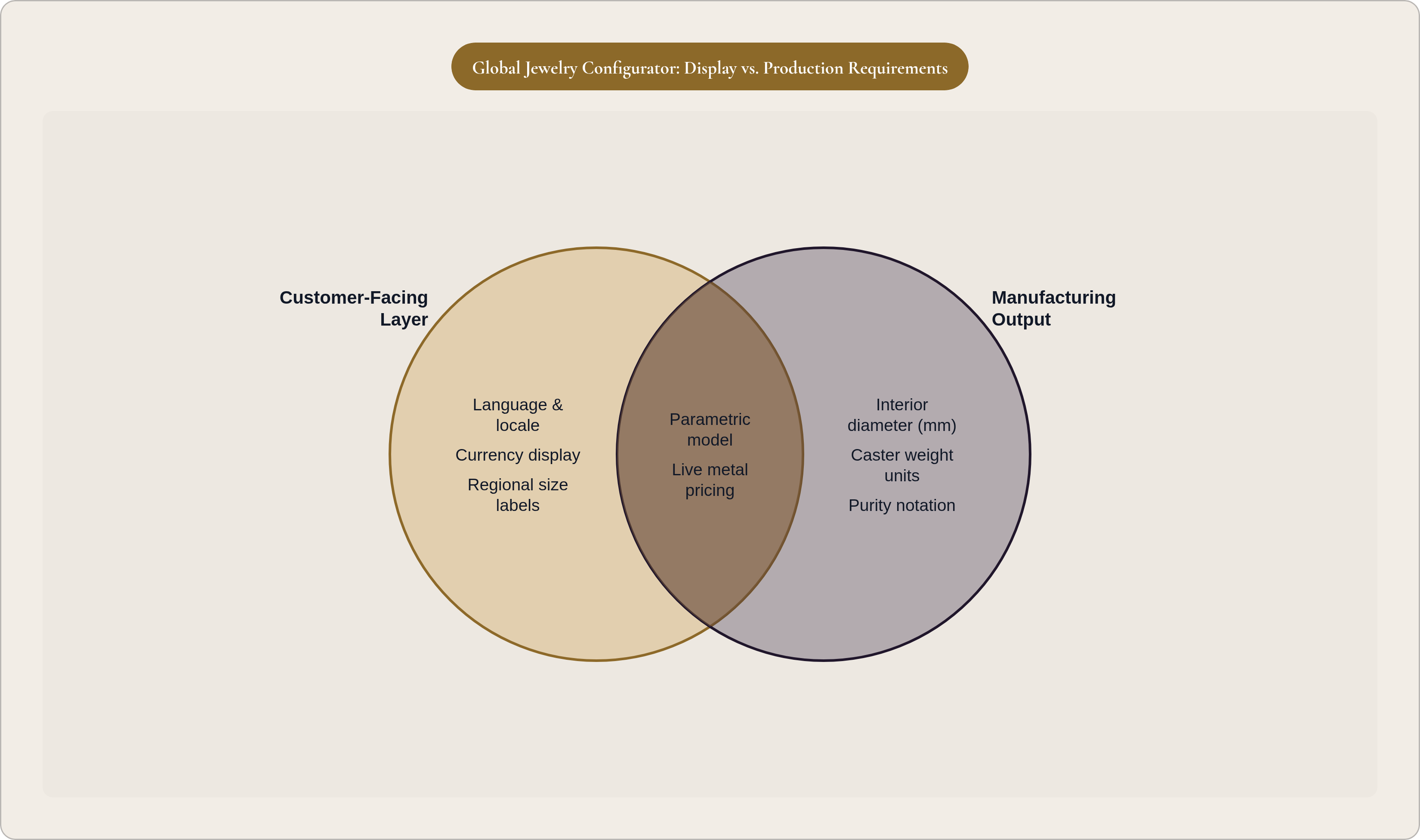
A configurator can nail the price, the currency, and the language, and still fail completely if the CAD file it spits out uses the wrong ring size scale for the manufacturer receiving it. Not a rounding error. A ring that doesn't fit, shipped to someone who paid full price for one that would.
A manufacturing-ready file needs the correct interior diameter for whatever regional size the customer picked, the metal weight in whatever unit the caster actually works in, the alloy spelled out in the purity notation that manufacturer recognizes, stone dimensions in millimeters, and the exact setting and prong count configured, with zero substitutions. The CAD file is the contract between what got sold and what gets built. Any gap between the customer-facing screen and that file is a production mistake waiting for its moment.
Order data needs locale-specific fields riding along too, the hallmarking requirement for the destination market, the certificate type expected there, any compliance flag the rules engine raised along the way. Pencil Design handles this end to end, producing a production-grade CAD file straight from the configuration, ready for casting, so the parametric model, the pricing engine, and the localization layer all land in one file a manufacturer can actually use, instead of a pretty render someone still has to turn into real geometry later.
That's the actual dividing line. A global jewelry configurator resolves everything, from a shopper's language and currency clear through to a market-correct, castable file. Anything short of that is just a good-looking product page wearing a lot of dropdown menus.