Production Lead Time Management for Made-to-Order Jewelry Brands
Design bottlenecks before casting cause most made-to-order jewelry delays.
Made-to-order jewelry brands burn most of their production time before a single piece hits the bench. The delay lives in design and file-handoff, and that's the part almost nobody blames when a delivery date slips.
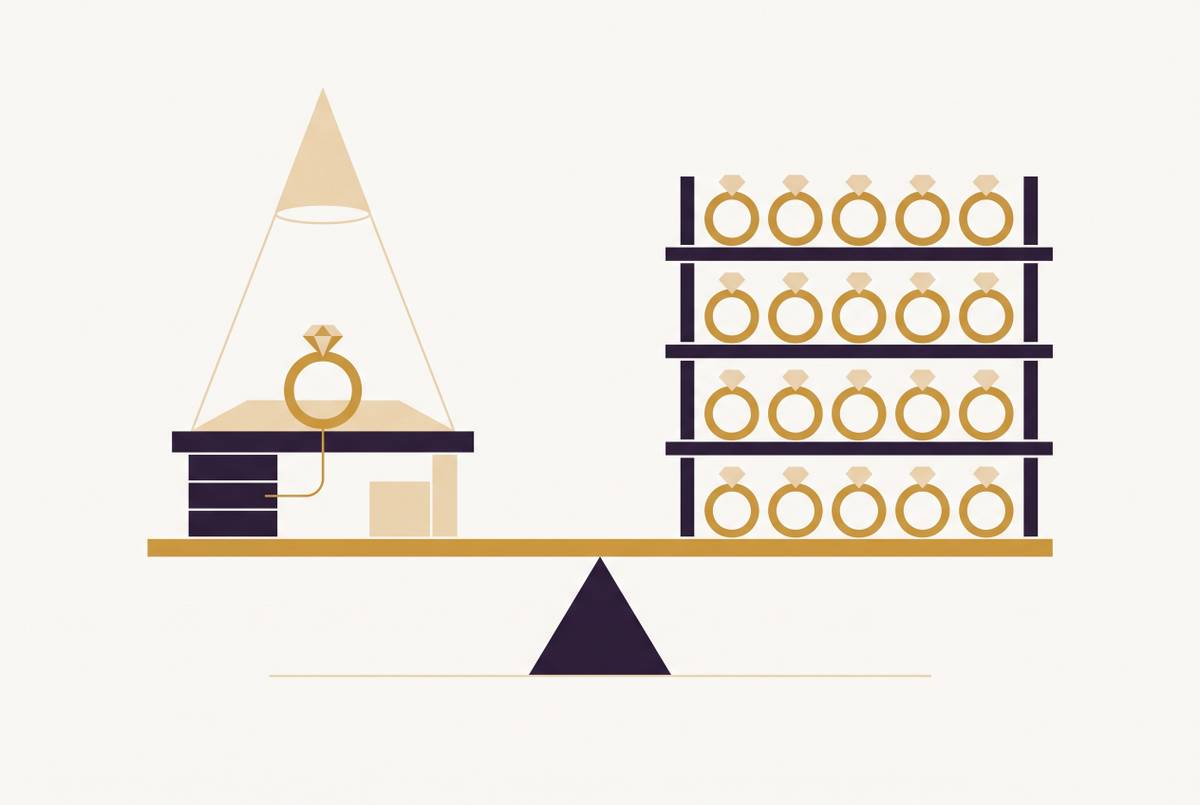
Every brand blames the same suspects when timelines slip: casting queues, polishing backlogs, a supplier who "should have shipped Tuesday." Those are real problems, but they account for a smaller share of the schedule than most people assume. By the time a piece reaches the bench, the schedule got decided upstream, in the gap between a customer submitting a custom order and a validated, production-ready file landing in the manufacturer's inbox. That gap is where design interpretation happens, where CAD gets built, where revisions bounce back and forth, where files get approved or don't. Jewelry By Johan puts the real-world range for made-to-order pieces at 3 to 7 weeks and says that window depends heavily on design complexity. Complexity gets locked in before casting ever begins, which means the piece that ships in three weeks and the piece that ships in seven got decided by the same design meeting, not the same casting house.
What the made-to-order lead time chain actually looks like, stage by stage
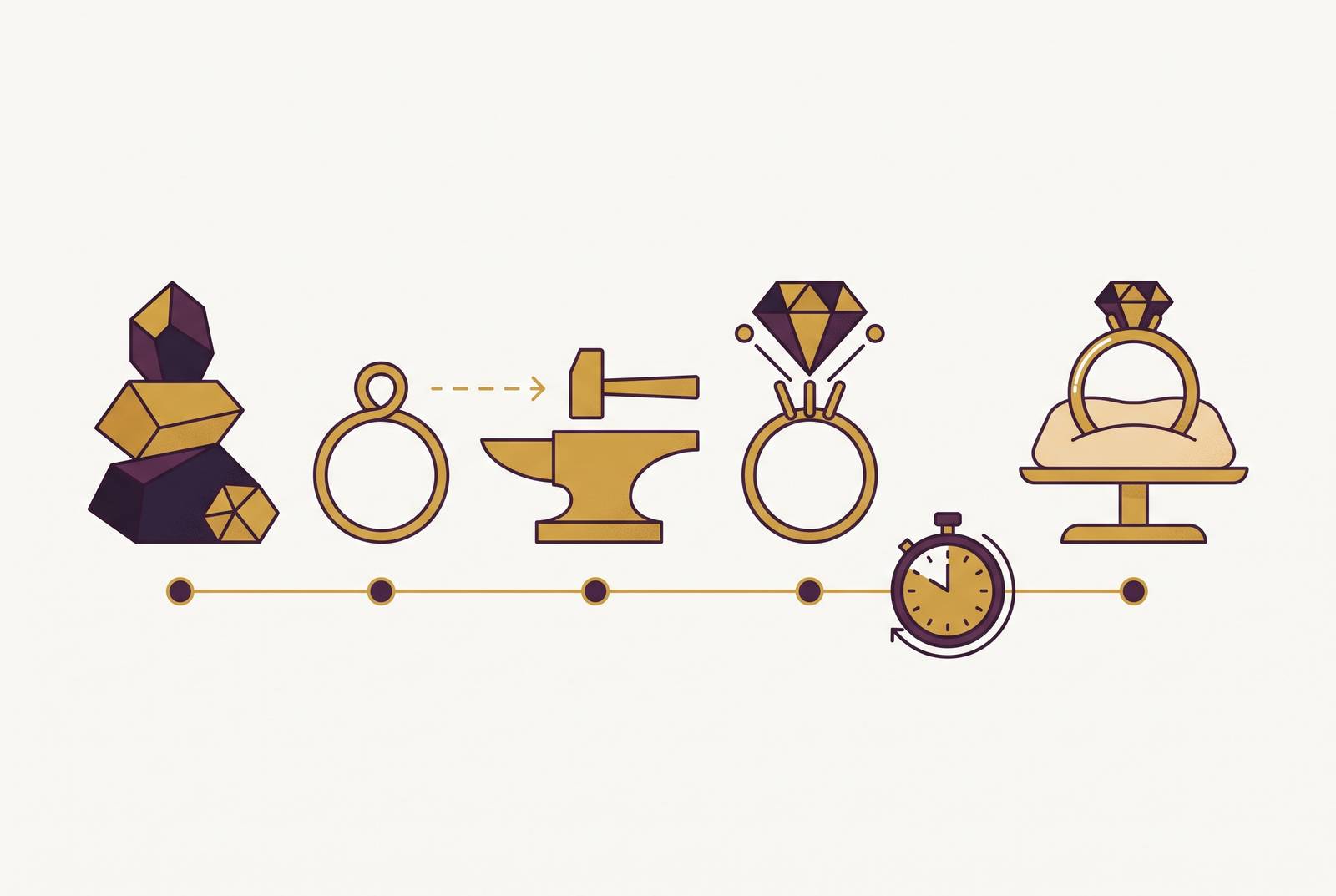
Here's the full sequence, in order: customer order, design interpretation, CAD creation, client approval, file validation, manufacturing queue entry, casting, finishing, quality control, ship.
Brands often measure "production lead time" starting from queue entry. That starting point undercounts the real timeline, and it's why so many estimates run short. Everything before queue entry belongs to the brand, not the manufacturer. Design interpretation (turning a customer's vague wish into something a machinist can actually build), CAD creation, revision loops, and file validation all sit on the brand's side of the fence. Get those wrong and a week is gone before the manufacturer even opens the file.
Downstream, the brand has influence but not control. Casting and polishing tend to have one stage that slows the entire timeline down. Material availability shifts things too, especially for brands sourcing reactively instead of keeping stock on hand. Seasonal demand (Valentine's Day, the December rush) compresses manufacturer capacity across the whole industry at once, so every brand's queue gets longer on the same calendar week, no matter how good any single shop's process is.
The leverage sits upstream, full stop. That's where a brand has the most room to move, and it's where small delays compound hardest into the downstream schedule. Tighten the front end and the whole chain gets shorter. Loosen it, and no amount of casting-house efficiency saves the delivery date.
How revision loops silently extend the timeline
Revision loops are the quiet timeline killer. Each round-trip between customer, designer, and manufacturer looks small on its own, maybe a day, maybe two, but they stack fast, and nobody notices until the ship date has already moved twice.
A few things cause most of them. Customers describe rings and pendants in language that doesn't map cleanly onto manufacturing specs ("make it delicate but substantial" is a design brief and a riddle at the same time). Non-parametric CAD files often need rebuilding from scratch just to change a ring size or swap a stone. Clients approve static renders instead of interactive 3D models, then get surprised when the physical prototype doesn't match what they pictured, and slow approvals stretch projects out on their own. The principle is straightforward: a manufacturer can only move as fast as the project definition allows.
Here's the part that matters most: a revision caught at order intake costs almost nothing. The same revision caught after CAD is built costs real time, because now someone has to unbuild and rebuild instead of just adjusting a number. Brands running tight schedules front-load the work, nailing down design details, material assumptions, and option limits before the order is even confirmed. CAD starts from a finished brief instead of a rough draft.
The order intake form works as a scheduling tool, whether or not a brand treats it that way.
Parametric CAD as the structural fix for revision-driven delay
Two ways to build a 3D jewelry model exist, and most shops are still running the slower one without realizing it costs them anything.
Direct modeling means pushing and pulling surfaces by hand. Fine for a one-off tweak, but every systematic change (a new ring size, a different stone shape) means manual rework, start to finish. Parametric modeling bakes the design logic into the file's history instead. Change one dimension, one stone size, one metal type, and the change ripples through the whole model on its own.
The time difference isn't subtle, and it isn't close. A parametric file can absorb a customer's change request in minutes. A non-parametric file might eat hours. Formlabs' review of Jewelry CAD Dream's parametric engine describes it running models with 500-plus gemstones (choker colliers, lavaliere pendants) without geometry breaking when curvature or stone arrays get edited. That's the gap between a same-day revision and a two-day rebuild, and it shows up on every order, not just the complicated ones.
MatrixGold 4.0, released in 2025, added tools built specifically to cut manual labor, including a Duplicate Command that replicates parametric elements while keeping their values intact. Each such addition shaves time off every revision a CAD artist has to make.
The CAD file works as the scheduling instrument as much as it works as a design document. How it's built determines how fast it can flex, and how fast it can flex determines how fast the order moves.
Manufacturability constraints as a lead time gate built into the design stage
The most expensive mistake in the whole chain is a finished CAD file that can't actually be cast: wrong wall thickness, an unsupported undercut, a stone seat that doesn't match the stone. That failure surfaces after the longest, most labor-intensive stage is already done. Now the clock restarts from a worse position than where it started.
Most shops catch manufacturability problems at handoff, which is exactly backwards. By then, the failure is expensive to fix and the revision loop restarts from scratch. Better shops build the constraint into the configuration stage, before CAD exists at all. Metal options get limited to what the casting house actually runs. Stone choices get limited to what's in stock or reliably sourceable. Dimensions get bounded by minimums and maximums that match real production tolerances, not aspirational ones.
That's the logic behind platforms that let manufacturers set option constraints at the product level. A customer literally cannot configure something the shop can't build. Every order that reaches the queue has already passed the test.
Once a file is guaranteed castable before it arrives, queue entry happens right away. There's no lag between "order confirmed" and "production starts," because there's nothing left to check. For pieces still in development, printing a physical model before committing to precious metal gives a cheap way to catch fit and form problems early, before they turn into a post-casting redo.
AI-assisted design generation and what it does to the early stage of the timeline
The first bottleneck in any custom order is translation: turning a customer's fuzzy idea into a design a machinist can build. That's traditionally a skilled designer's job, and it usually takes at least one round of back-and-forth to nail down.
The GIA's Fall 2024 evaluation, published in Gems & Gemology, found that the most common practical use of generative AI in jewelry design is something it calls "AIdeation": feed in a few words, get back a batch of design iterations, and narrow in on a concept fast. That compresses the gap between "customer has a vague idea" and "designer has something buildable," potentially turning a multi-day back-and-forth into a single conversation.
It's worth being precise here, though, because the tools serve different purposes. General AI image tools like Midjourney or DALL-E generate pictures that look great and mean nothing to a caster; they speed up brainstorming, but they have zero understanding of whether a design can actually be built in metal. Jewelry-specific AI platforms go further, connecting a chosen concept directly into a 3D modeling pipeline that feeds parametric CAD. Pencil Design, for instance, is built around producing production-ready CAD files from that pipeline rather than stopping at a rendered image. The gap between a mood board and a manufacturing input is exactly what separates the two categories of tool, and mixing them up is how a brand ends up with a gorgeous render and no path to a casting file.
The market is scaling to match. SNS Insider valued the AI-generated 3D asset market at $1.63 billion in 2024, projecting growth to $9.24 billion by 2032 at a 24.29% annual clip. That's the infrastructure for AI-native design pipelines getting built in real time.
One caution worth stating plainly: AI generation without a manufacturability check doesn't save time. It moves the uncertainty further down the line, where it costs more to fix.
How configurators shift the design-to-production handoff from days to seconds
A configurator does something specific to the lead time chain: it lets the customer complete the design interpretation stage themselves, in real time, inside limits the brand has already validated.
Three stages disappear outright for a configured order: design briefing, CAD interpretation, first-draft approval. All three get resolved the moment the customer clicks "buy."
Building that requires work up front, though, and skipping the work is how configurators fail. Every configurable product needs a parametric model built to handle every allowed variation without manual rework behind the scenes. Manufacturability constraints have to be baked into the option set so invalid combinations are impossible, not just unlikely or discouraged. The system needs to spit out a production-ready CAD file automatically the moment a customer finalizes a design, not queue it for a human to build later.
Dynamic pricing rides along as a bonus. Real-time price updates as customers pick options cut down on pricing disputes that would otherwise stall approval after the fact.
Scale is where this pays off hardest. A brand running a well-built configurator can take in and immediately queue dozens of custom orders at once, a load that would create a multi-week pileup under a traditional CAD-on-demand setup. Building the parametric, constrained configurator costs real time up front, but it pays that time back on every order after the first. Per-order design time trends toward zero the more orders run through it.
What to communicate to customers about lead time, and when
None of the upstream fixes matter to a customer if they don't know the number, or if the number turns out to be wrong. What gets communicated, and when, decides whether a real lead time reads as satisfying or infuriating.
Underpromise, then beat it. That's the whole rule, and brands that ignore it lose customers over timelines they actually hit. Quote three weeks, deliver in two, and a customer becomes a fan. Quote two weeks, deliver in three, and that same customer files a refund request. Same piece, same actual production timeline, opposite outcome depending on which number got said first.
Sound practice, reflected across the industry, puts lead time information in three places: on the product page above the add-to-bag button (not buried three clicks deep in an FAQ), in the cart under the product name so the customer confirms it at checkout, and in the order confirmation email so there's a written record without anyone needing to call support.
Buffer time works as insurance, not padding. Casting queues wobble, materials get delayed, holidays surge, and a published lead time needs room to absorb all of that without breaking its promise. Customers who understand they're waiting on a piece being built specifically for them tolerate the wait far better than customers who think they're just experiencing a slow shipment. Configurator orders have a natural edge here too: the customer already took part in designing the thing, so the wait feels like anticipation instead of delay.
Managing downstream production variables once the file is in queue
Downstream is genuinely downstream: casting queue position, finishing and polishing throughput, quality control holds, material availability on the day production actually runs.
A pattern worth remembering: usually one stage, casting or polishing, slows the whole timeline down. Finding which stage is the bottleneck at a given manufacturer is the first real step toward managing around it, instead of guessing and hoping the next batch runs faster.
Material availability shows up again and again as the recurring variable. Order materials only after the order comes in, and supplier lead time gets baked into every single production cycle, whether anyone planned for it or not. Keep frequently used materials in stock, or qualify more than one supplier, and that variable turns into a constant that can actually be planned around.
Seasonal surges compress capacity across the whole industry at once. Holidays and gifting events don't just slow one brand's manufacturer; they slow everyone's, at the same time, for the same reason. Brands that forecast volume and lock in capacity ahead of time avoid getting pushed to the back of someone else's casting queue. AI-driven production monitoring is starting to help here too: machine learning applied to production data can flag inefficiencies in casting, polishing, and finishing before they turn into a blown schedule, not after.
Upstream and downstream connect directly. A validated, castable file needs no pre-production clarification, so it slides straight into the casting queue. A file with ambiguities gets held for review, eating into the exact buffer time the brand built in to protect against everything else.
The compounding advantage of treating the design-to-production handoff as a system
Line the pieces up and they stop looking like separate fixes. Parametric CAD absorbs change requests without a rebuild. Manufacturability constraints keep bad configurations out of the pipeline entirely. AI-assisted ideation shortens the brief-definition stage at the very front. Configurators skip the design interpretation stage altogether for defined product lines. Validated files queue immediately instead of sitting in review. Clear communication turns the remaining wait into something the customer signed up for.
Each improvement removes rework that would otherwise land on the next stage down the line, which is the actual reason the gains multiply instead of just adding up.
Brands that can take on more custom volume without hiring proportionally more designers are the ones that turned the upstream handoff into an actual system, instead of a series of manual steps held together by email threads. The design-to-production pipeline becomes the thing that lets the brand grow, easing the pressure to scale headcount one designer at a time.
And the growth is real. Online jewelry sales have crossed $46.1 billion, compounding at 13.8% a year, with made-to-order and customization driving a good chunk of that. Brands whose operations can't scale to match that digital demand won't lose customers gently; that growth simply flows to brands whose systems can absorb it. Whether a brand builds parametric configurators and automated file output in-house or adopts a platform that already does it, the math stays the same: weigh the design time saved on every order against the cost of building it once.