Make-to-Order vs Make-to-Stock Trade-Offs for Jewelry Brands
Choose make-to-order or make-to-stock; everything else in jewelry follows.

Whether a jewelry brand makes to order or makes to stock decides its cash position, its inventory risk, and how fast it can respond to demand shifts. Everything else in the business follows downstream of that one call. Founders often treat this as a shipping question: how fast the order gets out the door. The sharper question is how long cash sits locked up in metal and stone before it's cash again.
It's a balance sheet question wearing a merchandising costume.
Consider the gap between the two models. Eightx's analysis of public jewelry 10-Ks found that stock-heavy retail jewelry operations carry roughly two and a half times as many days of inventory as made-to-order DTC operations. That ratio is the whole argument, compressed into one number. Every dollar sitting in unsold rings can't hire a designer, fund marketing, or cushion a slow quarter. Production model choice sets how many of those dollars get stuck, and for how long.
MTO and MTS in a jewelry context
The definitions are simple, but complications arise once gold, gemstones, and ring sizes enter the picture, and brands treating the terms as interchangeable tend to make expensive mistakes.
Make to stock means production runs against a forecast, finished pieces sit on shelves before any customer appears, and the brand accepts inventory risk for faster shipping. In jewelry, "finished goods" usually means cast, set, and polished pieces in a specific metal, stone, and size combination. Each combination is its own SKU, forecast separately, so a single ring design can quietly multiply into dozens of inventory positions. Uphance's research found that markdown rates in comparable fashion categories run 15 to 35% of MTS volume.
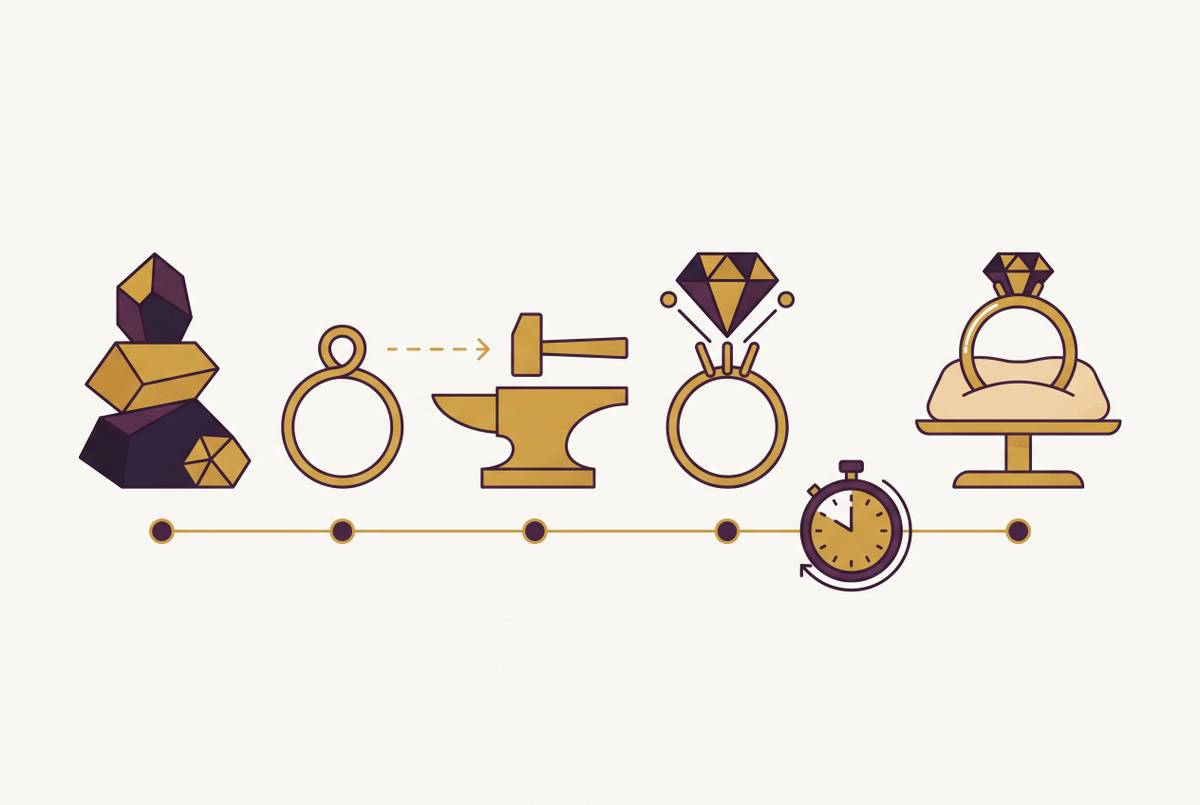
Make to order flips the sequence: production starts only after a confirmed buyer. Obsolescence risk drops near zero since nothing is built without a committed buyer. The tradeoff is time. Jewelry production runs two to twelve weeks depending on complexity, sourcing, and whether materials are on hand or must be procured.
A third mode sits between the two and deserves its own name: Assemble to Order. Settings, shanks, and findings get pre-manufactured, then combined once the order lands. It's quicker than MTO and more flexible than MTS, and shows up constantly in configurable fine jewelry.
This needn't be decided once, company-wide; the right level is the product line. A bestselling solitaire can run MTS while a one-of-one sculptural piece runs MTO, inside the same brand, at the same time.
Why jewelry makes MTS financially riskier than most product categories
Three things stack together in jewelry unlike most retail categories: expensive materials, hard-to-predict demand, and SKU counts that multiply faster than expected. Together they make overstocked inventory a sharper problem here than almost anywhere else.
Start with material cost. Gold, platinum, and gemstones carry real market value, and that value moves. Holding finished inventory is capital frozen in physical form, and rising 2026 material costs have pushed up jewelers' expenses and retail prices, so the amount locked into every unsold unit keeps climbing.
Then there's demand. Jewelry purchases are low-frequency and occasion-driven: engagements, anniversaries, graduations. Last season's sell-through tells little about next season's demand, and a missed forecast produces not a clearance rack but expensive inventory that ages slowly and painfully.
Layer SKU proliferation on top. One ring design in three metals, five sizes, and three stone options becomes dozens of distinct SKUs. Running that at MTS scale means forecasting and stocking every line.
The Brilliant Earth numbers make the case concrete. Brilliant Earth runs an MTO-adjacent model: most inventory arrives from suppliers only after an order is placed, though higher-volume items get batch-produced and pre-stocked. It posts the highest gross margin among the three public jewelry comparisons in Eightx's report on SEC 10-K filings, and carries the fewest inventory days. Signet, the second most stock-heavy of the group behind Movado, posts the lowest gross margin and sits on substantially more inventory days.
That comparison shouldn't get oversold, though. Brilliant Earth's operating margin is negative despite its gross margin lead, because acquisition and fulfillment costs run structurally high in jewelry. A strong gross margin doesn't automatically survive the trip down to the bottom line. Plan MTO with real discipline; the negative operating margin is a reason for that discipline, not evidence the model doesn't work.
Where MTS still wins
MTO isn't the universal right answer here. Certain product lines and sales channels make MTS the only workable model, and pretending otherwise leads brands to promise what their operations can't deliver.
Wholesale is the clearest case. Buyers commit at trade shows, retailers negotiate ship windows of days or weeks, and a delay becomes a chargeback or cancelled order. No wholesale account is going to sit patiently through an eight-week MTO lead time on a standard program.
Stable, proven SKUs are the second case. One has a track record to lean on. The other is a guess.
Price point and buyer psychology matter too. MTS captures impulse purchases MTO structurally can't. An order shipping in days hits a different buyer than one taking weeks, and at lower price points an impatient customer simply buys elsewhere.
Uphance's 2024 framework, built for fashion but applicable to jewelry, boils the decision to four questions per product line: demand predictability, customer wait tolerance, channel requirements, and whether margin supports the model's cost structure. Running those questions honestly usually shows that channel mix answers the question before margin math even gets involved. A wholesale-heavy brand may be structurally locked into MTS for most of its volume no matter what its founders would prefer on paper.
The 2026 tariff environment and sourcing geography have shifted the MTO cost equation
Tariffs in 2026 have added a genuinely new variable to a decision that used to be mostly about lead time and forecasting. For brands importing finished or semi-finished pieces from China, sourcing geography and production model can no longer be decided separately.
Domestic manufacturers turn work around faster and skip import duties, at higher per-piece cost and less scale flexibility. That tradeoff has grown more attractive as China import costs became less predictable rather than simply higher.
For MTO, domestic or nearshore sourcing shortens the production-to-delivery window and reduces the odds a mid-production tariff shift changes landed cost after a price is quoted. For MTS, a brand pricing inventory against one landed-cost assumption can find a different number at the border, eating margin on goods it's already committed capital to.
The OEM versus ODM distinction matters more under this pressure than it used to. OEM, where the brand owns the design and the factory builds to spec, runs three to five months with sampling and higher tooling costs. An Alibaba seller blog describes ODM, where the factory owns the base design and the brand customizes only branding, colors, packaging, and minor features (no IP ownership), as moving faster at one to three months with lower minimum order quantity and upfront cost, but with less differentiation. For small-batch MTO, ODM paired with a domestic or nearshore factory can balance speed, cost, and tariff predictability better than any single lever alone. Brands whose whole positioning rests on a proprietary design don't get to take that shortcut. OEM stays necessary for them, cost premium and all.
Designing a hybrid model on purpose
Most fine jewelry brands end up running some blend of MTO and MTS whether they plan to or not. Whether that blend got designed on purpose or assembled by accident under deadline pressure decides how well it holds up.
A brand bolts custom orders onto an MTS operation without touching its systems. Uphance's research describes exactly that: two standard pieces ship from warehouse stock while a custom MTO order sits at the factory for eight weeks, yet one order-entry system treats both the same. Manual workarounds end up holding the whole thing together, which works until it doesn't.
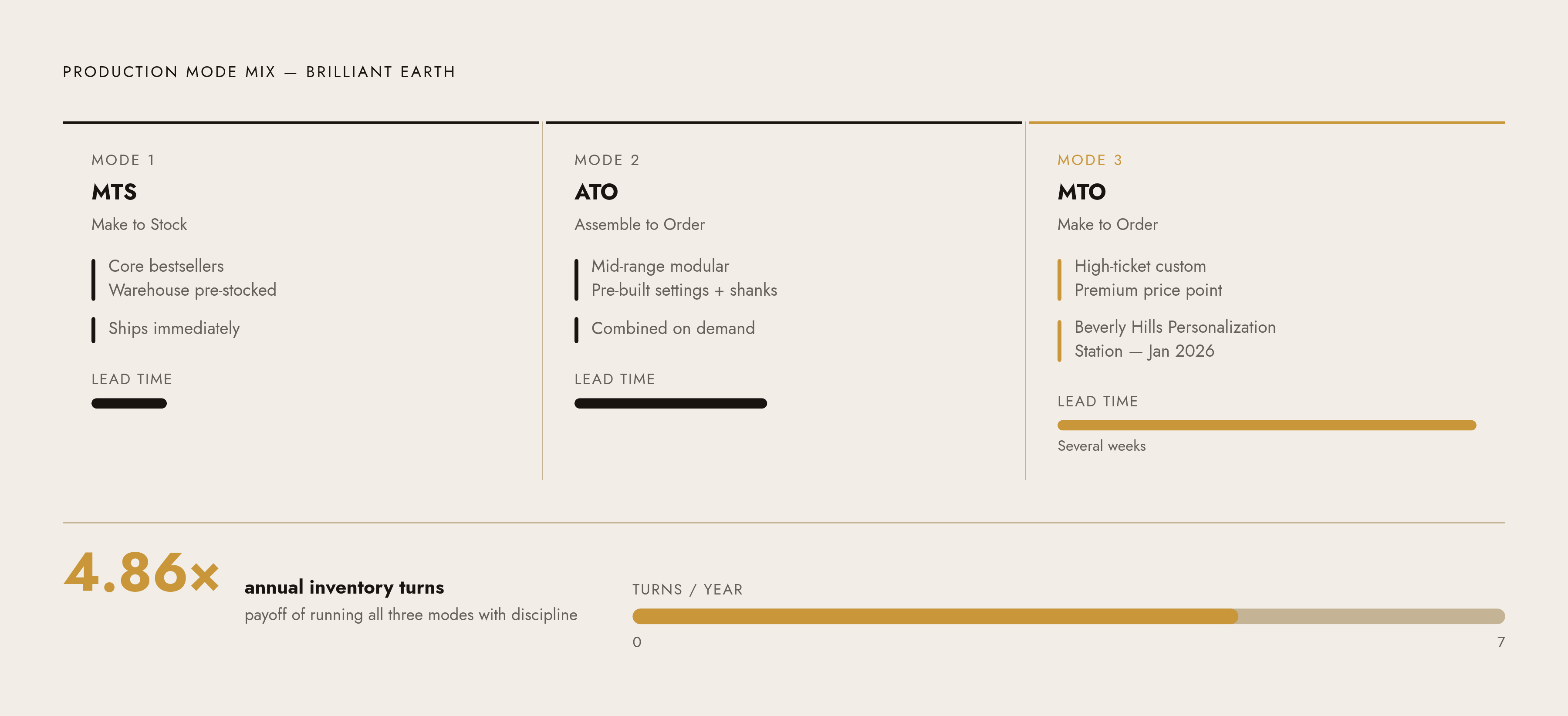
The designed version sorts every product line against four criteria: demand predictability, customer wait tolerance, channel requirements, and margin support for the cost structure. Applied consistently, that sorting logic tends to land in a fairly clean pattern. Core bestsellers with real sell-through history run as MTS, since forecasting risk is low and fulfillment speed matters to buyers. The highest-ticket, most customizable, or lowest-volume pieces run as MTO, since buyers signal willingness to wait and speculative inventory risk is too high. Mid-range pieces from modular components, settings and shanks pre-made and combined later, run as Assemble to Order, splitting speed and flexibility.
Brilliant Earth is the clearest documented case of this running at real scale. Standard inventory arrives from suppliers only after an order is placed, an MTO-adjacent approach yielding 4.86x annual inventory turns in Eightx's 2025 analysis. Custom-designed pieces take several weeks and start at a premium price point. The Beverly Hills flagship, opened January 2026 and branded the "Showroom of the Future," includes a Personalization Station for on-site custom charms, pendants, and medallions. Three different production modes, running inside one brand, at the same time.
None of that works without the systems underneath it. Whatever platform manages orders must route MTS and MTO lines independently: split fulfillment, separate lead-time messaging, distinct production instructions. Brands whose software can't do that end up doing it by hand, where expensive mistakes occur. Cash freed up by trimming MTS overstock on the right lines becomes the internal budget for building out MTO capability elsewhere in the business.
How AI and parametric design compress MTO lead time
The oldest objection to MTO in jewelry is simple: customers won't wait weeks for a ring. That objection was really about how slow production used to be, and AI-assisted design tools now shrink the concept-to-CAD stage.
AI is taking over the sketching and concepting phase that precedes the precision CAD work. A designer can generate and evaluate dozens of concepts before CAD finishing, producing more output faster, though the final manufacturing file still requires CAD precision, per Neural4D's research. That distinction matters because general-purpose image generators produce pretty pictures a bench jeweler has no way to actually build. Jewelry-specific AI tools instead model construction logic directly (prong geometry, pavé seat depth, band load capacity at a given width), producing a manufacturable starting point rather than a mood board. Neural4D's research found AI-assisted casting workflows cut defect rates 30 to 35%, since the starting mesh is more geometrically consistent than a hand-sculpted wax pattern.
Parametric design is what actually makes mass customization pencil out financially. A single master file can generate a ring across dozens of sizes, metal weights, or stone-seat configurations without rebuilding the design, so every MTO variation skips the full design cycle. Blender's Geometry Nodes exemplifies this, letting designers build parametric jewelry structures and render them with physically accurate lighting.
The customer-facing side closes the remaining gap. A web-based configurator generating a quote, bill of materials, and CAD-exportable file in one session turns a multi-day consultation into something closer to self-checkout. Jewelcloud's RingBuilder® is built to do exactly this, producing quote, BOM, and CAD-exportable file in one sitting. For B2B wholesale, three capabilities separate a working tool from a failing one: a parametric engine recalculating geometry instantly, real-time synced inventory and pricing, and automatic BOM/CAD export so orders move straight into production without manual retyping.
The order-management platform is what actually makes AI-assisted MTO operate at scale rather than as a novelty. Infrastructure like Kickflip's mass-customization tools for DTC, alongside jewelry-specific platforms validating manufacturability and adjusting pricing dynamically, turns a 3D preview into an order a factory can execute. The rules engine behind the configurator blocks invalid combinations before they reach the cart, closing the gap between screen appearance and physical manufacturability.
Applying the framework: which model fits which situation in jewelry
Run the four questions against every product line before assigning it a model: how predictable is demand, how long will the customer tolerate waiting, what does the sales channel require, and does the margin actually cover the cost structure that model demands.
A wholesale-heavy brand with proven bestsellers belongs in MTS by default, since retail partners negotiate ship windows in days or weeks and won't absorb an eight-week lead time on a standard program. A DTC brand selling high-ticket, highly customizable pieces belongs in MTO, since buyers signal willingness to wait and speculative inventory is too costly. A brand selling modular, mid-range pieces, with settings and shanks pre-built and finished on demand, fits Assemble to Order best, capturing speed without MTS's full inventory exposure.
Sourcing geography now sits inside this same decision rather than beside it. Domestic or nearshore sourcing paired with MTO reduces exposure to tariff shifts mid-production. Brands still importing heavily from overseas must price that uncertainty into MTS forecasts rather than discover it at the border.
Above all of this sits the systems question. None of the sorting logic survives contact with reality if the order-management platform can't route MTS and MTO lines independently. Get that infrastructure right first, and the rest of the framework has somewhere to actually live.
Sources
- Make to Order vs Make to Stock for Apparel Brands: How to Choose (2026)
- OEM vs ODM Jewelry Manufacturing: A Complete B2B Sourcing Guide for 2026 - Alibaba.com Seller Blog
- Jewelry Brand Financial Benchmarks 2026 | Eightx
- Made to Order: What It Means, How It Works, and Why Customers Love It | Kickflip
- Looking Back on Jewelry Retail in 2025, and Ahead for 2026