Bill of Materials Structure for Configurable Jewelry Products
How configurable BOMs use rules instead of spreadsheets to handle jewelry's infinite variations.
A customer picks platinum over yellow gold, bumps the center stone up to two carats, and switches the setting from prongs to a bezel. Three clicks. To the factory floor, that's not a variation on one ring, it's basically a different ring, with different weights, different tolerances, and different casting specs. A standard bill of materials was never built to handle that. It's a structured list of materials, components, subassemblies, quantities, and instructions needed to make or service a product, and it works great, right up until the product changes shape depending on who's buying it.
Fine for a chair. Hundreds of components wearing a trench coat now call themselves "a ring." That's hundreds of them wearing a trench coat and calling themselves "a ring."
You cannot write a separate BOM for every possible combination. At a certain point the spreadsheet itself becomes the bottleneck, not the casting equipment, not the setter, not the polishing wheel.
And most shops are still doing this by hand. Per the 2026 State of Manufacturing report cited by Tacton, only 23% of manufacturers generate BOMs automatically from a quote, and the rest rely on manual interpretation at one or more handoffs. In jewelry, that manual step causes things to go sideways fast: a missed stone size, a wrong prong count, or a metal weight typed in from the wrong column sends the order bouncing back before it ever sees a crucible.
That's not a rounding error when the volume gets large enough. The jewelry market is worth hundreds of billions of dollars globally, and a meaningful, fast-growing slice of that moves through online, configurable channels. Manual BOM resolution isn't an occasional headache at that scale, it's a structural bottleneck sitting directly in the revenue path. Traditional BOMs rely on a static assumption: one product definition, one parts list.
What a BOM contains and which type applies to jewelry
Stripping a BOM down to its studs gives you part numbers, descriptions, quantities, unit of measure, and how the components relate to one another. That's it. That's the whole skeleton. What changes is which "view" of the product a given team needs, and jewelry manufacturing actually runs on four distinct flavors of BOM, each one answering a different question for a different department.
The Sales BOM is the customer's side of the story: what they picked, what's included, the configuration as sold. It's the starting gun for every jewelry order. The Engineering BOM (EBOM) is the product as designed, CAD references, specs, tolerances, the blueprint of intent, though notably it doesn't tell anyone the order in which things get assembled. The Manufacturing BOM (MBOM) is the one that actually drives the bench: assembly steps, routing, consumables, scrap allowances, shop-floor instructions, and it feeds purchasing too. And the Service BOM covers what happens after delivery, the parts available for repair or resizing, relevant for anything sold with a warranty or a resize guarantee.
The handoff between EBOM and engineering's intent and the MBOM's shop-floor reality is where things tend to fall apart. Research from the World Journal of Advanced Engineering Technology and Sciences, cited by Ivalua, found that poor EBOM-to-MBOM translation drives 32 to 41% of new product introduction delays in electronics, and getting that translation right can speed time-to-market by up to 30%. Swapping "electronics" for "jewelry" leaves the mechanism identical, with the EBOM as the CAD file and the MBOM as the casting instruction, and metal weight, stone seat depth, prong dimensions, and sprue placement all belong firmly in the latter, not the former.
For configurable jewelry, there's a fifth structure that has to enter the picture, and it's the one this whole piece is actually about: the Configurable BOM. It doesn't run on a fixed parts list. It runs on rules. It doesn't need a new BOM written for every variation a customer might dream up, and it only collapses down into a precise, buildable MBOM once every choice has actually been made. Think of it less like a parts list and more like a very disciplined choose-your-own-adventure book, one that refuses to let you pick an ending that doesn't exist.
How a configurable BOM encodes variation instead of multiplying it
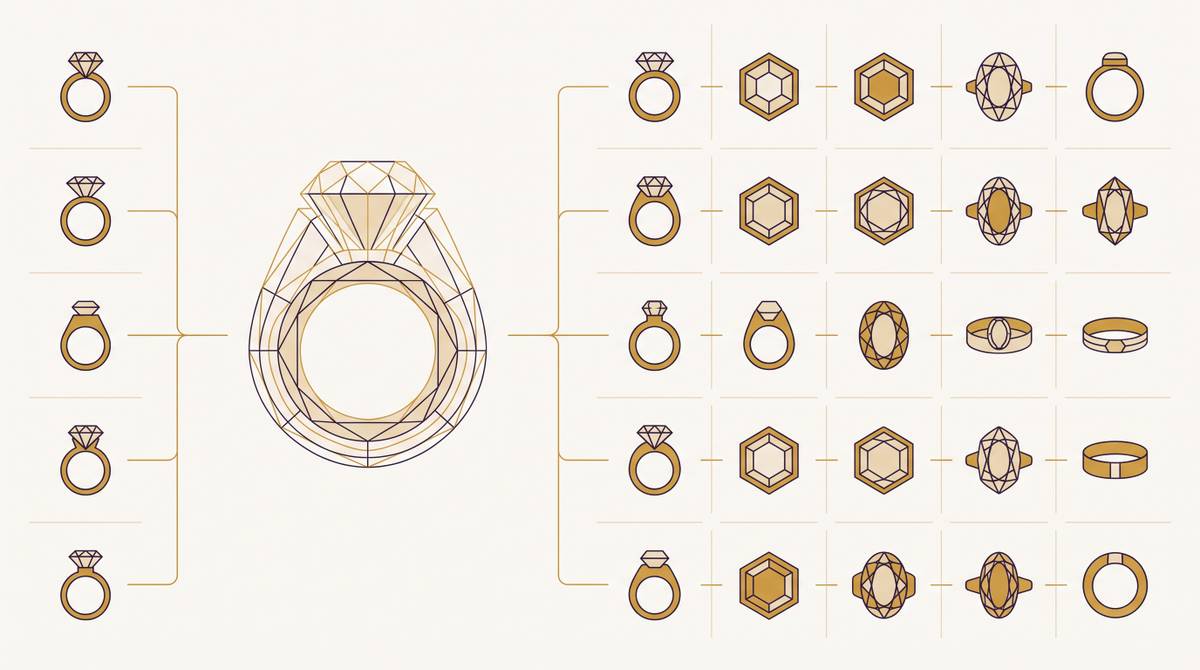
Variation lives inside the structure as rules and parameters, not as a stack of separate BOMs multiplied out for every combination a customer could theoretically choose. Per Ivalua and Mearas Technologies, configurable BOMs allow for alternative parts and flexibility without creating separate BOMs for each product variation.
Three mechanisms do the heavy lifting, and a solitaire ring is a clean way to see all three in action.
Parameters are the numeric dials: band width in millimeters, finger diameter, stone size in carats or millimeters. Punch in a finger size of 16.4 mm instead of a standard size, and the parameter should ripple through the entire model automatically, no one redrawing anything by hand. Option sets are the discrete swaps, metal type, setting style, finish, and each option ties to a specific part number, weight, and cost. Conditional rules are the referee: a 1.5 mm band can't hold a three-carat stone, a bezel setting needs different prong logic than a six-prong basket, pavé needs a specific seat depth, and the rules exist precisely to stop someone from configuring a ring that physics won't allow.
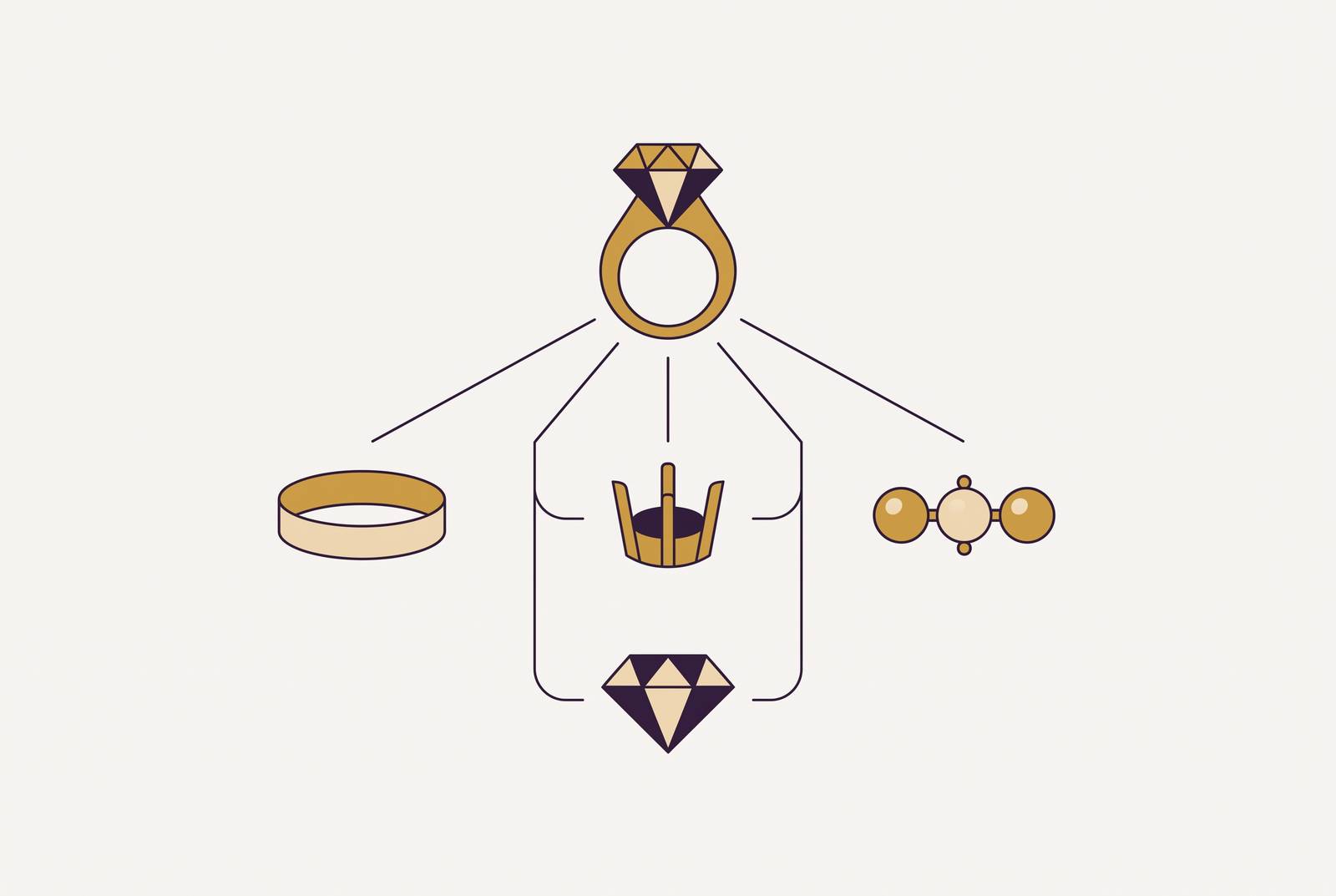
A parent-child hierarchy sits beneath it, finished piece, down to subassembly, down to component, down to raw material. For that solitaire ring, the ring itself breaks into a shank subassembly and a head subassembly, which break further into prongs, the seat, gallery wire, and shank stock, which resolve down to metal weight in grams and stone size in millimeters. Changing something at the top propagates it all the way down without anyone touching the lower levels by hand.
At the very bottom, the leaf level, you find the physical, orderable stuff, the specific alloy, the stone dimension, the clasp mechanism, the finding type, and the surface treatment. This is the stuff that actually gets purchased and cast. Manufacturing literature outside jewelry uses a simpler version of this same idea, a furniture maker offering a coffee table in a handful of colors and finishes doesn't build a new BOM per color, color is just a configurable parameter on one BOM. Jewelry runs the identical logic, just with dramatically more moving parts.
Get this structure right, and any customer selection, no matter how unusual, resolves automatically into a precise, unambiguous parts list. No one has to sit down and manually figure out what a "16.4 mm platinum bezel with a hidden halo" actually requires. The rules layer beneath the structure has to be airtight, because rules are what stop the structure from generating nonsense.
Writing the constraint rules that keep configurations manufacturable
A configurable BOM without solid constraint logic will happily generate combinations that look perfectly reasonable on a screen and are completely impossible to build. An ultra-narrow band paired with a huge center stone. A pavé field sized wrong for the stone next to it, throwing off the seat count. A metal alloy that can't take the surface treatment someone selected. None of these appear as errors on screen unless somebody wrote a rule to catch them.
Three categories of rules cover most of the ground. Inclusion rules say picking option A requires option B, a hidden halo setting drags along a secondary stone row component whether the customer thought about it or not, and a channel-set band pulls in channel dimensions tied directly to the stone's diameter. Exclusion rules say picking option A rules out option C, a bezel and a prong setting can't both apply to the same center stone, and a hammered finish has no business anywhere near a pavé surface. Range constraints keep one parameter honest against another, metal thickness has a floor set by the stone's weight, and band width has its own floor set by the structural limits of whatever alloy got chosen.
Some of this rule-writing has to get specific to the bench. Stone seat tolerances differ by cut, a round brilliant in a six-prong basket needs different clearances than an emerald cut sitting in a bezel. Metal shrinkage during casting varies by alloy, so the BOM has to know exactly which alloy is in play so the downstream CAD file applies the right shrinkage factor. And weight has to recalculate in real time as parameters shift, because weight is what drives material cost, and material cost is what drives the price a customer sees.
None of this lives in a vacuum. The EBOM already defines the tolerances and the design intent, engineering did that work up front, and the rules inside the configurable BOM exist to enforce those tolerances the moment a customer starts clicking options. Get the rules right, and the MBOM that eventually spits out at the other end is something the shop floor can actually trust. Mearas Technologies makes the practical payoff explicit for 2026: real-time cost calculation and inventory verification before a delivery date gets promised, both of which only work if the rules beneath are complete. Sloppy rules, sloppy promises. It's the same problem wearing a nicer outfit.
How parametric CAD connects the configurable BOM to a production-ready file
All those rules and parameters need somewhere physical to land, and that's parametric CAD. A parametric model is driven by inputs, not fixed geometry, so instead of a designer redrawing a ring from scratch for every customer, the model itself adjusts on command. Every parameter sitting inside the BOM, stone size, band width, metal type, setting style, has a direct counterpart inside the CAD model, and once the BOM resolves a customer's configuration, those values flow straight into the model and it updates.
That connection is the whole trick. A customer who types in a finger size of 16.4 mm, something no standard sizing chart covers, gets a correctly dimensioned CAD file back. Switching from platinum to yellow gold changes more than a label, the metal weight calculation and the casting spec update along with it. Adding a hidden halo triggers the inclusion rule from the BOM automatically, pulling in the secondary stone row subassembly and reshaping the CAD geometry to match.
The file that comes out is a strong starting point, not a finished instruction set. Shrinkage, stone seat tolerances, structural integrity, sprue and runner geometry, all of that still needs a qualified CAD designer or manufacturer to check it before anything goes near a crucible.
On the tooling side, RhinoGold and MatrixGold both ship with a Parametric Component Library, settings, shanks, and clasps that adjust in real time, plus a Smart Gemstone System stocked with preset gem cuts and sizes across a wide range, and MatrixGold 4.0 specifically lines up design, material decisions, and production insight into one workflow. RhinoArtisan 7.0, which launched September 18, 2026, in Barcelona, shipped a Hidden Halo feature built with full parametric flexibility, a good example of one specific design element getting turned into something fully configurable at the CAD level.
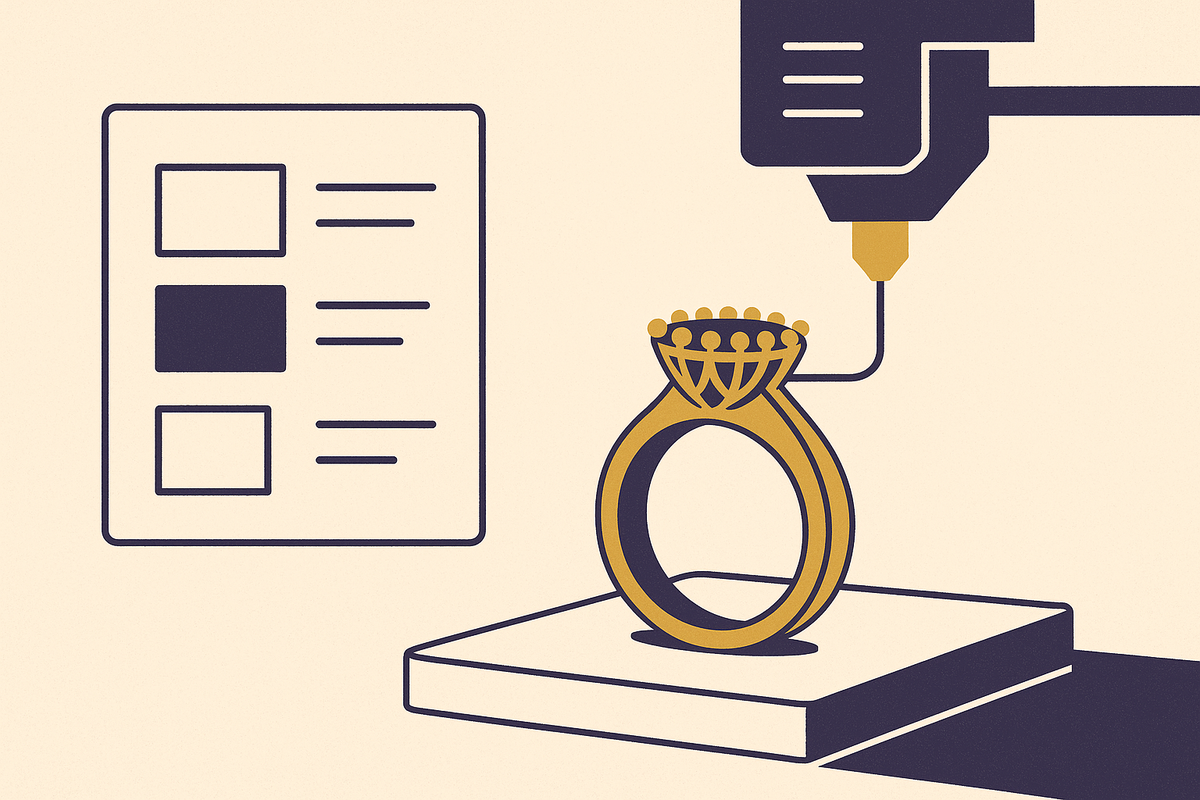
The natural next step is wiring the configurable BOM, the parametric CAD, and the customer-facing configurator into one continuous pipeline, so a shopper's click on a product page resolves straight into a production-grade CAD file with no designer sitting in the loop translating it by hand. Platforms built this way are what make made-to-order jewelry viable at real scale rather than a boutique exception.
Surfacing the BOM in a customer-facing jewelry configurator
Flipping the whole thing around shows what it looks like from the customer's side of the screen. Static product photos and a dropdown menu can't show anyone what their actual ring, their specific metal, their specific stone, their specific setting, is going to look like, and that gap is where sales quietly die. By 2026, a live 3D configurator isn't a flashy add-on for premium jewelry brands, it's fast turning into table stakes.
What powers that configurator on the back end is the exact same BOM doing the manufacturing work, just viewed from the other direction. The option sets that populate the menus come straight from the BOM, and because the exclusion rules already filtered out anything unbuildable, a customer literally cannot select a combination that doesn't work. Pricing updates live as someone swaps metal or bumps stone size, because the BOM's cost logic is running underneath the page, not bolted on after. Availability checks run the same way, verifying stock before anyone commits to a delivery date. And the 3D render on screen comes from the same parametric CAD model the BOM drives, so what the customer sees is, quite literally, what gets built.
That is the real payoff. Because the configurator and the factory floor are pulling from the same document, there's no translation layer left for errors to sneak into. Because the configurator draws from the same BOM that generates the manufacturing file, there is no translation layer where errors enter, the customer's selection and the factory's instruction are the same document viewed at different levels.