Demand Forecasting for Custom Jewelry Without Historical SKU Data
Forecast custom jewelry by tracking ingredient patterns, not individual pieces.
Custom jewelry breaks demand forecasting at the root, because the object a model would need to study doesn't exist until someone orders it. Standard retail forecasting runs on the SKU: a stable unit with a price, a description, and a sales history a model can read and learn from. A ring that gets built to one customer's exact specs, in a metal and stone combination chosen that day, has none of that. It has no past, because it has no "before." The act of ordering is the act of creating the thing.
This is a different problem than the one most forecasting advice is built to solve. A brand launching a new sneaker color has no sales history either, but that gap is temporary. History starts accumulating the moment the shoe ships, and within a season the model has real data to work with. Custom jewelry never gets there, because every piece is still its own one-off creation, no matter how many thousands of orders came before it. Olertis, the Boston-based custom jewelry company working in gold and platinum, runs on exactly this kind of order-driven model: production starts after the customer specifies the piece, not before, so there's no pre-production SKU history to mine no matter how long the business has operated.
That's the structural wall. A forecasting approach that waits around for SKU-level transaction data will stay empty-handed forever, not just during a slow quarter. The fix is a different unit of analysis altogether, one that doesn't depend on any single piece repeating.
Shifting the forecasting unit from individual products to configurations and categories
The way around the dead end is to stop forecasting products and start forecasting configurations and categories instead. A custom ring may never repeat exactly, but its ingredients do. Metal type, stone shape, setting style, and price band recur across hundreds of different orders, even when no two finished pieces are identical. Each of those attributes builds its own history, piece by piece, order by order, even while the specific combinations stay unique.
This mirrors how forecasting already works in fashion and apparel, where a new style has no sales record but shares color, fabric, silhouette, and price tier with items that do. Retailers build demand curves for a new jacket by finding past jackets that look, cost, and feel similar, then borrowing their sales pattern as a starting estimate. Jewelry works the same way: metal type, stone shape, setting style, silhouette category, and price bracket all function as the shared traits that let a brand borrow demand patterns from history that technically belongs to a different, similar piece.
Category forecasting isn't too broad to act on, because it maps directly onto the decisions a jewelry brand actually has to make ahead of time: how much metal to buy, how many stones to hold in a given shape and grade, how many setting components to keep in stock, how many CAD hours and production slots to staff for. None of those decisions require knowing which exact ring gets ordered on a given Tuesday. They require knowing, in aggregate, what customers tend to want and how much of it. That's a question category data can answer even when item data never will.
Using external signals as proxies for the transaction history that doesn't exist
Once the forecasting unit shifts to categories, the next question is what feeds it. With no item-level sales data to lean on, external signals do the job internal transaction history would normally do. Search volume for specific styles and terms, social engagement around particular jewelry aesthetics, fashion-week and celebrity coverage, broader economic indicators tied to luxury spending, and engagement or wedding rate projections all function as early readings of demand before a single order comes in.
Search data is especially useful because trends move geographically before they move chronologically. A setting style trending in one city or country often appears in another market weeks later, and tracking thousands of jewelry-related search terms at once can reveal that lag while there's still time to act on it. Social engagement carries a similar kind of signal, but the quality of the engagement shapes how much weight it should carry more than the size of the audience does. A single viral post is weak evidence on its own. Steady growth over several weeks, with real sentiment and a consistent audience behind it, is a stronger sign that a style has staying power than a 48-hour spike is.
Calendar-driven demand adds another layer of structure that doesn't require any guesswork about trends. Valentine's Day, wedding season, the holiday window, and Mother's Day each pull demand toward different style categories, and each ramps up on its own schedule. A forecasting system built around these dates can anticipate not just when demand rises, but which categories rise with it. Dedicated trend intelligence platforms like Trendalytics, Stylumia, and WGSN exist specifically to pull these signal types together automatically, classifying whether a given trend is rising, peaking, or already fading, giving a brand a lifecycle view of a design direction.
Why made-to-order production makes accurate category forecasting a financial necessity, not a nice-to-have
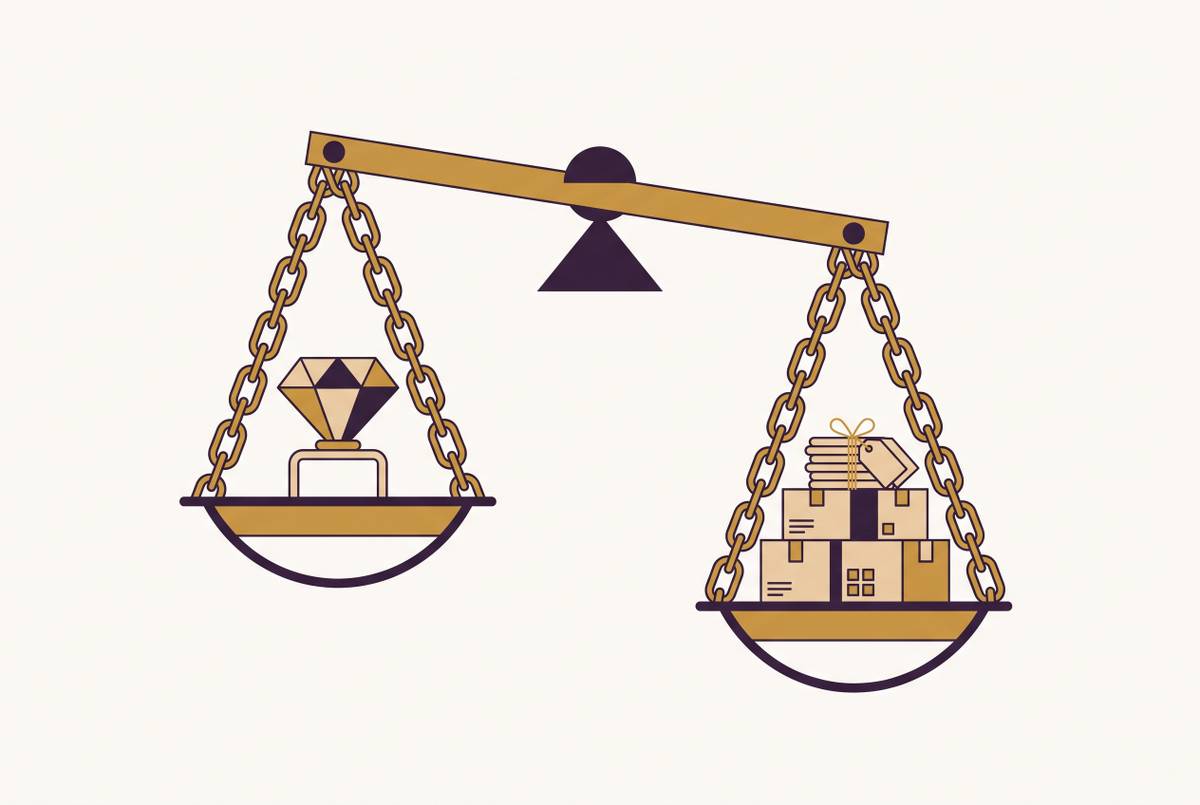
Made-to-order production solves the classic inventory problem (no finished rings sitting in a vault, unsold and depreciating) but it doesn't eliminate risk. It just moves the risk upstream, into materials and production capacity. Capital still gets tied up, just earlier in the process: in gold and platinum sitting in a safe, in stones purchased ahead of demand, in CAD hours and casting slots reserved for orders that may or may not show up on schedule.
Revenue in this kind of project-based model is naturally harder to predict than revenue from a shelf of fixed products, and production capacity becomes the real bottleneck once order volume gets uneven. That's precisely the gap category-level forecasting is built to close. The jewelry brand needs to know how much gold, how many stones of this shape and grade, and how many production slots to reserve for the next quarter, not how many of this ring to stock. Every part of that question is forecastable at the category level, with no SKU history required.
Get the category forecast wrong in a made-to-order business, and the damage doesn't appear as a clearance rack full of unsold rings. It appears in production instead, as a bottleneck: not enough gold on hand during a demand spike, not enough stones in the right grade, not enough CAD hours scheduled to keep up with orders. The cost shows up as delayed delivery and lost orders during peak windows. In a business built on custom pieces and real relationships with customers, a late ring does more damage to the brand than a discounted one ever would.
A Working AI Demand Forecast in Practice
In practice, a working forecast for custom jewelry pulls internal intent signals and external trend data into one system, and the output is a set of decisions, not a sales prediction for any single ring. It tells a brand how much metal to commit to, how many production slots to reserve, and when to put marketing dollars behind a push, rather than guessing which exact design will sell next Tuesday.
This mirrors a two-stage structure already used in new product forecasting more broadly. Before meaningful order volume exists for a given configuration, the model leans on external signals and attribute analogs, the search trends and lookalike styles described earlier. Once real order data starts accumulating at the configuration level (not the individual-piece level, but the metal-stone-setting combination level), the model hands off to that accumulated history and starts leaning on its own track record. The forecast gets sharper over time even though no single SKU ever builds a sales history of its own.
None of this requires a jewelry brand to build a forecasting system from scratch. AI-native inventory platforms already integrate with the ERP, POS, and data warehouse systems most retailers run on, pulling in sales, inventory, and order data and returning concrete recommendations on ordering and allocation. The forecasting layer sits on top of systems a brand likely already has in place, rather than demanding a rebuild of the entire tech stack just to get a usable demand signal.
The configurator as a demand-sensing instrument before production begins
A custom jewelry configurator does something no external signal can do: it shows exactly which combinations a brand's own customers are actively building, at what price points, with which stones and metals, before a single order gets placed. That's a direct window into intent, not a proxy borrowed from search trends or social posts.
Configuration session data answers questions no outside signal can touch. Which metal-stone pairings get explored repeatedly but abandoned before checkout, signaling price friction that needs investigating? Which setting styles get picked most often in a given season? Which price bands see the highest completion rates, versus the ones that generate a lot of browsing but few finished orders? Each of those questions points to a specific, fixable decision, and the configurator is the tool generating the data to answer them.
This reinforces the capital logic behind made-to-order production. A brand that only produces what a customer has already configured and committed to isn't guessing and hoping the guess sells. The configurator is what makes that demand visible before any material gets cut or cast. A parametric design system sharpens this signal even further. When a configurator runs on parametric geometry (band width, setting height, stone size, all adjustable along a continuous range rather than locked to fixed options), every customer interaction produces a data point along a spectrum. That's a richer, more granular signal feeding directly into the forecasting model described in the sections above.
Translating configuration data and external signals into production capacity decisions
All of this, the attribute-level categories, the external trend signals, the configurator data, exists to answer one practical question: how much to buy, how much to staff, and when. Category-level forecasting needs to tell a brand how much gold and platinum to purchase by grade, how many stones to hold by shape and carat tier, how many CAD hours and casting slots to reserve for the coming production window, and when to open or close the order pipeline relative to a predicted demand peak.
Parametric design pulls real weight here too. Because a parametric model adjusts stone size, band dimensions, and setting geometry to a customer's input without a designer rebuilding the file from zero, one well-built parametric template can cover a large share of the configuration space a brand actually sells into. That cuts down the number of distinct production setups needed while still giving customers a piece that feels genuinely their own.
The consultation process itself feeds capacity planning in a less obvious way. Showing a customer three to five polished design directions, instead of one or two rough sketches, surfaces disagreements and preferences earlier in the process. CAD work starts only once the customer has actually settled on a direction, which cuts down on revision cycles later. The practical result is more predictable CAD hours per order, which makes capacity planning tighter and less prone to surprise. And like any good forecasting system, this one should never sit still: continuous updates as new signals arrive beat a static quarterly forecast, because a two-week-old search trend or configurator pattern is more useful to act on than a demand projection built three months ago and left untouched.
Custom jewelry forecasting isn't a workaround for data a brand wishes it had. It measures the attributes, configurations, and capacity constraints that actually run a made-to-order business, which makes it a sharper instrument than SKU-based forecasting ever was for this kind of work, built for a business that was never going to have a catalog of repeating products.