Agentic Commerce Workflows in Jewelry Retail Systems
AI agents are already buying jewelry, and most retailers' data isn't built for them.

A shopper tells an AI agent to find an engravable white-gold band under $800 that ships in two weeks. The agent doesn't open a browser tab, scroll through a homepage, or admire anyone's lifestyle photography. It checks metal type, size range, price, and lead time against its own list, picks a merchant, and finishes the purchase, often with no human ever landing on the product page. That's the subject of this piece: AI agents are already buying jewelry on behalf of shoppers, and most jewelry retail systems aren't built to be seen by them.
Google Cloud's own framing of this shift, laid out at NRF 2026, is that agentic commerce turns browsing into doing. For a category built on walking the floor, trying things on, and listening to a salesperson talk about craftsmanship, that's a real problem. Jewelry has always sold through touch and story. An agent can't feel a weight in its hand or get talked into anything. It reads data and acts on it.
This isn't a trend to watch from a distance. Those are buyers who already decided, with an agent doing the comparison shopping for them. Google has said people shop across its platforms more than a billion times a day, which gives some sense of just how much of this traffic already runs on autopilot.
Brand loyalty doesn't carry over to an agent. An agent doesn't care how long a name has been around or how many magazine spreads it's been in. It cares whether the product data answers its questions. A brand that only has glossy photos and soft language loses that competition before it even starts, because the agent never sees it in the first place.
How agentic systems read a product catalog
Agents don't browse a product page the way a person does. They pull out specific facts, the kind that get stored in a database field, and judge a product entirely on the facts they can find. A catalog built for human eyes, full of pretty words and prettier pictures, is close to invisible to a system that's hunting for structured answers.
The technical pipes behind this are already in place. Anthropic's Model Context Protocol, or MCP, gives agents a way to pull real-time inventory, pricing, and product details straight from a retailer's systems. Stripe and OpenAI built the Agentic Commerce Protocol, known as ACP, which powers product discovery and merchant redirects inside ChatGPT Shopping, and originally handled checkout directly. Microsoft has built something similar with its Dynamics 365 Commerce MCP Server, which exposes catalog, pricing, promotions, inventory, carts, orders, and fulfillment logic in a form an agent can query. These are the roads agents drive on, and a jewelry catalog without an on-ramp never gets reached. If a jewelry catalog hasn't built an on-ramp, the agent simply never arrives.
Most jewelry catalogs weren't built with any of this in mind. And any configuration option that only exists inside a visual ring builder, where a shopper clicks through metal finishes and stone shapes on screen, stays completely hidden from an agent that can't click a mouse or read a rendered interface. Those options have to exist as data the agent can query directly, or they don't exist for agentic buyers.
The standard an agent applies is the same one it applies to any query anywhere: clear, accurate, structured facts are what it has to work with. Agentic Commerce Optimization, or ACO, is the discipline built around fixing exactly this, auditing catalog data and closing the gaps. It starts with how the catalog is structured.
Parametric design as the prerequisite for agent-readable product data
A jewelry design built on a parametric system produces structured attribute data as a natural byproduct of how it's made. A jewelry design built as a one-off static render doesn't produce that data at all, no matter how much metadata gets bolted on afterward.
A parametric design is one defined by its parameters. Finger size, stone dimensions, metal type, finish, setting style, each one has a range of valid values the system already knows. Changing the ring size automatically adjusts the stone setting and prong spacing to match, without anyone redrawing the piece from scratch. That's the same structure an agent is searching for when it evaluates a product. A static design, even a gorgeous one, locks in a single fixed shape. Every other option for that ring lives only in a designer's notes or in a visual configurator on a website, not in any data an agent can read.
Whether a product is agent-readable gets decided the day the design is built. If the design file already knows which parameters can change and what range each one covers, that information can flow straight into the commerce system as structured data. If it doesn't, the catalog team is stuck reverse-engineering configuration logic from finished images, which is slow, error-prone work that never quite catches every combination. A parametric, AI-powered design platform produces something different: every valid combination of metal, stone, and size already exists as a state the system can compute, not a variant someone had to build and photograph by hand.
That's why picking a jewelry design tool is a decision about commerce infrastructure, not just a decision about creative workflow. A parametric AI design platform is what makes a machine-readable catalog possible. Everything downstream, the product feed, the schema, the agent's ability to find the piece at all, depends on that first choice.
What production-readiness means in an agentic context
An agent that finds and picks a jewelry product is only useful to the business selling it if whatever configuration got chosen can actually be made.
The handoff between design and manufacturing is where a lot of these systems fall apart today. A configuration that looks completely valid in a visual tool can turn out to be geometrically impossible to cast, and when that happens, the shopper's agent has already completed the purchase, the jeweler has no way to build it, and the order simply fails.
That's the line between a concept-generation tool and a production-ready platform. One makes pictures. The other makes a CAD file that goes straight to manufacturing without anyone touching it up by hand. Production-readiness isn't a quality check that happens after the design is finished. It has to be built into the design system from the start, or it doesn't really exist. Adobe's traffic numbers suggest agents can already drive real purchase volume, and a process that needs a human to sit between the order and the manufacturing file can't keep pace with that kind of demand.
Architecting the commerce layer for agent discovery and transactions
Building for agentic buyers means getting four things right in the commerce layer: structured product data, real-time inventory and availability, machine-readable configuration logic, and transaction endpoints that follow the current protocols.
Structured product data means every attribute that can change, metal alloy, stone type and size, ring size range, finish, weight, has to live as its own field in a database, not buried in a paragraph of marketing copy or locked inside a visual interface. Real-time inventory works differently for made-to-order pieces. A made-to-order page needs to stay live permanently, since the piece is always available even with nothing sitting in a drawer, and unless that made-to-order status is marked clearly in the data, an agent reading a zero in the stock field will assume the product is gone and skip it.
Machine-readable configuration logic means every combination the brand supports has to be something the product record can answer on its own, not something buried inside a configurator a shopper clicks through visually. And transaction endpoints need to speak the protocols agents actually use. ACP and MCP are how agents find and buy right now, and a retailer that hasn't connected its catalog and cart to these protocols simply can't be reached by an agent working through ChatGPT Shopping, Perplexity Shopping, or similar platforms.
Not every e-commerce platform can support this. Platforms that allow custom product models, ones that centralize metal rates, stone prices, and formula-based pricing into one connected set of tables, can expose that configuration logic as data an agent reads directly. Platforms built around rigid, fixed product schemas can't do this no matter how much customization gets layered on top. Canonical URLs and ProductGroup schema tell an agent which record is the real product and which attributes make up its valid range of options.
Answer Engine Optimization for jewelry: making products visible to agents that recommend before a shopper queries
Structured commerce data makes a product something an agent can buy. Answer Engine Optimization makes it something an agent recommends in the first place, and recommendation happens before a transaction ever starts.
The growth opportunity in 2026 is showing up in AI visibility, getting named when a shopper asks ChatGPT or Perplexity what to buy. A small independent jeweler with a precise, fact-filled product page can out-rank a massive luxury name whose page is all mood and no measurements. It's the same structural edge that parametric, production-ready design already builds at the catalog level: exact, enumerable detail beats scale when an algorithm is doing the judging, not a person.
Writing for agents calls for a different kind of content than writing for search engines. Agents evaluate facts, not stories. A description that says "18k yellow gold, 1.2mm band width, 0.5ct round brilliant, available in sizes 4 to 9, made-to-order in 10 business days" gives it everything. And this connects straight back to the design system. A product built parametrically already has every one of these attributes defined and ready to go. Writing AEO content, at that point, is mostly a matter of surfacing facts the design system already knows, not inventing new copy from scratch.
None of this works without measurement. Setting a baseline for how visible a brand currently is to AI systems, then tracking how often products get found, where they rank, and how competitors shift after new releases, is what turns content work into something that actually moves the needle on agent discoverability.
What made-to-order jewelry businesses must change to survive agentic purchasing
Made-to-order jewelry fits agentic commerce unusually well. It offers deep personalization, attributes an agent can evaluate precisely, and low return rates. None of that holds up, though, unless the backend can take an agent-placed order and process it without a person stepping in to interpret anything.
A customer who personalizes a piece with a name or a meaningful date is far less likely to send it back, and that return-rate advantage survives agentic buying as long as the order is configured precisely, since the agent has already checked the exact specification before completing the purchase. Availability, lead time, and configuration options all need to be readable by a machine, not just a person. Otherwise the agent either skips the product entirely or places an order the jeweler can't actually interpret without picking up the phone.
An agentic-ready made-to-order operation needs three things working together: dual inventory flags that separate ready-stock items from made-to-order ones, so routing logic sends each down the right path, warehouse fulfillment for one, production for the other, without a person sorting it manually. It needs lead time that's readable as structured data, so an agent checking a deadline (say, a piece that has to arrive before an anniversary on the 15th) can actually calculate whether that's feasible. And it needs the production workflow itself to end in a manufacturing-ready file, not a design brief that still needs a CAD operator to build it out. A parametric system that generates a production-grade CAD file for every valid configuration closes that loop end to end. A system that still needs human design work between the order coming in and the file going to the bench creates a bottleneck that agent-driven volume will eventually overwhelm.
The architectural standard jewelry retail systems must meet to compete in agentic commerce
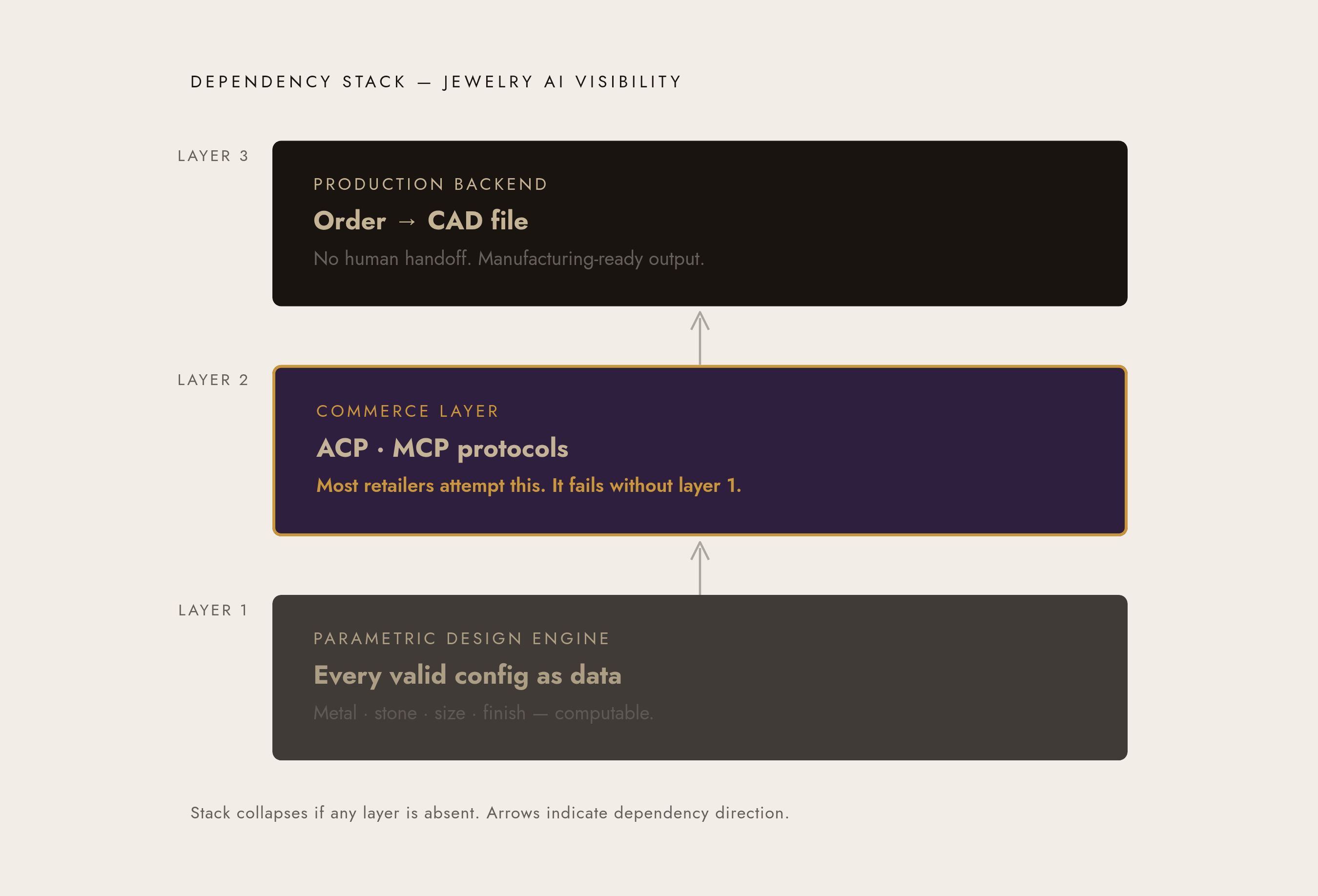
Jewelry retail systems that stay visible to agentic buyers are built on three layers working together: a parametric design engine that can enumerate every valid configuration, a commerce layer that exposes that configuration as structured data through standard protocols, and a production backend that turns any agent-placed order directly into a manufacturing file.
Each layer only works because the one underneath it works. Schema markup can't fix a catalog built on configurations that were never actually computable. Good made-to-order operations can't fix a design system that still needs a human to turn an order into a production file. Skipping a layer doesn't just mean the business runs a little slower, it means the business goes missing. There's no partial credit.
The brands putting this architecture together now, parametric design, production connected directly to the catalog, protocols built to standard, are the ones setting themselves up for the advantage that will decide who's visible as agentic commerce grows toward the scale analysts are projecting by 2030. That advantage isn't about company size. An independent designer running on a parametric, AI-powered platform that outputs production-ready CAD for every configuration sits architecturally closer to agentic readiness than a large, established brand still running a static catalog with variants managed by hand, because the design system is the foundation everything else gets built on top of. Enterprise-grade parametric tools now scale down to fit independent designers too, so the real requirement is picking the design system that makes everything downstream, the catalog, the commerce layer, the manufacturing file, possible to build.