Measuring Conversion Impact of AI Agents on Jewelry Product Pages
AI agents lift jewelry conversion four times higher than unassisted shoppers.

Jewelry e-commerce has a math problem. Orders average $436, the highest of any online retail category, but conversion is between 0.9% and 1.35%, the lowest. Cart abandonment runs well above the e-commerce average, worse than any other vertical. U.S. online jewelry revenue hit $16.8 billion in 2025, up 185% from pre-pandemic levels, so the demand is clearly there. The gap between that demand and the conversion rate is where money quietly walks out the door, and AI agents are one of the few tools closing it in ways that can actually be measured.
Three things cause the gap, and none of them are mysterious. Price points over $400 trigger the kind of loss-aversion that makes shoppers freeze rather than click "buy." Catalogs run into the thousands of SKUs across metal, stone, cut, and setting, which turns a filter-and-grid layout into a maze. And a huge share of visitors are gift buyers who don't know how to describe what they want in dropdown-menu language. Research cited by Alhena AI found that 80% of jewelry site visitors never ask a question even when they have one, simply because there's no easy way to ask. That 80% figure is the baseline. Before anyone installs an AI agent and claims credit for a lift, that starting line needs to be written down, not assumed.
What an AI agent on a jewelry product page does versus a standard chatbot
E-commerce chat has gone through three generations, and only the third one moves the needle on conversion.
Generation one is the rule-based chatbot: scripted decision trees that snap the moment a shopper types something the script didn't expect. These add friction. They don't remove it. Generation two, the NLP chatbot, is a step up, it can figure out intent and match it to a template, which is fine for "where's my order" but falls apart the second a shopper wants an actual recommendation.
Generation three is different in kind, not just degree. These are AI conversational or agentic agents. They carry context across the whole conversation, pull from live catalog and behavioral data, and adjust what they say in real time. The agentic versions go further and take action: adding to cart, applying a discount, starting checkout.
That split between conversational and agentic matters for how a brand measures results. Conversational AI resolves doubt and nudges a decision along, so its fingerprints appear in assisted conversion rate. Agentic AI actually does something, so its impact is visible in cart completion rate, AOV, and return rate. Most of the jewelry deployments that work well run both layers at once.
Picture the difference on an actual product page. A shopper types, "does this ring run small?" A rule-based bot spits back a link to the sizing chart. An AI agent, instead, draws on available product data to come back with a more useful, direct response. One adds a step. The other removes the exact hesitation that was about to end the session.
This distinction decides which numbers are worth watching. Track chat volume against a generation-three deployment and the report will understate what's happening, because volume was never the point. Industry research indicates only a small fraction of organizations run AI agents at full scale, with partial deployments and pilots still representing the majority of efforts. Most brands calling something "AI-powered" are sitting in tier one or two, so nobody there should expect generation-three results yet.
The core conversion KPIs that isolate AI agent impact
Five numbers actually reflect what an AI agent is doing on a jewelry product page. Everything else is noise dressed up as insight.
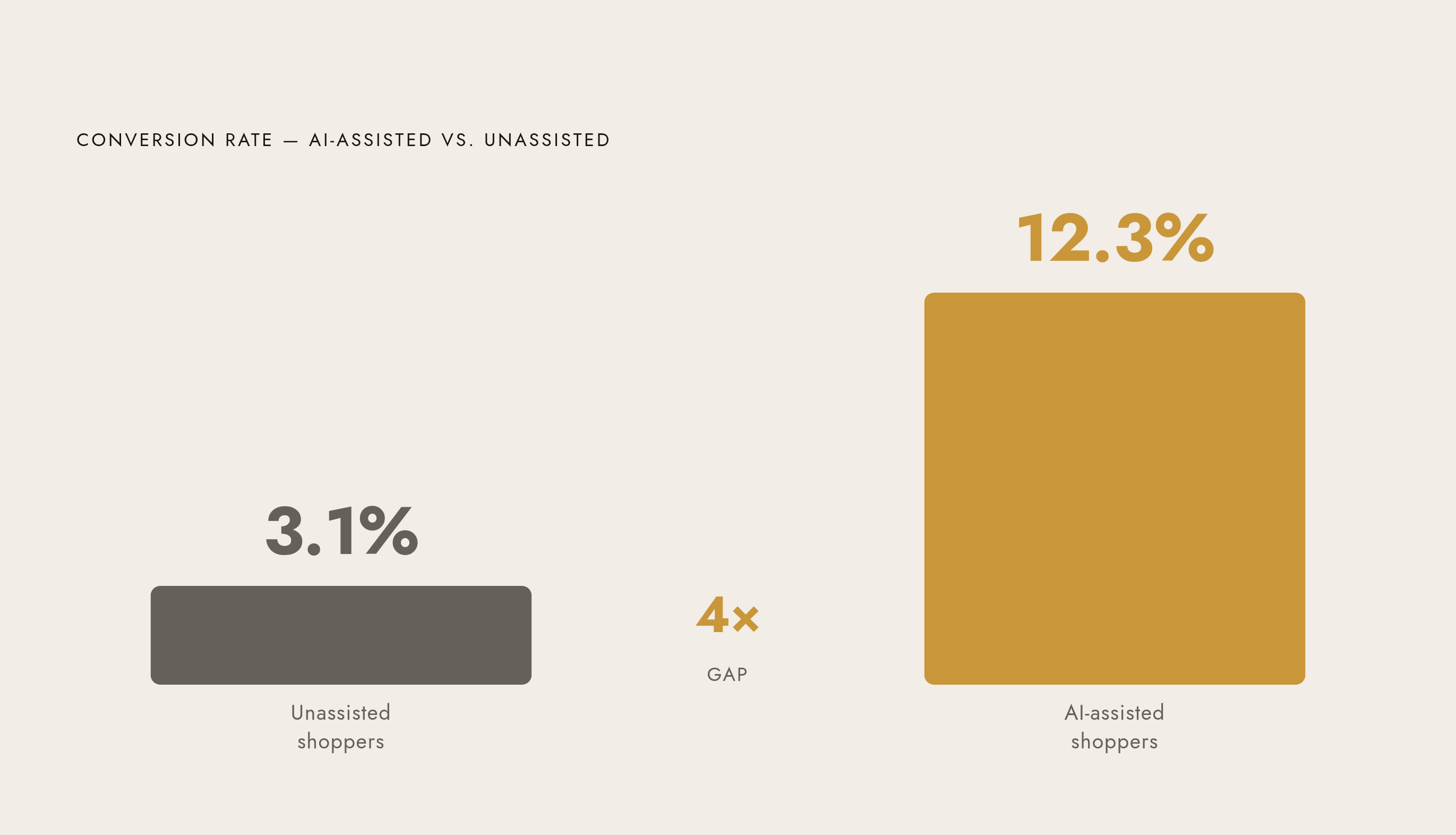
Assisted conversion rate is the headline metric, the share of purchases completed in sessions that included an agent interaction. Alhena AI's platform data put AI-assisted conversion at 12.3% against 3.1% for unassisted shoppers, roughly a four-times gap.
Cart recovery rate tracks how often the agent catches a session showing abandonment signals (long dwell time, repeated flipping between variants, a cart that's gone quiet) and turns it into a sale. This one matters more in jewelry than almost anywhere else, given an abandonment rate well above the halfway mark.
AOV lift compares order value between AI-assisted and unassisted completions. The upsell here happens inside the decision moment itself, right as it unfolds. Rep AI's 2025 numbers show returning shoppers who engage with AI spending 25% more per session than returning shoppers who don't.
Speed-to-purchase measures the median time from first product view to checkout. Research found AI-assisted shoppers completing purchases 47% faster than unassisted shoppers. In a category where hesitation is the enemy, that kind of acceleration means less time for second-guessing to set in.
Revenue attribution rate is the ceiling metric: what share of total site revenue traces back to AI-assisted sessions. It tells a brand whether the agent is a nice add-on or an actual revenue channel.
A few secondary metrics round out the picture but shouldn't carry a report on their own. Engagement rate (how many product page visitors even start a conversation with the agent) puts assisted CVR in context, since a high conversion rate on a tiny sliver of engaged shoppers means most of the site's problem is untouched. Proactive engagement recovery rate measures how many silent visitors the agent pulls in before they leave; Alhena AI's research found proactive AI engaging 45% of visitors who'd otherwise exit without ever asking a question. Return rate delta matters for brands running AR or configurator-linked agents, comparing return rates between AI-assisted and unassisted purchases.
Chat volume, deflection rate, and CSAT scores don't belong here at all. Those measure how well a support desk is running. They say nothing about revenue and shouldn't be anywhere near an attribution report.
Isolating AI agent impact from everything else moving on the page
Shoppers who start a chat are often already closer to buying than shoppers who don't, which is the trap most brands fall into. Compare raw assisted-versus-unassisted conversion rates without accounting for that, and the agent's impact gets inflated on paper before it's done anything.
Three methods get around this. A/B holdout testing splits product page traffic, one group sees the agent, one doesn't, then compares conversion, AOV, and speed-to-purchase across matched segments. It's the cleanest method, though it needs enough traffic to reach statistical significance, which smaller catalogs may struggle to hit. Behavioral-trigger segmentation compares sessions where the agent fired on a specific signal (extended dwell time, repeated variant switching) against sessions with that same signal where no agent showed up. This controls for intent by matching on hesitation behavior instead of random assignment. Pre/post with a control product runs the agent on some product pages while leaving comparable ones alone, then tracks both groups over the same stretch of time, adjusting for pricing and catalog differences.
Conversation data itself is a first-party advantage no ad platform can replicate. An AI agent session records which comparison a shopper made right before adding to cart, which objection killed the session, which question came right before checkout. That's a level of behavioral detail that can't be bought from an ad network and doesn't occur in a standard analytics dashboard either.
None of this works without proper tagging. Every agent-assisted session needs to be labeled consistently in analytics from day one, or pulling assisted CVR and revenue attribution later turns into a manual reconciliation nightmare nobody wants to own.
Timing the measurement window matters just as much. Jewelry sales swing hard around Valentine's Day, Mother's Day, BFCM, and Christmas. A 30-day pilot that happens to cross one of those spikes will read the results wrong in either direction, too rosy or too grim depending on which way the seasonal wave broke. Plan the window around the calendar as well as around hitting a traffic threshold.
Most published benchmarks, including the 12.3% versus 3.1% figures from Alhena AI's platform data, come from observational data, not randomized trials. They're useful for setting a pilot target. They are not a guarantee of what any specific brand will see.
What the jewelry-specific evidence shows about real deployment results
Kendra Scott offers the most detailed public case study in the category. Its AI Copilot now handles a substantial share of customer inquiries, representing a significant jump from earlier versions. A meaningful share of e-commerce sales are influenced by the Copilot, with a substantial increase in revenue tied to interactions with the tool. Separately, predictive AI analyzing behavioral signals across customer touchpoints is reported to be delivering a meaningful incremental sales increase for the business. The measurement infrastructure scaled right alongside the AI deployment instead of getting bolted on afterward. Kendra Scott is a large-scale retailer, worth keeping in mind when translating percentage-point moves into actual dollars.
Signet Jewelers shows an 88.6% conversion uplift tied to its AI shopping assistant, per Alhena AI, one of the more striking single-brand figures available in this category.
Zoom out across Alhena AI's aggregated platform data spanning 329 brands from Q4 2024 through Q1 2026, and a smaller pattern emerges: the small slice of shoppers who actually interact with an AI agent drive roughly 10% of total site revenue. In jewelry specifically, where average orders already run at $436, that concentration effect hits even harder.
None of this is a randomized controlled trial. Kendra Scott's 160% revenue increase from Copilot interactions doesn't control for whether shoppers who choose to engage the tool were already more likely to buy. The direction of the signal is strong and consistent across every brand named here. The precise size of the causal effect isn't nailed down yet, and won't be until brands run their own controlled comparisons. Which is exactly the point: use these figures to build the internal business case and set a pilot target, then run the attribution methods above to find out what's actually true for that brand's own traffic.
Configurators and AI design tools that extend the conversion measurement picture
A ring configurator is an AI agent surface too, even though nobody's typing questions into a chat box. When a shopper picks a metal, swaps a stone, adjusts a setting, and watches the price update live, that interaction throws off the same kind of behavioral data as a chat session: which variants get picked together, where people bail, and how often a finished configuration turns into an actual order.
That configuration data reveals which options push a sale through versus which ones stall it. Preferred variant combinations show which options push a sale through versus which ones stall it. Abandonment points inside the configurator flag exactly where the friction lives, whether that's confusing pricing, too many options, or missing information the shopper needed before committing. Configuration-to-production rate, the share of finished configurations that turn into placed orders, is basically the configurator's version of assisted conversion rate.
A few platforms illustrate what this looks like in practice. Lindsey Scoggins built a digital version of its custom engagement ring studio on Threekit, which handles parametric customization with pricing that updates live and wishlists shoppers can share. A jewelry company launched an AI-powered custom jewelry platform in May 2025 offering real-time image rendering, instant pricing, and customization across more than 25,000 editable CAD files, backed by a pricing engine for instant quotes and built-in logic that handles stone counts and size conversions automatically. Doogma supports jewelry configurators across a wide range of storefront platforms, including Magento, Shopify, BigCommerce, Wix, Weebly, WooCommerce, and PrestaShop.
Beyond configurators sit AI-powered jewelry design platforms serving over 100,000 designers building parametric, production-ready pieces. These close the loop from a customer's initial configuration all the way through to manufacturing, generating data across the full funnel rather than stopping at the front-end conversion event.
A brand running both a chat agent and a configurator needs to track each surface on its own and together. A shopper who plays with the configurator, then asks the chat agent one pricing question before finally checking out, is a conversion that a chat-only measurement setup will completely miss.
Building the measurement dashboard: what to report, to whom, and on what cadence
Three audiences need three different views of this data, and handing everyone the same spreadsheet helps no one.
Merchandising and product teams want configuration abandonment points, the variant combinations that convert best, and the questions that tend to precede a cart add. That's the raw material for fixing catalog structure, pricing transparency, and product page copy. Marketing and growth teams need assisted CVR against unassisted CVR, AOV lift, revenue attribution rate, and speed-to-purchase, the numbers that justify budget and set the next quarter's targets. Operations and leadership just need the summary: what share of total e-commerce revenue traces back to AI-assisted sessions, and how the cost per interaction stacks up against a human agent. That's the whole economic case in a few lines.
Cadence should follow jewelry's seasonal rhythm rather than a generic reporting calendar. Weekly, watch engagement rate and cart recovery rate, the leading indicators that show whether the agent is actually reaching shoppers before they leave. Monthly, check assisted CVR, AOV lift, and speed-to-purchase, since these need a decent volume of sessions before the numbers settle down and mean anything. Quarterly, review revenue attribution rate, return rate delta, and any A/B holdout results, the strategic numbers that decide whether the deployment expands, gets adjusted, or stays put.
None of it means anything without a baseline recorded before the agent goes live: current unassisted CVR (somewhere in the 0.9% to 1.35% range for jewelry), current AOV, current cart abandonment rate (81.7% to 84.5% industry-wide), and current median time-to-purchase. Skip that step and every post-launch number floats with nothing to anchor it to.
Per Capgemini's research, only 2% of organizations run AI agents at full scale. A jewelry brand rolling out a customer-facing agentic tool is moving ahead of a crowded field. It's operating ahead of where most of retail actually stands today.