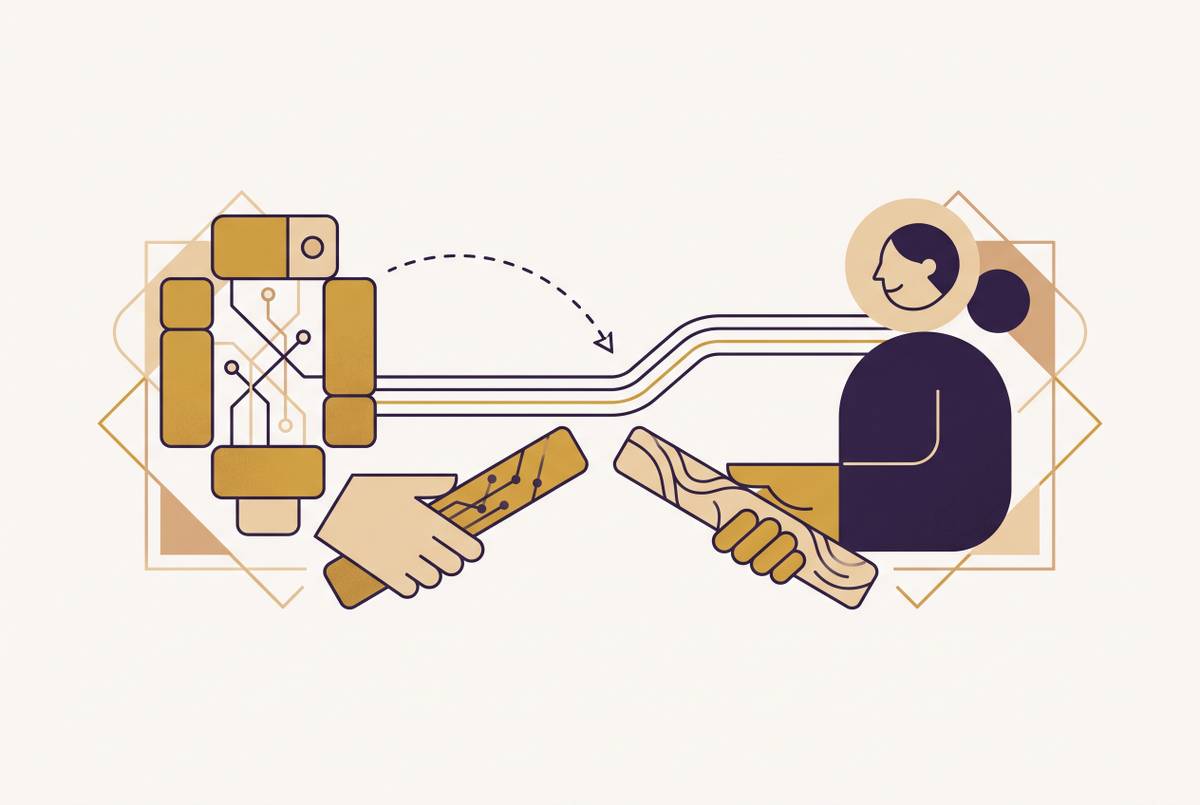
Personalization Engines for Jewelry E-Commerce Using AI Agent Data
AI agents that remember customer answers outperform systems that just track where visitors click.

Analytics watches. An agent participates. That's the difference, and mixing the two up is where most jewelry brands get personalization wrong from the start. A tracking script logs which pages loaded. An agent asks a question, gets an answer, and remembers it.
The behavioral layer is the easy part to build. Time spent on diamond solitaires versus stackable bands, carts abandoned mid-checkout, items saved to a wishlist (both signal real intent even without a purchase), which metal option got clicked, where in the configurator someone paused and backed out. All of that is useful, and all of it is inferred. Nobody typed "I like white gold." The system guessed based on where the cursor went.
The conversational layer is worth more, because it's stated, not inferred. When a shopping assistant asks about occasion, budget, recipient, and style, and the customer actually answers, that's a labeled fact sitting in the database, not a guess reconstructed from mouse movement. Alhena's AI Shopping Assistant runs this way: it walks a buyer through occasion, budget, and style, then surfaces matching pieces from the catalog. It plugs into Shopify, WooCommerce, Magento, and Salesforce Commerce Cloud, and syncs the product catalog without someone doing it by hand.
Combine the two layers and the picture sharpens fast. One visit browsing gold-tone stainless rings is a shrug. That same person doing it across three visits, then abandoning a cart on visit four, isn't a shrug anymore. That's a taste profile, forming in real time, and ignoring it is the mistake.
None of this works without trust, and that part isn't negotiable. Most shoppers will trade data for a better experience, but the trade only holds if the brand doesn't misuse what it collects. Treat the exchange like a smash-and-grab and there's no second round of data coming.
How personalization engines convert that signal into recommendations, prompts, and purchase flows
Recommendation engines touch the signal first. They read product views, abandoned carts, and wishlist saves, then push jewelry that matches what a shopper has actually shown interest in, not whatever's trending across the whole catalog. The homepage, the cart, the follow-up email: all of it should reweight continuously instead of sitting behind a static "you may also like" block nobody's touched since launch.
Someone who keeps circling gold-tone rings should start seeing layered bracelets and earrings that complete that look. Not a random pull from the homepage carousel.
Configurators are the second layer, and this is where the real leverage sits. If a shopper's browsing history skews toward yellow gold and oval-cut stones, the configurator should open already set to that combination, not some neutral factory default nobody asked for. That single change cuts decision fatigue, which is the biggest reason people bail on jewelry customization halfway through. The prompt can stay a plain visual preselect, or it can talk: "Based on what you've been looking at, want to try this in 18k yellow gold?"
Guided purchase flows are the third layer, and probably the one that matters most on a big-ticket item. Nobody wants a full catalog dumped in their lap and told to sort it out alone. An agent that already knows the occasion, the budget, and who the piece is for can narrow the field to three or five options with a reason attached to each one. Industry analysis of 2026 jewelry trends points to a hybrid model: the agent qualifies and engages the high-intent shopper first, then hands off to a human advisor for the part of the conversation that actually earns trust on a purchase this size. People aren't going anywhere here. The agent is a filter that gets the right shopper to a person faster, and most brands still get this backwards, treating the agent as the whole solution instead of the triage step before one.
Kendra Scott saw a 160% revenue jump tied to its AI rollout. Signet posted an 88.6% conversion uplift. Those two numbers say more about what's actually working than any industry-wide average ever could.
Where the configurator sits in the personalization loop, and why it must connect to manufacturing
The configurator carries the whole catalog on its back. It's the exact moment a shopper's preference turns into a real product spec. Pick a metal, a stone, a setting, an engraving, a ring size, and that shopper just co-authored a SKU that may never have existed before they clicked through it.
Fine, right up until that spec has to travel to a factory. If it can't make that trip cleanly, the whole personalization effort collapses at the one step the customer never sees. This, not the website, is where most jewelry brands actually lose the deal.
Here's the industry's real bottleneck: 2D concepts don't translate to 3D manufacturing without a slow, expensive, manual CAD conversion step. That gap is where speed dies. A production-ready file needs prong dimensions calculated correctly, shrinkage allowances built in for casting, and stone-seat geometry that actually holds a stone, the kind of detail a trained modeler handles inside Rhino, MatrixGold, or JewelCAD. One custom ring design, done the traditional way, eats up 8 to 16 hours of a skilled modeler's time.
Speed alone isn't the win, though. A gorgeous render that can't be cast is just a nice picture, and some AI design tools stop right there, handing the manufacturer a file that still needs expensive rework before a jeweler can touch it. A personalization engine only closes the loop when the configurator's output is already production-grade CAD, no conversion required. Parametric platforms, where every configurable option generates valid, castable geometry on its own, are what make this hold up at scale. Pencil is one platform built on that model: it generates production-grade CAD straight from each configuration a customer builds, so the file that comes out the other end is the file a jeweler casts, not a starting point for someone else's rework.
What a jewelry personalization engine needs to handle that generic e-commerce platforms don't
Jewelry breaks tools built for simple, low-variation retail goods, and it breaks them in specific, technical ways. This is a significant edge case. It's the entire reason generic e-commerce software keeps failing this category.
Start with the material itself. Standard image segmentation models, the kind trained on ordinary product photos, fall apart on reflective metal and faceted gemstones. One widely cited benchmark (SAM) manages only 48.47% accuracy on glass and reflective objects, against 88.16% for methods built specifically for that surface type. Standard image-generation models have the same problem running the other direction: they flatten out the high-frequency detail, facet edges, prong geometry, engraving, that is the entire point of a piece of jewelry.
Then there's the sheer number of ways a piece can be built. Metal type, stone type, color, cut, size, setting style, engraving, chain length, gift packaging. Multiply that out and the combinations run into the tens of thousands. Pencil's platform supports more than 5 million customization options across its catalog logic, which gives some sense of the scale a jewelry-specific engine has to reason across. A generic recommendation engine trained on flat catalog data has no way to navigate a space that dense. A parametric system that understands how options relate to each other does, and that gap is the whole ballgame.
The purchase itself carries emotional weight that most retail software isn't built to respect. Someone buying a piece with a four-figure average order value isn't in the same headspace as someone grabbing a phone case off a shelf. Research on AI in luxury retail (Journal of Retailing and Consumer Services, 2025) argues AI needs to work as background infrastructure here, reinforcing the ritual and emotional weight of the purchase instead of announcing itself as automation. Nobody wants to feel like a chatbot upsold them a wedding ring.
Virtual try-on adds a layer of signal most brands aren't using yet. A 2024 framework called PM-Jewelry used a diffusion model to build realistic, personalized try-on simulations from a mix of text and image input. Every try-on session doubles as preference data: a shopper who tries three yellow-gold pieces before finally trying one in white gold has just told the system something about metal preference, without ever answering a direct question about it. Separate classification research on jewelry imagery (a VGG-16 and GRU model tested across rings, necklaces, earrings, and bracelets, on a set of over 5,000 images) hit accuracy in the low-to-mid 90s. That's the kind of building block that makes automated catalog tagging, and the recommendations stacked on top of it, actually workable.
How to build the data flywheel: connecting agent interactions, configurator sessions, and purchase history into a compounding signal
Call it a flywheel because that's exactly what it is. Each interaction sharpens the next recommendation, the sharper recommendation drives more engagement, and the extra engagement generates more data to sharpen the next one again.
Trace the arc across visits. First visit: the agent asks about occasion and budget, logs the answers alongside the browsing pattern, and serves up something reasonably broad. Second visit: the engine recognizes the returning shopper. The configurator opens on the metal and stone combination most likely to land, and the agent skips questions it already has answers to. After purchase, the transaction data recalibrates everything again: what got bought, what got browsed and dropped, what got configured and abandoned right before checkout.
Discovery is shifting fast, too. AI search increasingly sits in front of a plain Google search, and showing up inside those machine-generated answers is turning into its own discipline: structured data, real customer reviews, a product story that reads clearly instead of like ad copy. Which search terms bring someone to the site is a signal on its own, before that person has clicked a single product.
None of this should live in a silo. A conversation that starts on web chat should shape what a customer sees later over email or WhatsApp. Alhena's assistant runs across web chat, email, Instagram, WhatsApp, and voice, which is really the point of building it that way: one coherent signal instead of five disconnected ones. Brands with physical stores need to tie in-person visits back to the online experience too. A customer who tries on a piece in-store, then goes home to fiddle with that same piece in an online configurator, has just told the brand exactly how close to a sale they are.
Leading AI-enabled jewelry retailers have reported AI setups answering the vast majority of customer questions without a human stepping in, alongside significant reported revenue increases from AI implementation. That result doesn't come from one clever chatbot script. It comes from volume: every agent-logged interaction feeding back into the model, over and over, until the recommendations get good enough that customers notice.
For a brand starting from zero, the build order is straightforward. Get a conversational agent live, logging occasion, budget, and style answers. Connect that agent to a configurator that uses those answers as starting parameters. Make sure the configurator's output is production-ready, so made-to-order fulfillment doesn't stall on a manual CAD step somewhere down the line. Then feed everything that happens after purchase back into the model. The loop isn't finished until a shopper's stated preference travels all the way through to something a factory can actually build.
What jewelry brands can act on now, by business size
One rule applies no matter the size of the business: collect data before trying to optimize recommendations. An engine with nothing to read off just produces noise dressed up as personalization. Brands that skip straight to "smart" recommendations before they have signal are spending budget on guesswork with better branding attached.
Independent designers and small studios should start with a conversational agent logging occasion, budget, and style from the very first session. The whole signal layer costs nothing extra if a customer-service chat tool is already running. Pair it with configurator software that outputs production-grade CAD straight out of the session. Platforms like Pencil generate production-grade CAD directly from each customer configuration, so the loop from preference to manufacturable file closes without a manual conversion step. Custom ring design that used to eat 8 to 16 hours of modeling time collapses to minutes, which means a one-person studio can offer a level of custom work that used to require a full team behind it.
Mid-sized brands are usually sitting on more browsing and purchase history than they're actually using, and that gap comes from failing to connect the data, not from lacking it. The fix is combining cart abandonment, wishlist activity, and past orders into a single profile per customer instead of treating each channel like its own island. Getting the configurator to open on a shopper's likely preference, instead of a neutral default, is a cheap change with an outsized effect on completion rates.
Larger retailers and multi-channel brands have the scale to run the full flywheel: agent data feeding recommendations, recommendations feeding configurator defaults, configurator sessions feeding manufacturing, purchase history feeding all of it back into the model. Kendra Scott's revenue jump and Signet's conversion gains didn't come from one standout tool doing all the work. They came from treating every piece as connected, instead of running four separate vendor systems that never talk to each other.
Scale changes the tooling. It doesn't change the principle. Data in, signal read correctly, and a configurator that can actually build what the shopper designed.