Integrating a Jewelry Design AI Agent into a Shopify or WooCommerce Store
AI agents cut jewelry's 84% cart abandonment by answering silent questions before checkout.

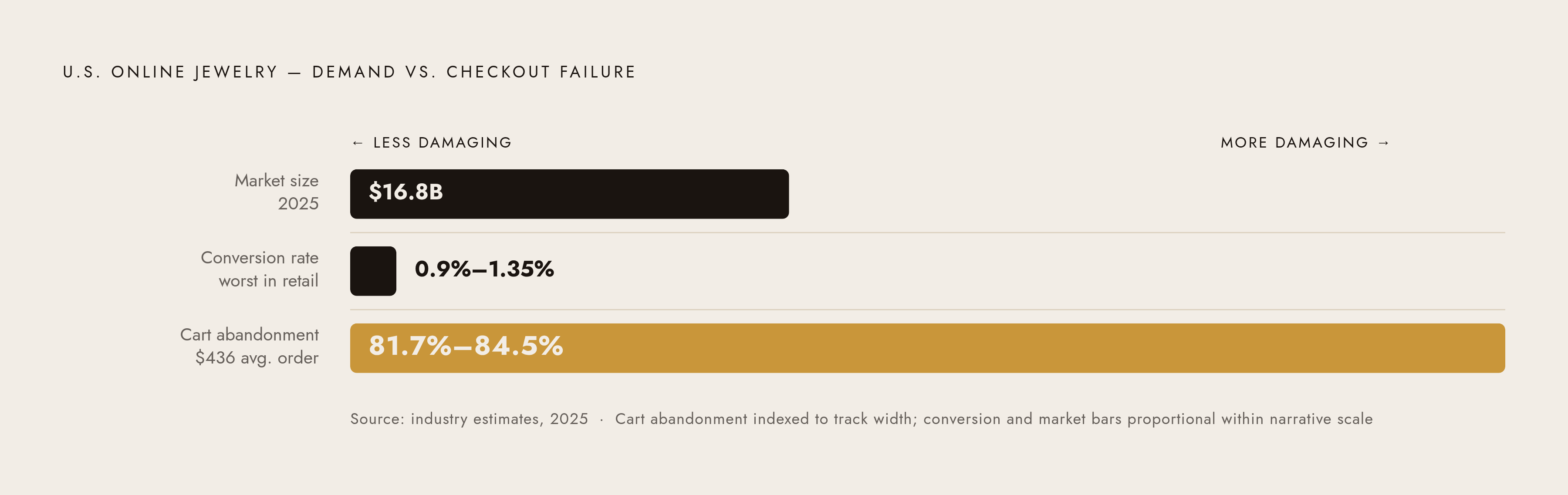
U.S. online jewelry sales hit $16.8 billion in 2025. Jewelry still converts at 0.9% to 1.35%, the worst rate in retail, and cart abandonment sits between 81.7% and 84.5%. That gap between real demand and a checkout process people keep walking away from is exactly what AI agents get built to close, and this piece breaks down how to actually build one on Shopify and WooCommerce.
Here's the number that should keep a merchandising team up at night: average order value for jewelry is $436. That's not an impulse buy. It's a "let me think about this for three days and ask my sister" purchase. Research shows 80% of jewelry site visitors have questions they never bother asking. They just leave, quietly, no chat message, no email, no phone call. They close the tab and move on.
So when Kendra Scott reports 160% more revenue tied to AI, or Signet posts an 88.6% lift in conversion, that's not a marketing trick paying off. A structural problem (silent, hesitant buyers spending real money on pieces they can't quite picture) is getting a structural fix. The rest of this piece walks through what that fix looks like, and how Shopify and WooCommerce get you there through two genuinely different technical roads.
What a jewelry design AI agent actually does in a storefront context
Merchants lump three different things under one label, "AI agent," and that's where most of the confusion starts. Pull them apart and the picture gets a lot clearer.
The conversational shopping assistant comes first. Picture a well-trained salesperson who never sleeps and never rolls their eyes at a customer's fortieth question about clarity grades. It guides discovery, walks someone through buying a gift for a person whose ring size they don't know, and explains the 4Cs without making the shopper feel dumb for asking.
Second is the design and configurator agent, the tool that lets a shopper build their own piece. Pick the metal, choose the stone, set the ring size, add an engraving, and get back something that isn't just a pretty picture but a configuration a jeweler can actually produce.
Third, and newest, is the agentic commerce agent. This one reads live inventory and pricing and can execute, or hand off, a checkout on a buyer's behalf. It's the frontier that protocols like UCP and MCP are designed to support, and it's the piece most stores haven't touched yet.
Jewelry needs a deeper knowledge layer than a general retail chatbot selling sneakers. Metal purity, stone certifications, the 4Cs, ring sizing charts, setting styles (prong versus bezel versus halo), all of that has to live inside the agent's brain, not just its script. A shoe-store bot can get away with "runs small, order half a size up." A jewelry bot has to explain why a 1.2-carat oval reads bigger than a 1.5-carat round, in a sentence a non-expert actually understands.
Proactive engagement matters more here than almost anywhere else in retail. AI that notices hesitation (someone hovering on a product page, flipping back and forth between two rings, an idle cart sitting untouched) and steps in with a question or an offer engages 45% of visitors who'd otherwise vanish without a trace. It recovers up to 35% of sessions that would've ended in abandonment.
The real dividing line for design agents comes down to one blunt question: does the output stop at a pretty 3D render, or does it produce a file a foundry can cut and cast from? A configurator that ends at visualization just moves the bottleneck downstream, into a manual CAD conversion step that eats days and margin. One that outputs a production-ready file closes the loop between "customer clicked a button" and "jeweler starts work." Skip that distinction and the whole investment stalls at the pretty-picture stage.
AI-driven personalization tends to push revenue up somewhere between 5% and 15%, while improving marketing efficiency by 10% to 30%. And 60% of shoppers who get a genuinely personalized experience come back to buy again. That's not a nice-to-have feature. That's a repeat-customer machine, quietly doing more for lifetime value than another discount code ever will.
How Shopify's UCP and WooCommerce's MCP shape the integration differently
Merchants keep treating UCP and MCP like rivals. They're not, and that mistake is worth clearing up before any implementation step makes sense, because the two protocols sit at completely different layers of the stack.
MCP, the Model Context Protocol, is the interface layer. It's how an AI agent reads live store data (what's in stock, what it costs, what the order status is) instead of working off stale training data from six months back. Anthropic built it, and by now ChatGPT, Claude, Gemini, Cursor, and most of the major AI clients have picked it up.
UCP, the Universal Commerce Protocol, is the commerce orchestration layer. Shopify and Google co-developed it, and it launched in January 2026 with more than 20 retail, payments, and commerce partners on board. UCP defines how an agent finds a merchant, negotiates what it's allowed to do (checkout, order status, catalog browsing, with extensions for discounts, subscriptions, and loyalty programs), and completes an actual checkout start to finish. It's transport-agnostic, so it can ride on top of MCP, REST, A2A, or other protocols. JSON-RPC is just the message format MCP happens to use underneath, not a separate UCP transport of its own.
Simplest way to hold the two in your head: MCP is the language the agent speaks. UCP is the contract it signs.
Shopify ships UCP natively, and UCP is MCP-compatible. WooCommerce went the other direction and shipped native MCP support (still in beta, developer preview) starting with version 10.3 in October 2025. Both platforms are agent-ready, but they get there through opposite philosophies, and that difference matters more than either company's marketing lets on. Shopify hands merchants a managed, opinionated standard: the platform absorbs the protocol complexity, and the merchant just flips on which capabilities to use. WooCommerce hands merchants an open, composable stack instead. An MCP-compatible AI client connects through a proxy called mcp-wordpress-remote, which translates MCP messages into authenticated REST API calls, and WooCommerce exposes its functionality as discoverable "abilities" through the WordPress Abilities API.
Payment execution isn't a real differentiator between the two, whatever the sales decks imply. Stripe's Agentic Commerce Protocol, ACP, runs natively on WooCommerce as of version 10.7, and Shopify merchants can reach it through ChatGPT's Instant Checkout opt-in, even though Shopify's own native standard is UCP. Zoom out and the full stack is four pieces built to work together rather than compete: UCP as the merchant-agent contract, MCP as the live-data interface, ACP for checkout, and AP2 (the Agent Payments Protocol) for delegated payment authority.
Integrating a jewelry AI agent into Shopify via UCP
Step 1: confirm eligibility, turn on agent-facing settings. UCP launched in January 2026 with over 20 retail partners, so start by checking current eligibility inside Shopify admin, under the agentic commerce settings panel. Turn on structured product data output while there. UCP agents need clean, machine-readable catalog fields (metal type, stone specs, sizing, price), not just nicely written product descriptions meant for human eyes.
Step 2: pick the agent layer. UCP-compatible agents come through the Shopify App Store or connect via API. Alhena AI syncs catalog, inventory, and pricing in real time. Manifest AI's Shopping Assistant runs on a large language model, recommends matching pieces, and nudges abandoned carts back to life. Other chatbot tools handle omnichannel conversations and can escalate to a human staffer when a high-ticket custom order needs a real person.
For the design and configurator side, look for a tool that outputs a production-ready CAD file, not just a render, and that handles customization across rings, necklaces, bracelets, and earrings with automated manufacturability checks built in. Zakeke delivers production-ready files straight to the back office. Threekit ties pricing directly to catalog items and supports multiple pricebooks and currencies (worth confirming current Shopify compatibility and live-pricing behavior before committing). Some configurator tools embed through an iframe and connect to the backend via API, with launch timelines that vary depending on how prepared the design files are.
Step 3: sync the catalog. Real-time sync of inventory, pricing, and variant logic is what separates an actual UCP-powered agent from a chatbot reciting a script. Map jewelry-specific fields into the data model: metal type, karat, stone type, cut, carat weight, setting style, size range. Those are the exact fields the agent needs to answer something like "show me a yellow gold oval sapphire ring under $800" without guessing.
Step 4: load the knowledge base. The 4Cs, GIA certification basics, metal properties, setting types, sizing and resizing policy, care instructions, all of it goes in as the agent's foundation. Build separate conversation paths for different occasions too. An engagement ring shopper needs a completely different tone and set of questions than someone buying an anniversary gift or treating themselves.
Step 5: set up hesitation triggers. Define what counts as a signal: long dwell time on one product, flipping between two SKUs repeatedly, a cart sitting idle. Proactive outreach on those signals is what engages 45% of hesitant visitors who would otherwise leave and recovers a meaningful chunk of abandoned sessions.
Step 6: test the checkout handoff. Stripe's ACP runs on Shopify, so test the full agent-initiated checkout flow end to end before flipping it live. Confirm PCI DSS compliance, SSL, and fraud detection are active. A $436 average order is not the moment to discover a broken checkout step.
Budget-wise, a Shopify build with agency help lands in the many-thousands-of-dollars range. Mid-market jewelry brands doing $1 to $5 million a year should plan for platform fees, app subscriptions, and typical freelance or agency support on top of that.
Integrating a jewelry AI agent into WooCommerce via MCP
WooCommerce 10.3 or later is a hard requirement here, shipped October 21, 2025. Native MCP support doesn't exist in anything earlier, so check the version number before doing anything else, no shortcuts on this one.
Step 1: update and activate. MCP ships natively starting in 10.3. Update the plugin, then confirm the WordPress Abilities API is running, since that's the foundation the whole agentic layer sits on. WooCommerce exposes inventory, pricing, and order management as discoverable "abilities" that an AI agent can read and act on.
Step 2: set up the proxy. An MCP-compatible client (Claude, ChatGPT, Gemini, Cursor, VS Code) connects to the WordPress install through the mcp-wordpress-remote proxy. That proxy translates MCP messages into authenticated REST API calls, the piece that turns a general-purpose AI client into something that actually understands the store. This step usually calls for a developer, in-house or contracted, since WooCommerce's open model means the merchant owns this configuration instead of the platform handling it automatically.
Step 3: connect the agent. Alhena AI works here too, with the same automatic catalog sync as its Shopify version. JewelxyTech links WooCommerce, Shopify, Magento, QuickBooks, RapNet, GIA, and WhatsApp into one automated system, useful for brands juggling multi-channel inventory and stone certifications in one place. Uploadify AI covers WooCommerce alongside marketplaces like 1stDibs, Etsy, Ruby Lane, eBay, Chairish, Amazon, Walmart, Chrono24, Bezel, and RapNet, handy for brands selling in more places than just their own site.
On the configurator side, Doogma supports WooCommerce along with Magento, Shopify, BigCommerce, Wix, Weebly, and PrestaShop. Similar configurator options work on WooCommerce through iframe embeds and API backends, with launch timelines depending on file readiness. Zakeke's WooCommerce integration outputs print-ready files (PDF, PNG, SVG, DXF), worth confirming whether these formats meet the requirements of the specific foundry or manufacturer involved, so run the same test here as on Shopify. Does this end in a file a foundry can use, or a picture a customer can admire?
Step 4: map the catalog. WooCommerce's open attribute system gives full control over how product data gets structured, so use it to build out metal type, karat, stone, cut, carat, setting, and size as fields the MCP agent can query directly. The JewelxyTech integration with RapNet and GIA lets live diamond inventory and certification data flow straight into the product catalog, relevant for anyone selling certified stones at scale. Pricing logic (by ring size, gemstone, metal weight, engraving) can run through WooCommerce's pricing plugins, but check that whichever plugin gets used actually plays nice with the MCP layer.
Step 5: build the knowledge base. Same education requirements as Shopify: the 4Cs, certifications, metals, settings, sizing, loaded through the MCP client's configuration. The WhatsApp connection through JewelxyTech extends the agent into conversational commerce beyond the website itself, worth considering for brands with a heavy mobile or international customer base.
Step 6: test payments and lock down security. Stripe's ACP runs live on WooCommerce, so test the agent-to-checkout handoff fully before launch. Unlike Shopify, hosting security, SSL, and PCI DSS compliance are the merchant's job on WooCommerce, not the platform's. That's the trade-off with open source: more control over every piece, more responsibility for every piece.
Cost-wise, a WooCommerce build with a developer typically runs lower than a comparable Shopify agency build. Hosting, plugin choices, and an ongoing developer retainer are the variables that move the number most, and "free plugin" as a starting price tag badly understates what the finished setup actually costs to run and maintain.
Choosing between the two paths: what actually determines the right platform for a jewelry brand
This isn't a coin flip, and treating it like one is how brands end up rebuilding six months in. Three things decide it: how much technical talent lives in-house, how complicated the catalog is, and how much control the brand actually wants over its own agentic stack.
Shopify's UCP path wins on speed, full stop. The platform absorbs the protocol complexity, the app ecosystem is mature, and a brand with a lean team and a straightforward catalog can get a conversational agent and a configurator live without hiring a developer to babysit a proxy server. That's the trade brands make when they pick Shopify: less control over the plumbing, in exchange for a lot less time spent underneath the floorboards.
WooCommerce's MCP path suits a different brand: one with developer resources already on staff or on retainer, a catalog complicated enough (certified stones, RapNet feeds, multi-marketplace listings) to need custom data mapping, and a real appetite for owning the full stack instead of renting a managed version of it. The mcp-wordpress-remote proxy setup takes real effort, closer to a multi-day build than a weekend project, and it needs someone who already knows their way around REST APIs. Bringing in a junior dev to "figure it out" is how that timeline turns into a month.
Neither path is correct in some universal sense, and anyone selling it that way is selling something else too. The $436 average order value and the sub-1.5% conversion rate are the same structural problem no matter which platform a brand runs on. What changes is who does the heavy lifting to fix it: the platform, or the team behind it.