AI Agent Handoff Protocols Between Design Assistance and Human Consultation
AI handles the creative legwork, but humans must own the handoff to avoid losing the sale.
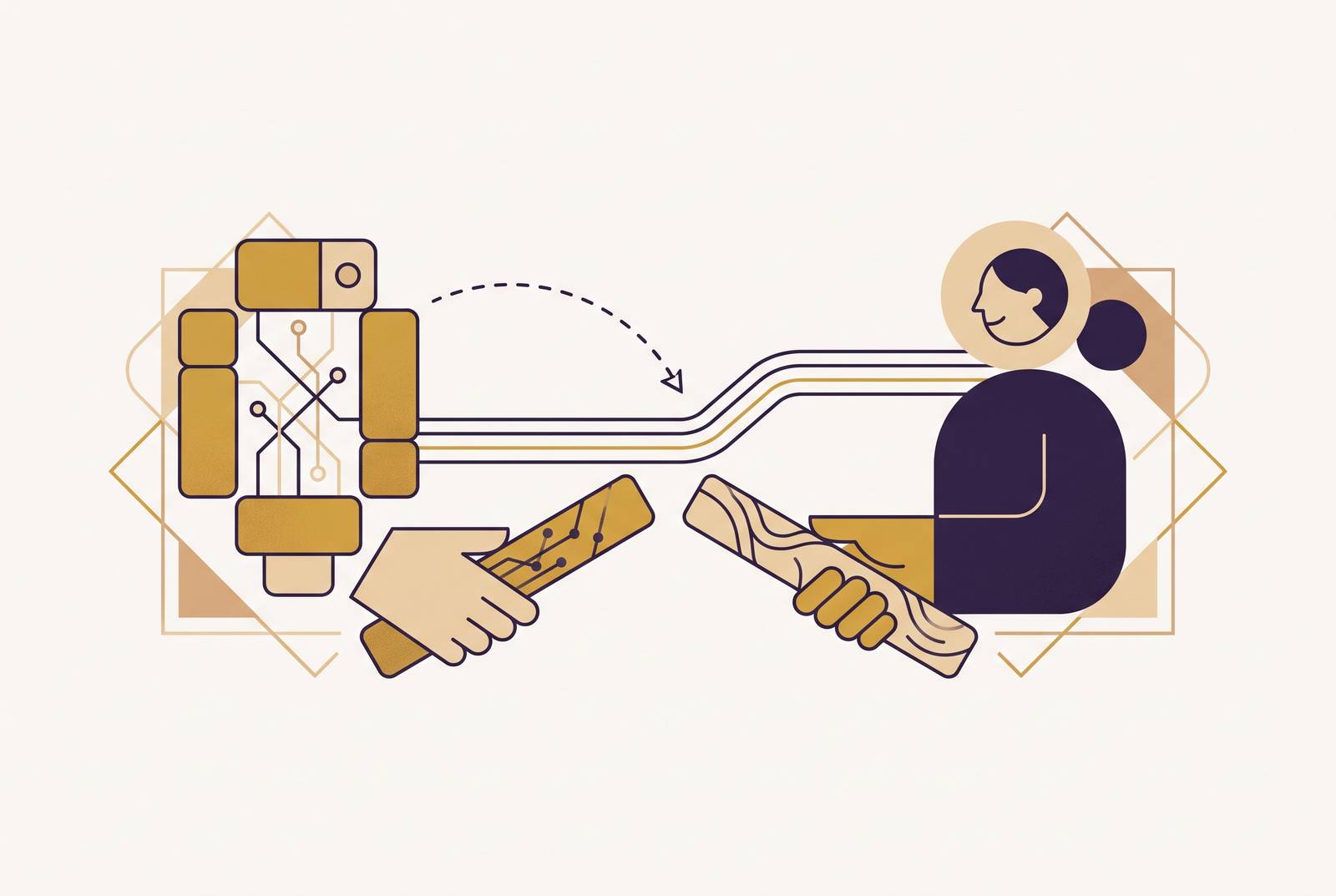
An AI agent handing a customer off to a human jeweler mid-consultation is a designed feature of the system. It's the system working as designed, assuming the handoff was actually designed and not bolted on as an afterthought.
The real subject here is how jewelry brands move a customer from an AI design tool to a human specialist without making that person repeat their whole life story. Get the handoff wrong and you don't just lose a support ticket, you lose a high-value engagement ring order and probably a referral or two. Get it right and the customer barely notices the seam.
AI is genuinely good at the front end of jewelry design. Tools like Tashvi AI can spit out a custom ring, necklace, or earring concept in about 60 seconds, using a guided flow that asks about stone type, setting style, metal, and occasion. Sketch-to-render workflows let a customer scribble something or describe it in plain words, and the AI turns that into a visual fast enough that nobody's checking their watch. Generate ten variations on a halo setting? The AI won't get tired, won't roll its eyes, won't need a coffee break. At least one platform in this space already offers over five million customization options, which means a customer can wander through more options in twenty minutes than a human designer could realistically sketch in a week. Pricing updates in real time as the customer swaps a sapphire for a moissanite. On the operations side, AI handles demand forecasting, inventory matching, and quality control through computer vision, quietly and reliably, in the background.
Where it falls apart is detail and judgment. Complex gem refractions, intricate prong work, micro-pavé settings where dozens of tiny stones need to sit flush and even, these still trip up AI models according to a 2026 software review from RubyKinglet. The output an AI generates is essentially a fixed rendering. It visualizes well, but it can't be resized, can't have its head swapped out, can't be taken apart and rebuilt piece by piece without a human sitting down in CAD software and doing the actual work.
Then there's the emotional side, which no model handles well because it isn't a math problem. A customer building a memorial piece for a parent who just passed, or a nervous partner planning a proposal, needs a human who can read the room. Whether a design is physically buildable at 14 karat versus 18 karat, whether the prongs will hold at that gauge, whether the casting process will survive that level of detail, these are manufacturing calls that require a person who has actually stood at a bench.
This tension is widely recognized in the industry: generative AI opens real creative doors in jewelry design, but it also produces errors and raises IP questions nobody's fully settled. Human review is a core, load-bearing layer. It's load-bearing.
So the workflow splits cleanly in practice. AI runs the front of the consultation: exploration, visualization, configuration. Humans run the back: CAD refinement, engineering judgment, the bench work that turns a rendering into a ring that survives forty years of wear. That split is exactly why the handoff between the two needs to be designed on purpose, not improvised when a customer gets frustrated and types "can I talk to a person."
The three triggers that should escalate a jewelry AI session to a human expert
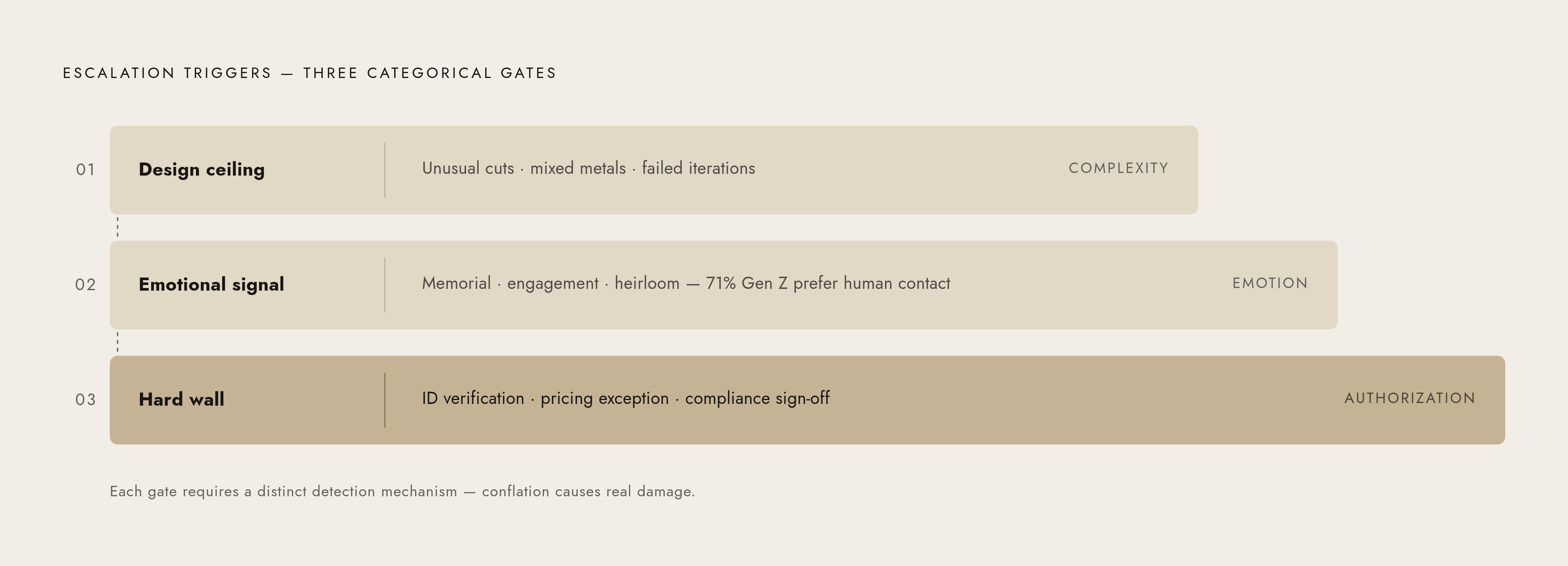
Three things should kick a session out of AI hands and into a human's. Not five, not one. Three, and each one is distinct enough that conflating them causes real damage.
Trigger one: the request outgrows the AI's toolkit. Unusual stone cuts, mixed-metal builds, organic asymmetric shapes, anything requiring engineering judgment about structural viability or casting method: these need a human. So does a session where the AI has already produced two or three renders and none of them land, because at that point the tool is just repeating variations without direction. It's guessing. Multi-step custom work is its own flavor of this trigger too. When one parameter change (say, upsizing a center stone) cascades into resizing the halo, the shank, and the prong height all at once, that's interdependent decision-making an AI configurator isn't built to reason through.
Trigger two: emotional signal, or the customer just asks. If someone sounds frustrated or confused by what the AI's shown them, that's a signal, full stop. Memorial jewelry, engagement rings, heirloom redesigns: these categories carry emotional weight that no chatbot script accounts for. And per Cresta's 2026 handoff guide, any explicit request to talk to a real person ("transfer me," "let me speak to a designer") should escalate immediately. No exceptions, no "let me just try one more thing first." Per Blackader (2024), 71% of Gen Z customers believe phone or direct human contact is the quickest and most effective way to resolve a customer service matter. That's a generation that grew up with chatbots and still doesn't want to argue with one over something that matters.
Trigger three: the system itself hits a wall. Identity verification, account-level changes, pricing exceptions, custom quote approval, manufacturing lead-time commitments are not something the AI is authorized to do, regardless of how confident its answer sounds. Compliance situations that need a documented human sign-off fall here too.
Sound handoff design requires these triggers to live at the system level, defined ahead of time, not left to an individual conversation's judgment call. That's what's called threshold-based confidence escalation, meaning the system routes to a human once a pre-set limit gets crossed (retry count, iteration count, time spent reasoning) rather than waiting for the AI to decide for itself that it's stuck.
Jewelry adds a wrinkle most contact-center frameworks never touch. A lot of these triggers are aesthetic. "The AI isn't capturing what I mean" is a completely valid, completely common reason to escalate, and it doesn't fit neatly into a support ticket taxonomy built for return requests and shipping delays.
What full context transfer looks like in a jewelry consultation handoff
Here's the actual mechanics of what needs to move from the AI session to the human specialist's screen, drawing on Cresta's 2026 guide on handoff best practices.
Five things, no more, no fewer:
- The full transcript. Every message, every AI response, the whole arc of how the design idea evolved (or didn't) across the conversation.
- Every design artifact. Renders, configuration states, any visual output the customer already reviewed. The specialist needs to be looking at exactly what the customer already looked at, not a verbal summary of it.
- Extracted entities. Stone type, metal, budget, occasion, size, and any specific phrases the customer used to describe the vision they're chasing.
- What's already been tried and rejected. Which directions were shown, which got a thumbs-down, and ideally why. A specialist who reruns a concept the customer already hated loses trust in about four seconds.
- The reason for escalation itself. Complexity, emotion, explicit request, or system limit. That reason shapes how the specialist opens their mouth.
Relevant customer context needs to be sitting there before the specialist says hello, not fetched mid-call while the customer waits and wonders if they're being ignored.
Cresta's 2026 guide draws a further distinction between cold and warm transfer. Cold transfer: the specialist picks up straight from the context package, with no live coordination before the customer is connected. That works fine when the package is genuinely thorough. Warm transfer: the receiving specialist reviews the context package and coordinates with the handoff process before the customer gets looped back in. It costs more time, but for a high-value custom piece or a memorial commission, it's the right default.
The failure mode to watch for is context that technically exists but never makes it into the package. The specialist gets the transcript but not the renders. Or the renders but not the notes on why the customer rejected concept two. Every handoff needs an explicit status line: why is control moving to a human, and what's still unresolved. Not just a log of what happened. A reason.
How escalation protocols are structured at the system level
Three pattern types show up in how these systems get built, per Augment Code's 2025 guide.
Threshold-based confidence escalation routes to a human once some pre-set limit gets crossed, whether that's retry count, time spent reasoning, or how many design iterations have run without landing on something the customer likes. This stops the AI from quietly compounding bad guesses into worse ones.
High-risk action gates pause specific moves, like locking in a custom order, confirming final pricing, or approving a CAD file for manufacturing, until a human explicitly signs off.
Explicit request triggers fire the second a customer asks for a human, regardless of how confident the AI's internal scoring says it is. Confidence is irrelevant here. The customer asked. The rule stops there.
A relevant architecture worth knowing about: HADA, out of Aalto University in June 2025, wraps AI decision-making in role-specific agents so different stakeholders, business managers, data scientists, auditors, ethics leads, customers, can each step in, trace outcomes against KPIs, and contest a result if something looks off. Map that onto jewelry and you get a designer agent, a manufacturing agent, and a customer-facing agent, each with a defined boundary for where it hands off to the next.
On the plumbing side, emerging interoperability standards are what make governed handoffs technically possible between agents and between an agent and its tools. Any jewelry platform building multi-agent workflows should have both on its radar.
A principle that applies directly here: AI amplifies whatever's already there, strengths and weaknesses both. A poorly designed escalation system doesn't just fail quietly. At scale, it means every bit of automation-driven productivity gets partially eaten back up by human specialists drowning in review work they shouldn't be doing.
Trust calibration isn't fixed, either. Data cited in Augment Code's guide, sourced from Anthropic, shows experienced users auto-approving AI outputs in over 40% of sessions, versus roughly 20% for new users. Escalation thresholds should shift as specialists get more comfortable with what the AI actually produces, not stay locked at day-one settings forever.
Jewelry's particular headache: aesthetic judgment resists being turned into a clean threshold the way a transactional decision does. "This isn't what I meant" doesn't have a number attached to it. The closest practical stand-in is iteration count, tracking how many rounds of design tweaks have happened, as a rough proxy for the moment the AI has run out of useful variation to offer.
What the human specialist does differently with AI session context in hand
A specialist walking into a call with full context doesn't start by asking questions. They start already knowing what the customer's seen, what got a yes, what got a hard no, and why. The conversation opens three or four steps further along than it would cold.
The AI's renders don't get thrown out just because the customer escalated. They become reference material. "Here's what the AI built from your description, let me show you exactly where the manufacturing runs into trouble, and here's what we can do instead" lands very differently than starting from a blank page. Even an imperfect sketch-to-render output is a communication artifact. It gives the specialist something concrete to point at, which beats trying to interpret a written brief from scratch every time.
On complex builds, micro-pavé, unusual prong arrangements, mixed-metal shanks, the specialist can take that AI-generated mesh and rebuild it parametrically in CAD, using the original purely as a shape reference rather than a starting file. That's a meaningfully different, faster process than starting design from zero.
Knowing the escalation reason ahead of time also shapes tone. A specialist walking into a frustration-triggered handoff opens differently than one walking into a complexity-triggered handoff, which is different again from a memorial commission. That's not guesswork, that's the escalation reason doing its job.
And the AI doesn't clock out once the human takes over. Per Cresta's 2026 guide, real-time support, surfacing relevant knowledge, flagging behavioral cues, should keep running through the human-led portion of the call so the transition feels like one continuous conversation to the customer, not two separate ones stitched together.
Klarna's 2024 case showed that even after aggressive automation, roughly a third of support contacts still needed a human agent to close them out. Jewelry, given how emotionally loaded and technically fiddly the category is, almost certainly sits above that number. The human specialist isn't a leftover the AI couldn't handle. That role is the premium layer the whole experience is built around.
How configurators and AI design tools create the handoff surface in practice
A browser-based configurator, where a customer's picking metal, then a stone, then a setting, then engraving text, generates something genuinely useful for handoff: structured data. Every click is a data point, and that transfers to a human specialist far more cleanly than a transcript of loose conversation ever could.
Over 30% of online jewelry shoppers say they hesitate to buy because they can't visualize or customize a piece accurately enough. Configurators chip away at that hesitation, but there's a ceiling. The moment a customer's actual vision outgrows what the configurator's dropdown menus can express, that's a natural, clean point to route them to a human.
A few named tools show how this plays out. Tashvi AI's guided design mode asks structured questions (stone type, setting style, metal, occasion), and because the answers are structured rather than free text, they hand off cleanly to a specialist's screen. Its roughly 60-second generation time also means there's already a visual reference artifact ready the moment a human picks up the thread. Zakeke, a 3D configurator and AR tool built to work with Magento, Shopify, BigCommerce, and WooCommerce, can preserve session state, though whether that state actually reaches a specialist's desktop depends entirely on how well it's wired into the store's CRM. Jewelry platforms running AI agents with extensive customization options, hand specialists a real advantage: the AI's already confirmed the design can physically be built, so the human inherits a buildable starting point instead of a wish list.
Mobile matters here too. A large share of web traffic runs through phones and tablets, which means handoff triggers and context capture have to work just as well on a five-inch screen mid-commute as they do on a desktop at a jewelry counter. A customer who escalates from a phone shouldn't lose their half-built ring design in the process.
There's also a physical checkpoint: prototyping a design in 3D-printed resin for client approval before anything gets cast in actual metal. That's a natural, human-gated pause built right into the production pipeline, and the handoff from AI-generated file to physical prototype review is itself a structured moment, not an afterthought.
Once a specialist has that AI output in hand, professional CAD tools let them treat the AI's output as a shape reference and rebuild the whole thing parametrically. That's what makes resizing, stone swaps, and halo adjustments possible without starting the entire design over from a blank screen.
Measuring whether handoffs are actually working
The AI's job doesn't end when the human picks up the call. Whatever happens after that escalation, whether the customer buys, walks, or comes back with more changes, needs to feed back into the system that triggered the handoff in the first place.
A platform that loses visibility the moment a human takes over can't tell whether its escalation triggers are firing at the right moments, whether context transfer is actually complete, or whether customers are getting a smoother experience or just a differently annoying one. Handoff design is an ongoing practice. It's a loop, and the loop only works if someone's watching both ends of it.