Email and SMS Retention Flows for Made-to-Order Jewelry Customers
Specialized flows and channel logic turn the production wait into a trust-building advantage.
Made-to-order jewelry creates a production window with no equivalent anywhere else in e-commerce, and most retention flows ignore it completely because they were built for a different kind of purchase. A standard DTC order ships in days: confirmation, shipping alert, delivery, review request, done. A made-to-order ring doesn't exist yet when the customer pays for it, and they wait weeks for something to be built, cast, set and finished, often for an engagement, an anniversary, or a memorial piece that carries more emotional weight than a pair of sneakers ever will.
A generic flow that fires a cheerful "how's your order?" email three days after purchase is alarming, because the piece hasn't even entered the production queue yet, and the customer has no way to know if that's normal or a warning sign. The standard sequence (confirmation, shipping alert, delivery, review ask) depends on triggers that don't fire on a jewelry timeline. That leaves a communication void right when trust is thinnest, making it the single biggest reason made-to-order brands need their own playbook.
What the production window looks like from the customer's side
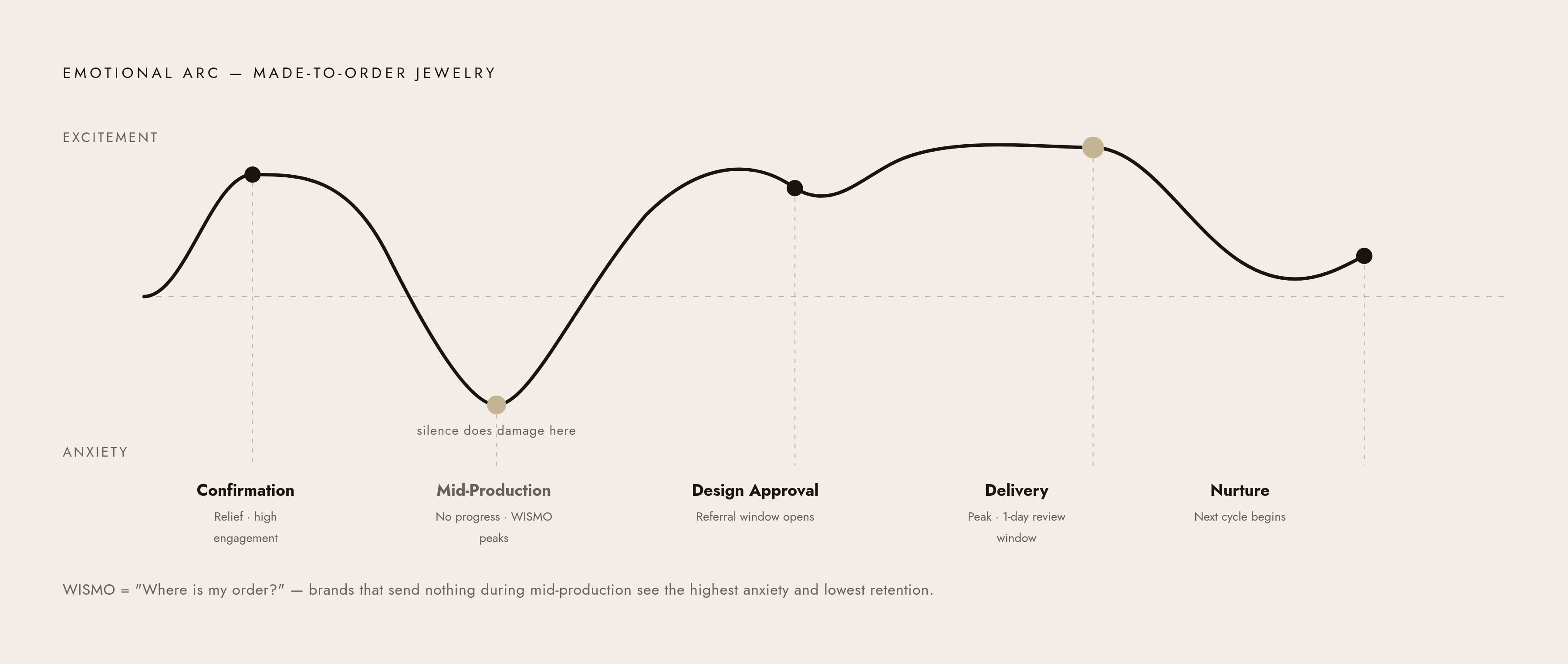
The production window is measured by how anxious the customer feels on any given day, and that arc has a shape worth understanding before building a single flow around it.
At order confirmation, the customer feels relief and excitement. The decision is made, and this is the highest-engagement moment in the entire post-purchase relationship. It's also the moment most brands waste by sending nothing more than a receipt.
Then comes the middle stretch, and it's the hardest part of the wait. There's no visible progress and no natural checkpoint, so buyer's remorse creeps in and "where is my order" messages start piling up in the inbox. As the piece nears completion, excitement returns. The customer senses the wait is almost over, and that lift in attention makes this a strong window for a referral ask or a cross-sell nudge, assuming the brand is paying attention to the timing.
Delivery is the peak of the emotional arc, but it's short-lived. The brand has a narrow window, maybe a day, to capture a review, a photo, or a referral before the moment passes and the customer moves on with their life.
One structural shift changes the texture of this whole arc: AI-assisted design workflows. When a customer has already seen and approved polished design directions before production even starts, the wait feels different, because the outcome is already concrete. They're not wondering if the final piece will match what they imagined. They already know, because they picked it. Earlier visual alignment means fewer "is it what I imagined" fears sitting in the back of the customer's mind during the wait.
The seven flows in the made-to-order arc
The retention architecture for made-to-order jewelry is a sequence, each flow handing off to the next, built around the emotional arc just described.
Flow 1 is the welcome series, and it runs before any purchase happens. Most brands treat this as pure storytelling, brand voice, origin story, maybe a discount code. For made-to-order jewelry, the welcome series has a second job: setting the production timeline expectation early, so the wait doesn't arrive as a surprise three weeks later. A customer who knows upfront that custom pieces take six to eight weeks is a calmer customer at week four.
Flow 2 is browse and cart abandonment, and it needs a different tone than a typical DTC abandonment sequence. Jewelry shoppers spend days or weeks comparing settings, metals and price points before deciding, so this flow should acknowledge the weight of the decision, maybe offering a design consultation or a saved-design reminder instead of a countdown timer that implies the ring will vanish if they don't buy in the next twelve hours.
Flow 3 is the custom-order status cadence, the flow most brands skip, and it matters most for that reason. This is the sequence that covers the entire mid-production stretch where silence does the most damage. Skipping it while running the other six flows perfectly is the single most common and most expensive gap in made-to-order retention, because it leaves customers exactly where they're most anxious with nothing to hold onto.
Flow 4 treats design-approval milestones as an occasion rather than a checkbox. Flow 5 covers pre-shipment re-engagement. Flow 6 covers delivery and care. Flow 7 covers post-purchase nurture, the start of the next cycle.
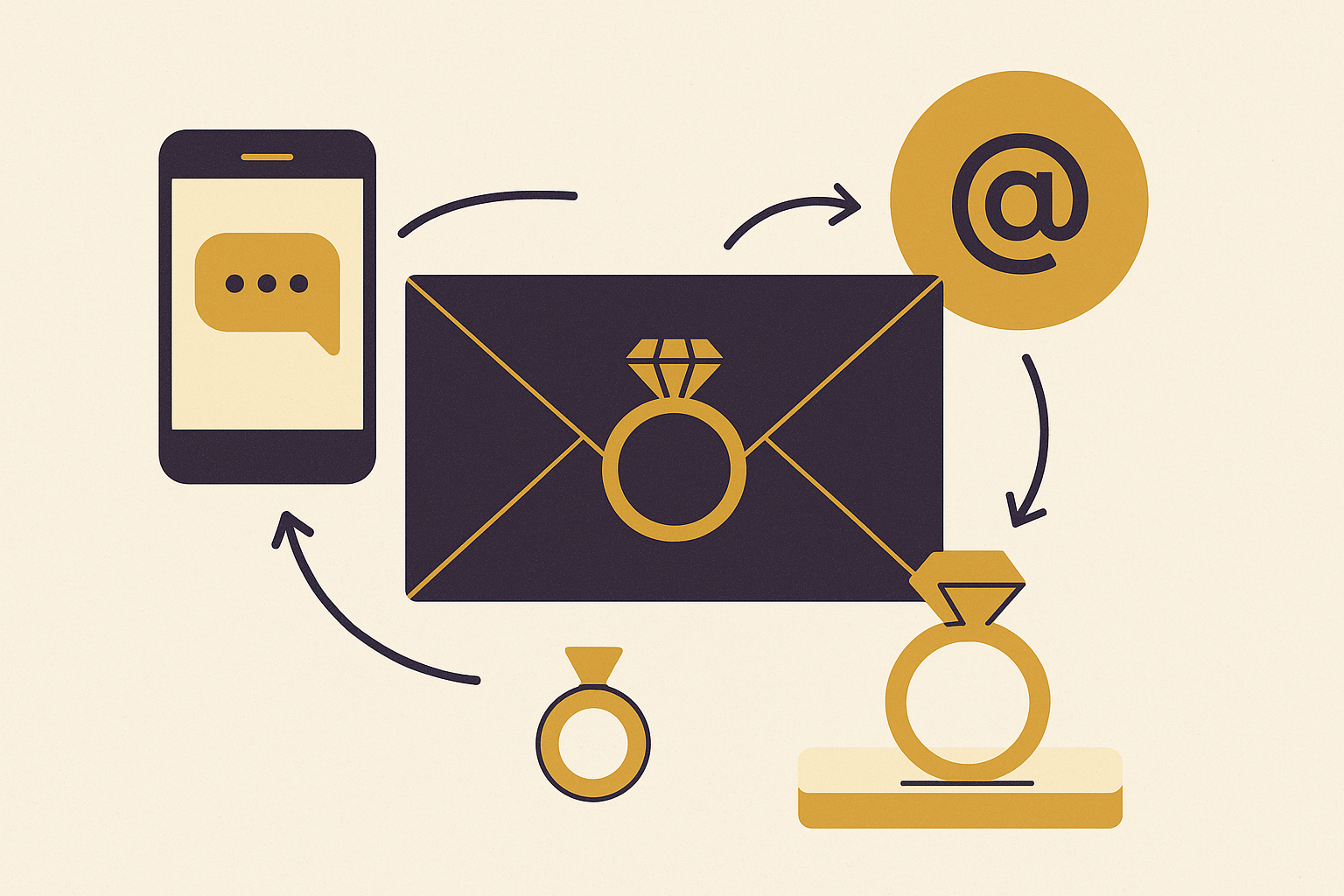
SMS earns a specific job inside this system. Status updates belong on SMS because they're short, time-sensitive, and meant to be read in the next few minutes, not sitting in an inbox for six hours. Email handles the richer milestone moments. A design-approved email is a small occasion. It deserves a message that shows the approved render and says something specific about why that piece is distinctive.
Delivery emails are also some of the highest-opened messages in all of e-commerce, open rates well above the sixty to seventy percent range aren't unusual for this specific trigger, which makes it the wrong moment to send something generic and the right moment to send care instructions specific to the actual metals and stones the customer bought. A jewelry-native CRM that tracks which specific piece a customer owns, and what occasion it was bought for, makes it possible to send an anniversary email a year later that names the piece itself. Platforms already active in this space include Klaviyo and Attentive for lifecycle flows, and Luxare for unifying jewelry-specific CRM data.
Channel logic for email and SMS across the production window
Email and SMS do different jobs, and treating them as interchangeable wastes both.
If a message can wait six hours without the customer getting anxious, it's email. If it needs to land in under an hour to do its job, it's SMS.
Email carries education, storytelling, design-approval reveals, detailed care instructions, and richer cross-sell content, anything that benefits from length, images, and a reader who isn't in a rush. SMS carries production status alerts, last-chance reminders, shipping notifications, and the short, anxiety-reducing pings that matter during the production wait. Nobody wants a long email explaining that their ring moved from casting to polishing. They want one line, and they want it now.
Both channels together are reserved for the moments that actually justify double coverage: a major launch, a limited production run, or pulling a dormant customer back in during a seasonal window. Anything less than that, doubling up just trains customers to ignore one of the two channels.
For the custom-order status cadence specifically, this plays out cleanly. SMS fires at each production milestone because the customer wants the update now, not later. Email follows on the moments carrying real emotional weight, design finalized, piece ready, and uses that extra room to tell the story of what just happened in the workshop.
Configurators create one more trigger worth building a rule around. When a customer shares a unique design link with a partner or a parent before placing the order, that's a high-intent signal. The design is already done and the consideration window is closing, so a follow-up reminder lands in context.
Messaging logic for the production window
Architecture and channel rules only get a brand halfway there. The content of the message is the harder problem, and it's where most practitioners get it wrong even after nailing the flow structure.
The order confirmation message should do real work, not just confirm a transaction. Compare two versions. A generic one says: "Thanks for your order! We'll be in touch." A design-specific one shows the approved render, restates the timeline in plain language ("your ring enters casting in 12 days and should ship by March 4"), and tells the customer what message they'll get next and when. The second version is doing orientation work. The first is doing paperwork. If an AI-assisted design workflow was part of the process, this message can reference the specific directions the customer reviewed and chose between, so the confirmation reads like the next line in a conversation.
Mid-production updates work best as a single SMS line: "Your ring is in casting today, on track for March 4." Brevity is the entire point, because a short, specific update does more for a customer's confidence than a long email ever could.
If a design-approval step falls mid-flow, treat it like a small celebration. Show the final render, name what makes the piece distinctive, and plant an early cross-sell seed, something like "pairs beautifully with" a matching band, timed for when the customer is already feeling good about their decision.
Pre-shipment is the re-engagement window, when excitement is climbing back up. This is a reasonable moment to introduce a referral ask, a review preview, or a soft "who's this for" prompt that quietly captures gifting data for future segmentation.
Delivery works best as a paired message. SMS confirms the piece arrived. Email carries care instructions specific to the actual materials in that piece, the review request, and, for first-time buyers, the opening touch of the next nurture sequence.
A few things to avoid: generic "thank you for your order" language that ignores the design the customer spent weeks building, urgency language during the wait that implies something to worry about, and over-communication that turns reassurance into noise. Three well-timed messages beat nine anxious ones.
How the configurator experience shapes what retention flows can do
A strong configurator doesn't just convert a shopper into a buyer. It generates the exact data that makes every later retention message sharper, more specific, and more useful than anything a generic flow could produce.
A customer who finishes a full configuration session has already invested real time choosing a metal, a stone, and an engraving before they ever hit checkout. That investment raises the emotional stakes of the purchase, but it also raises how closely they're paying attention to every message that follows. They're watching for updates on the thing they built.
The data from that session, the metal selected, the stone chosen, the engraving specified, becomes the raw material for messages that name the actual piece. A confirmation email that says "your 14k rose gold ring with the pear-cut sapphire" lands differently than one that just says "your recent purchase."
Configurators that export production-ready files in DXF, STL, and STEP formats, and route orders straight into a CRM, ERP, or order management system with auto-pricing attached, create a cleaner handoff into manufacturing. A cleaner handoff makes production timelines more predictable, and more predictable timelines let a brand send milestone messages that are actually accurate.
Customers sharing a saved design link with a partner before ordering is a behavior worth building a trigger around. The design work is already finished, so the only thing standing between the customer and checkout is a nudge at the right moment.
Turning delivery into the first touch of the next purchase cycle
Delivery is the opening move of the next purchase cycle, and brands that treat it as a closing moment waste the highest-leverage window in the entire customer relationship.
The review request should land at or right after delivery, while the excitement is still at its peak, not a week later once the feeling has faded into "oh right, I should probably leave a review." Made-to-order pieces come with a story attached, the design choices, the wait, the reveal, so the prompt should ask for that story, not just a star rating.
The cross-sell that follows delivery works best when it's anchored in the actual design logic of the piece just received. A customer who chose rose gold with a pear-cut stone is a person who just told the brand, in very specific terms, what they like. A follow-up that builds on that choice, a matching band, a complementary pair of earrings, turns delivery from an ending into the first step of a relationship that's already pointed toward the next purchase.