Post-Purchase AI Agent Flows for Custom Jewelry Order Management
Automated updates and decision-making transform custom jewelry's chaotic post-purchase experience.

A customer clicks "place order" on a custom engagement ring and the real work starts right then, not before. That click kicks off a waiting period where a person who just spent thousands of dollars has no idea what happens next, and no custom jewelry brand can afford to leave that silence unfilled.
Custom pieces don't sit on a shelf. There's no box to grab and ship. Every order has to be designed, approved by the customer, cast, set with stones, polished, checked for quality, and packed, and each of those steps needs someone to actually tell the customer it happened. That's the trade a made-to-order business makes: no leftover inventory sitting around collecting dust, but all the complexity of production and communication gets pushed onto the brand's post-purchase team instead of being solved ahead of time on a warehouse shelf.
And the emotional weight here is heavier than almost any other retail category. People don't buy custom jewelry on a whim. They buy it for proposals, anniversaries, and memorials, tied to a date that matters and can't be moved. A delayed shipping update for a phone case is an annoyance. A delayed update for a ring that's supposed to be in someone's pocket before they get down on one knee is a five-alarm fire. The stakes don't scale with the price tag. They scale with the occasion.
What makes custom jewelry order flows structurally different from standard e-commerce post-purchase
Standard e-commerce post-purchase runs in a straight line: warehouse, label, truck, doorstep. Custom jewelry runs through a series of checkpoints where the customer has to show up and make a decision, not just wait for a box.
Start with design approval. Before a single gram of metal gets melted, the customer has to look at a CAD rendering and say yes, that's the ring. Then production itself breaks into milestones a standard retailer never has to think about: casting, stone setting, finishing, quality check. Each one is a moment a customer might reasonably want to hear about. Then there's the wildcard that custom orders invite and standard retail never does: the modification request. A customer who wants a thinner band or a different stone two weeks into production isn't asking for a feature, they're opening a decision with real cost and timeline consequences. And finally, before anything ships, there's a pre-shipment sign-off, where the finished piece gets photographed and the customer confirms it actually matches what they ordered.
None of those four checkpoints exist in a normal online order. A phone case doesn't get mid-production modification requests.
WISMO, short for "Where Is My Order," is already the single highest-volume category of post-purchase contact in retail generally. In custom jewelry, that same question carries more urgency and usually waits longer for an answer, because the honest answer is often "it's still being cast.
The cost of getting any of this wrong is also lopsided compared to normal retail. A return in standard e-commerce is a shipping label and a restock. A return in custom jewelry is often a dead end: the piece can't be resold, because it was built to one person's exact size and spec. Every modification request handled late, every production error caught after the fact, costs more in custom jewelry than it would anywhere else in retail.
AI Agents in 2026 vs. Earlier Chatbots
A chatbot answers a question. An agent finishes a job. A chatbot finishes answering; an agent finishes the job, and that gap is why this conversation matters.
Older bots could tell a customer their order status if someone had already typed that status into a system. An agent can go get the status itself, decide what to do with it, and carry out a multi-step task toward a goal, without someone walking it through each step by hand. It can complete a job end to end: check production stage, decide whether a milestone notification is due, send it, and log the interaction, all without a human in the loop.
The clearest real-world example of this shift is Narvar NAVI, launched in early 2026. NAVI doesn't sit around waiting for a customer to ask where their package is. It works off 74 billion consumer touchpoints and billions of tracked parcels to spot delivery problems before the customer even notices one, then resolves them on its own. That's the whole philosophy in one product: stop waiting for the question, go find the problem first.
This capability runs on new plumbing, too. Google and Shopify built the Universal Commerce Protocol, launched at NRF 2026, as a shared standard covering the full commerce journey from someone discovering a product all the way through what happens after they buy it. That protocol gives agents in 2026 a common language to pull real data from multiple systems instead of guessing, which lets them do more than answer questions.
What separates these systems from a glorified FAQ page is context. A capable agent can weigh a customer's order history, the margin on the product, the reason for a return request, and what's actually available right now, then make a judgment call. That kind of policy-aware decision-making is what a chatbot was never built to do.
The four post-purchase flows where AI agents remove the most friction in custom jewelry
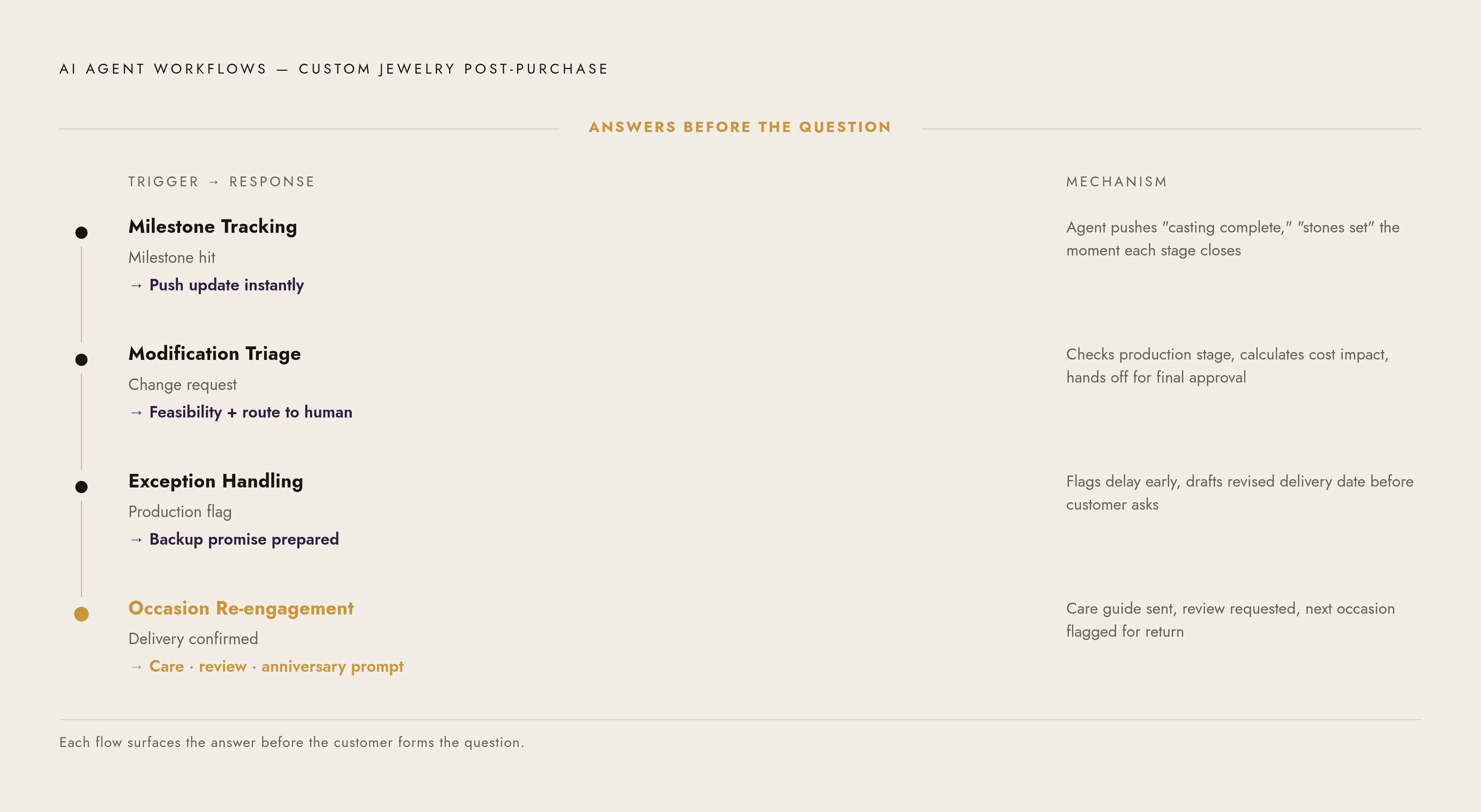
Four workflows account for most of the friction in custom jewelry post-purchase, and each one is a different flavor of the same underlying problem: too much waiting, not enough information flowing toward the customer without being asked.
Flow 1 is automated order status and production milestone tracking. The problem: someone has to notice that casting finished, or that stone setting wrapped up, and then relay that to the customer, usually by hand, usually late. The fix: an agent pulls real-time production status and pushes a message the moment a milestone hits, whether that's "casting complete" or "stones set, finishing starts tomorrow." Jewelry stores already name order tracking and proactive client communication as one of their biggest pain points, and this flow attacks it directly by sending the update before the customer has to ask for it. Fewer "where is my ring" messages come in, because the answer showed up before the question did.
Flow 2 is modification request triage and routing. The problem: a customer asks for a thinner band or an extra stone midway through production, and someone has to figure out, often under time pressure, whether that's even possible at this stage and what it'll cost. The fix: an agent that knows the order's current production stage and the customer's history can make a first-pass call on feasibility, work out the timeline and cost impact, and route the request to the right person for final approval. A request made before casting is a completely different animal from the same request made after casting, and an agent that understands which stage the order sits in can tell the difference instead of just logging a ticket and hoping someone catches it in time.
Flow 3 is proactive exception handling and delay communication. The problem: things go wrong in production. A stone fails inspection. A metal alloy order gets delayed. A sizing error appears at finishing. These things happen in custom jewelry regardless of how tight the operation runs, and the only real question is whether the customer hears about it from the brand first or finds out by chasing down an answer themselves. The fix: an agent that assesses risk and confidence in real time can flag the exception early and decide what delivery promise to make and what backup plan to prepare ahead of time. For a ring that has to arrive before a proposal, or a gift timed to an anniversary, catching that exception early and saying something about it immediately keeps a stressed customer from becoming a furious one.
Flow 4 is post-delivery follow-up and occasion-based re-engagement. The problem: brands treat delivery as the finish line, when it's really a checkpoint. Care instructions, warranty registration, a simple "how do you like it" check-in, and the first anniversary of the purchase are all natural moments to reconnect, and most brands let them slip by. The fix: an agent handles that follow-up automatically, encourages a review, and flags the brand for a repeat purchase down the line. In custom jewelry, a happy customer is often the best marketing channel a brand has, and automating the follow-up frees staff to spend their time on the conversations that actually need a human.
How production-ready CAD data makes post-purchase agent flows more accurate
An agent is only as good as the data sitting behind it, and in custom jewelry, that data starts life as a CAD file and a bill of materials generated the moment an order comes in.
Everything downstream, every status update and every modification decision, traces back to specs locked in at that CAD stage: stone shape, dimensions, type and quantity, ring size, band width and thickness, setting style, and whether the piece is being cast or fabricated by hand. When an agent answers "what stage is my ring at," it's reading off that data. When it's weighing whether a modification request is feasible, it's checking that data against the current production stage.
If that handoff is sloppy or incomplete, the agent's answers get vague fast. Instead of "stone setting complete, finishing starts tomorrow," the customer gets "in production," which tells them nothing they didn't already know. The gap between those two messages is entirely a gap in data quality, not a gap in how smart the agent is.
Parametric design tools help close that gap by letting one change, a ring size, a band width, ripple through the entire design automatically instead of requiring someone to re-enter every spec by hand. That keeps the data the agent references current and consistent, rather than a snapshot that quietly goes stale the moment a customer requests a tweak.
Design data generated by AI tools often isn't accurate enough to hand straight to manufacturing. Turning that rough data into a clean, editable, production-ready CAD model without a human checking the parameters is genuinely hard. That's the real argument for AI assisting CAD review. It also means an agent's post-purchase accuracy rests entirely on a human-verified CAD file sitting upstream of it. Platforms that generate production-grade CAD for every single configuration, so what a customer sees on a product page is what ends up on the bench, are the ones whose agents can tell a customer something specific and true.
The UCP Order Data Model for Jewelry Brands
The Universal Commerce Protocol's Order capability gives post-purchase automation a shared structure to run on, so brands aren't stuck building a custom, brittle integration for every platform they touch.
One piece of that structure is Fulfillment Expectations, the buyer-facing delivery commitments a brand makes and has to stand behind. A webhook-driven setup moves lifecycle events between merchants, platforms, and agents through standardized hooks, so a production milestone logged in a manufacturing system can trigger a customer text in a messaging platform without anyone manually bridging the two.
That event-driven shape fits custom jewelry almost perfectly, because custom jewelry already runs in discrete stages: design approval, casting, stone setting, finishing, quality check, shipment. Each one can be its own lifecycle event that fires off an agent action the second it happens.
For a brand sitting down to evaluate post-purchase automation right now, the practical question is simple: does this system emit and read UCP-compatible events, or not? A platform that skips this standard is building on its own private foundation, one that gets harder and more expensive to connect to everything else as UCP becomes the thing everyone else in the industry is already speaking.
The objection that AI agents depersonalize high-touch custom jewelry relationships
There's a real objection sitting under all of this, and it deserves a straight answer: custom jewelry runs on trust, craft, and a personal relationship between a jeweler and a customer, and swapping a human's follow-up call for an automated message risks cheapening the exact thing that made the customer choose a custom piece.
The objection is aimed at the wrong target. Agents are built to run the operational layer: status updates, modification routing, flagging exceptions, sending occasion reminders. Humans still run the relationship layer: the design consultation, resolving a real conflict, the emotional conversation that happens around a purchase this significant. One doesn't replace the other, because they're not doing the same job.
A customer getting a milestone update at 10 PM, telling them their stone just got set, is getting information faster than any human could reasonably provide it at that hour, which frees the actual jeweler to spend their time on the phone call that matters: talking someone through a modification, or walking them through what happens if a stone doesn't pass inspection. Automation picks up the parts of the job that were never where the relationship lived. The relationship was always in the consultation and the conversation, and that's exactly where the humans stay.