Returns and Exchange Policy Design for Custom Jewelry E-Commerce
Custom jewelry returns demand rules stock items don't, and most retailers ignore the difference.

Custom jewelry can't be returned the way a sweater can. That single fact should shape every line of a retailer's returns policy, and yet most brands write one policy for everything they sell, stock rings and bespoke engagement pieces alike. That mismatch is where the trust breaks down, and where the money leaks out.
Return rates in jewelry sit well below the general e-commerce average. Overall online retail returns ran around 16.9%, roughly $890 billion in returned goods across the U.S. in 2024, per the NRF and Happy Returns. Jewelry lands closer to 8%. Sounds like a win, but the average order value in jewelry is high enough that one bad return does more damage to margin than five sweater returns combined.
Here's why the category plays by different rules than apparel or home goods. A custom piece gets built for one person, so reselling it after a return is basically off the table. Engraving, stone setting, a bespoke ring size, these turn a returned item into dead stock the second it comes back through the door. High unit value also drags in fraud risk that a cheap t-shirt never has to worry about: gemstone swaps, counterfeit substitutions, boxes that arrive empty. And on the flip side, cheap items create their own headache, where the cost of shipping a return back and processing it is more than the item itself was worth.
Then there's the part that spreadsheets don't capture. Custom jewelry usually marks a milestone, an engagement, an anniversary, a promise to someone. The buyer isn't just expecting a product; they're expecting a moment to land correctly. Research from Business Research Insights found 60% of consumers choose custom jewelry specifically to express individuality, meaning the piece carries identity, not just function. A policy built for a stock warehouse SKU will misfire on that kind of order in both directions: too rigid, and buyers won't trust you enough to hand over a deposit; too loose, and every dissatisfied customer becomes a refund waiting to happen.
What most jewelry retailers get wrong about policy transparency
A 2026 audit of 20 jewelry retailers scored their policies across custom deposits, cancellation terms, return windows, warranties, and buyer protections. The top scorer landed at 66 out of 100. The bottom scorer landed at 31. That's a 35-point gap in an industry where everyone's selling more or less the same category of product.
The biggest driver of that gap wasn't return windows or warranty length. It was money. Specifically, what happens to a buyer's deposit when a custom order goes sideways. At 17 of the 20 retailers audited, there was no published answer anywhere, not on the policy page, not in the FAQ, not in the terms of service, for whether a custom deposit is refundable, under what conditions, or what a buyer can do if the order gets delayed or disputed.
That list includes names you'd expect to have this figured out. Kay, Zales, and Jared, all under Signet Jewelers, had no published policy governing custom order disputes anywhere a customer could find before paying.
Which means most of the market has left a wide-open trust gap sitting right there, unattended. For a smaller or mid-sized jeweler, that gap is an opportunity, and not because you have to be more generous than Kay or Zales. You just have to be clearer. Customers who can't find the terms before buying are the same customers who file a dispute after buying, because uncertainty breeds suspicion once something feels off.
Loop Returns found that 67% of shoppers check the returns page before they buy anything. That number alone should settle the argument about whether policy writing is a legal chore or a sales tool. It's both, but the sales half is the part most retailers ignore.
How to structure the non-returnable custom item clause without alienating buyers
Custom and made-to-order pieces are legitimately non-returnable. That's not in dispute, and no reasonable customer expects otherwise once it's explained well. The problem isn't the rule. It's how and where you say it.
Sweet Custom Jewelry runs a clean model worth studying: special orders require a substantial deposit up front, balance due at delivery, and the order is explicitly non-returnable with no exchange. Simple, stated plainly, no surprises.
A clause like that needs four things to actually work:
- A clear definition of what "custom" or "special order" even means, because vague language is exactly what invites a dispute later
- The specific point where the order becomes non-cancellable, which should be tied to when production starts, not when payment clears
- Named exceptions: manufacturing defects, the wrong item shipped, a specification that's measurably wrong compared to what was approved
- What the buyer can still get, even without a refund, whether that's a remake, store credit, or a repair
Placement matters as much as wording. This clause shouldn't live only on a policy page buried three clicks deep. It belongs on the product page itself, right near the configurator or the add-to-cart button. It belongs at checkout, as something the buyer actively acknowledges before paying. And it belongs in the order confirmation email, so there's a written record the customer already agreed to.
Here's the framing that actually works: "this item is made specifically for you" is a feature and a policy at the same time. Lead with the feature. The policy follows naturally once the customer understands the piece is theirs and theirs alone. Bury the non-returnable language in six-point font at the bottom of a generic policy page, and you haven't avoided the conversation, you've just delayed it until it shows up as a chargeback or a one-star review.
Deposit and cancellation terms — the clause most brands skip
Remember that 17 of 20 stat from the audit? That's not a footnote, that's basically an open lane. Write a clear deposit and cancellation policy, and you're ahead of most of the jewelry industry by default.
A deposit policy needs to answer a short, specific set of questions. What percentage do you collect at order placement, and why, materials, design time, whatever the real reason is. Is that deposit refundable, and at what point does it stop being refundable. What triggers a full refund, usually a seller mistake, a production failure, or an inability to deliver the agreed specification. What triggers a partial refund, say the design consultation happened but production hadn't started yet. And what triggers no refund at all, which is production that's already underway or finished.
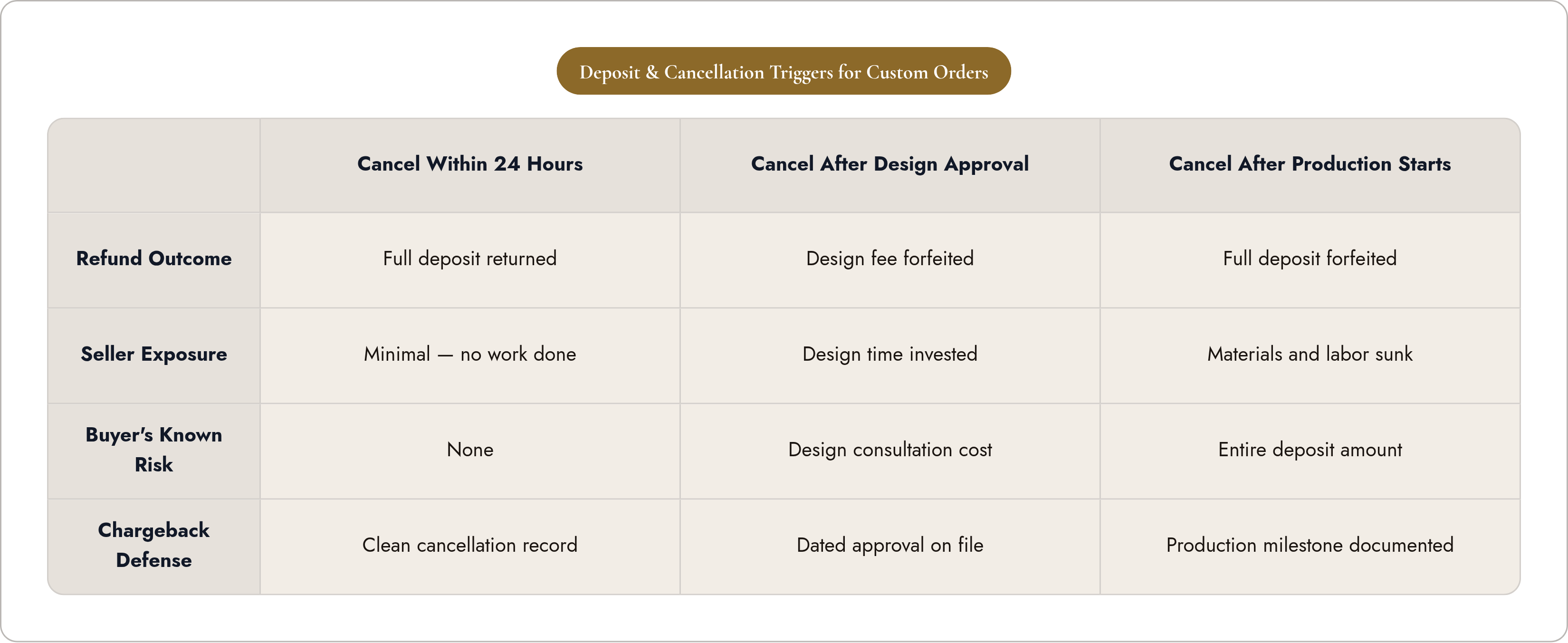
The cancellation window should hook to a production milestone, not a calendar date. A policy that says "cancel within 30 days" falls apart the moment one order takes two weeks to produce and another takes eight. Better logic looks like this: cancel within 24 hours of ordering, full deposit back; cancel after design approval, forfeit the design fee; cancel after production starts, forfeit the full deposit.
This protects both sides of the transaction, not just the seller. The buyer knows exactly what they're risking before they commit to anything. The seller has a documented, dated set of terms that closes off the classic chargeback argument of "I didn't know." Tie your cancellation triggers to actual production steps, design approval, casting, stone setting, rather than an arbitrary number of days, and the policy holds up no matter how complex any given order gets.
Return window design for the parts of the catalog that are returnable
Most jewelry brands aren't selling one type of product. They're selling three: fully stock pieces, semi-custom pieces that can be resized or re-engraved, and fully bespoke builds. Treating all three under one flat return policy is where confusion starts.
For stock items, a two-tier window beats a single window every time. Qalo runs a 30-day return period alongside a 60-day exchange period, and that gap isn't an accident, it nudges customers toward exchanging instead of refunding, which keeps the revenue in the business. Sweeten that further with free return shipping on exchanges or a small bonus credit, and the nudge gets stronger.
On window length itself, there's no real evidence that 30 days is some magic number. A longer window can actually signal confidence in the product and cut down on the anxious, too-fast returns that happen when people feel rushed to decide.
Cheap items, roughly under €15, deserve their own logic entirely. Shipping a return back and processing it often costs more than the item is worth, so just letting the customer keep it and refunding them anyway is the economically sane move, and it buys real goodwill for basically nothing.
High-value stock pieces need the opposite treatment: RMA numbers, original tags intact, gemstone certificates from GIA, IGI, or HRD still attached, original packaging included. No shortcuts there.
Sizing, for what it's worth, is the number one reason rings and bracelets come back at all. Route sizing complaints toward an exchange instead of a refund, and you keep revenue that would otherwise walk. Some brands offer one free resize within a set window, which quietly turns a near-return into a reason the customer trusts you more, not less. The policy page should map out clearly which products fall under which window; one paragraph trying to cover stock, semi-custom, and bespoke all at once is a support ticket generator.
Fraud prevention controls that don't punish honest customers
Jewelry gets targeted by return fraud more than most categories, for reasons that are pretty obvious once you say them out loud. Gemstone swaps, where a real stone gets pulled and a fake one goes back in the box. Empty boxes shipped back as if the item's inside. Worn items sent back claiming they were never touched. Return fraud is rising across retail broadly, and jewelry's combination of high value and the difficulty of inspecting a piece visually makes it a bigger target than a lot of other categories.
The controls that work are the ones that don't feel like an accusation. An RMA number required before anything ships back creates a paper trail and stops random packages from showing up unannounced. Clear condition requirements stated at the time of purchase, tags, seals, and certificates intact, item unworn, original packaging present, so nobody's surprised later. A manual inspection before any refund gets issued, stated in the policy up front so it reads as standard procedure, not suspicion. Photo documentation requested at the time of return shipment cuts down on arguments about what condition the item was actually in.
Every policy needs a right-to-refuse clause too, the ability to reject a return that shows signs of wear or tampering. It has to be written into the policy to hold up, but how you frame it changes everything. "We inspect all returns to confirm items arrive in original condition before processing your refund" reads as quality control. "We reserve the right to reject returns we suspect of fraud" reads as an accusation aimed at every customer, guilty or not.
For higher-value pieces, requiring insured, tracked return shipping protects both sides, since the buyer now has proof the item was delivered and in what state. Just don't let the inspection process get so heavy that an honest customer gives up halfway through and files a chargeback instead. That outcome costs more than the fraud you were trying to prevent, and it leaves a worse paper trail behind.
How configurators and pre-purchase transparency reduce return rates before they start
Most jewelry returns don't happen because something broke. They happen because what showed up didn't match what the customer pictured in their head. That gap between imagination and reality is where returns actually come from, and the configurator is the first tool that can close it.
Real-time 3D visualization lets a buyer see the exact metal, stone, and setting combination rendered before anything gets manufactured. Rotate it, zoom in, check it from every angle, and "it didn't look like the picture" stops being a valid complaint because there was never really a picture to begin with, just an accurate model. Parametric configurators that output production-grade specs, not just pretty renders, make sure what the customer approved is exactly what the workshop builds.
The policy itself should live inside that configurator flow, not off to the side. Put the non-returnable disclosure right at the configuration summary, before checkout, not buried on a separate page nobody reads. Add a design approval step where the customer actively confirms their build, which creates a dated record that backs up the non-returnable clause if a dispute ever comes up. And send an order confirmation that recaps the exact spec, metal, stone, size, finish, so both sides have the same reference document going forward.
Put it together, and a buyer who built their own piece, saw it rendered accurately, and signed off on the spec before paying is far less likely to dispute the result. And if they do dispute it, you've got the paper trail to back your side of the story. That's the real advantage of running custom orders through a proper configurator instead of taking specs over email or a phone call: the documentation builds itself into the purchase, instead of getting reconstructed after the fact.
Warranty and post-sale service as the exchange alternative customers actually want
Once a piece is genuinely non-returnable, the customer's worry doesn't disappear, it just shifts. What happens if it breaks. What happens if the stone falls out. What happens if the sizing turns out wrong after all. A strong warranty answers all three without ever opening a return window back up.
Oak & Luna's approach is a good reference point: a 24-month warranty covering repair or replacement of broken parts. Two years is a long commitment, and it signals a level of quality confidence that shortens the hesitation a buyer feels before clicking purchase in the first place.
A warranty for custom jewelry needs to draw a clear line between manufacturing defects and normal wear and damage, since blurring that line is where disputes come from. It should say plainly whether stone settings are covered and under what conditions a lost stone gets replaced. It should offer one complimentary resize within a defined window for rings, turning what could've been a return into a service touchpoint instead. And it should state clearly what voids the warranty: third-party alterations, obvious misuse, ignoring the care instructions you gave them.
Think about the service angle too. Offering a repair or re-polish keeps a customer inside your ecosystem instead of sending them to a competitor next time they want something fixed or upgraded. And warranty length itself is a signal, maybe the clearest one you can send. A brand willing to back a custom piece for 24 months is making a claim about its own manufacturing that a 30-day return window simply can't make. For brands that keep production-ready CAD files on record for every order, remaking a piece to fix a genuine manufacturing error becomes a realistic option, not just a promise on paper, since the exact spec is already sitting on file waiting to be rebuilt.
Building the policy page itself — structure, placement, and language that reduces disputes
A policy page written like a legal document tells the customer it was written to protect the company from them, not to help them. And a customer who feels unprotected doesn't call customer service, they call their credit card company instead.
Here's what the page actually needs to include, in language a normal person can read without a law degree:
- Clear category definitions: stock, semi-custom, fully bespoke, each one linked to its own specific terms
- Return windows stated as actual timeframes, not vague phrases like "reasonable time"
- Deposit terms for custom orders: the percentage, whether it's refundable, and the cancellation milestones
- A plainly stated non-returnable clause, along with its exceptions: defective items, wrong item shipped, a specification error
- The exchange process: how to start one, what qualifies, what the customer ends up receiving
- The fraud and inspection process, framed as quality verification rather than accusation
- Warranty terms: how long, what's covered, how a claim actually gets filed
- A real contact process for policy questions, a named path, not a generic contact form that vanishes into a queue
Get this right, and the policy page stops being the fine print nobody reads. It becomes one of the reasons someone trusts you enough to hand over a deposit on a piece that hasn't been made yet.