Unit Economics of Custom Jewelry vs Ready-to-Ship Product Lines
Custom jewelry operates on fundamentally different unit economics than ready-to-ship.
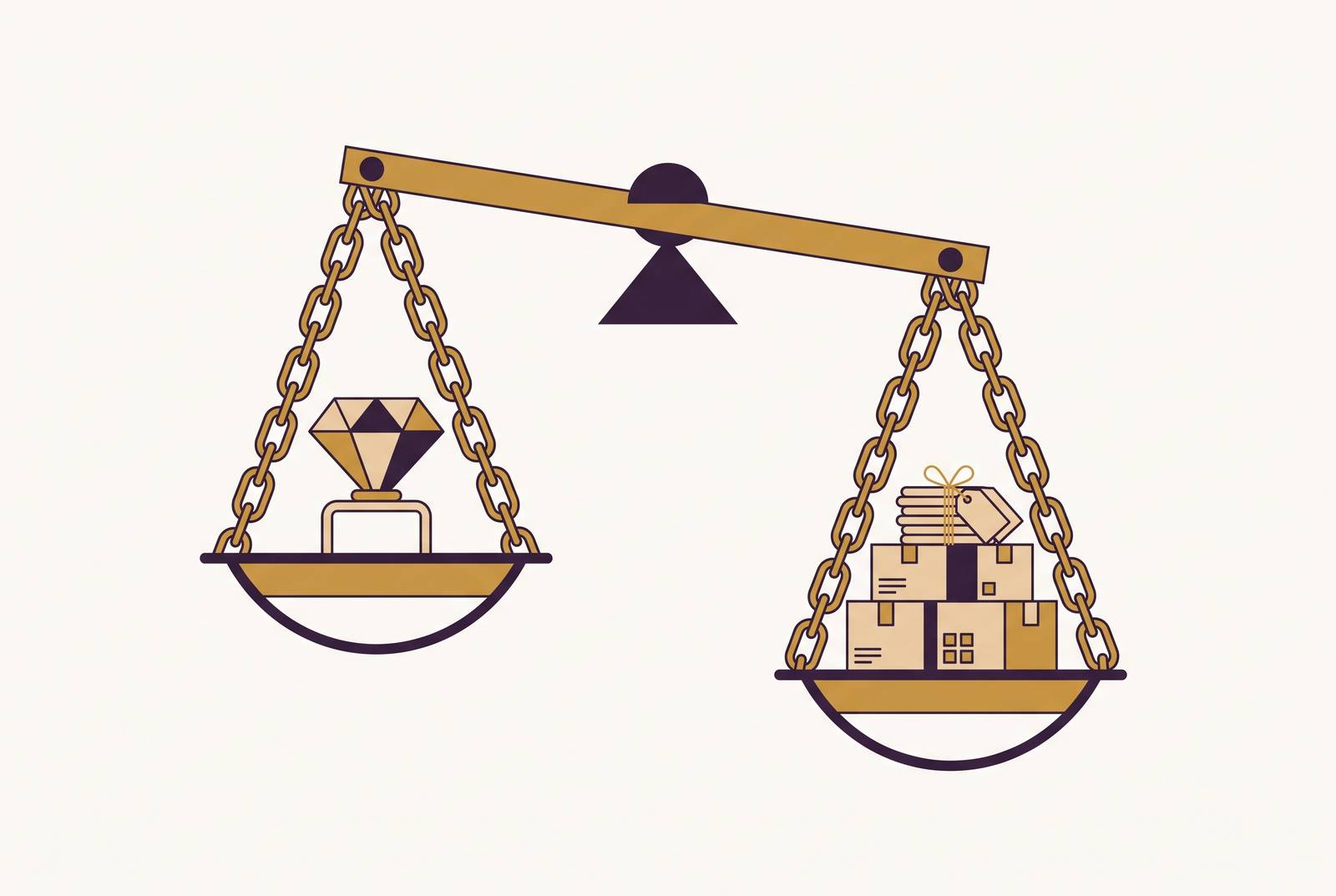
Custom and ready-to-ship jewelry share a storefront, but that's about all they share. The cost structure, the cash timing, the risk sitting underneath each one, none of it lines up. Most jewelers treat the custom-vs-stock question like a product decision: which pieces to make, which to keep on shelves. Really, it's a different business model wearing the same apron.
The overall jewelry market is big and, frankly, kind of boring: $232.94 billion in 2024, on track for $343.90 billion by 2032, growing about 5.10% a year. Nobody loses sleep over numbers like that, since that's what a mature market looks like, the retail equivalent of a savings bond.
Custom is a different animal. That segment sat at $36.98 billion in 2025 and is headed toward $104.89 billion by 2032, growing at 16.06% a year, more than three times the pace of the broader market. Something is dragging buyers toward custom, and it's not subtle. 60% of consumers say they prefer custom pieces for self-expression, and 80% of adults now buy fine jewelry for themselves instead of waiting around for a gift (BriteCo's survey, October 2025), with millennials leading the pack at 86%. People buy on their own timeline now, wanting the piece to feel like theirs rather than something picked off a rack for them.
Add to that: 67% of consumers say they'd rather build a custom piece through their phone or a website than walk into a store. A custom brand without a decent online configurator is basically leaving money folded up in someone's back pocket.
None of this makes custom the smarter bet automatically, since demand pointing up doesn't hand you margin for free. Whether the business actually works comes down to something else entirely.
How gross margin actually behaves across the two models
Jewelry gross margins typically land between 42% and 47%, with net margins for a healthy e-commerce brand somewhere in the 10% to 20% range. Skip the retail middleman and sell direct, though, and gross margin can jump to 60% or 70%. Channel matters almost as much as the product.
Custom pulls ahead here, and not by a hair. Estimated operating margin for custom jewelry sits near 51% for 2026, propped up by high average sale prices. Engagement rings averaging close to $12,000 tell you everything about the pricing power custom carries. Run the per-unit math with similar cost-of-goods ratios, and a standard necklace clears roughly $108 in gross profit while a custom piece clears around $210, almost double on the same sale.
Why? A custom piece can't get comparison-shopped, since there's no identical listing sitting three tabs over. Price anchors to how much the customer cares, not to what a near-identical item costs down the street. Ready-to-ship lives and dies on price transparency; custom lives on the fact that nobody else has this exact thing, ever.
The range for personalized jewelry actually runs 40% to 65%, wide enough that material, complexity, and sourcing swing it around quite a bit. Plenty of custom work never gets anywhere near that top end.
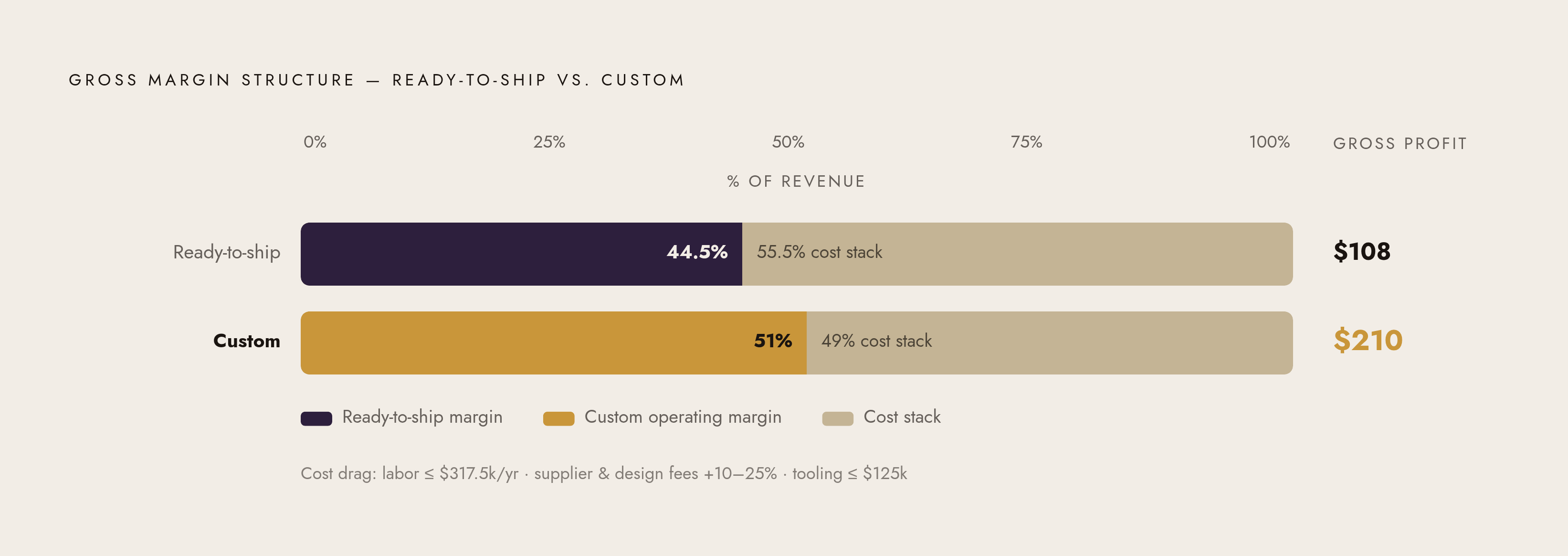
The cost items that close the gap between custom's higher gross margin and its actual profitability
Labor eats the difference. A custom jewelry atelier can carry fixed labor costs up to $317,500 a year at the high end, and that bill shows up whether or not orders do. It's owed either way, like rent on a shop that sometimes has customers in it and sometimes just has you, staring at the door.
Stack more costs on top. Supplier customization fees, engraving, bespoke design work tack on another 10% to 25% to total product cost. Design iteration eats time ready-to-ship never spends: consultations, revisions, rounds of approval that simply don't exist when you're shipping a necklace straight off a shelf. Setting up the operation in the first place, tooling and equipment, can run as high as $125,000 for a full custom shop.
Ready-to-ship carries its own cost, just tucked somewhere less obvious. Inventory sits on shelves, markdowns happen when it doesn't move, and cash gets locked up in stock nobody wants yet. That cost never shows up on a gross margin line, but it's real money, leaving slowly instead of all at once.
Material prices hit both models, just from different angles. Gold moved 18% over 2025, and Morgan Stanley projected prices could approach $4,800 an ounce by late 2026. A brand sitting on gold inventory eats that swing directly. A custom brand just passes it through, pricing at order time or tacking on a surcharge. Custom's margin edge is real, but it needs enough order volume to cover that $317,500 labor line; ready-to-ship trades margin for inventory risk instead.
Cash flow timing and working capital — where the two models feel most different operationally
Ready-to-ship spends money before it makes any: buy the inventory, wait, and hope it sells. Holidays and Valentine's Day mean big upfront buys with zero guarantee the stock clears in time, and every unsold piece is cash frozen behind glass.
Custom flips that order around. A deposit, sometimes the full payment, lands before production even starts, so the customer is effectively financing their own order. Working capital needs drop a lot because of that. For an established custom shop, breakeven can arrive fast, one model projects roughly a month.
Here's the catch: the pipeline has to stay full. A slow month for custom means that $317,500 in fixed labor is running against almost no revenue, a much scarier version of a slow month than ready-to-ship ever produces. Brands running both can lean on ready-to-ship's steadier cash flow to smooth out custom's rough patches, though running two separate inventory and production tracks at once isn't free either.
Return rates, customer lifetime value, and what happens after the first sale
A ring engraved with someone's name isn't going back. There's no resale market for a piece built around one specific person's specific date, so custom has a structural edge on returns that ready-to-ship just can't touch.
Ready-to-ship deals with the usual e-commerce headaches instead: wrong fit, style regret, gifting mistakes. Every one of those returns quietly chips away at the margin that made the original sale look good on paper.
Repeat purchase splits the same way. Custom tends to run on relationships, where a customer who had a good first experience comes back for the next milestone, an anniversary, a kid's first piece, an upgrade a few years down the line. Ready-to-ship repeat purchase runs on merchandising and timing instead, more transactional, less personal. Put a higher gross profit per unit next to stickier customers, and custom's lifetime value compounds in a way a single-sale comparison completely undersells.
There's a catch, though: this only works if the first custom order actually goes well, since lead time, communication, and quality on delivery decide whether there's a second sale at all.
The two biggest conversion blockers for custom jewelry and what they cost in real revenue
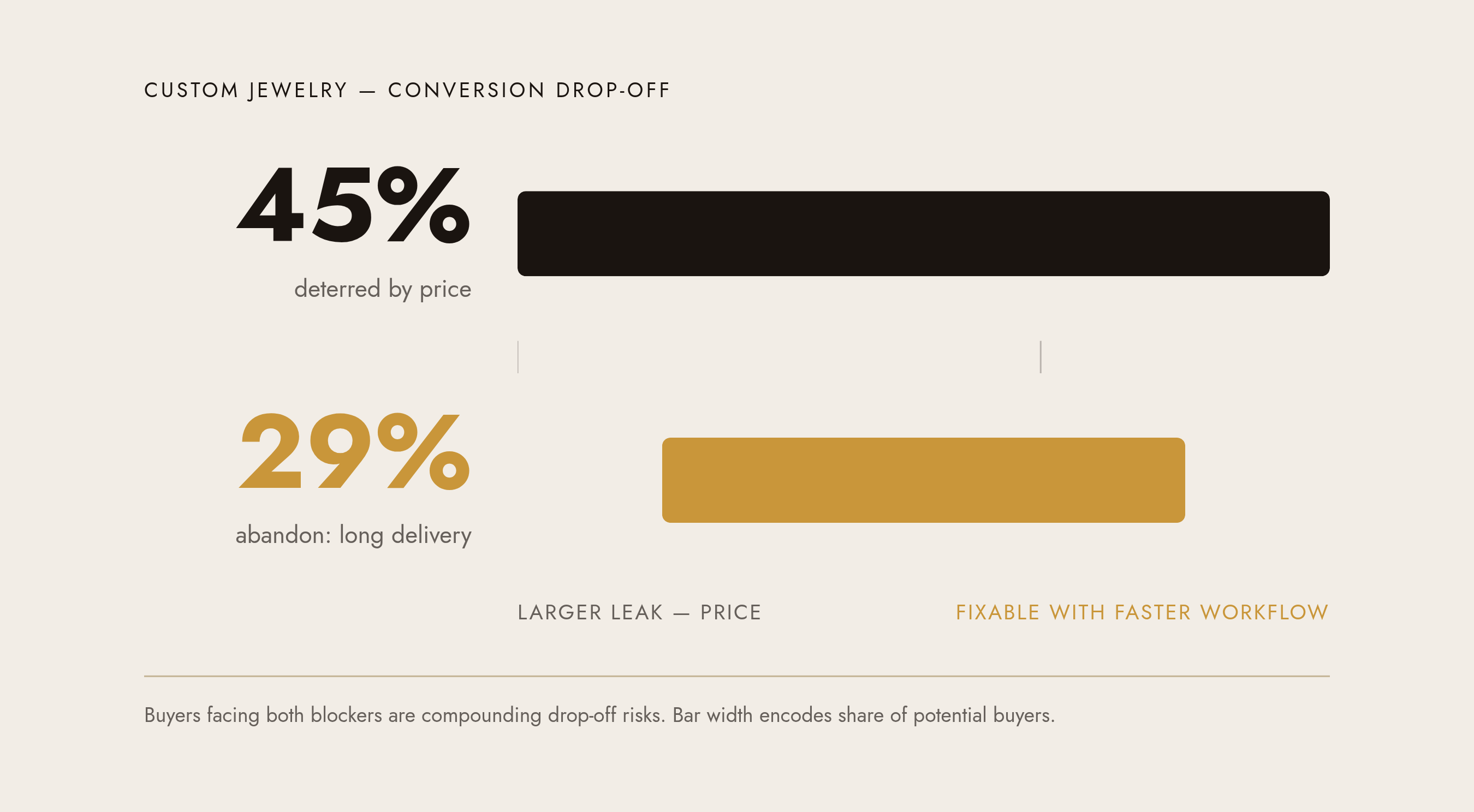
Two things kill custom sales before they close, and only one of them is about money. Roughly 29% of consumers say they skipped customized luxury jewelry specifically because of long delivery times. That's not a small leak, since it's real demand walking away over a calendar, not a design.
The second blocker is price, and 45% of potential buyers say cost deters them from going custom. Some of that is the price genuinely being high, and some of it is the brand failing to make the case for why it's worth paying.
These two problems feed each other, too. A buyer who might stomach a higher price if the wait were short gets a lot more resistant when both the timeline and the cost feel heavy at once. Ready-to-ship skips these two barriers entirely, though it isn't off the hook either; it just trades them for price competition and thinner margins.
That $210 per-unit gross profit figure from earlier only counts if the sale actually closes. Every abandoned custom order is a high-margin unit that vanished before it ever hit the books. Shrinking design-to-delivery time and making the customization process feel effortless recovers revenue that's currently leaking straight out of the funnel.
How parametric and AI-powered design workflows change the cost structure of custom
Skilled CAD work is a substantial investment to develop, and turning a customer's rough idea into a manufacturing-ready 3D file the traditional way costs somewhere between $500 and $2,000 per design when it's outsourced. That's a real tax sitting on every custom order before the ring gets anywhere near a casting furnace.
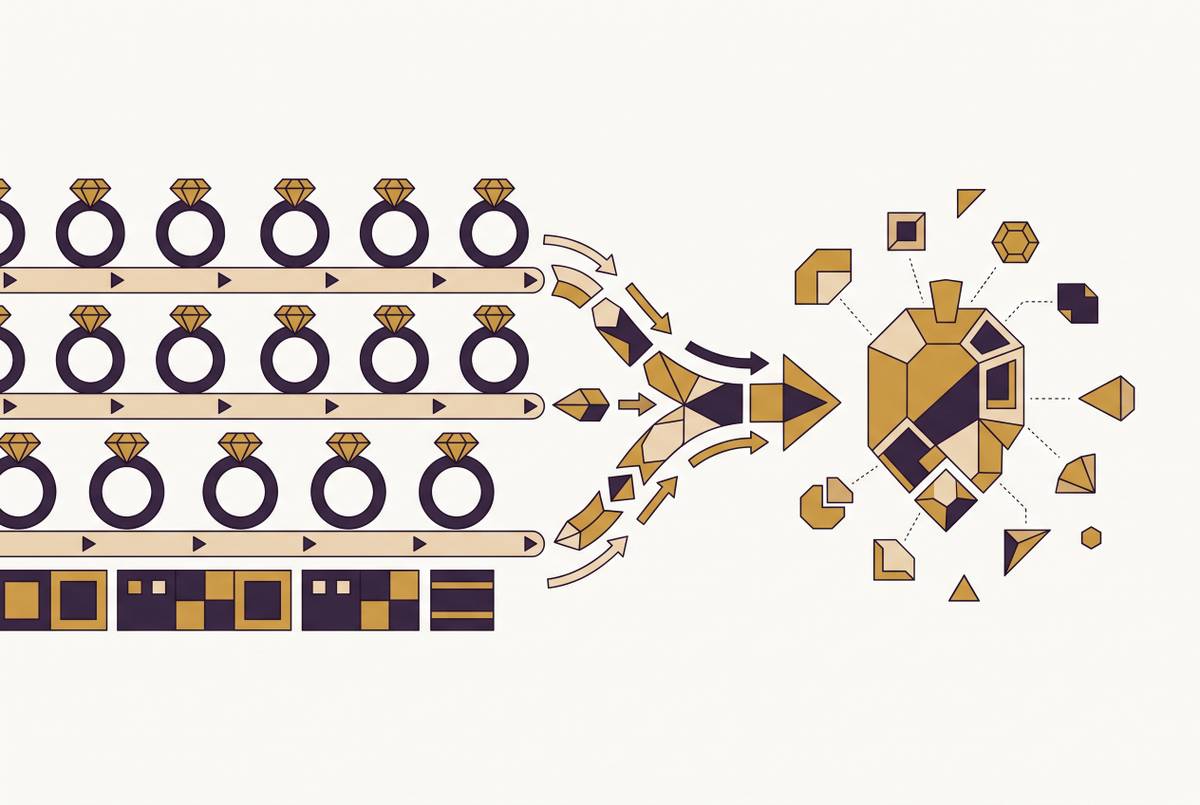
Parametric design changes that math considerably. Instead of building each ring from scratch, a parametric template lets ring size, stone size, metal weight, and halo dimensions get adjusted in minutes. The expensive design work happens once, building the template, not once per order. That's a direct hit to the biggest variable cost in the custom pipeline, and it flows straight to net margin per piece.
AI-native 3D platforms push this further. About 27% of luxury retailers brought in AI-assisted customization software during 2025, meaningfully compressing the design phase. Production-readiness still matters, though, since if the fancy digital design still needs CAD rework before it can get cast, all that saved time sneaks back in through the side door. Every extra step between "customer clicks confirm" and "file is ready to manufacture" is a small margin leak somewhere.
3D printing has become the bridge that makes iteration cheap. A printed prototype costs meaningfully less than casting the same design in solid gold. A shop can therefore test a design before committing real material cost to it. Platforms that go straight from a customer's configuration to a production-grade file skip the conversion bottleneck entirely, turning what used to be a $500 to $2,000 per-order tax into a fixed platform cost that spreads thinner as volume climbs.
What a mixed model actually looks like in unit economics terms
Running both is a hedge. Ready-to-ship gives predictable cash flow and simpler operations, while custom gives higher margin per unit and stickier customers. Put them together and each one covers the other's weak spot.
Here's the math: a brand running mostly ready-to-ship at 42% to 47% gross margin, adding a custom line at 51%+ operating margin, lifts its blended margin with every custom unit it sells. Ready-to-ship revenue keeps the lights on during the slow stretches when custom orders thin out, which takes the edge off that scary fixed-labor problem.
Splitting the product line matters too. Ready-to-ship fits gifting, entry-level price points, impulse buys. Necklaces alone hold the largest share of the market at 34.2% in 2025, driven by both gifting and customization demand. Custom fits milestone purchases: engagement rings, anniversary pieces, the high-spend customers worth holding onto for years.
One rule doesn't bend here: the two tracks have to stay separate. Route a custom order through the ready-to-ship production line and you'll get delays that wreck the custom experience and burn the exact margin advantage that made custom worth doing in the first place. Since 67% of buyers want to configure custom pieces online, the website has to serve both models cleanly, or the ready-to-ship pages quietly steal attention from custom.
Choosing and optimizing your model based on where your unit economics actually stand
The question was never which model has better margins on paper, but whether a given business can run well enough to actually collect the margin its model is supposed to deliver.
Custom's advantage is within reach when design-to-delivery time beats that 29% abandonment number, when parametric tools or AI-assisted workflows keep per-order design cost low enough that the $317,500 labor bill doesn't swallow the gross margin gain, and when order volume is high enough to spread that fixed labor cost across enough units to make it worth it.
Ready-to-ship becomes the safer bet when working capital is tight and inventory needs to stay lean, when the product line has repeat buyers who don't need a relationship to come back, and when the brand's real strength is discovery and merchandising rather than personalization.
One lever moves the needle no matter which model a business runs: closing the gap between what a customer sees on screen and what actually gets manufactured. Configuration tools that hand off production-ready files, no rework, no extra conversion step, remove the quiet cost eating margin in both models at once. The jewelry businesses that come out ahead built the plumbing to actually collect the margin their model promised, instead of just assuming it would show up on its own.