Handling Complex Jewelry Geometries with AI Assistance
Design-intelligence AI ensures jewelry geometries are castable, not just visually stunning.
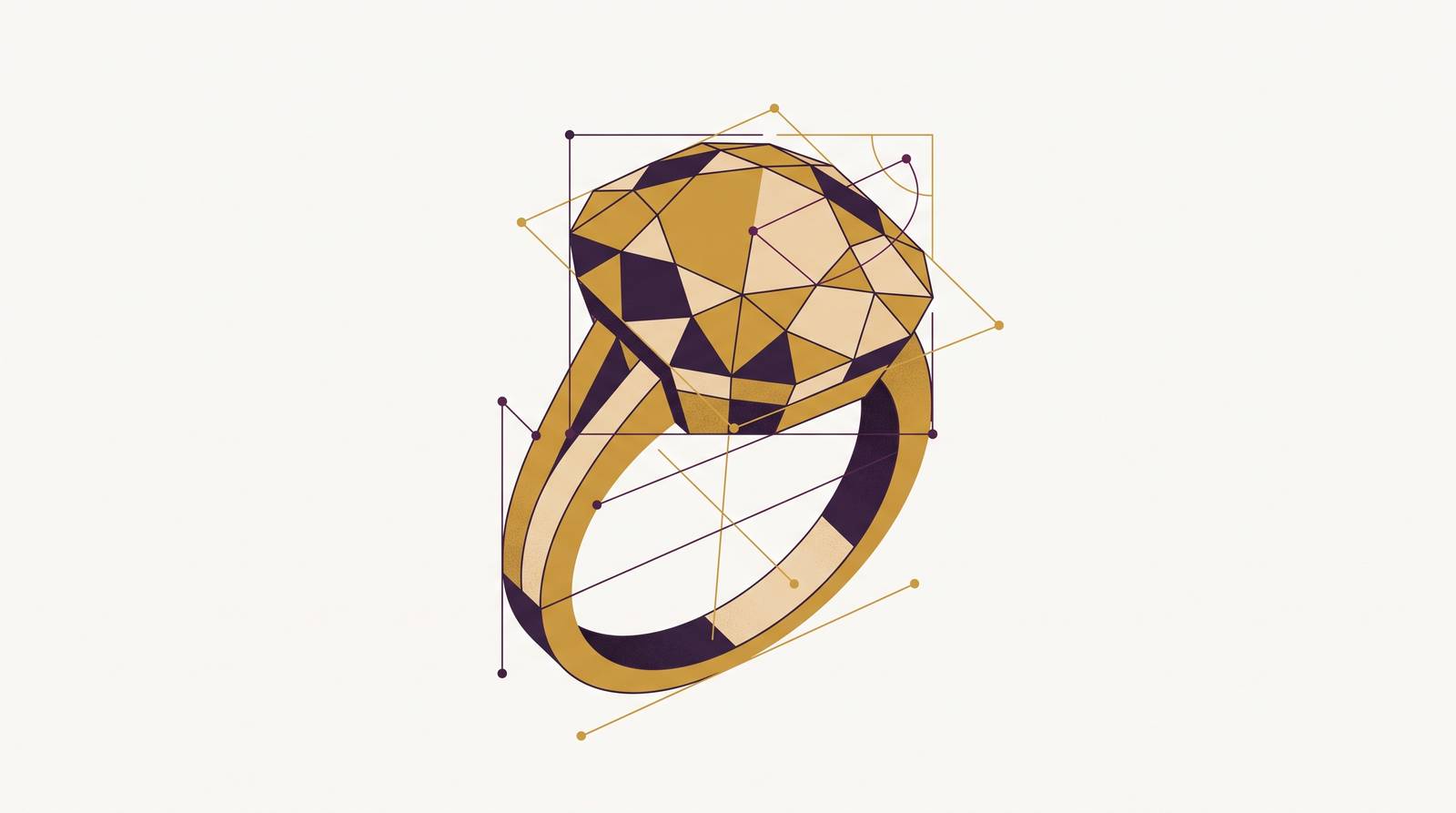
Here's the thing most people miss when they first encounter AI jewelry design tools: looking good and being buildable are completely different problems.
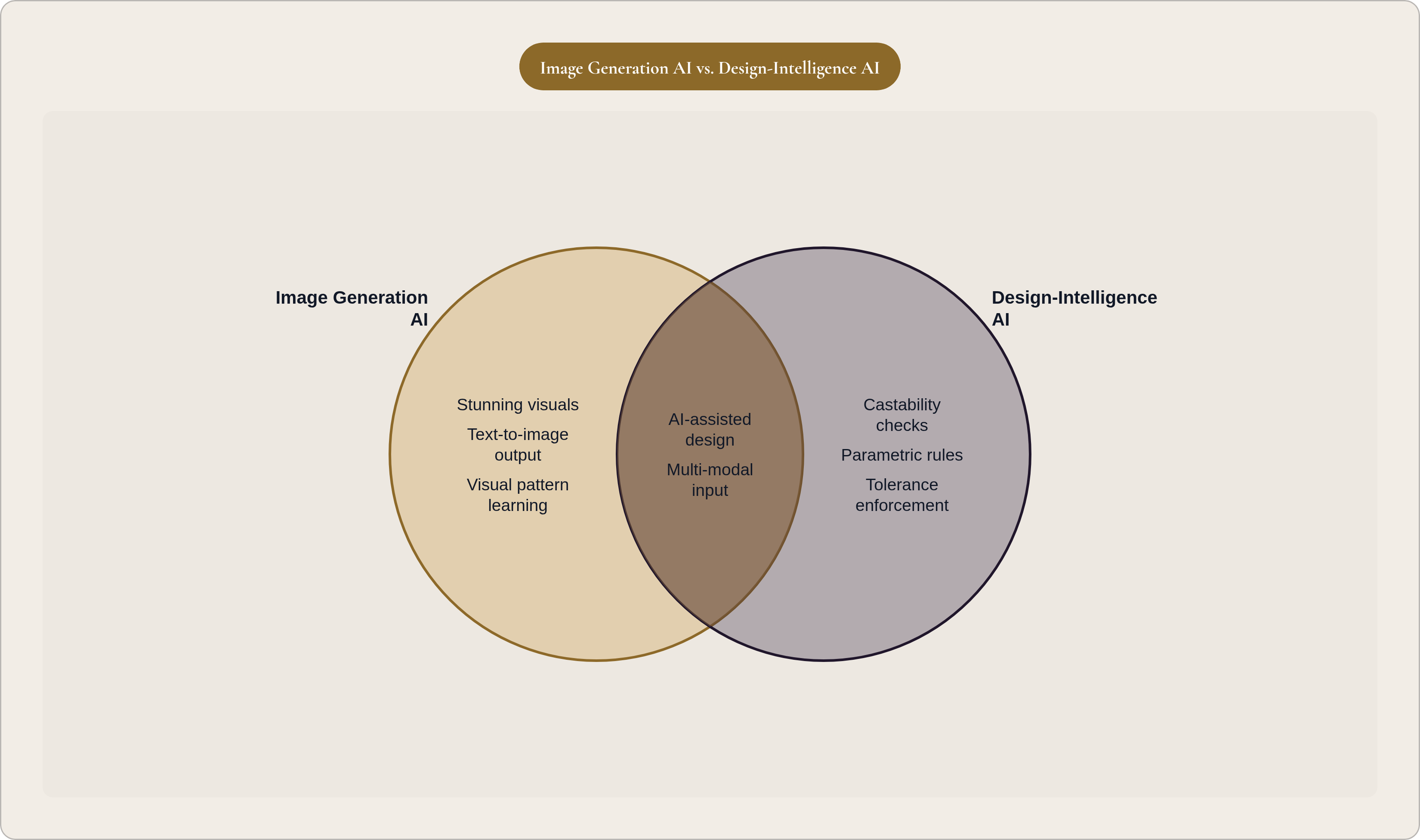
Tools built for image generation are genuinely impressive. They produce stunning jewelry visuals from a text prompt or a rough sketch. GIA's research in Gems & Gemology (Fall 2024) captured their limitation clearly: these tools excel at visual generation while falling apart on structural accuracy. Prong geometry gets hallucinated. Settings are physically impossible. Compositions look right but can't be cast.
That's not a criticism. Those tools were simply built for a different purpose.
Design-intelligence AI is a different animal entirely. Instead of learning visual patterns, it encodes manufacturing rules. Wall thickness minimums live inside the generation constraints, not in a checklist you run afterward. Prong strength rules update automatically as stone count changes. Stone clearances recalculate as the surrounding curve shifts. Castability gets checked before output, not after the first failed prototype comes back from the caster looking like a crime scene.
The structural foundation underneath all of this is parametric modeling. In a parametric model, geometry is built from a sequence of editable steps, so when you change one input (stone size, ring size, halo width), the model updates throughout. Jewelry CAD Dream has demonstrated this running cleanly on models with 500 or more gemstones. That's the engine. AI layers on top of it, suggesting, constraining, and validating. It doesn't replace the geometry engine. It makes the geometry engine accessible to people who never learned to speak CAD fluently.
The input change matters too. Older CAD tools demanded technical fluency. Next-generation platforms accept text, sketches, image references, even voice. That matches how designers actually think, which turns out to be less "I will now input a parametric constraint" and more "something like this, but softer, more botanical."
How AI handles undercuts and interlocking structures
Undercuts are among the most reliably annoying problems in jewelry casting, and they're annoying in a specific way: they don't always announce themselves until something tears.
Any recessed geometry that traps investment material or prevents clean removal of a wax or resin pattern from its mold is an undercut. Experienced CAD operators miss them on complex assemblies all the time because a 3D view doesn't always surface them. You find the problem when you try to demold the wax, or when the casting comes back wrong, or both.
AI-assisted tools move that discovery earlier. Automated manufacturability checks, wall thickness validation, prong strength flags, castability reviews. These run at the design stage, before anything physical exists. Not because AI is smarter than an experienced operator, but because it runs the checklist every single time without forgetting. That's the actual value.
Interlocking structures (articulated links, hinged elements, anything that moves) are fundamentally a tolerance problem. Too tight and the pieces bind. Too loose and they rattle or fall apart. In traditional CAD workflows, adjusting dimensions means manually recalculating clearances. AI tools that encode tolerance rules maintain those clearance relationships as dimensions change. The recalculation just happens.
And because high-resolution resin printing can hold tolerances down to 25 microns (0.025 mm), the precision in the digital file actually shows up in the physical pattern.
One thing worth being clear about: AI enforces the rules once design intent is set. Whether an interlocking structure should move freely or lock in place is still a human call. AI doesn't make that decision. It just makes sure the geometry honors whatever you decided.
Micropavé at scale — the stone-setting geometry problem AI is well-suited to solve
Micropavé is tedious in exactly the way computers are good at and humans are not.
Each stone in a pavé array needs a seat depth calibrated to that stone's diameter, cut, and girdle thickness. It needs consistent prong or bead placement. It needs sufficient wall thickness between adjacent seats so the metal doesn't collapse during casting. And the spacing logic has to follow a curved surface without distorting the whole array. Get any of those wrong across 200 stones and you're looking at a weak setting, a failed casting, or a scrapped piece. Finding the error post-cast is expensive. Finding it pre-cast is less expensive but still means redesign and reprint.
Parametric AI handles this at scale because the rules aren't applied stone by stone. They're embedded in the array logic itself. MatrixGold's parametric tools do this for eternity bands and halo configurations. Change the stone size, and seat geometry recalculates across the entire array. Jewelry CAD Dream has demonstrated stable feature history on models with 500 or more gemstones.
The commercial implication is straightforward. A designer without deep CAD training can specify a three-row micropavé band and receive a production-ready file, because the geometric intelligence lives in the platform rather than in the operator.
The 3D-printed jewelry segment, where pavé and complex setting work is most concentrated, is projected to grow from USD 6.8 billion in 2025 to USD 21.5 billion by 2035. That kind of trajectory doesn't happen because a niche audience is interested. It happens because the tools are making previously inaccessible complexity routine.
Organic and freeform curves — where direct modeling and AI generation meet
Organic shapes are where parametric modeling runs into its own limits, and it's worth being honest about that.
Parametric logic works beautifully when geometry decomposes into editable steps. Nature-inspired forms, sculptural shanks, irregular surface textures. These don't decompose cleanly. Editing a parametric organic model often means rebuilding the surface from scratch rather than nudging a slider.
Firestorm CAD takes a different approach entirely. It's direct modeling software, meaning you push, pull, and twist geometry rather than defining it through parameters. Genuinely more suited to freeform work. The learning curve just points in a different direction than parametric CAD does.
AI generation adds something both approaches lack: a starting point that isn't a blank screen. Feed in a sketch, a text description, and an image reference. The AI generates organic surface variations. The designer refines from there. That matches how designers actually conceive organic pieces, not as parameter values but as visual references and gut feelings. Multi-modal input (sketch plus text plus image) honors that process instead of fighting it.
One genuine limitation worth knowing: metal surfaces create complex reflection patterns that confuse image-based AI analysis. Reproducing or interpreting an existing piece from a photograph is a real problem. Generating from scratch is much less affected, and that's increasingly the primary use case anyway.
The remaining tension is real, though. Organic AI output still needs validation for wall thickness and castability. Generation and manufacturability checking are two separate steps. The best platforms integrate them. Others leave them disconnected, and you find out the hard way what "disconnected" means when a beautiful generated surface turns out to have walls too thin to cast.
The digital-to-physical thread that makes AI-designed complexity manufacturable
A geometrically sound file matters only as much as what happens after you close the design software.
The integrated pipeline is what makes AI-designed complexity actually land in metal. Capture, design, validation, production planning, manufacture, verification. Data flows automatically between stages. Manufacturability checks happen before production begins. No manual re-entry. No geometry lost in translation between tools.
The dominant physical output path is lost-wax casting via high-resolution resin. Resin patterns printed to 25-micron detail feed directly into casting in gold, silver, or platinum. AI-designed pavé arrays, undercut profiles, organic surfaces. They all translate to physical pieces when the digital file is geometrically sound. When it isn't, that's where an integrated pipeline catches the problem before it costs you a casting.
For structures that casting can't produce, selective laser melting and direct metal laser sintering build fully solid metal pieces layer by layer from titanium, stainless steel, 18K gold, and platinum. Filigree, lattice, and micro-pavé structures that are difficult or impossible to mill find a home here. Post-processing is intensive and this path is primarily for luxury custom and artistic one-offs. But it handles geometry that no other method can, which matters when a client wants something that has genuinely never existed before.
Digital twins close the verification loop. A finished casting gets scanned and compared against the digital master. Shrinkage, warping, surface defects. Caught before the piece ships. This works specifically because AI-designed geometry has a precise reference to check against. Hand-carved wax doesn't.
"Production-ready" means something specific here: the geometry a customer or designer sees is the exact geometry that gets cast. No translation. No bench jeweler trying to interpret what the designer probably meant.
What changes for designers and studios when geometry complexity is no longer a skill barrier
The biggest shift is where skill lives, not whether it matters.
Deep CAD expertise moves from a prerequisite to a specialization. Still valuable. Still necessary for edge cases and genuinely novel structures. Just no longer required to produce production-ready complexity. For independent designers, that means attempting geometries that previously required a studio with dedicated CAD staff. For boutique studios, it means offering micropavé, organic forms, and interlocking designs without outsourcing the hard parts.
Speed changes too. Running through dozens of digital design variations before committing to a single prototype is now realistic. The pre-AI baseline for something like a filigree ring looked like this: two wax iterations, around 14 artisan hours, two days of queue time. Per a 2025 audit of a regional atelier. That's the cost structure AI-assisted pipelines are competing against, and it's not a close contest on turnaround time.
For boutique studios and independents, bridal is the commercial opportunity that makes this concrete. Most couples now choose customized rings over off-the-shelf designs. Studios that can execute complex geometry in-house, quickly, without outsourcing, have a direct advantage. The ability to say yes to a request and deliver it in the same week is a different business than the one most boutique studios have been running.
For enterprise brands, the model looks different. Parametric platforms let design parameters be exposed directly to customer configurators. Customers adjust stone size, band width, setting style. The geometry recalculates without a designer in the loop. AI-driven design suggestions informed by consumer preference data have moved upselling rates meaningfully. A 2023 audit of 300 jewelry brands found 18% had return rates over 12% due to inconsistencies in customized products. Production-ready geometry from the configuration stage addresses that problem at the source.
The honest limit: AI encodes known manufacturing rules. Novel structural innovations, truly unprecedented geometries, and design intent still require human authorship. AI is accelerating the execution of complexity, not generating the ideas behind it. The best platforms are built around that distinction rather than pretending it doesn't exist.