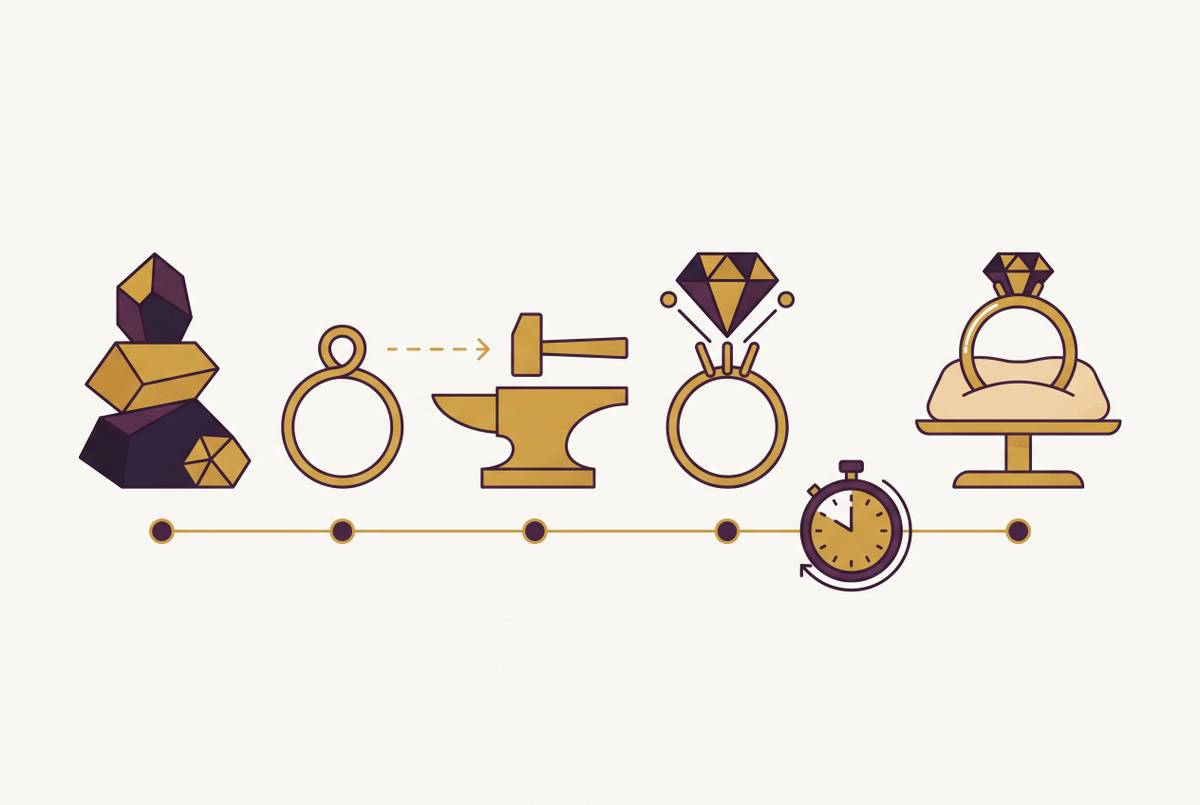
Supplier Coordination Cadence for Custom Jewelry Fulfillment
Scheduled supplier check-ins at each production stage prevent costly delays and rework.
Custom jewelry orders fall apart most often not because you picked bad suppliers. They fall apart because the right people heard from you at the wrong moments. A missed check-in that takes two days to surface becomes a two-week delay by the time it reaches the casting stage. The fix is a cadence: scheduled contact at each stage, with defined outputs before anyone moves forward.
Why the timing of supplier contact determines custom jewelry outcomes
A custom order gets cast only after it passes four approval gates. Those gates are design approval, file handoff, prototype sign-off, and material confirmation. When silence fills the gaps between those gates, small problems compound. A misaligned stone seat caught at prototype review costs a day to fix. The same issue caught after batch casting means scrapping the entire run.
You can work with excellent casting houses and skilled stone setters and still lose weeks to rework. The supplier wasn't wrong. The timing of the conversation was. Standard production tolerates a loose message here and there because the process is fixed and repeatable. Custom work has no such slack. Every order is a one-off, and every stage depends on information flowing before the next stage starts. A cadence means scheduled, stage-specific contact with defined outputs at each check-in, not ad hoc messages when something breaks.
The digital-to-physical handoff as the first high-stakes coordination point
The transition from a digital design to a manufacturer-ready file is where supplier misalignment usually begins. What a client approves on screen and what a caster or printer can actually use are two very different artifacts. The format distinction is operational, not cosmetic. An STL is a frozen mesh. It prints and mills fine but resists editing the moment anything changes. A 3DM stores NURBS geometry and, optionally, construction history, so geometry can be modified when a shank changes or a stone gets resized. Casting houses generally want 3DM. Printers take STL.
A parallel trap compounds this. CAD for manufacturing contains dimensional data and goes to manufacturers. CAD for rendering is photorealistic and goes to customers. These workflows do not overlap, and conflating them causes supplier friction and production delays. Sending a render file to a caster is like handing a sketch to a machinist and asking for a part. The first cadence checkpoint therefore happens before any file leaves the design stage. Confirm with the receiving supplier which format they require. Check whether the file carries correct wall thickness and shank tolerances, true stone seats with proper undercuts, and millimeter-true dimensions in the correct ring size. AI-assisted design shifts the timing of this check. The AI-driven workflow starts CAD after clearer client approval and with less revision churn, which means the file handoff can happen earlier and with higher confidence. But that only holds if the supplier is briefed on what an AI-originated file looks like versus a traditional CAD file.
Structuring supplier touchpoints through the prototype and mold stage
Prototyping is where supplier coordination failures become physically visible and most expensive to correct. It demands the densest concentration of touchpoints in the entire workflow. At least three distinct supplier contacts belong here. First, file delivery and specification confirmation before printing begins. Second, review the physical prototype for fit, wall thickness, and stone-seat geometry before you make any mold. Third, mold approval before batch wax injection starts.
The wax-injection process can be repeated many times from a single mold, which enables batch production. You assemble multiple wax copies onto a wax tree, so several pieces can be cast simultaneously. An error approved at mold stage multiplies across the entire batch. That is the costliest failure in custom jewelry, and it comes from one skipped confirmation. The in-house compressed schedule shows what a minimum viable cadence looks like when supplier and studio are tightly integrated. Morning: finalize design. Afternoon: modify CAD. Evening: print wax overnight. Day two: lost-wax casting. Day three: polishing, stone setting, and final inspection. Each transition is a checkpoint, not an assumption. If you outsource wax printing, every one of those transitions becomes an explicit supplier communication. Not a same-day handoff but a scheduled confirmation with defined acceptance criteria before the next stage begins.
Stone setter and finishing supplier coordination as a separate cadence track
Stone setting is not a continuation of casting. It is a separate craft with its own supplier relationship, lead time, and specification requirements. It must be coordinated in parallel, not assumed into the sequence. Stone setting takes two to four days. Finishing and inspection take additional days. Both stages require confirmed stone availability, setting style specification, and finishing instructions before the cast piece arrives.
The specification handoff to a stone setter must include three things. Stone dimensions as they appear in the CAD file, not the client's verbal description. Setting style confirmed against the caster's output tolerances. Any engraving or surface treatment that must happen before or after setting. Skip this and you get a familiar failure: the setter receives a cast piece with no advance notice of stone dimensions or setting type. That delay can equal the entire stone-setting stage while corrections get made. That is preventable with a parallel briefing sent at prototype approval, not at casting completion. For made-to-order brands, such as Olertis, a US-based custom jewelry company specializing in gold and platinum with an order-driven production model, parallel supplier coordination is the operational norm rather than the exception. Each order is unique and no standing inventory buffers a missed touchpoint.
How parametric design and digital configurators change the upstream cadence
When a configurator generates production-ready specifications automatically, supplier coordination moves upstream. It shifts from per-order file handoffs to system-level agreements about what the configurator can and cannot produce. With parametric systems, each order adapts automatically to customer input, so you avoid manual intervention and repeated modeling. That reduces per-order supplier friction only if suppliers have been pre-briefed on the full range of parameter combinations the system can output.
A production-ready B2B configurator raises the technical bar. It needs a parametric engine that recalculates geometry instantly, real-time inventory and pricing sync, and automatic BOM and CAD export so the order moves straight to production. Each of those needs a supplier agreement before the configurator goes live, not after orders start arriving. Pricing sync is a concrete operational risk. File-feed updates on a daily cycle create windows where a buyer can configure and quote a combination that is already out of stock or mispriced. API-based sync, pulling from the product feed on every session, closes that gap. The supplier coordination required to enable API sync must happen at platform setup, not per order. JewelCloud's RingBuilder connects retailers to JewelCloud's structured feed so pricing and inventory reflect real wholesale data from day one. That is a configurator built on pre-established supplier data agreements rather than manual per-order coordination. Brilliant Earth's product configurator lets customers design engagement rings online with 360-degree diamond viewing and virtual try-on, choosing diamond shapes, quality, settings, and diamond origin. It is a consumer-facing example where the supplier coordination enabling real-time configuration happened entirely before the customer interaction. Parametric scale moves the cadence earlier. It does not eliminate it.
Managing cadence across multiple suppliers when orders scale
The coordination methods that work for a handful of monthly custom orders break down when volume grows. The same manual touchpoints that are manageable at low volume become the primary bottleneck at scale. Customized jewelry requires specialized skills, manual craftsmanship, and individualized workflows, which makes mass scaling genuinely hard. Supplier coordination is one of those individualized workflows. It must be systematized before scaling begins, not after problems accumulate. The made-to-order model's financial logic depends on tight coordination. You get lower inventory risk, higher inventory turnover, less capital locked in unsold merchandise, and higher profit margins. Those benefits evaporate when supplier delays convert short production cycles into long ones.
At scale, a jewelry PIM functions as the coordination layer. A specialized jewelry PIM stores every granular detail: metal purities, stone weights, GIA certification numbers, alongside high-resolution imagery. It ensures brand voice remains consistent across every touchpoint. More importantly, it becomes the single source of truth that every supplier draws from. That reduces the version-control failures that happen when specifications get communicated ad hoc. Virtual Stock serves as a cadence tool for multi-channel operators. It allows selling based on component availability rather than finished pieces. If the stones and settings are ready, the system knows fulfillment is possible even before the ring is assembled. Supplier component confirmations become a scheduled system event, not a per-order phone call. The sensible operational progression: establish custom operations through direct-to-consumer or made-to-order models first. Build supplier relationships and cadence discipline there. Then transition to wholesale after the coordination system is repeatable, not before.
Building a repeatable supplier cadence: the stage-by-stage touchpoint map
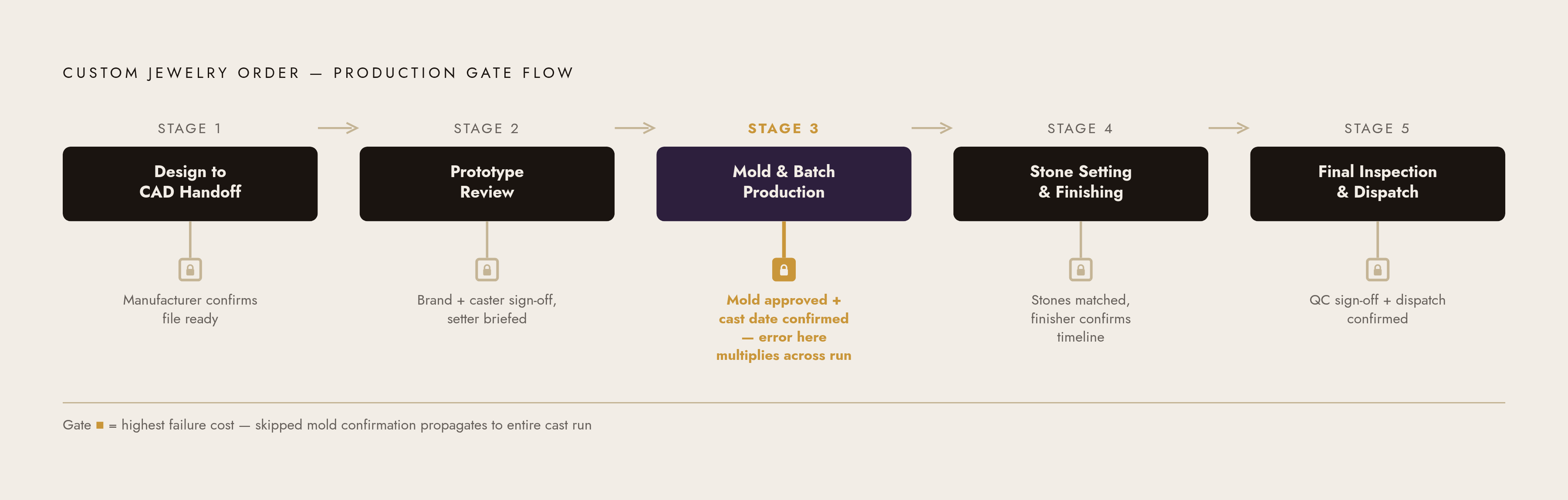
A repeatable cadence is not a communication policy. It is a touchpoint map: a defined set of contacts, at defined moments, with defined outputs required before the next stage begins. The same for every order, regardless of complexity. Here is the map that turns the principles into schedulable actions.
Stage 1, Design to CAD handoff. Before export, confirm with the casting house or printer which file format they need, 3DM or STL. Confirm wall thickness, shank tolerances, and stone-seat specifications against the manufacturer's stated requirements. Confirm that the file sent to the manufacturer is the manufacturing CAD, not the rendering CAD. Separate documents, separate sign-offs. Output required before advancing: written confirmation from the manufacturer that the file is production-ready.
Stage 2, Prototype review. Schedule physical prototype review with the caster or printer before mold creation begins. Confirm fit, wall integrity, and stone-seat geometry against the CAD specification. Send a parallel briefing to the stone setter at prototype approval covering stone dimensions, setting style, and finishing requirements, so the setter is ready when the cast piece arrives. Output required before advancing: prototype sign-off from both brand and caster, and stone setter briefing confirmed received.
Stage 3, Mold and batch production. Confirm mold approval before wax injection begins. This is the last point to catch a systemic error before it multiplies across the batch. Confirm batch quantity and casting timeline with the caster against the order delivery commitment. Output required before advancing: mold sign-off and confirmed casting completion date.
Stage 4, Stone setting and finishing. Confirm stone availability and delivery to the setter before cast pieces ship from the caster. Confirm setting and finishing instructions are unchanged from the prototype-stage briefing. Schedule finishing and inspection completion date against the customer delivery commitment. Output required before advancing: stone setter confirms stones received and specifications matched, and finishing supplier confirms timeline.
Stage 5, Final inspection and dispatch. Quality check against the original CAD specification and client-approved render. Not a visual impression but a documented comparison. Confirm dispatch date and carrier with the fulfillment supplier. Output required before advancing: QC sign-off and dispatch confirmation to the customer.
The cadence works because every stage has a defined exit condition, a required output that cannot be waived. Skipping a touchpoint is not a time-saver. It is a delayed problem with a higher correction cost. You can build your own version of this map for your specific supplier set. The shape is the point: defined contact, defined moment, defined output.
Where AI-powered design tools fit into a supplier cadence and what they change
AI design tools reduce cadence friction most in the stages where information ambiguity is highest: the client brief to approved design. AI-assisted workflows generate many concept directions early. That makes it easier to converge on taste faster, reduce revision churn, and keep the project within budget. The CAD handoff to a manufacturer happens from a cleaner, more confirmed starting point, which reduces the chance of supplier-facing corrections downstream. The hybrid workflow winning in 2026 runs AI at the front for concept and a first file, and CAD at the back for variations and manufacturing prep. The supplier cadence remains structurally the same. The design phase before it is shorter and produces higher-confidence files.
AI does not change one critical distinction. Final engineering, including stone seats, tolerances, prong thickness, and weight balance, still requires human craft and supplier confirmation. Manufacturing decisions like casting, setting, finishing, and QC still require the same. AI shortens the path to the cadence. It does not replace the cadence. Platforms that output production-ready CAD directly from a configuration, rather than stopping at visualization or a render, compress the design-to-supplier-handoff stage most aggressively. The file that goes to the manufacturer gets generated as part of the design session, not assembled afterward. That capability makes the first touchpoint in the cadence faster and more reliable. For independent designers and enterprise brands alike, the most durable efficiency gain is not a faster design session. It is a cleaner file handoff. A file that a caster can use on first receipt eliminates an entire round of supplier back-and-forth that the cadence would otherwise require. The cadence is the structure. AI is the accelerant.