Version Control for Jewelry CAD Files Across Multi-Designer Teams
Jewelry studios need PDM systems, not Git, to track binary CAD files safely.
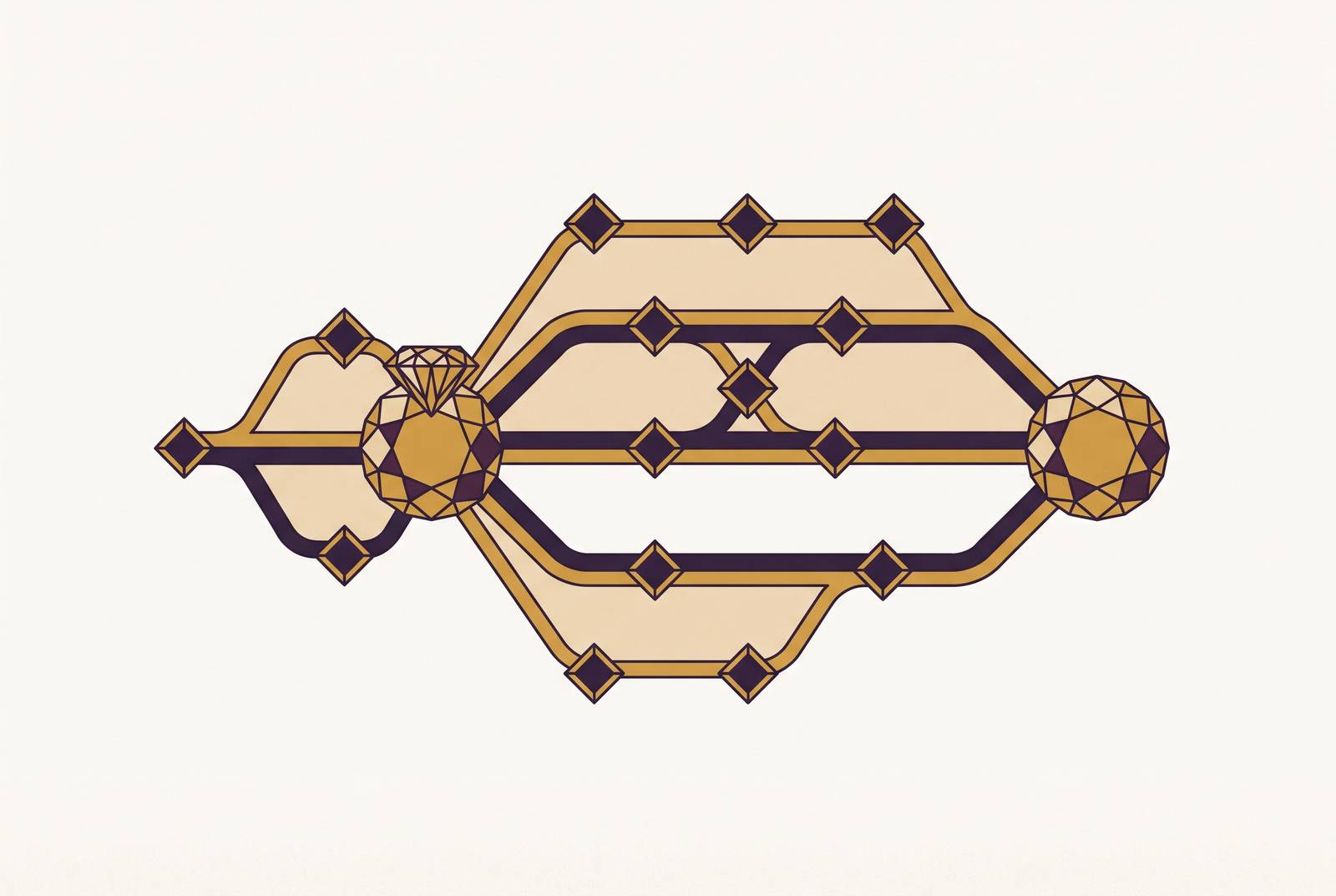
Most jewelry studios solve a version problem the same way: rename the file, add "v2," drop it in a shared cloud folder, and hope nobody opens the wrong one. That instinct makes sense because it works for a Word document. It fails for CAD because the file underneath isn't text, it's binary, and binary files don't let you compare one version against another the way software teams compare code. RhinoGold, 3Design, and MatrixGold all export the.3dm format, and it's binary, even though its documentation is open. JewelCAD uses its own proprietary binary format. Either way, a developer's go-to move, running a diff to see what changed between two versions, simply doesn't work on these files. There's nothing to read.
This isn't limited to jewelry-specific software. SolidWorks.sldprt files are OLE Structured Storage containers. AutoCAD's DWG format is Autodesk's own proprietary binary. No standard version control tool can diff or merge either one. That matters because it rules out the most basic coordination trick software teams rely on: letting two people edit the same file and merging their changes automatically. With CAD, if two designers touch the same file at the same time, one of them loses their work with no way to combine the two. Every version control approach for CAD has to accept that constraint outright or quietly cover it up.
File size adds another wall. A single small-to-mid jewelry product assembly, counting part files, assembly files, and drawings, can run into gigabytes of active data. Git was built to track lines of code efficiently, not to shuttle gigabyte-sized binaries back and forth on every commit. PDM systems were built for exactly that job, which is the first hint that software-team tools and jewelry CAD tools are solving different problems even when they look similar on the surface. Studios running more than one CAD platform, say RhinoGold for one line and 3Design or MatrixGold for another, stack format incompatibility directly on top of this mess. Format incompatibility and the inability to diff or merge binary files are two separate problems pretending to be one.
Parametric interdependencies and jewelry CAD fragility under multi-designer conditions
Jewelry CAD carries a structural property that makes the general CAD problem worse: nearly every file is a parametric web, not a standalone object. A single project usually runs on a main assembly plus dozens, sometimes hundreds, of referenced part files, drawings, and cross-references, and all of them need to stay current at the same moment. An assembly that treats any one of those files as independent can quietly stop making sense.
Export and import cycles make this fragile in a specific way. When a design gets exported and the same parts get pulled into another file, those parts are imported again rather than linked back to the original, and the references between them don't survive the round trip. Someone has to manually rebuild those relationships, which is slow and invites mistakes on exactly the kind of deadline where mistakes are expensive.
Folder structure causes a similar failure, just less obviously. SolidWorks assemblies point to their part files with an absolute or relative file path. Move a folder to clean up a shared drive and those paths can break; the assembly then opens with parts missing or unresolved. Git and Subversion have no idea this happened. Neither tracks or updates file references when something gets renamed or relocated, so the assembly opens with a mystery break instead of a flagged error. Dedicated PDM systems do track this, which is the main reason they exist.
Some teams respond by splitting large designs into smaller documents, because they hope finer granularity gives them more control. It tends to do the opposite: more documents means more reference chains, and more reference chains means more places for the same breakage to happen.
Software with real parametric history helps here, but only partway. 3Design and MatrixGold both support parametric histories, so a designer can modify or resize a piece at any stage without losing earlier work, and that functions as a built-in version layer for the geometry itself. That history is only trustworthy if the files feeding it are controlled with the same rigor. A designer who updates a stone dimension on a shared prong component needs to know whether a colleague is mid-session on an assembly that references that exact component. Without some kind of check-out signal, there's no way to know, and the two edits collide anyway.
The three breakdown patterns that recur on multi-designer jewelry teams without a formal system
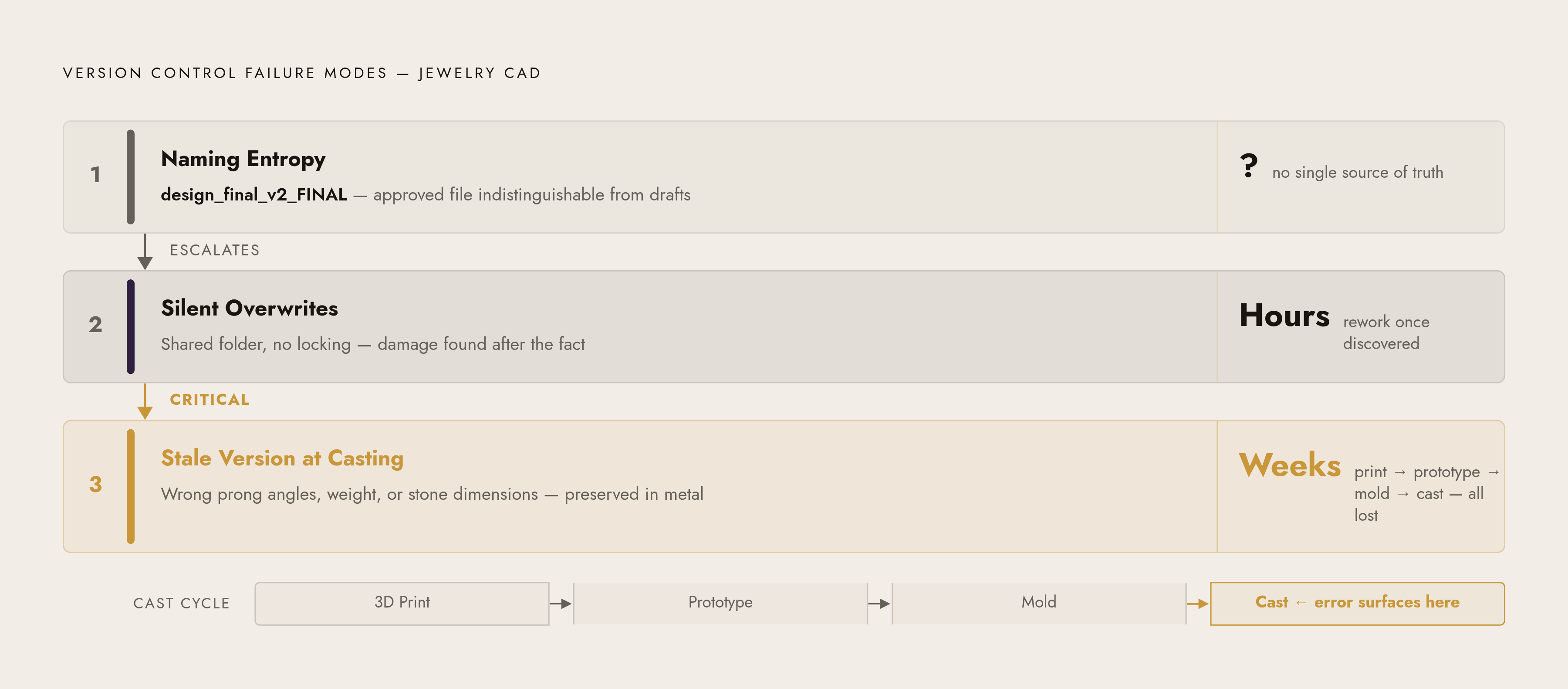
Teams without a formal system tend to break down in one of three recognizable ways, and each one has its own cause and its own price tag.
The first is naming entropy. Filenames like "design_final_v2" multiply until nobody can tell which one is actually approved for production. Standards exist to prevent this. ISO 19650 Annex A, for instance, recommends a structured naming format built from seven fields: Project, Originator, Volume, Level, Type, Role, and Number. Almost no small jewelry studio adopts something like this, so the filename stops carrying any real information, and it becomes decoration instead.
The second pattern sits in the middle ground between file locking and no locking. Locking works by flagging a checked-out file so the rest of the team sees it's in use and plans around it, which prevents two people from editing the same thing and creating a conflict neither can resolve. The tradeoff is that locking slows a team down, since only one person can touch a file at a time. The riskier spot is the middle ground: studios that dump files into a shared network folder with no locking mechanism at all get neither the coordination benefit nor the speed. They just get silent overwrites, discovered only after the damage is done.
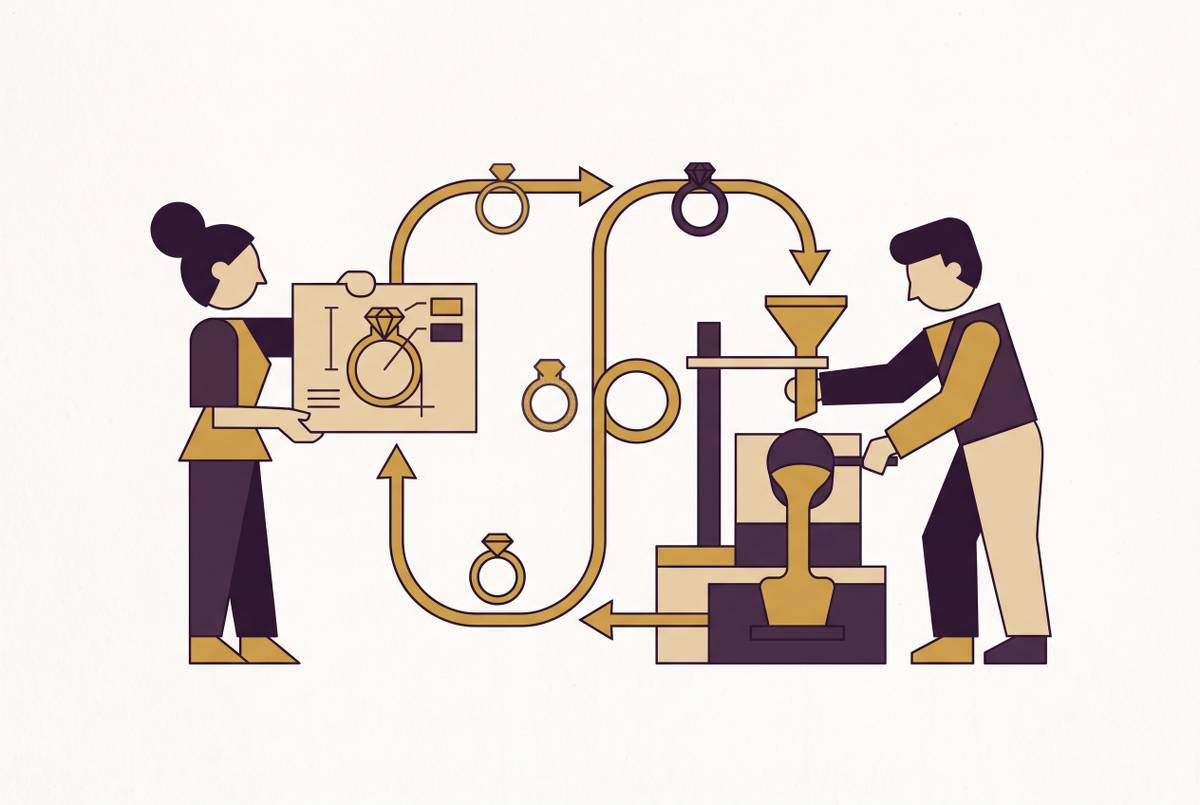
The third pattern is the most expensive: a stale version makes it all the way to the casting floor. At that point the wrong prong angles, the wrong metal weight, the wrong stone dimensions are no longer a file problem, they're a physical object. The path from CAD design through 3D printing, prototype review, mold making, and casting can take anywhere from a few days to several weeks, so a version mistake caught late means redoing real time instead of reopening a file. A lot of studios print using something like Formlabs' Form 4 with Castable Wax 40 resin, a common MSLA path for jewelry prototypes. The resin burns out clean during casting, which sounds like good news until you realize what it actually means: the metal cavity reproduces the CAD file exactly, wrong prong angles and all. The process doesn't correct mistakes. It preserves them in metal.
The version load AI-assisted concepting adds before a CAD file is officially opened
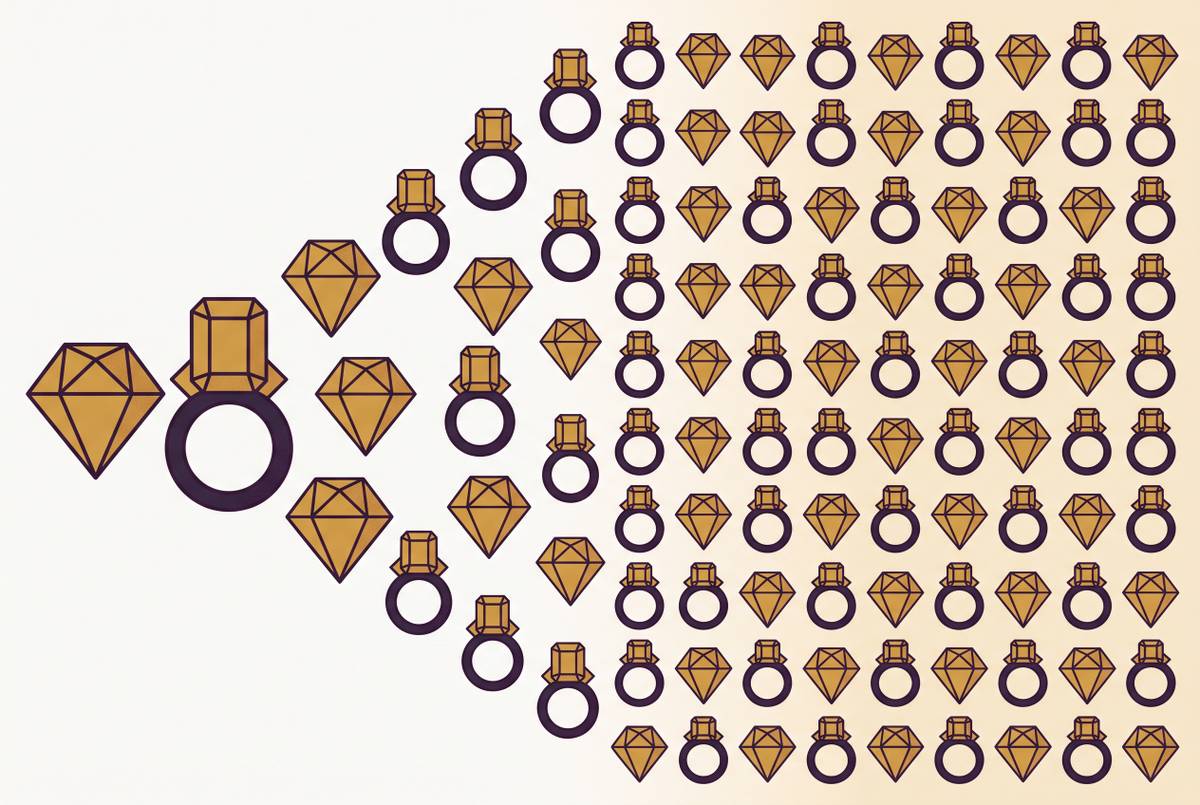
AI-assisted concepting speeds up design work, so it creates a version management problem before anyone has even opened a CAD file. Instead of spending hours sketching a handful of directions ahead of a client meeting, a designer can now generate a dozen distinct concepts in an afternoon. Clients get to see real options before any CAD work starts, which cuts down on the expensive kind of revision that happens after manufacturing is already underway. That part is a genuine win.
The version control side runs the opposite direction. More variants generated upstream means more candidate files floating around, more informal saves, and more pressure on whoever manages the tracked repository to figure out which versions were ever actually approved and which were just exploration. Some studios run the process in reverse, specifying technical parameters first, things like stone dimensions, prong configuration, or metal weight targets, and letting the AI generate a design that fits those constraints. Specifying technical parameters first still produces constrained variants just as fast, so the sheer volume of files keeps piling up.
Newer CAD software adds to this by building AI features directly into parametric modeling, automated stone placement, and structural analysis. These tools speed up common tasks, and that also speeds up how often a file's state changes, producing more snapshots worth tracking in less time. The practical fix is an approval gate: a clear, defined moment where a concept shifts from exploratory output to a named, tracked CAD file. If that gate is missing, the version control system fills up with noise, and the handful of files headed toward production get buried under drafts nobody meant to keep.
Once a studio is generating that many variants that fast, the files worth tracking stop being one-off designs and start looking like configurations drawn from a master template, a distinct version control challenge.
Parametric master files and version control at catalog scale
A parametric master file isn't a single design. It functions as a production rule set, and once a brand sells any kind of customization, that master governs every configuration a customer can order. Unlike a static 3D model, a parametric engine lets a designer adjust ring size, prong count, or stone dimensions instantly without rebuilding the piece from scratch. That flexibility is the whole point of a configurator, but it also means a single file now sits upstream of potentially thousands of distinct outputs.
Each of those outputs has to trace back to a specific, approved revision of the master. Update the master without real version discipline and a past order becomes impossible to reproduce exactly, because the file that generated it no longer exists in that form. Good practice means you keep an immutable export snapshot for every configuration that's actually sold, so manufacturing can reproduce that exact order later even after the main library has moved on. It also means you run periodic topology audits as the catalog grows, so you catch drift before it turns into a batch of rejected production runs.
Geometry and metadata have to be versioned together, not separately. The metadata, stone spec, metal weight, prong count, has to match the geometry at all times. When the two drift apart, the result is a bill of materials describing a ring the CAD file doesn't actually model, which is a problem nobody catches until a customer or a bench jeweler notices the mismatch by hand.
GLAMIRA offers a useful stress test of this idea at real scale. The global custom-jewelry brand generates nearly 50% of its citrine ring revenue from digitally customized orders. A business built on that model only works if the parametric master files behind it are under tight version control. Without it, a routine library update could silently change configurations customers already paid for and received, turning a design update into a liability nobody signed up for.
Automated bill-of-materials generation is also where a real production tool shows itself apart from a nice-looking marketing demo. When a customer finishes configuring a ring online, the system should output a complete bill of materials, metal weight, stone specifications, prong count, assembly notes, and a 2D drawing, all without anyone touching it by hand. That output is only as trustworthy as the parametric master behind it. Automate the BOM on top of an unversioned master and the system is just generating confident-looking paperwork for a ring that might not match it.
Three tools for enforcing version control on CAD files
No single tool covers every constraint a jewelry CAD team runs into. The right pick depends on your team size, which software the studio already runs, and whether files eventually have to feed into manufacturing systems.
The first option is Git paired with Git LFS. It suits teams already using Git for software, firmware, or documentation who want to extend that same system to CAD files without buying separate PDM software. Git LFS works by storing large files on a separate server and leaving lightweight pointer files inside the Git repository itself. Skip LFS and those large assembly files get baked directly into Git's object store on every commit, and the repository slows to a crawl over time. Locking is available, but it takes setup: it needs server-side support, which GitHub, Azure DevOps, and Gitea all provide, and files have to be explicitly marked lockable in.gitattributes. Once locked, Git LFS makes the local copy read-only for everyone except the person holding the lock, and SolidWorks respects that flag, so it warns the user before they try to make a change. The real gap is references: Git and Subversion don't track or update assembly references when a file gets renamed or moved, which is precisely the failure mode that breaks jewelry assembly chains without warning.
The second option is a dedicated PDM system. SolidWorks offers two tiers: PDM Standard covers check-in and check-out, revision history, and reference tracking, while PDM Professional adds workflow automation and replication across multiple sites. Autodesk's Vault provides similar coverage for shops built around Inventor, AutoCAD, Revit, and other Autodesk tools. The feature that actually matters for jewelry studios is reference tracking: PDM systems update file references automatically when something gets renamed, which is the exact property Git lacks and the exact property jewelry assembly chains depend on. Cost is the real obstacle. Formal PDM systems come with substantial per-seat annual fees that climb steeply from entry-level setups to full enterprise PLM, so the entry point is out of reach for most independent jewelry studios. Autodesk Vault and Onshape's built-in version control give you a cheaper middle ground, if your team needs reference tracking but not the full PDM price tag.
The third option is a cloud-native CAD platform, where version control is built into the architecture itself rather than bolted on afterward. Onshape is the clearest example: it stores all geometry on its own servers instead of local machines, so there's no argument over whose laptop has the current file. Every feature change gets recorded automatically, the full history stays available, and you can roll back to an earlier state in one action instead of searching through old folders. That's a different foundation than PDM layered onto a desktop tool, because here version control isn't an add-on feature, it's what the whole platform is built around. The tradeoff: cloud-native platforms need an internet connection for all editing, and moving an existing library of RhinoGold or MatrixGold files into a cloud-native system means a format conversion that can damage parametric histories along the way. If your studio has years of parametric work already built up, you need to weigh that conversion cost carefully before you make the jump.