Design Sprint Methodology for Launching a New Jewelry Collection
Fast feedback beats slow consensus in jewelry design launches.
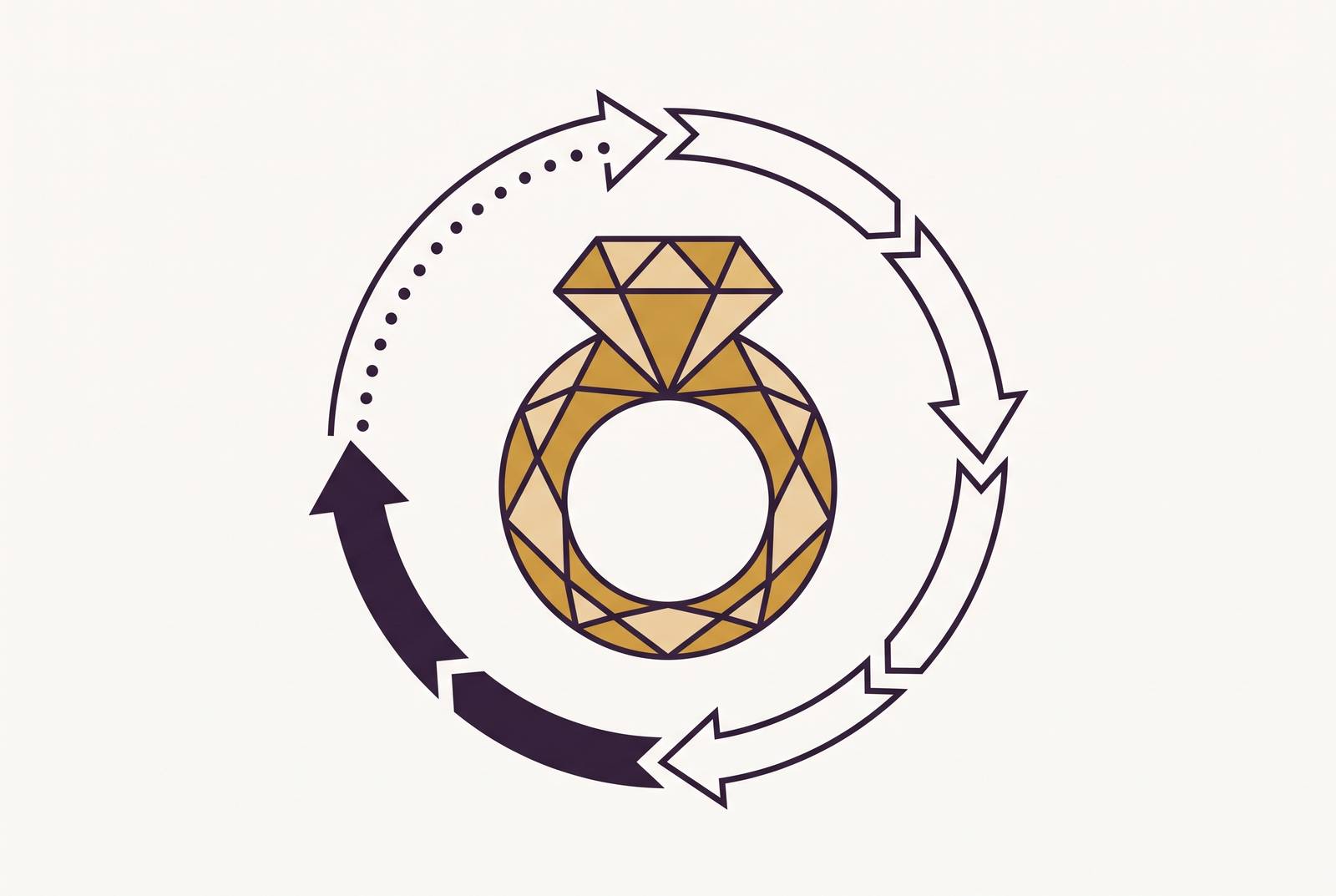
A jewelry collection launch usually dies from a slow yes, not a bad idea. Feedback loops stretch six to eight weeks, trend windows close, and by the time everyone agrees on a direction, the manufacturing slot is gone. The design sprint framework, built for software but borrowed here for good reason, compresses that mess into five bounded phases: understand, sketch, decide, prototype, test. Running it right gets a team from brief to validated concept in days, not months. Skipping it lets the calendar make the decision instead of the team.
Jewelry is especially bad at this. Too many cooks (designers, merchandisers, buyers, manufacturers) all get a vote, and nobody wants to be the one who greenlit a ring that didn't sell. Committing to tooling before anyone's tested the idea adds cost and turns the process into a slow-motion group project where the deadline is the only thing moving fast. Meanwhile, AI-equipped production lines have already pushed design-to-market cycles down to two to three weeks. The gap between those timelines is where selling time gets lost.
Phase 1: Understand: translating a collection brief into a shared problem statement
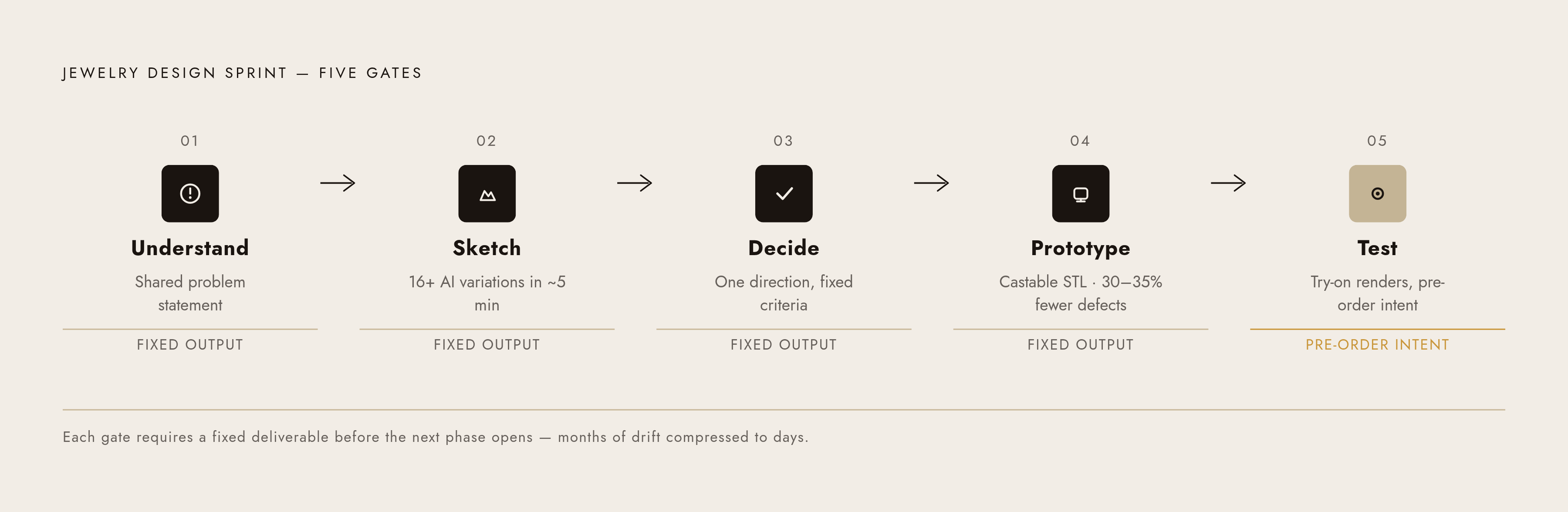
Before anyone sketches a single stone setting, the team needs to agree on what problem the collection is actually solving. That's the entire point of the understand phase: surface the assumptions, pin down the constraints, and write down what success looks like, on paper, before anyone touches a pencil or a prompt box.
For jewelry specifically, that means nailing down a short list of things that feel obvious in a meeting and turn out to be very much not obvious once people start disagreeing:
- Who's wearing this, and why (everyday stacking piece, bridal, a gift, a treat-yourself purchase)
- The price tier and metal or stone budget, which are manufacturing constraints, not vibes
- The sales channel (direct-to-consumer online, wholesale, in-store configurator), since that decides which formats even make sense
- What the trend data says right now, not what it said last season
On that last point: trend intelligence tools now sift through social media engagement, search behavior, retail sales data, and runway imagery to flag jewelry directions months before they peak. Research into AI design tooling makes this case directly. Feeding that into the understand phase stops the team from designing toward a trend that's already cresting.
The output here is one page. Stated customer, stated occasion, stated constraints, and three "how might we" questions the collection has to answer. Teams that skip this step tend to treat the original brief as good enough alignment. Teams that skip this step end up without real alignment, not with an acceptable shortcut. They end up with gorgeous sketches that answer a question nobody actually asked.
Phase 2: Sketch: using AI ideation to generate collection directions fast
Sketch phase is about going wide before going narrow. Generate a pile of directions, commit to none of them yet.
The old bottleneck here was simple math: a skilled CAD jeweler needs 8 to 16 hours to build one custom design, and getting to that skill level takes 6 months to 2 years of training. Hand-sketching ten directions from a blank page just isn't realistic on a sprint timeline.
AI ideation changes the math. As of fall 2024, using AI to quickly spin up design starting points has become the most common way designers actually use these tools day to day. A platform like Midjourney can generate 16 or more variations in approximately five minutes, giving the team something to react to instead of something to invent from nothing.
A workable structure for the session:
- Spend the first 30 to 60 minutes generating with AI
- Aim for 6 to 10 distinct directions (solitaire, halo, vintage, architectural, organic, whatever the brief calls for)
- Shortlist 2 for real development
- Push 1 forward into CAD
Phase 3: Decide: picking one direction and defining the collection architecture
Somebody has to win, and everybody else has to lose. That's the whole mechanism of the decide phase, and it's a gate, not a vote.
Jewelry teams resist this instinctively, because aesthetic calls feel subjective and nobody wants their name on the direction that flops. But the sprint format doesn't ask for consensus. It asks for a decision, made against fixed criteria, at a fixed point in time:
- Does the direction actually answer the "how might we" questions from phase one?
- Can it be made within the stated metal and stone budget?
- Does it have parametric range, meaning can one master design spin off a coherent family of pieces?
Once a direction wins, the decide phase does one more job: it maps the collection's shape. Hero piece, supporting pieces, entry-level piece. That's a different exercise than designing each SKU as its own standalone puzzle, and it separates a collection from a pile of unrelated rings.
Phase 4: Prototype: moving from AI render to production-ready CAD geometry
A prototype in this context is a digital model solid enough to review, cost out, and greenlight for a physical sample. It's a digital model solid enough to review, cost out, and greenlight for a physical sample.
The pipeline runs from AI concept generation, to 3D model creation, to refinement, to STL export, to either 3D printing or investment casting. AI has genuinely collapsed the early part of the process: ideation that used to take hours now takes seconds, and mesh generation that used to take days now takes minutes. But the leap from a generated mesh to a castable STL file doesn't happen on its own.
Wall thickness checks, sprue placement, shrinkage scaling: these stay manual. A human still has to verify stone settings and structural thickness before anything goes to production, no matter how clean the AI-generated mesh looks on screen. AI-assisted casting workflows have cut defect rates by roughly 30 to 35%, mostly because the starting mesh geometry is more consistent than a hand-sculpted wax pattern ever was. Consistency helps. It doesn't replace the person checking the prongs.
Phase 5: Test: validating collection concepts before committing to production tooling
Testing means putting the prototype in front of real (or realistic) buyers and pulling specific signal, not vague impressions, tied directly back to the questions from phase one.
Before a physical sample even exists, digital tools do a lot of the work:
- 3D configurator previews: a meaningful share of online jewelry shoppers hesitate to buy because they can't picture or customize the piece accurately. A configurator preview solves that hesitation directly and produces engagement data in the process.
- AI-rendered try-on images (The New Black's Models studio is one example) showing the piece on an ear, wrist, or neck. Scale and skin contact are half of what makes a design work; a plain white-background render hides proportion problems that an in-situ render exposes immediately.
- A limited pre-order or waitlist page for the hero piece, which measures actual purchase intent instead of somebody nodding politely in a focus group.
Once a 3D-printed sample exists, testing moves to the sales team (checked against the price tier from the brief), wholesale buyers if that's a channel in play, and the manufacturing partner, who signs off on castability.
If the concept fails at this stage, that's not a setback, it's the sprint doing its job. Days of work just saved months of drift and a tooling budget nobody wanted to explain later. The failed brief doesn't get thrown out either: it becomes the understand-phase input for the next sprint.
Sprint cadence by team size and tooling access
Independent designers and micro-studios get the most out of this framework, mostly because they have the least process to begin with, and creative drift fills whatever vacuum is left. AI ideation tools lower the entry cost for the sketch phase enough that a solo designer can run phases 1 through 3 in a single day. CAD investment then goes toward one validated hero piece instead of a speculative pile of options nobody asked for. Jewelry-specific AI platforms that output manufacturing-ready specs fit the sprint format better than general image generators, which still need a full CAD conversion pass afterward. When resources are thin, that choice matters more, not less.
Small teams and boutique brands use the sprint mostly as a shared language. It gives designers, merchandisers, and founders a common structure to argue inside of, instead of an endless back-and-forth with no finish line. And the parametric CAD files coming out of the prototype phase can double as the backbone of a customer-facing configurator, which shortens the path from collection design straight into digital commerce.
Enterprise and multi-line brands get the most value from running the sprint in parallel, across multiple collection lines at once, all following the same five-phase structure. That gives leadership comparable outputs to weigh against each other using the same criteria, instead of five teams each inventing their own process. AI trend analysis tools, feeding social data, retail numbers, and runway imagery into several sprint teams' understand phases at the same time, help keep those parallel directions genuinely different instead of accidentally converging on the same ring. Design-to-market cycles have dropped from six to eight weeks down to two to three weeks in AI-equipped production lines. Brands running the sprint systematically are already living in that window. The ones that aren't are just giving away selling time.
Where the framework's limits sit in jewelry specifically
A sprint validates a concept. It does not validate a supply chain. A finished, approved CAD file still needs a manufacturing partner, sourced materials, and a negotiated lead time, none of which move any faster just because the design phase got shorter.
AI renders are not manufacturing plans. GIA's fall 2024 analysis makes the point directly: AI has no concept of what can actually be manufactured. A sprint that ends at a pretty AI image, without ever reaching watertight CAD, has validated a look. It hasn't validated a product.
Parametric design has a ceiling too. A master model that spins off multiple digital variants still needs each variant checked individually before production. Stone seat geometry, prong dimensions, wall thickness: none of that comes out correct automatically just because the parent design worked.
And the five-day sprint, in its original software form, is a guideline here. Physical prototyping in jewelry takes real time in a way that a clickable software mockup never did. A realistic expectation for a full jewelry sprint, physical validation included, runs two to three weeks. Anyone promising five days for a finished, cast, tested collection concept is promising something the metal itself won't allow.