Scaling Jewelry Design Output From 10 to 100 SKUs per Month
Redesigning the workflow, not hiring more designers, unlocks 10x output.
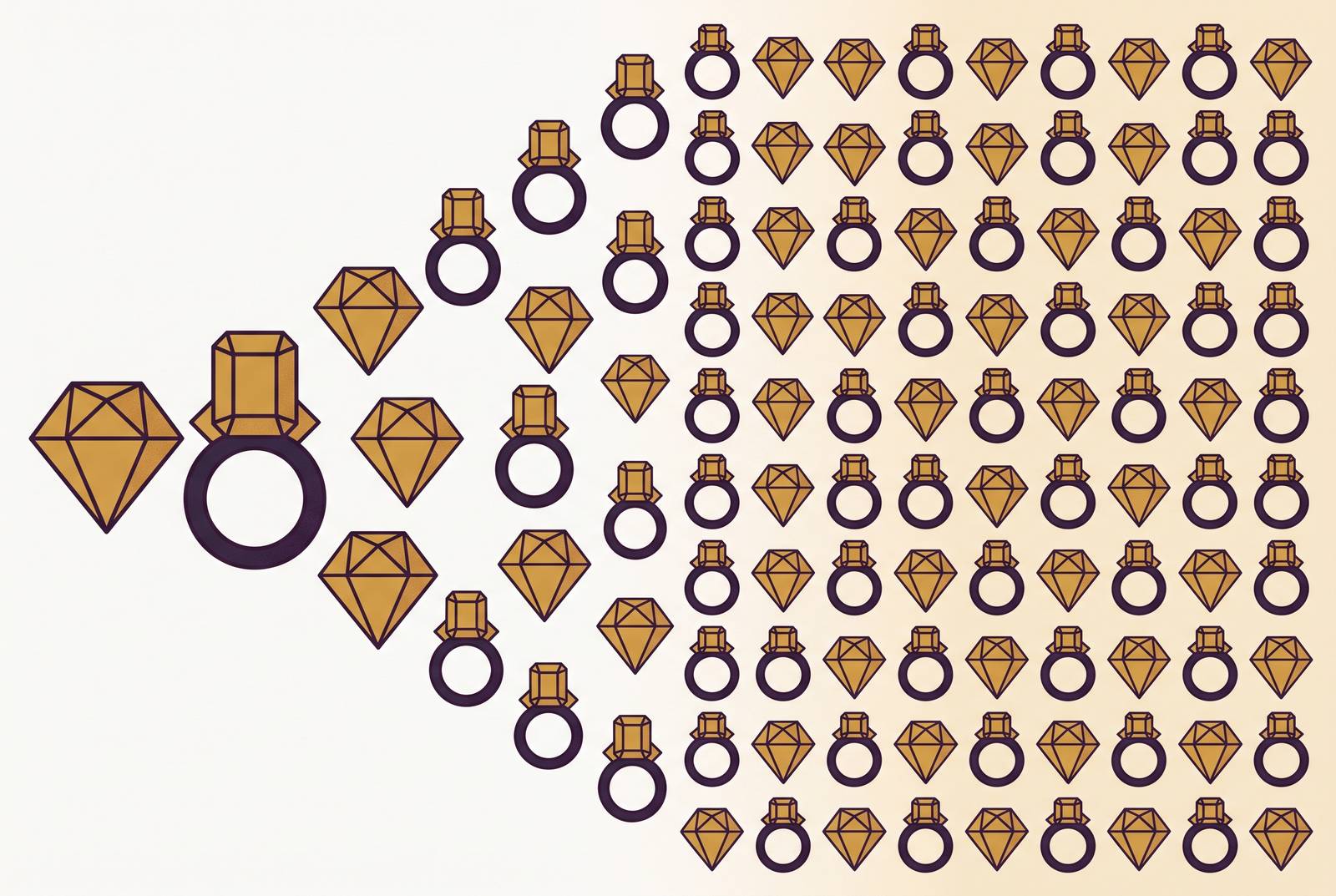
Jewelry brands don't stall at 10 SKUs a month because they lack talent. They stall because the process only knows how to make one ring at a time, and the fix people reach for (hire another designer) just buys you a second slow lane instead of a faster road.
Why most jewelry businesses stall at low SKU counts
A professional CAD modeler needs somewhere between 8 and 16 hours to take one design from sketch to finished file. Getting good enough to do that takes months to years of training. Multiply that by a catalog of 50 or 100 pieces and you can see the problem before anyone opens a spreadsheet.
The workflow itself is the issue. A designer sketches, iterates, hands it to CAD, gets notes back, revises again, and only then does the piece move toward production. Every single ring rides through that whole chain start to finish before the next one gets a turn. It's a single-file road with one lane, and it doesn't matter how many good drivers you add to the line, they still can't pass each other.
Shops that have rebuilt around AI-assisted design have pushed the design-to-market cycle down to 2 to 3 weeks, compressed from the 6-to-8-week timeline that used to be standard. Shops still running the old sequential model haven't moved off that older timeline at all. That gap comes down to a difference in clocks rather than talent.
The structure stays broken no matter how many designers are hired. It just adds more people standing in the same one-lane road. Costs go up, coordination gets messier (now someone has to manage five sketch-to-CAD handoffs instead of one), and the fundamental bottleneck, one person owning one piece from start to finish, never actually moves.
What a redesigned pipeline looks like: the four stages from concept to production-ready output
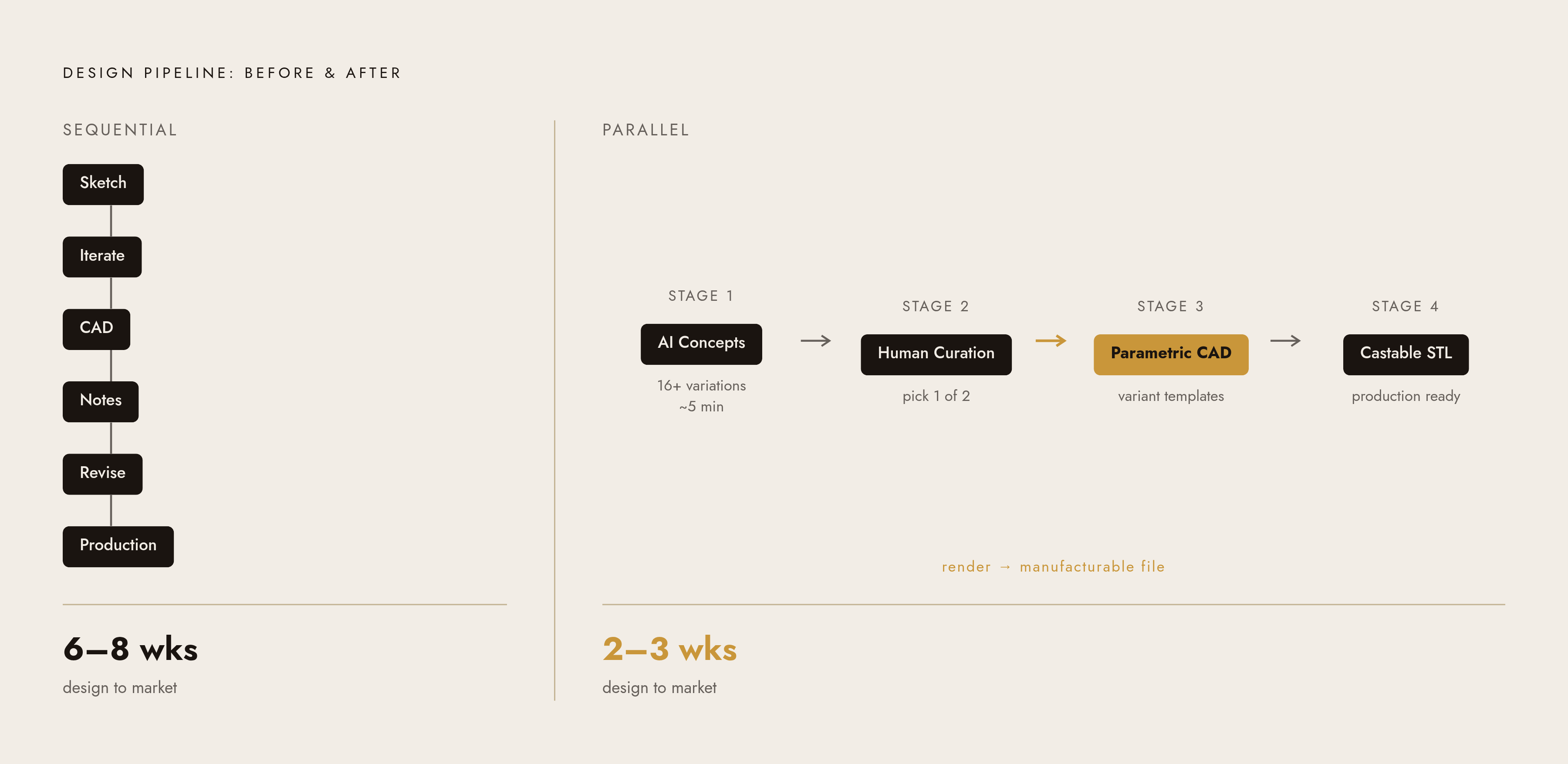
The shops hitting higher output numbers have split the single long process into four distinct stages, each one built to run at a different speed and, in some cases, without a human touching every step.
The shape of it:
In Stage 1, concept generation, AI produces a wide spread of design directions fast. Stage 2, curation: a human picks the strongest concepts and sets direction. Stage 3, CAD and parametric modeling: the chosen concept becomes a structurally sound, manufacturable model. Stage 4, production-ready output: the model becomes an actual castable file, ready to hand to a foundry.
The distinction that matters most sits between Stage 2 and Stage 3. A gorgeous computer-generated render is a marketing image. It's great for a social post or a customer preview, but you cannot cast it, set a stone in it, or send it to a foundry. Only Stage 3 and Stage 4 produce something a foundry can actually pour metal into. Confusing a pretty picture with a production file is the fastest way to get a very disappointed customer and a very tight deadline.
None of this has to move in a straight line through one person anymore. Stage 1 can churn out concepts in parallel for a dozen projects at once. Stage 3 can template variants off a proven base design. That's the actual mechanism behind 10x output without 10x headcount, not magic, just stages that no longer wait on each other.
Stage 1, compressing ideation from days to minutes with AI concept generation
The industry has a name for this now: AIdeation, a term that showed up in GIA's Gems & Gemology in late 2024. It describes the most common way jewelry designers are actually using AI today, and it's less flashy than the name suggests. It's just fast idea generation.
The numbers make the case on their own. A tool like Midjourney can spit out 16 or more design variations in around 5 minutes. Compare that to a sketch pad and a few hours of hand drawing, and it's not a close race.
The workflow that seems to work best in practice: spend the first 30 to 60 minutes of any new project purely in AI generation mode. Produce 6 to 10 concept directions, maybe a solitaire, a halo setting, something with a vintage flare. Narrow that down to 2 strong contenders, pick 1, and only then does anyone touch CAD software. Direction gets locked before the expensive modeling work starts, which means less backtracking later.
The bestseller family approach takes a piece that's already selling well. Take a piece that's already selling well, feed it in as a reference image, and describe what should change: swap the metal, change the center stone, adjust the halo. The result keeps the core identity of the original piece while generating a whole family of variants around it. That's how a single bestseller becomes a whole family of variants instead of staying a one-off.
Stage 2, human curation as a design multiplier, not a creative bottleneck
AI handles the repetitive grunt work here, generating options, iterating on variations, so the designer's actual time gets spent on judgment, taste, and storytelling, the parts of the job that made som... It's handling the repetitive grunt work (generating options, iterating on variations) so the designer's actual time gets spent on judgment, taste, and storytelling, the parts of the job that made someone a good designer in the first place.
At Stage 2, the designer's job changes shape entirely. Instead of drawing a concept from a blank page, they're evaluating a stack of computer-generated options against a few clear questions: Does this look coherent? Does it match the brand? Does it fit what the customer actually asked for? Can this even be manufactured without a nightmare? Then they pick the winner and write the brief for Stage 3.
That's a real shift in what the job requires. A designer who spends their day choosing the best of 20 solid concepts is operating at a completely different scale than one hand-drawing a single concept from nothing. Selection becomes the valuable skill. Drawing speed stops being the bottleneck it used to be.
Jewelry-specific AI platforms and general-purpose image generators are not interchangeable here. Jewelry-focused tools understand settings, stone placement, and metal behavior, and some connect straight into CAD pipelines. A general image generator just makes pictures. Nice pictures, sure, but someone still has to do the full CAD conversion from scratch, and the curation step gets a lot harder when you're working from an image that has no idea what a prong actually does.
Stage 3, parametric CAD as the engine for variant generation at scale
Here's the concept that makes high SKU counts possible at all: parametric design. You define the inputs once, ring size, band width, halo diameter, stone count, and then changing any single one of those numbers regenerates the whole model automatically. Instead of rebuilding a design from scratch for every size or stone swap, you're just turning dials on one that already exists.
What that buys a designer is genuinely useful: a parametric ring keeps its shape and proportion no matter what finger it's sized for. Every element scales together, so a size 5 and a size 9 version of the same ring both look like the ring they're supposed to be, not a stretched or shrunken version of it. Sizing headaches, which used to eat real production time, mostly disappear.
On the software side, Jewelry CAD Dream (JCD) has a feature history system, which handles complexity that trips up a lot of other tools, multi-row chokers or lavaliere pendants carrying 500 or more gemstones, for instance. Designers can define the critical parameters up front and push them into an input panel that lets someone downstream customize a piece without touching the core model. SolidWorks and Rhinoceros serve a related but different purpose: they're solid and surface modelers, strong for tightly controlled geometric shapes where every dimension needs to be numerically locked down.
Stage 4, what "production-ready" means and why the distinction matters for scale
AI has cut first-draft modeling time from a full workday down to under 2 minutes in some workflows. That's a real number and it's a big deal, but it also creates a trap: a fast, clean-looking mesh is not the same thing as a file a foundry can actually cast.
Getting from generated mesh to castable STL means running through a specific checklist, and skipping any item on it means a ring that either won't cast right or won't hold its stones:
- Wall thickness verification, so the piece doesn't collapse or wear through.
- Stone-setting accuracy, so prongs and bezels actually hold what they're supposed to hold.
- Sprue placement, so molten metal can actually flow into the mold correctly.
- Watertight, manifold geometry, so the file has no gaps or holes a printer or caster will choke on.
Each of those is its own documented step that you revisit continually. AI-assisted casting workflows have been shown to reduce defects by 30 to 35%, a gain attributed to the more consistent, predictable geometry that comes out of the process. Still, no software finishes the job on its own. Foundry prep still needs a human who knows what a bad sprue placement actually does to a pour.
The scale of adoption backs this up: the 3D-printed jewelry sector was valued at $4.89 billion in 2026, growing at a 17.3% compound annual rate. Print-to-cast is just how a growing share of jewelry gets made. It's just how a growing share of jewelry gets made.
How configurators extend the same parametric logic into customer-facing sales
Customers show up with a picture in their head. They know the metal, the stone, maybe even the engraving they want. Then they hit a product page with 3 stock photos and a dropdown menu, and the gap between what they imagined and what they can actually see on screen is exactly where a sale quietly dies.
Configurators close that gap by putting the same parametric logic from Stage 3 directly in front of the customer. Shoppers adjust size, metal, stone, and setting in real time, and the system keeps the design balanced and actually manufacturable behind the scenes, so nobody accidentally configures a ring that physically can't be made.
Adoption numbers back up why brands are investing here: A growing share of jewelers globally are rolling out AR and virtual try-on tools, and younger shoppers have shown growing appetite for virtual customization tools before buying. AI-driven suggestions based on customer preferences have shown promise as an upselling mechanism.
A few named platforms show what this looks like in practice. Threekit lets brands build and distribute configurable product data across their own site, retailers, and distributors at once, tying pricing directly to the catalog so the price on screen updates automatically as a shopper builds their piece, across multiple currencies and pricebooks. Lindsey Scoggins used Threekit to turn an in-person custom engagement ring studio into a digital one. Keyideas' Jewelith 3D Configurator lets a customer build a ring, bracelet, or necklace piece by component, add engraving, adjust proportions, and see a photorealistic render before they ever place the order. Vizora tackles a narrower but stubborn problem, the "how does this actually look on my hand" question, by letting someone place a photorealistic render of a ring or bracelet onto their own hand through their phone camera, no app download required.
The made-to-order model that makes high SKU counts financially viable
The business model underneath still assumes a warehouse full of inventory, and that assumption produces the constraint that limits everything described in the last four sections. Traditional jewelry retail ran on stocking shelves, real product, sitting in real stores, tying up real capital, and carrying real risk if it didn't sell.
Parametric design paired with a configurator flips that arrangement. A SKU doesn't need to exist as a physical object sitting in a drawer somewhere. It exists as a set of parameters, ready to become a real ring the moment a customer actually orders one. No inventory sitting on a shelf, no capital tied up in stock that might not move.
That's what actually makes 100 SKUs a month realistic instead of a fantasy. You're not manufacturing 100 finished pieces and hoping they sell. You're maintaining 100 sets of parameters and manufacturing only the ones a customer has already paid for. Combined with online jewelry sales pulling further ahead of physical retail every year, and lab-grown diamonds now making up more than 45% of US engagement ring sales, the brands treating personalization as a core offering are positioned to meet the demand already at their door.