Collaboration Workflows Between Jewelry Designers and Casting Partners
Designers and casters must align on millimeter details or production stalls completely.
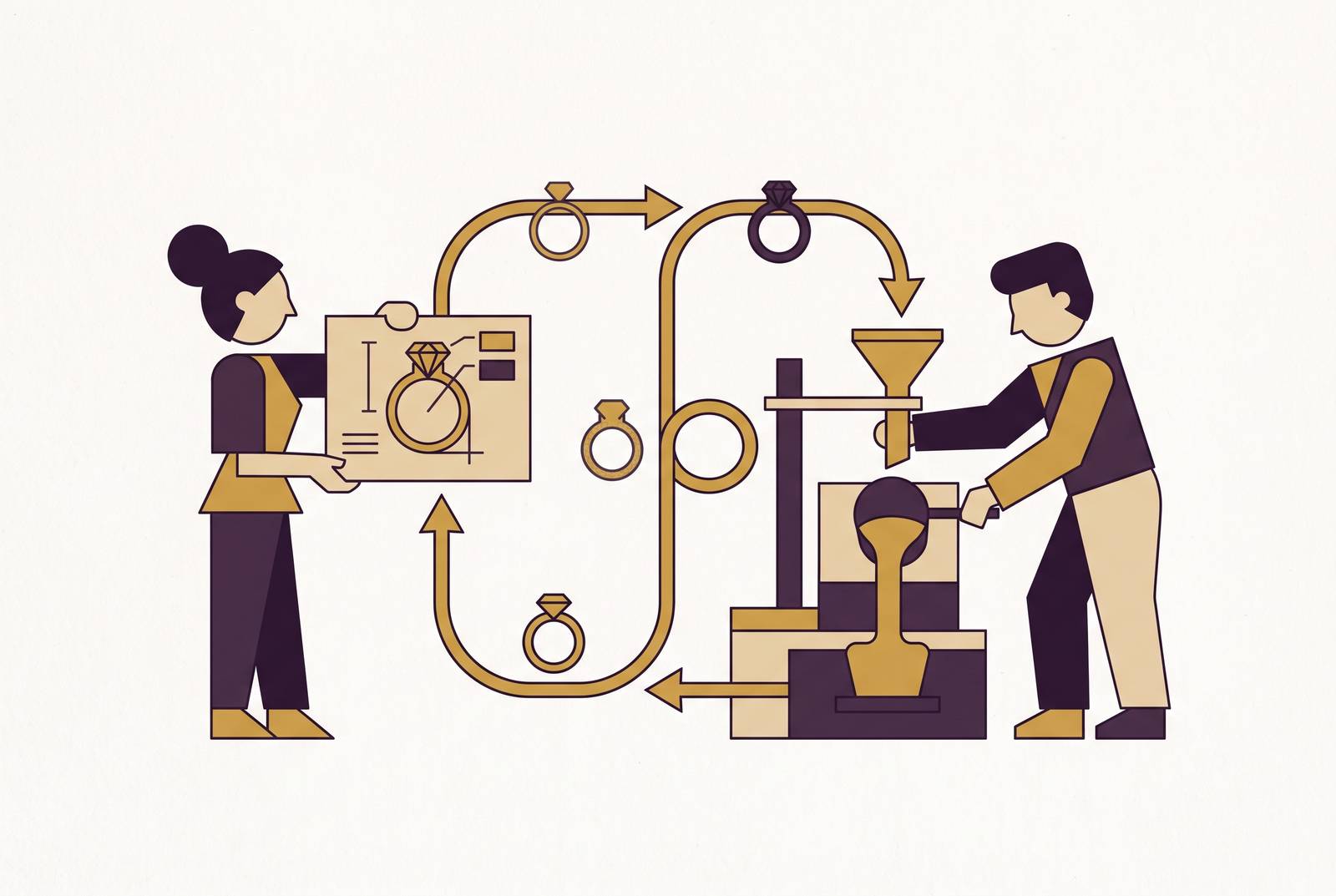
Two completely different disciplines have to agree on the same physical object, down to the fraction of a millimeter, or the whole production run stalls. Two completely different disciplines have to agree on the same physical object, down to the fraction of a millimeter, or the whole production run stalls, and that agreement is the job. Jewelry design and casting live in different worlds (one deals in aesthetics and client mood boards, the other deals in metal shrinkage and burnout temperatures), and the seam between them is where nearly every production headache starts.
This isn't a single handoff, either. People treat it like a relay race: designer finishes the leg, hands off the baton, caster runs with it. Wrong. It's closer to a long group text thread with multiple people chiming in at different points, except getting it wrong costs actual gold.
When that seam breaks, it breaks in three predictable ways. Miscommunication about what the design is actually supposed to look like. Revision cycles that quietly eat two weeks off a deadline. And castings that arrive looking nothing like what got approved on-screen.
That last one stings the most, because it's rarely anyone's fault in the obvious sense. A ring can look flawless in a render, all clean lines and dramatic lighting, and still be a nightmare on the bench. Inside corners that no polishing tool can reach. Prongs modeled thin because thin looked elegant. Channels cut so tight a setter can't get a tool in without risking a chipped stone. The render doesn't know any of that. Manufacturing reality does.
Each party's contributions to the collaboration, and their knowledge gaps
The designer shows up with aesthetic instinct, the client relationship, and a sense of what the piece is supposed to mean. The casting partner shows up with material science, process limits, and the sequencing knowledge to actually get metal into the right shape. Neither one has the full picture on their own, and that's not a knock on either side. It's just how specialization works.
Designers, understandably, don't always know casting shrinkage allowances off the top of their head, or which geometries leave enough room for a polishing bit to get in and do its job. Casting partners, on their end, don't always grasp why a client is emotionally attached to one specific curve on a custom engagement ring. Both gaps cause friction if nobody names them out loud.
Three spots cause most of the trouble:
Stone setting tolerances top the list. A seat that looks perfectly sized in a 3D render can leave insufficient clearance for a setter's tool, and that's a problem nobody notices until the piece is already cast. Wall thickness runs a close second, especially now. AI-generated concepts and fast concept-stage models have a bad habit of producing geometry that's gorgeous and dangerously thin, the kind that can pose serious problems once it reaches the casting stage. And surface finish can be a source of miscommunication, because a CAD file captures geometry rather than texture. Matte versus polished versus brushed has to be spelled out separately, in words, or someone's guessing.
The single most valuable thing a casting partner can do, and the thing that gets skipped too often, is a feasibility review before the file gets finalized. Structural checks, a look at what the metal choice actually implies for durability, a gut check on whether the casting method even suits the design. Catching a fragile prong on a screen is far cheaper than catching it after the tree's already been cast.
AI's impact on the concept and ideation stage for the caster
Jewelry is in the middle of a shift that looks a lot like the CAD revolution of the 1990s, except running on fast-forward. CAD took roughly a decade to become the industry standard. AI tools are getting adopted in a fraction of that time, so casting partners don't get the luxury of a slow onboarding period.
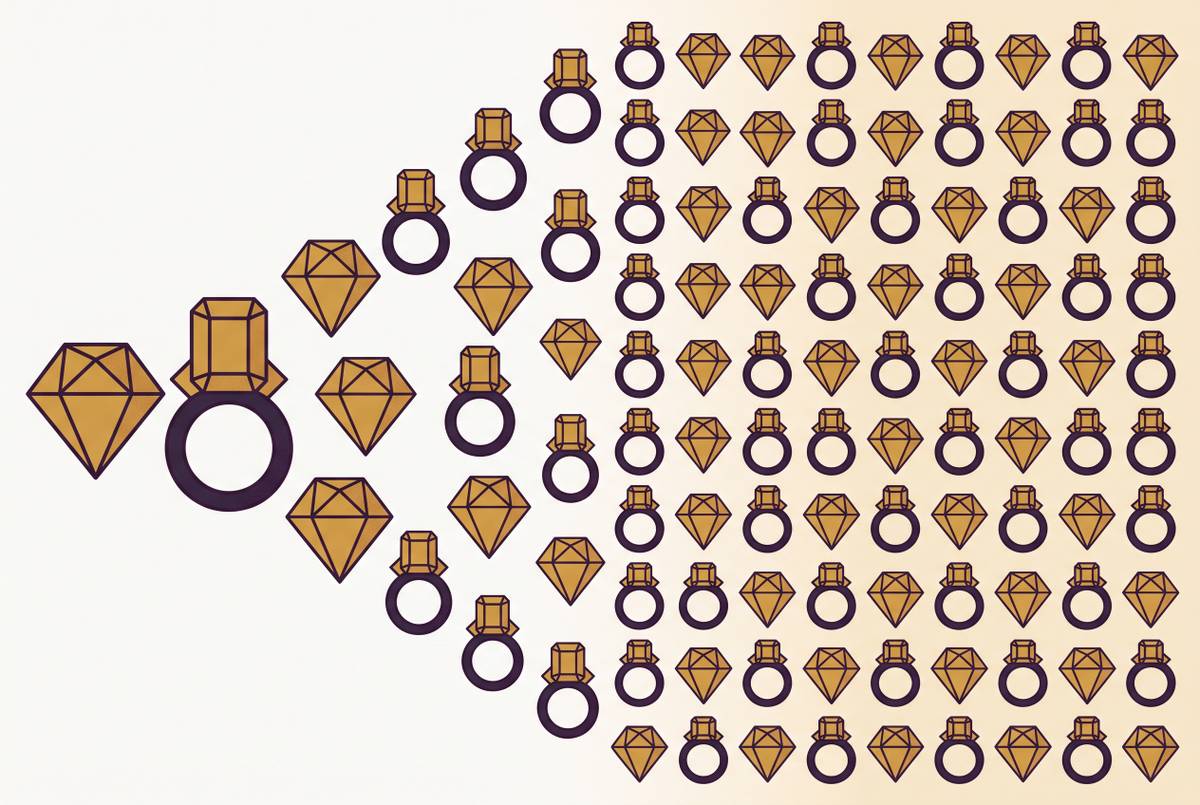
Call it "AIdeation," because someone in this industry was always going to coin that term eventually. The dominant use case right now is AI generating a pile of concept directions fast, from a text prompt or a reference image, so a designer can pick a direction before anyone touches real CAD software. It's AI generating a pile of concept directions fast, from a text prompt or a reference image, so a designer can pick a direction before anyone touches real CAD software.
Midjourney, as one example, can spit out sixteen or more variations on a design theme in about five minutes. A sketch pad and an afternoon of erasing produce far less in that time.
What comes out the other end is a picture, though, not a part. It's precise enough to make a decision with, sharp enough to show a client or a workshop for a gut reaction, but it is not castable. Designers are using it exactly where they used to use a sketch: the idea stage, before anything has to survive contact with molten metal.
The CAD file as the shared language of the collaboration
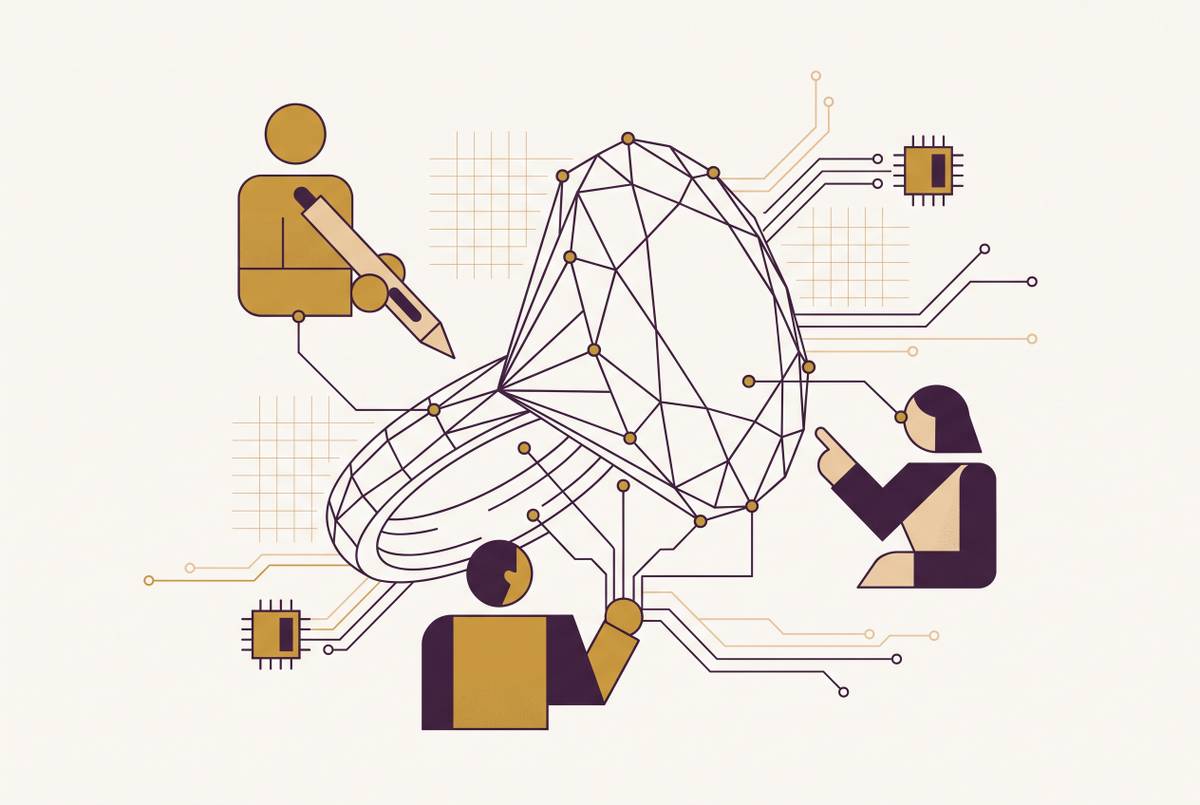
Once the concept's locked, the CAD model takes over as the one document everybody actually reads from. Designers reference it, setters reference it, casters reference it. It's the shared language, and if it's wrong, everyone downstream inherits that mistake without knowing it.
A file that's merely presentable is not the same thing as a file that's production-ready, and that gap trips people up constantly. A production-ready file has correct wall thickness everywhere (thin spots crack during casting, full stop), stone seats engineered to exact diameter and depth rather than eyeballed, and shrinkage allowances baked in, because metal contracts as it cools and the model has to plan for that contraction in advance. It needs polishing access, meaning inside corners and channels a finishing tool can actually reach, and it needs structural symmetry. An asymmetric detail might read as artistic flair in a render. To a caster, the same asymmetry can read as a weak point waiting to happen.
Professional studios generally work in platforms like RhinoGold, JewelCAD, Matrix, or 3Design. MatrixGold is essentially Rhino tuned for jewelry work, and it carries parametric history: a designer can bump a finger size, swap a stone size, or widen a halo in seconds instead of rebuilding the model from scratch.
AI 3D modeling has narrowed the distance between concept and production file, but it hasn't closed it. Traditional CAD modeling runs eight to sixteen hours for a first draft. AI 3D modeling can produce that same first draft in two to five minutes, which sounds like it solves everything. Wall thickness still needs verification, stone-setting geometry still needs a human check, and sprue placement still has to be decided by someone who understands the process. Wall thickness still needs verification. Stone-setting geometry still needs a human check. Sprue placement, the point where metal actually flows into the mold, still has to be decided by someone who understands casting flow, not just geometry. Tools like Neural4D, as of 2026, are producing watertight, manifold-ready meshes with material separation built in, which shrinks the gap further. It still hasn't erased the need for a trained eye at the finish line.
Moving from approved CAD to casting floor: the physical pipeline step by step
Once the CAD file is locked, tolerances correct, stone seats accurate, shrinkage accounted for, the piece follows a fairly fixed physical path from screen to shelf.
The file exports to.STL or a similar production format. From there it gets 3D printed in castable resin: ring shanks, engraving, and prong geometry at ring scale need layer heights as fine as 25 microns to come out clean. The printed pieces get attached to a central wax stem, called a "tree," which lets a caster run multiple pieces through the same casting cycle instead of one at a time. That's not a minor efficiency trick. Running multiple pieces through the same casting cycle instead of one at a time is what separates a casting house running profitably from one that isn't.
The tree gets encased in investment plaster. The resin burns out under heat, molten metal gets poured into the void it leaves behind, and out comes a rough casting. Setting and finishing come after that.
Three printing technologies are used across this pipeline, each suited to something different. SLA (stereolithography) delivers the highest detail, which makes it the go-to for delicate diamond settings where a fraction of a millimeter matters. DLP (digital light processing) runs faster and tends to get used for bulk production runs where speed outweighs the very last degree of fine detail. Direct wax printing skips a step entirely by producing wax-like models that go straight into investment casting.
Resin choice isn't cosmetic, either. Castable resin has to burn out completely, leaving no ash behind in the investment mold. Standard engineering resin, the kind used for prototyping in other industries, does not burn clean and will ruin a casting outright if someone grabs the wrong bottle off the shelf.
Turnaround varies by shop and by how complicated the piece is. At least one casting house advertises that a file received by 2:30 p.m. CST will be cast and ready to ship in as little as two business days. CAD-only delivery from specialist studios can run three days for straightforward work, five to seven for anything complex. As a general planning rule, once a design gets approved, seven to ten days covers casting, setting, and finishing. And on the AI-equipped end of the industry, some production lines have compressed the full design-to-market cycle significantly, though specific timelines vary by shop and process.
The tech pack: what designers should send
A lot of designers treat "the model is done" as the finish line. It isn't, not for a business relationship that has to survive more than one order. Sending a caster a single file attachment and calling it a day is one of the most common, and most avoidable, sourcing mistakes in the industry.
A real tech pack does two jobs at once. It gets the current piece approved faster, and it sets up every reorder and every size run that comes after, without anyone having to reverse-engineer the original intent from a lone STL file six months later.
What belongs in it: the watertight CAD file itself, in an accepted format like.STL or.OBJ. Full stone specifications, meaning size, shape, quality grade, quantity, and exactly where each one sits. Metal specifications, alloy and karat and a target weight or acceptable range. Finish specifications broken out by zone if the piece mixes matte and polished sections, because "polished" alone doesn't tell a finisher which surfaces stay rough on purpose. Photorealistic renders with dimensions marked and any intent notes that the geometry alone won't communicate. And shrinkage notes, if the designer's already accounted for them, or an explicit flag saying they haven't, so the caster knows to apply their own math instead of assuming someone already did it.
Digital files and renders make all of this easier to pass around, to clients, to manufacturers, to whoever else needs eyes on the piece, and that alone cuts down on misunderstandings that used to require three phone calls to sort out.
The source of revision cycles and how to break the pattern.
Most revision cycles trace back to one of three moments. Late-stage aesthetic changes requested after structural decisions are already locked in. Manufacturing feasibility problems nobody flagged early enough. Or a finish and detail miscommunication that the CAD file, on its own, was never going to catch.
The late aesthetic change is the expensive one, financially and emotionally. If the design side and the production side aren't talking to each other early and often, a client can request a major change after approval, after tooling's underway, after the resin's already printed. At that point a "small tweak" means starting a chunk of the pipeline over.
GIA's Gems & Gemology has pointed out that current AI image tools are far from perfect and, for now, work better for generating fresh ideas than for refining an image that's nearly finished. The takeaway for a production workflow: AI-generated concepts need an explicit feasibility pass before anyone treats them as a locked, approved direction. Skipping that step just moves the revision cycle later, where it costs more.
The structural surprises that cause the worst disruption tend to repeat: inside corners no polishing tool can reach, prongs too delicate to survive the setting process, channels too tight for a setter's tool to fit into, and wall sections that drop below the minimum thickness a casting can survive. All four are catchable early. None of them are catchable after the metal's already poured.
How digital configurators are changing casting partner readiness
Configurators have changed the shape of demand itself, not just the design process. A jewelry 3D configurator lets a shopper swap metals, pick a different stone, adjust a setting style, or add an engraving, and see all of it rendered instantly in a photorealistic 3D view. Over 30% of online jewelry shoppers report hesitating to buy because they can't picture or customize a piece accurately, and configurators exist specifically to close that gap and, in turn, push order volume up.
For a casting partner, that shift changes what "normal" production even looks like. Every configuration a shopper finishes and checks out with is potentially its own unique SKU, not a repeat of yesterday's run. That means the casting partner needs to be set up to receive a constant stream of varied files rather than the same handful of molds run over and over.
The requirement that actually matters here: whatever a customer finalizes on-screen has to output a production-grade CAD file that matches, exactly, what ends up getting made. A configurator that only renders a pretty picture, without generating a file a caster can actually cast, breaks the whole chain right at the handoff. Pretty pictures don't get poured into molds. Files do.