Structuring a Jewelry Design Team Around AI and CAD Platform Tools
AI and CAD tools reshape jewelry design teams into four core human roles.
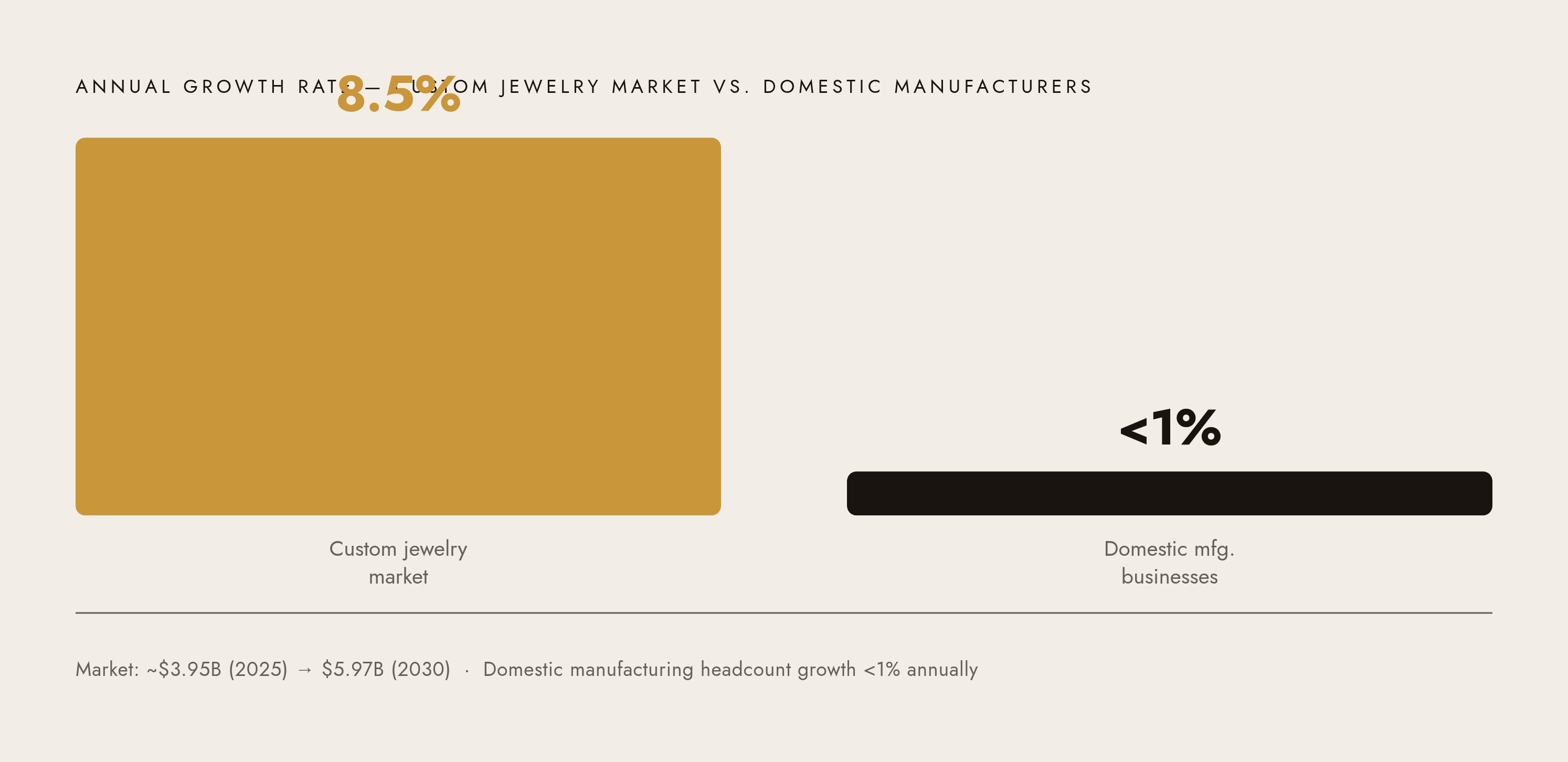
Custom jewelry hit $3.95 billion in 2025 and is on pace for $5.97 billion by 2030, growing about 8.5% a year. Domestic jewelry manufacturing businesses grew under 1% a year over that same stretch. Demand sprinted. The workforce jogged, at best. That gap is the whole story, and it means the old fix (hire more designers, buy more CAD seats) doesn't work fast enough anymore.
What AI and CAD platforms handle in a jewelry workflow, and what they do not
CAD changed jewelry design once already, back in the 1990s, and it took roughly a decade to become the industry standard. AI tools are covering that same ground in a couple of years. A tide coming in slowly and someone yanking the plug out of a full bathtub are two very different speeds of change, and jewelry just got the plug pulled.
The platforms are genuinely good at specific things. On the concept side, AI tools spit out photorealistic ring, necklace, and earring variations in seconds instead of days. On the production side, the better platforms output actual CAD files, not just pretty pictures, so what a customer sees on screen matches what gets cast in metal. A render is a promise. A CAD file is a contract, and that difference is the whole ballgame.
What the platform still can't do alone is sign off on a piece for manufacturing. Structural integrity, gemstone setting logic, wearability under daily use: someone with real bench experience has to look at it before it goes anywhere near a mold.
Mixing up tool categories wastes real time, and most studios do it at least once before they learn better. General image generators like Midjourney, DALL-E 3, and Leonardo AI make gorgeous mood board images, but a bench jeweler often can't build what they show, since these tools have no clue what a pavé setting or a cathedral shank actually requires structurally. Jewelry-specific concept and 3D platforms, Tashvi AI being one, understand construction limits and material relationships, and some export mesh files like STL, OBJ, or GLB that go straight toward printing or casting. Standalone 3D model generators such as Tripo AI turn a reference photo into a full exportable model, useful for bridging concept and production without opening traditional modeling software. Then there's AI-enhanced CAD, meaning Rhino 3D with jewelry plug-ins, Fusion 360, ZBrush, and similar production tools, where exact prong angles, metal weight, and stone dimensions get locked down, often with AI-assisted parametric modeling built right in.
According to tashvi.ai, the most effective workflow spends the first 30 to 60 minutes of any project purely on AI-generated concepts, getting client approval on direction, before anyone opens a CAD program. The real bottleneck in custom jewelry has always been turning a vague client idea into something concrete fast, revising it fast, and getting sign-off before the project bleeds margin. It's turning a vague client idea into something concrete fast, revising it fast, and getting sign-off before the project bleeds margin.
The four roles a lean AI-enabled jewelry team needs
Each role below exists for one reason: it needs a human's taste, judgment, or people skills, and no platform sells those.
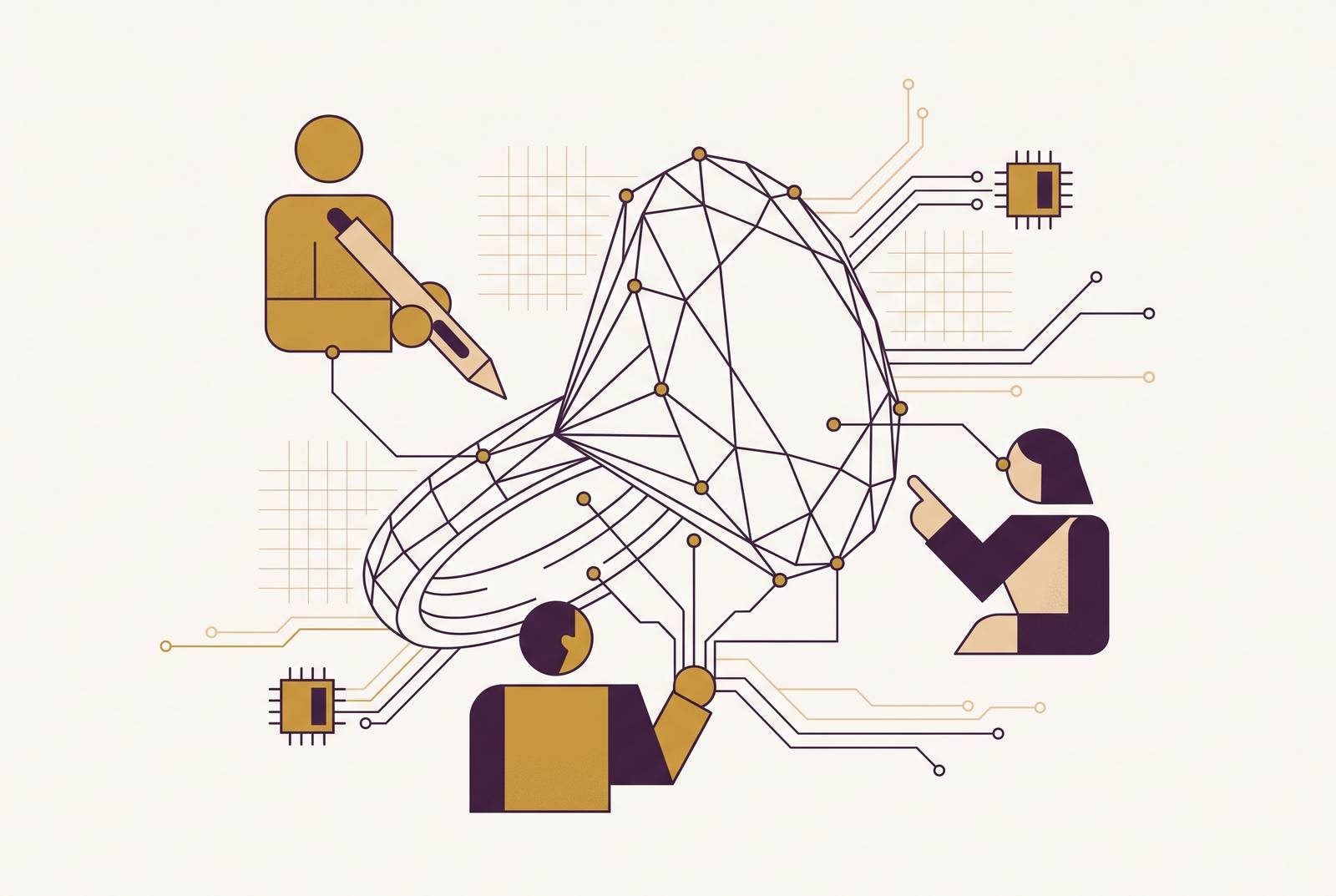
The Creative Director or Lead Designer owns the vision, the collection direction, the brand's whole aesthetic fingerprint. This person uses AI concept tools to throw out five directions before lunch instead of sketching one by hand over three days, then decides which output actually fits the brand and can be built in metal. In a small studio, this person often doubles as the CAD reviewer too. In a bigger one, they hand off once a direction gets approved. What the platform takes off their plate is the hours once spent redrawing the same ring six times because the client "wasn't quite feeling it."
The Production CAD Specialist turns an approved concept into geometry a factory can actually build, working inside platforms that lock down exact measurements, prong angles, metal weight, and stone dimensions. The value here is catching an inside corner nobody can polish, a prong too thin to survive shipping, or a channel cut too tight for the stone to seat, things the software won't flag on its own. Tashvi AI reports material savings of 15 to 25 percent per piece with AI-optimized CAD workflows, and this is the person who actually captures those savings on the shop floor. In a smaller shop, the lead designer just covers this role too, using an all-in-one platform, cutting headcount without cutting quality.
The Client Experience and Configurator Manager owns the digital storefront: product configurators, custom design flows, the entire online purchase path. This role makes sure the metal, stone, and setting options a customer clicks through on the website actually map to what production can deliver, not some fantasy combination that jams up the order later. It also handles the human side of custom work, turning "something like my grandmother's ring but modern" into an actual design brief someone can build from. 360 Research Reports finds that over half of online jewelry shoppers now use tools like 3D configurators and gemstone selectors to build their own pieces. In plenty of studios nobody owns that experience outright, so it gets split three ways between design, sales, and whoever last touched the website. That split rarely ends well.
The Operations and Manufacturing Liaison connects the design team to casting partners, print bureaus, and quality control. This person runs the loop: digital model to resin or wax print, sample review, CAD tweak, reprint, repeat, until it's right. They coordinate file formats and tolerances with manufacturing partners so nothing gets lost between "looks great on screen" and "prints correctly on a machine built in 2015." In high-volume shops, this role might also oversee AI-assisted quality checks that catch a defect a tired human eye could easily miss at 4pm on a Friday.
What's missing here matters just as much. No dedicated prompt engineer, no rendering artist sitting around waiting for work, no giant pool of generalist designers pumping out sketches. The platform absorbed those jobs whole. It never touched the taste.
Team structure across studio sizes, from solo designer to enterprise brand
A solo or micro-studio, one to two people, means one person wears all four hats, propped up by an all-in-one platform handling concept generation, CAD output, configurator setup, and manufacturing exports. The platform's job at this size is compressing time-to-first-design, so one person can serve a client volume that used to take four people. Hiring here should come from genuine overflow of work, not from panic about falling behind competitors.
A growing boutique or DTC brand, three to eight people, is usually where the lead designer and CAD specialist split into separate roles once volume demands it. Client experience gets its own dedicated owner, typically once the online configurator turns into a real sales channel instead of a nice-to-have nobody checks. Operations often still shares a desk with the CAD specialist at this size. The hiring call here comes down to a second designer versus a client experience manager, and the answer depends on where the actual traffic jam sits: concept output, or conversion and communication.
At enterprise or multi-line brand scale, each of the four roles becomes a full team, sometimes several. CAD specialists split by product line (bridal, fine, fashion) or by manufacturing partner. Client experience merges into e-commerce and merchandising. Operations expands to juggle multiple factories, quality systems, and shipping logistics across borders. AI trend-forecasting tools that scan social platforms and search data earn their keep here, flagging what's coming months before it peaks. Pricing infrastructure gets serious too: one jewelry-industry vendor launched an AI-powered pricing platform in June 2025 offering instant, editable pricing across more than 20,000 CAD designs, letting retailers close a sale in minutes instead of days.
Across every size, the ratio of output to headcount climbs whenever the platform absorbs work that used to require a new hire. Structure should follow what the platform can actually do, not the reverse. Studios that build headcount first tend to end up paying salaries for tasks a monthly subscription already covers, which is a slow way to bleed margin.
Where human judgment cannot be delegated to the platform
Manufacturing-aware CAD review draws the cleanest line the software can't cross by itself. A ring can look flawless in a render and still be a nightmare on the bench, with an inside corner nobody can polish, a prong too delicate to survive daily wear, or a channel cut too tight to seat the stone. Platforms flag some of this. None of them replace someone who has actually built jewelry and knows, from cutting metal, what breaks under stress.
Client relationships and design interpretation sit in the same category. Turning "something sparkly but not too much" into an approved, buildable design takes real listening and the right follow-up questions. Tashvi AI logged over 60 hours testing nine different tools and found the same pattern every time: purpose-built jewelry platforms produce manufacturable concepts, and general art tools produce nice mood boards and little else. Knowing which one a given moment calls for, and how to move between them without wasting a client's patience, is a judgment call no software makes.
Brand and aesthetic taste can't be automated either, no matter how deep the parametric engine goes. A tool spits out a thousand ring variations before lunch. Deciding which one is on-brand, which one is trend-right, which one a specific customer will fall for hard, still takes a human with market instincts built from paying attention over time. Final sign-off, confirming structural integrity and setting quality before anything goes to casting, stays a human job no matter how good the software gets. Skipping that step means a studio is gambling with a customer's ring finger.
The four roles above exist because of this exact split. The platform kills the volume work. It never touches the judgment work, not this decade anyway.
Practical steps for restructuring or building a team around an AI-CAD platform
Start by figuring out where time is actually going. Map the current workflow against the four roles (concept, production CAD, client experience, manufacturing liaison) before changing anything else. Most studios discover, often to their surprise, that the real bottleneck is concept-to-approval speed or client back-and-forth, not modeling.
Next, match the platform tier to the actual bottleneck. Solo shops want an all-in-one setup where concept generation, CAD output, and configurator tools live in one place, so nobody's juggling four logins and three subscriptions to finish one ring. Growing boutiques should check whether the platform handles configurator builds and manufacturing exports natively, so the client experience role doesn't require bolting on a whole separate tech stack. Enterprise teams need to check parametric depth and multi-user collaboration, and confirm the platform actually talks to the inventory and pricing systems already running.
Name the roles, even solo. A one-person shop holding all four roles should still treat them as separate modes of work. Concept time is different from CAD review time, which is different from a client call, which is different from checking in with the casting house. That separation makes it far easier to hand a role off later, because the job is already defined instead of tangled up in one person's head.
Treat the client-facing digital layer like infrastructure, not decoration. The configurator and custom design flow need an owner who maintains and improves them season over season. Every custom order that flows through a configurator into a CAD file into a casting house is a closed loop, and that loop only holds together if someone is actually responsible for the whole thing, start to finish.
Hire for judgment. Extend the platform for volume. Mixing those two up is the single most common planning mistake in this space. Add a person when the bottleneck is a human problem: client trust, manufacturing review, creative direction. Add platform capacity when the bottleneck is sheer volume: more concepts, more configurator options, faster turnaround. The broader custom jewelry market points one direction only. Betting on platform capacity to absorb that growth holds up far better than betting on headcount to keep pace with it, because headcount doesn't scale down when the next slow season hits. A subscription does.