AI Jewelry Design Workflow for Enterprise Product Development Teams
AI shrinks design cycles by automating SKU variation and concept exploration.

Walk through the traditional pipeline once and the cost becomes obvious.
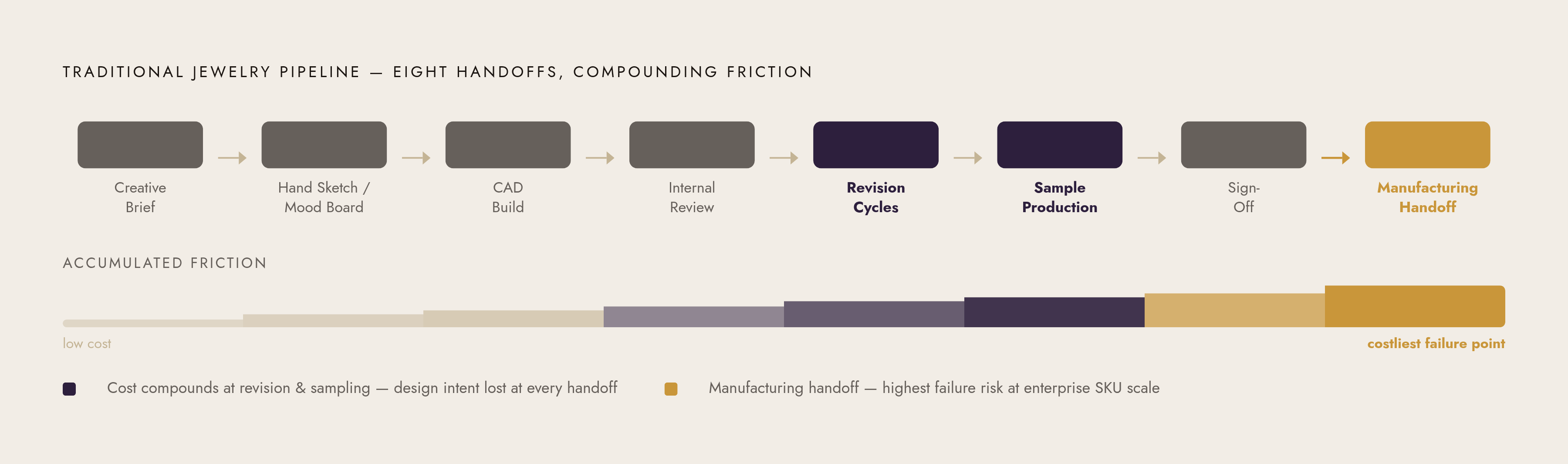
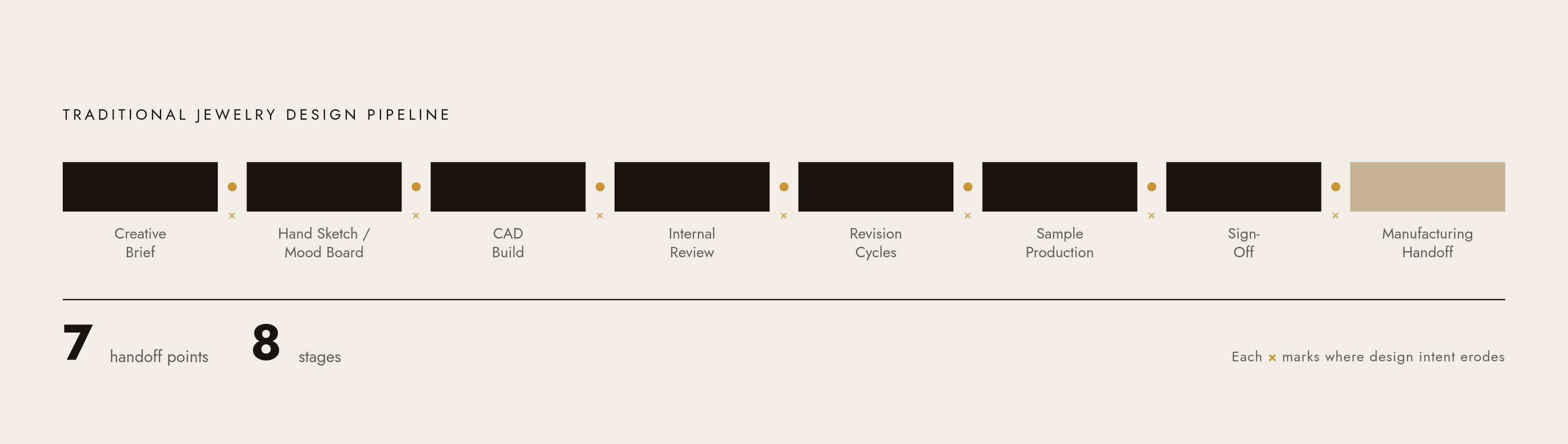
Creative brief. Hand sketch or mood board. CAD specialist builds the model. Internal review. Revision cycles. Sample production. Sign-off. Manufacturing handoff. Eight steps, each one a handoff, and each handoff is a place where design intent quietly evaporates.
For a small brand running one or two collections a year, this is annoying but survivable. For an enterprise team managing hundreds of SKUs across multiple collections and global manufacturing partners, the bottleneck is almost always CAD capacity. Skilled parametric modelers are scarce. Rebuilding variations by hand takes time. And here is the part that should embarrass everyone involved: those variations, a wider band, a slightly larger stone, a different halo diameter, are not new designs. They are the same design with adjusted parameters. The old model treats each one like a fresh build anyway.
The revision cost after physical sampling is where it really stings. When a dimensional problem surfaces in a wax model or a cut stone, you are not editing a file. You are rebuilding a physical object. That cost shows up in both budget and calendar, and it compounds fast across a large SKU range.
There is also a hidden cost that rarely makes it onto a P&L: collections get built around what the CAD team can produce in time, not what the market or brand strategy actually calls for. The creative ceiling becomes the operational ceiling. Nobody planned it that way. It just happens when you run a process designed for a slower, smaller world.
Design automation accounts for roughly 28.5% of total AI jewelry market revenue in 2025. It is concentrated there because CAD iteration and variant creation are where enterprise teams feel the most pain. The market did not stumble into that number by accident.
How Parametric Design Changes the Logic of Building a Collection
Parametric modeling is genuinely not that complicated to understand. Instead of building individual models, you build a rule-based system. Band width, ring size, stone diameter, prong height: these become variables, not fixed decisions. Change the variable, and the model updates everywhere that variable lives.
If your brand has a shank family or a halo architecture that recurs across your collection, you build that logic once. Every subsequent SKU that inherits that architecture requires an input rather than a rebuild. That shift sounds incremental until you are managing fifty SKUs that share the same structural logic, and changing a finger size propagates across the whole family in minutes instead of days.
Grasshopper, the algorithmic modeling environment that runs inside Rhino, is the tool most enterprise teams are working with. Designers can build parametric systems without needing programming knowledge. Stone arrays that follow a rule set. Motif layouts at scale. Controlled variation across a design family. Per MatrixGold's documentation, the kind of propagation that used to take days of manual rebuilding collapses into a single edit.
Grasshopper 2 has added capabilities that matter specifically for production-intent modeling. Native support for parallelism. Field-based data structures. Plugins like TRmesh and TRfem now run finite element simulations directly on the canvas, which means structural stress analysis and heat conduction modeling happen inside the parametric workflow rather than as a separate downstream check. Five years ago that kind of integrated stress testing simply did not exist in this workflow. It does now, and it changes what the tool is capable of catching before a file ever leaves the design environment.
For enterprise teams, the point worth sitting with is this: parametric design is not about flexibility for its own sake. It is about encoding your brand's design logic so that variation is systematic and every output is coherent with the collection. The system does not generate random options. It generates valid options, defined by rules your senior designers wrote.
One honest limitation: building a parametric system requires real upfront investment. You have to define the logic correctly before it pays off. The return compounds with SKU volume, which means the model heavily favors brands operating at scale. If you are managing dozens or hundreds of variants, the math works in your favor. If you are running a ten-SKU boutique collection, you should do that math carefully before you start.
Where AI Enters the Workflow and What It Actually Accelerates
Generative AI enters the workflow at the front end, in concept exploration. Tools like Midjourney can generate multiple design directions from a single text prompt. A GIA study from Fall 2024 compared five leading AI image generation programs on jewelry design tasks directly, including Midjourney and DALL-E, and it remains the most rigorous published benchmark available for this specific application.
What AI compresses is the concept exploration phase. Previously, a designer had to produce hand sketches or mood boards across multiple directions before any CAD work began. AI can surface a range of directions in roughly the time it used to take to produce one. That is real time savings at the front of the pipeline, and it adds up across every collection cycle.
AI is also being applied to brief interpretation, analyzing historical sales performance, trend data, and customer preferences to recommend design elements. This moves the starting point from instinct alone toward a data-informed instinct. Both matter. Neither replaces the other. Treating this as an either/or is missing how it actually works in practice.
Software solutions within AI jewelry tools are the fastest-growing segment, expanding at roughly 22.3% annually between 2025 and 2034. The tools are improving fast, and integration patterns are still being worked out in real time across the industry.
What AI does not compress, and enterprise teams need to be honest about this: structural integrity checks, manufacturing constraint reviews, and brand coherence judgment. These remain human, or they must be encoded into the parametric logic. AI generates directions. It does not validate them against a casting process.
There is also a specific failure mode worth understanding before choosing tools. Standard AI segmentation pipelines fail on reflective metal and gemstone surfaces. Research benchmarking the Segment Anything Model found it achieves only 48.47% IoU accuracy on glass and reflective objects, compared to 88.16% for specialized methods built for those surfaces. General-purpose AI tools applied to jewelry will underperform in exactly the places that matter most. Purpose-built jewelry AI, trained on the specific geometry and surface behavior of the materials you work with, is not a premium option. It is table stakes.
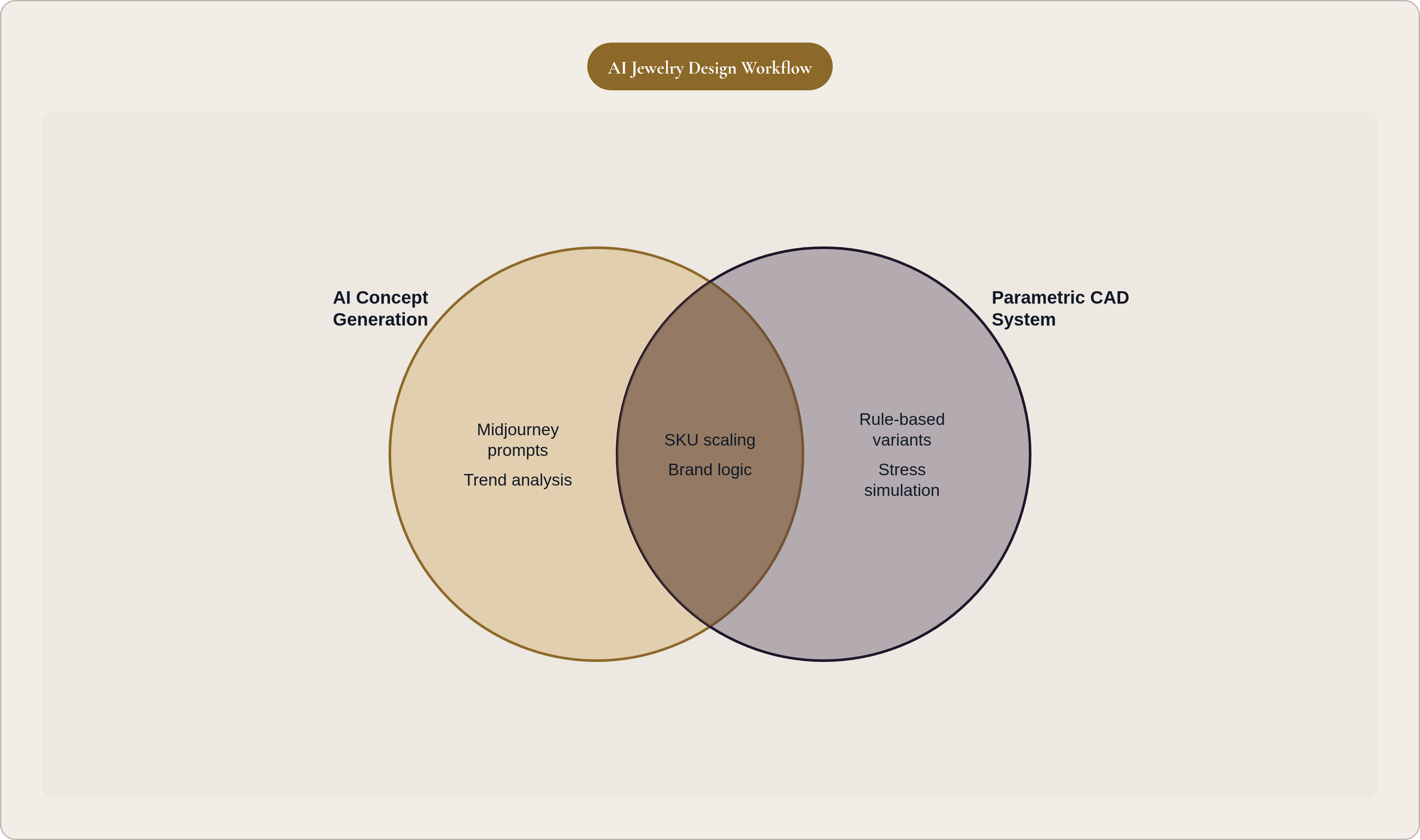
The overall workflow structure is: AI accelerates the front end. Parametric logic governs the middle. Human and system judgment on manufacturability closes the loop.
The Production-Ready Standard and Why It Defines the Whole System
Everything downstream of CAD depends on the accuracy of the model. This sounds like an obvious thing to say. The implications, though, are worth spelling out.
Production-ready in practice means clean STL files for 3D printing and casting. Micron-level geometric accuracy for gemstone settings and prong placements. Structural tolerances that survive the lost-wax casting process. The physical pipeline goes: digital model, 3D print in castable wax, wax serves as the master for lost-wax casting, cast in final material. Each stage amplifies any dimensional error in the original file. A small problem in the model becomes a bigger problem in the wax and a real problem in the cast piece.
What CAD makes possible that manual methods cannot is the ability to make changes without rebuilding a physical object. Widen a band. Adjust prong height. Reposition a stone. These are file edits. CAD also enables complex geometries that hand carving cannot achieve, which expands the design space for teams working on intricate or architecturally ambitious collections.
MatrixGold 4.0, released in late 2025, introduced a workflow-driven approach that aligns design, material decisions, and production insights in a single continuous process. It also added a Scoop feature designed to reduce metal weight while maintaining structural integrity. For enterprise teams managing material costs across hundreds of SKUs, that kind of built-in weight optimization is not a convenience feature. It is a margin tool.
A design that cannot go straight to manufacturing is not an asset. It is work in progress. It consumes review cycles, creates sample costs, and delays the collection calendar. The right metric for evaluating this operating model is not how fast a concept is generated. It is how many generated concepts reach manufacturing without requiring a manual rebuild. That ratio is what the system is built to move.
Managing SKU Range Expansion Without Proportional Team Growth
The traditional assumption is linear: more SKUs require more CAD specialists. More collections require a larger design team. Enterprise teams have been hiring to that assumption for years, and it works until it stops working. At a certain scale, headcount growth cannot keep pace with SKU range expansion, especially when trend cycles are compressing and customer personalization expectations keep rising.
The custom jewelry service market reached $3.95 billion in 2025 and is projected to grow to $4.3 billion in 2026. Made-to-order is growing fast enough that SKU range management is becoming a core enterprise capability, whether teams feel ready for it or not.
Parametric systems break the linear assumption. Variant generation becomes systematic rather than manual. AI handles concept exploration and iteration before a CAD specialist ever opens a file. A brand with five shank families, three halo architectures, and variable stone sizes can parameterize that matrix and generate production-ready variants on demand.
What scales: the parametric logic, the AI concept layer, the CAD output pipeline.
What does not have to scale as the bottleneck: the human design team, assuming the system is built correctly.
This implies a genuinely different role for senior designers. They spend their time defining and maintaining the parametric logic. Building and governing the system. Not executing individual models. That is a real shift in how design leadership functions inside an enterprise product team, and it requires honest conversation before anyone starts reconfiguring the org chart.
The risk is worth naming plainly. Parametric systems built on poorly defined logic replicate errors at scale. The leverage cuts both ways. A good parameter set propagates good outputs across hundreds of SKUs. A flawed parameter set propagates flawed outputs just as efficiently. This is why the initial system design is high-stakes work and why it needs your most experienced designers, not your most available ones. Those are usually different people.
Connecting the Digital Configurator to the Manufacturing Pipeline
A customer-facing jewelry configurator that cannot output a production-grade CAD file is a visualization tool. It is not a commerce tool. Teams tend to discover this distinction while managing fulfillment exceptions at scale, which is a bad time to discover it.
Mobile commerce represents over 60% of online jewelry transactions. Configurators have to perform at mobile fidelity, not just on a desktop with a fast connection. That is a technical constraint that shapes every design decision in the customer-facing layer.
The deeper constraint is this: the configurator must be anchored to the same parametric logic that governs the internal design system. Every combination a customer can select must be a valid manufacturing configuration. Not an aspirational rendering that requires someone to manually intervene before a manufacturer can do anything with it. A valid configuration that outputs a CAD file and goes directly to casting.
When the enterprise deployment works correctly, it looks like this: parametric rules define the configuration space. The configurator exposes that space to the customer. Each selection outputs a file that goes directly to the manufacturing handoff. No manual translation step between customer order and manufacturing instruction.
What breaks at scale without that connection is predictable. Order fulfillment exceptions pile up. Custom work requires manual CAD intervention for every individual order. Customer expectations get set by a render that the manufacturing process cannot actually reproduce. These are not edge cases at enterprise scale. They are the normal outcome of a configurator that is disconnected from the production system.
PIRO is actively working to connect AI-generated designs with inventory, manufacturing, and sales workflows. The industry is converging on this integration as the expected standard. Teams that treat the configurator as a front-end feature are building toward an architecture that will require significant rework later. The configurator is the customer-facing output of the same design system that runs the internal product development pipeline. Build it that way from the start.
What Enterprise Teams Need to Evaluate When Adopting AI Design Workflows
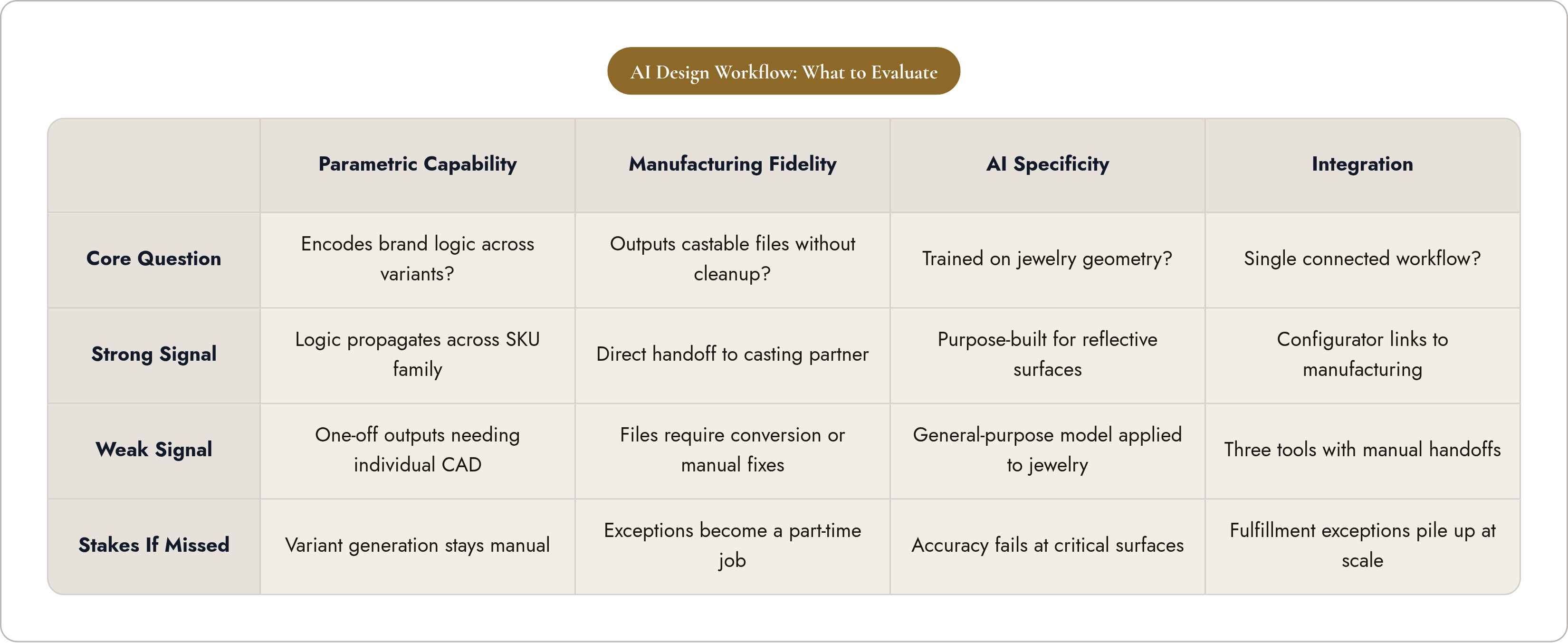
The core evaluation question is simple. Does the system connect concept generation to production-ready CAD output without requiring a manual rebuild at any stage? If the answer is no, or even a qualified yes, the operating model is incomplete regardless of how impressive the concept generation looks in a demo.
A few specific things worth assessing honestly:
- Parametric capability. Can the platform encode brand-specific design logic that propagates across SKU variants? Or does it generate one-off outputs that each require individual CAD work? These are fundamentally different tools dressed in similar marketing.
- Manufacturing fidelity. Does every configuration output a file format the casting or printing partner can receive without conversion or cleanup? Files that need cleanup create exceptions. Exceptions at scale become a part-time job for someone.
- Configuration scope. How many variables, metal type, stone size, band width, setting style, can the system hold simultaneously without generating an invalid combination? That ceiling determines the ceiling on your personalization offering.
- Integration. Does the platform connect the design system to the customer configurator and the manufacturing handoff in a single workflow? Or are teams managing three separate tools with manual handoffs between them?
- AI specificity. Is the AI layer trained on jewelry geometry and reflective surface behavior? The 48.47% IoU failure rate on reflective surfaces is the concrete reason this question matters. A general-purpose model applied to jewelry will underperform in exactly the places where accuracy is most critical.
Beyond the tool evaluation, there is an organizational question that teams consistently skip and then regret: has the team identified which senior designers will own the parametric logic, and what is the governance process for updating it when collections evolve? The system is only as good as the rules it runs on, and those rules require ongoing ownership. Nobody accidentally maintains a parametric system. Someone has to own it.
The measure of success at enterprise scale is not design speed in isolation. It is the ratio of configurations that reach manufacturing without exception handling. Track that number. That is what the operating model is actually built to move.