Grasshopper for Jewelry Design Workflows
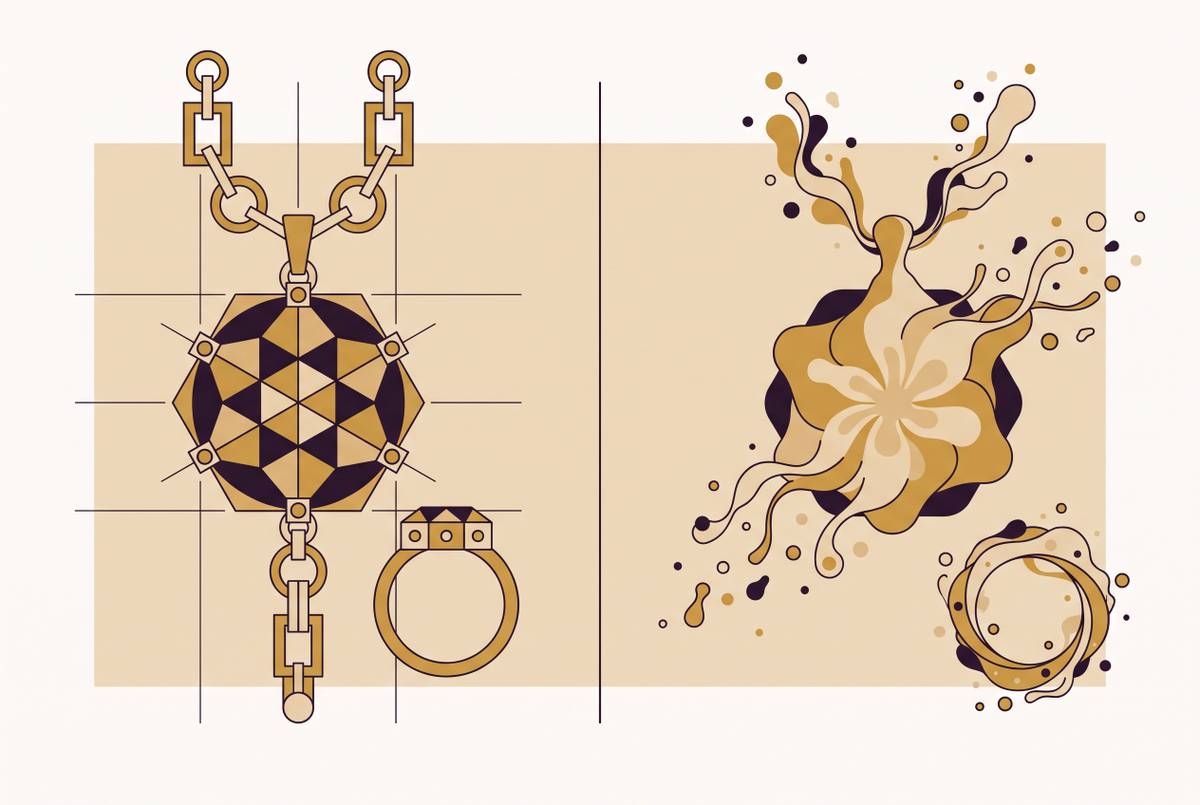
Parametric design shifts jewelry workflows from editing objects to automating families of forms.
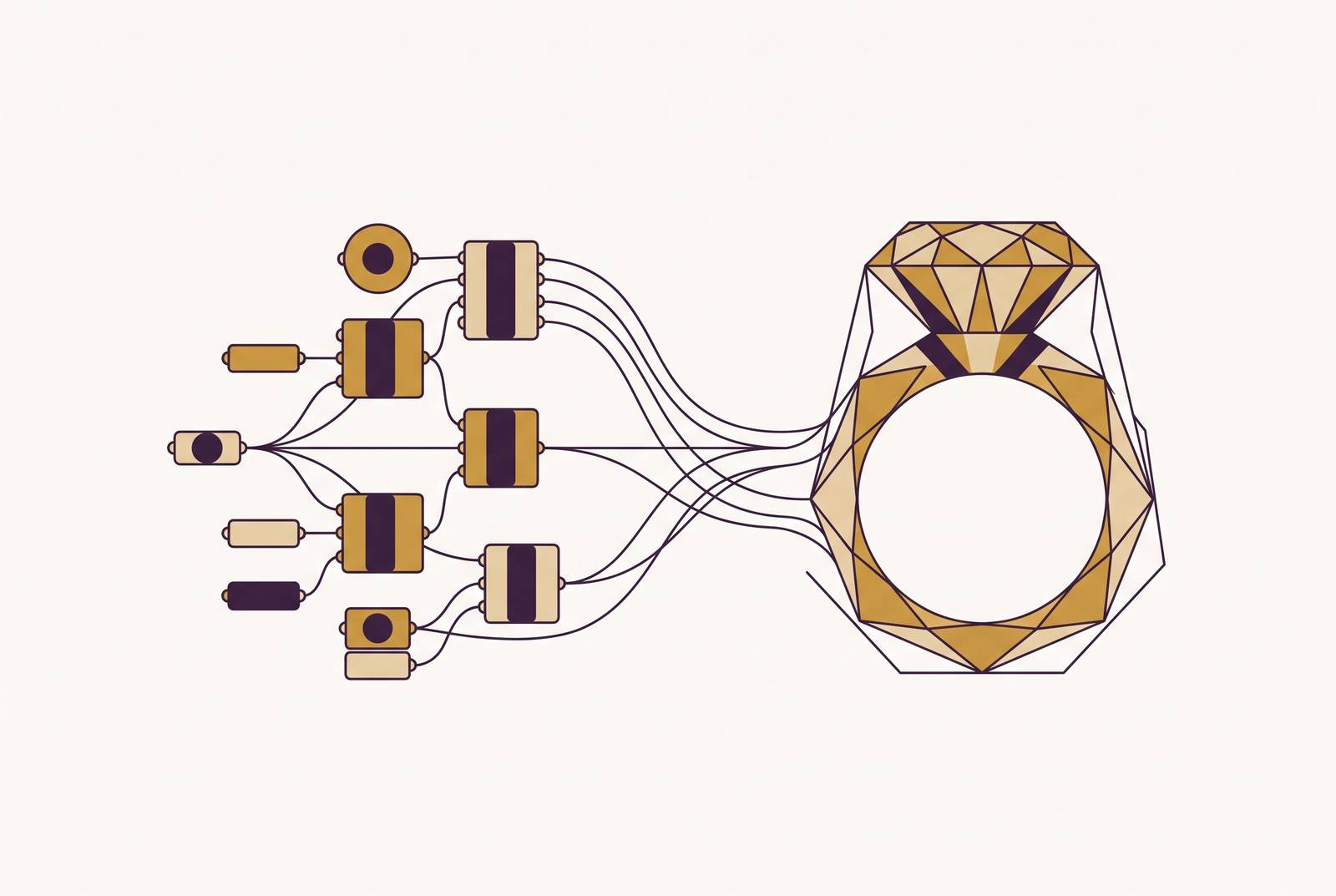
Grasshopper for jewelry design workflows turns design intent into a reusable procedure. Its strength is the rule set that produces a family of rings, pendants, or settings. Its limit is the distance between geometry that updates correctly and a file a manufacturer can accept. Choosing a workflow means accounting for both.
What Grasshopper actually does inside a jewelry workflow
A ring’s band thickness, prong height, stone seat diameter, and internal clearances are measurable values that affect one another. Grasshopper lets a designer wire those relationships into a definition, so a change to an input automatically updates the downstream geometry. The designer makes each variant by changing the values that govern it, saving the work of redrawing it by hand. The work shifts from making one object to describing how a whole family of objects should behave.
That is the useful distinction between design-as-object and design-as-procedure. An object-focused CAD workflow centers on editing the model, while a Grasshopper workflow centers on editing the instructions that generate it. Grasshopper is Rhino’s built-in algorithmic design tool, and Rhino’s jewelry page shows how it can be used to try out designs, make organic repetition with local variation, and improve form through optimization with analytics. The algorithm can keep the same underlying structure while controlling how parts of a piece or pieces in a collection differ.
The plugin layer that makes Grasshopper jewelry-capable
Grasshopper has the general rules engine, while its extensions add tools for specific jewelry tasks. Vector Fields and Voronoi components help make organic structures and detailed patterns on a surface. Kangaroo enables Differential Growth, which can make other kinds of growth-like forms. These tools address different geometric tasks rather than offering interchangeable routes to the same result. Choosing them is closer to choosing bench tools than collecting software badges.
Rhino’s jewelry page lists Peacock for Grasshopper as an open-source resource for algorithmic jewelry modeling, together with Grasshopper Gold and a Generative Jewelry Community. Rhino also describes CrossGems as professional 3D jewelry software for Rhino and Grasshopper that allows complex modeling without technical CAD knowledge. MatrixGold merges earlier Matrix/RhinoGold functionality with a parametric environment for designers who want adjustment without writing raw Grasshopper definitions. The approaches differ in how much of the procedure the designer must build.
Three IXU Design pieces that show parametric logic at work end-to-end
IXU Design’s documented practice connects algorithmic modeling with physical fabrication, although the supplied workflow details cover only two named pieces of the three announced in this section. Those two examples make the sequence concrete, from a geometric rule through specialized components to a fabricated object and bench finishing. The studio’s bench-work background informs how models are built.
For the Mobius Earrings, the algorithm begins with a Möbius surface generated with Lunchbox. Random points are distributed across that surface, and the Shortest Walk component traces pathways between them. Cocoon then builds the final organic centerpiece structure from this setup. The output is wax-printed and cast in gold before pink sapphires, neon blue apatite, and black rhodium plating are applied at the bench. Each stage has a distinct job, and the final piece depends on their order.
The Titanium Choker follows the same broad sequence with a different structure and material. Volumetric Voronoi structures are combined with Cocoon weighted components to generate the form. It is printed first in plastic, then cast in solid titanium at one of the few facilities capable of titanium casting at that scale. Progressive sanding, a sandblasted matte finish, and titanium anodizing follow at the bench. Here, the casting route is as much a part of the process as the definition that produces the geometry.
IXU Design also works with unconventional materials including titanium, meteorite, and osmium while maintaining strict fabrication precision. The limits of those materials can shape the parametric rules from the start, sparing the studio unwelcome news after modeling. Knowledge of casting, finishing, and stone setting therefore feeds back into the digital procedure. The algorithm handles how the parts of the geometry relate to one another, but the jeweler knows what those relationships must allow for. Even a very clever definition does not have a bench-work background of its own.
Where Grasshopper's parametric logic transfers across scales — from ring to garment
The same module logic can operate across rings, bracelets, collars, and garment panels. Arrays, attractors, graph mappers, and curve-based repetition control relationships. At jewelry scale, those controls can vary prong count, surface density, or motif spacing across a ring family.
That transferability explains both the reach of Grasshopper and its limits. A general rules engine lets designers make forms for more than one narrow kind of product. But that freedom comes without built-in rules for jewelry production tolerances, casting requirements, or manufacturing handoff. A procedure can travel across scales more easily than a manufacturing specification can.
The manufacturing handoff problem Grasshopper does not solve on its own
A Grasshopper definition can generate valid geometry that still fails in casting. Parametric correctness means the relationships behave as intended, while manufacturing correctness means the resulting object and file meet production needs. Those are separate tests. A band can update exactly as instructed without being suitable for the chosen material or process. Geometry does not become castable merely because it has obeyed instructions politely.
A parametric-to-configurator demonstration may look complete because its renders and mobile experience work well. Yet the pilot can stall when the STEP export needs manual cleanup before a CAM tool accepts it. The visual design and the algorithm may both be sound in that case. Someone still has to get the generated model ready for the production system that receives it, and the good-looking demo has quietly left them a repair bill.
Faster model generation does not remove that gap. Hitem3D can generate 3D meshes from reference images to accelerate initial prototyping, complementing traditional CAD. Whether geometry comes from AI or a parametric definition, a qualified CAD designer or manufacturer should validate dimensions, tolerances, stone security, material suitability, and the final file before production. Grasshopper is a geometry engine. Its usefulness remains substantial, but the handoff needs its own place in the workflow.
How AI-native tools are entering the same workflow — and where they split from it
AI CAD and Grasshopper address different moments in the work. AI CAD is strongest when a client sketch or reference photo needs to become an STL quickly, with turnaround measured in minutes, while Grasshopper scripting takes hours. For most standard rings, pendants, and studs, photo-to-STL can produce a printable mesh that is castable after a thickness check. Complex micro-pavé and unusual settings still go through a CAD jeweler.
The consultation stage can begin earlier still. HeyGema listens to client calls, sketches ideas live, and puts the specifications it captures into a PDF brief. That brief can feed either a Grasshopper definition or an AI CAD session. Capturing the brief and generating the geometry are connected tasks, but they are not the same task.
Grasshopper remains the stronger fit when the brief requires mathematically driven surface structures, algorithmic variation across a large family, or physics-based simulation through Kangaroo and Differential Growth. In those cases, the reusable rule set is itself a valuable product. AI-native tools suit work that starts with a reference image, a client’s description, or a standard form and needs to become a castable file quickly. Where manufacturing constraints are built into that output, they also address part of the handoff burden. The decision is less about which tool wins than which part of the work needs doing.
AADvark introduces an agentic system for generating CAD assemblies with movable parts by capturing dynamic part interactions with degrees of freedom. That is evidence of agent-aided design for dynamic assemblies. It suggests a direction for assistance with more complex CAD work. It does not remove the need to distinguish what a tool generates from what a jeweler can safely manufacture.
What production-ready parametric design looks like in a platform built for manufacturing handoff
The structural answer to the handoff problem is to make manufacturing constraints part of generation as well as later inspection. A configurator can recalculate geometry instantly and generate production-grade CAD within the same session. Its job is then more than showing a customer what an option looks like. It connects the option being sold to the file needed to make it.
That changes where expertise must live. A Grasshopper workflow depends on the team’s ability to write and maintain definitions that encode the right relationships. A platform built for manufacturing can supply that logic, so each designer can use it without writing an algorithm or knowing traditional CAD. This can serve independent designers without a large design team as well as enterprise brands. As the business grows, it must weigh how much custom scripting it needs for each offering.
The distinction is not that one approach can make appealing jewelry and the other cannot. It is whether manufacturing constraints reside in the engine or depend mainly on a designer’s later validation checklist. Built-in constraints address the gap earlier, but the label “production-ready” still has to mean something for the intended output. A production-grade CAD export and a fast printable mesh are not automatically equivalent deliverables. The platform’s value lies in the handoff it supports.
Choosing the right parametric approach for your jewelry workflow
The studio’s time commitments and its manufacturer’s requirements guide the choice of workflow. Grasshopper fits algorithmically complex work involving Voronoi structures, Differential Growth, or physics-based simulation, especially when scripting expertise is already embedded in the team. The studio also needs a qualified validator who can run wall-thickness and tolerance checks before the file leaves.
An AI-native platform fits when the team needs to get from a brief to a castable file fast, has no Grasshopper scripter, or needs manufacturing tolerances built into how the model is generated. It also fits configurators that customers use and that must produce production-grade CAD on demand. A hybrid workflow is viable when the studio has both needs. Grasshopper can handle algorithmically complex pieces that are one-of-a-kind or define a collection, while AI-native tools handle fast client work, standard forms, and sales through configurators.
Learning Grasshopper can still be worthwhile even where it will not handle every job. The PAACADEMY Dynamic Wearables workshop shows how thinking in modules can help with work at different body scales and in different fields of design. Before committing to a parametric workflow, trace what happens between the final export and acceptance by the CAM tool or casting house. If that path includes manual cleanup, its hidden cost belongs in the decision, no matter how quickly the model appeared on screen.