Digital Products Jewelry Brands Sell via Shopify
Jewelry brands are ditching inventory for digital tools that let shoppers trust their purchases.
Jewelry brands on Shopify have stopped relying on inventory to make money. A growing share of their revenue now comes from digital products: configurators, AI-generated previews, virtual try-on, downloadable design files. None of those are physical. All of them sell.
That shift solves a problem as old as online jewelry shopping itself. A ring is not a book or a phone case. A shopper can't hold it, feel the weight of it, or see how it catches light on their own hand before they buy. That uncertainty has always been the reason jewelry converts worse online than almost any other product category, and it's the exact gap the digital product stack was built to close.
The brands pulling ahead on Shopify right now are the ones that figured out how to make a shopper trust a purchase they can't physically touch, using tools that didn't exist five years ago, more than the ones with the best stones or the lowest prices. The rest of this piece maps what those tools actually are, how they work inside a Shopify storefront, and why each one earns its place in a modern jewelry business.
What counts as a digital product in a jewelry Shopify store
"Digital product" gets used loosely in jewelry e-commerce, and that looseness costs brands money. Treating a configurator and a downloadable CAD file as the same kind of investment leads to spending on the wrong tool at the wrong stage of a business.
Five categories cover the space. Interactive configurators let a customer build a piece choice by choice, metal by metal, stone by stone. AI-generated design previews turn a sketch or a prompt into a render a customer can approve before anything is made. Virtual try-on overlays a piece onto a shopper's own hand, ear, neck, or wrist through a phone camera. AI product photography generates catalog and lifestyle images without a studio shoot. Downloadable production files, in formats like STL, OBJ, and GLB, hand over the actual blueprint a manufacturer needs to cast the piece.
Some of these are the product a customer pays for directly, like a finished design file. Others are the mechanism that gets a customer to pay for something physical, like a try-on session that removes their last hesitation. Both belong on the list, but they don't do the same job, and a brand that mixes them up ends up building a beautiful configurator with no way to fulfill what it sells, or a gorgeous photo library with no design tool behind it. The five work best as a connected relay, not five separate shopping carts.
Custom configurators: turning a product page into a design studio
A configurator is the single highest-leverage digital product most jewelry brands can build, because it converts a passive scroll into an active decision. A customer who picks their own metal, stone, and setting has already started buying before they hit the "add to cart" button. That involvement raises conversion rates and average order size.
The mechanics are straightforward. A shopper selects metal type, gemstone, setting style, and personal touches like engraving. A live preview updates as they go. By the time they check out, the configuration they built isn't just a preference, it's the order record itself, the exact spec that moves on to production.
Kendra Scott built a billion-dollar brand around exactly this idea with its "Color Bar" tool, letting shoppers swap stones and metals and see the changes reflected back in real time. AARYAH takes a different path: customers pick metal type, setting, and finish, then a Bridal Specialist follows up personally rather than showing an instant visual preview, trading immediacy for a guided, human layer of confidence-building. GLDN leans into personalization as meaning rather than mechanics, building its entire model around initials, dates, and symbols that turn a customization step into something closer to a small ceremony. Moonglow goes further still: a shopper enters a date that matters to them, and the tool shows the moon phase from that night, converting a data input into an emotional moment before a single stone gets chosen.
What separates a genuinely useful configurator from an expensive visual toy is what happens after the customer clicks confirm. Every configuration has to output something a manufacturer can actually use. A tool that looks great on screen but can't translate into a production-ready spec just moves the fulfillment headache downstream, which is exactly where the next category comes in.
Downloadable and deliverable CAD files as a direct revenue line
Selling the design file itself, rather than the finished piece, opens a revenue line that has nothing to do with inventory. A brand doesn't need a single ring in stock to sell a production-ready STL, OBJ, or GLB file. What it needs is manufacturing access, packaged as a download.
Three kinds of buyers show up for this. Independent jewelers without in-house CAD capability. Customers who want to take a design they configured somewhere and bring it to their own manufacturer. Small brands building made-to-order collections without a design staff on payroll. For all three, the file is the product.
The distinction that matters here is the gap between a pretty picture and a working blueprint. A photorealistic AI render is a marketing asset. A watertight STL file is a production asset. They are not interchangeable, and a brand selling files has to deliver the second one, not the first. AI-generated 3D models still need a human to check stone settings and wall thickness before a piece is genuinely castable, so any brand in this business needs a verification step built into the workflow. Skipping that step means the brand charges production-file prices for something that's really just a nice picture.
Parametric design changes what's possible here in a meaningful way. A file built on a parametric system can have its ring size, stone size, or setting style adjusted later without rebuilding the whole model from scratch. That turns a delivered file into something genuinely flexible, a living blueprint rather than a frozen snapshot locked to one configuration forever.
AI-generated design previews and concept renders as presale tools
Before a single stone gets set, AI-generated previews let a jewelry brand show a customer what a piece will look like, in different metals, from different angles, in a photorealistic render built in minutes. What used to take a week of mood boards and sketches now takes about as long as a coffee break.
The workflow runs in a clean line: a text prompt or an uploaded sketch goes in, an AI tool generates a concept render, the designer or customer iterates in plain language ("make the band thinner," "switch to white gold"), and the approved direction moves on to CAD. That loop replaces a slower, more expensive back-and-forth that used to require redrawing by hand at every round.
The advantage appears earliest in the process. Generating many concept directions quickly helps a brand and a customer converge on taste fast, which cuts down on expensive revision churn once a design is already deep into production. For a Shopify storefront, this means a brand can list a design as a product and take deposits or full payment on it before the physical piece exists, supporting a made-to-order model with none of the risk that comes with unsold stock sitting in a drawer.
That only works if the render is connected to something that can actually be built. A tool like Midjourney produces gorgeous images, but some of those images depict jewelry that physics simply won't allow, a setting with no way to hold a stone, a band with no structural logic. A presale asset needs to come from a pipeline tied to manufacturable geometry. Otherwise a brand ends up with a customer who approved one thing and a manufacturer who can't cast it, which is a fulfillment gap no amount of marketing polish can paper over.
Virtual try-on as a conversion product embedded in the storefront
Virtual try-on isn't a novelty add-on. It answers the single biggest reason jewelry underperforms as an online category: shoppers can't see how a piece actually looks on their own body before they buy it, and that blind spot stops a lot of purchases cold.
The technology covers rings, earrings, necklaces, bracelets, and watches, rendered on a shopper's own hand, ear, neck, or wrist in real time through a phone camera. AI-powered sizing for rings and wrists adds another layer, estimating fit directly from a camera image and closing off one of the last excuses a shopper has for hesitating on jewelry sight-unseen. That sizing tool clears a real hurdle for a sight-unseen purchase, though it works best alongside, not in place of, a professional fitting.
The engineering underneath this mechanism is complex, even though the mechanism itself is simple to describe. Computer vision locates the relevant body part in the camera frame. A 3D model of the jewelry, usually a GLB or USDZ file, gets rendered onto it with realistic lighting and scale. The shopper sees something close to themselves wearing the piece, in their own living room, before they've spent a dollar.
For Shopify specifically, try-on isn't a separate app living off to the side. It gets embedded directly into the product page through an API or an app integration, becoming an extension of the page a customer is already looking at. And the asset that makes it work doubles as something a brand may already own: a 3D model built for parametric CAD or AI modeling can be repurposed directly for try-on, so the same file earns its keep twice, once in the factory and once on the customer's screen.
AI product photography as a scalable digital content product
AI photography has changed what kind of catalog a jewelry brand can field, and how fast. On-model imagery, lifestyle shots, multiple angles of the same piece, used to be a budget line reserved for brands big enough to book a studio, hire models, and pay a retoucher. Now it's within reach at nearly any scale.
The tool generates product shots, lifestyle scenes, and on-model images for e-commerce and marketing teams without any of that overhead. A small brand can produce a catalog that looks like it came out of a major studio, because increasingly, it didn't need to.
What that unlocks operationally is the more interesting part. A brand can generate imagery for a piece before the physical sample even exists. AI renders built from a confirmed CAD design can populate a full product page, supporting a presale or made-to-order listing with complete visual coverage on day one, not three weeks after the first sample ships.
That matters because the bar for a product page that actually converts keeps rising. High-resolution images from multiple angles, 3D and 360-degree views, on-model video, these have become the baseline a shopper expects before they'll trust a jewelry purchase online. AI photography makes hitting that baseline possible without the content budget that used to be the price of entry.
How Digital Products Connect Across a Shopify Storefront
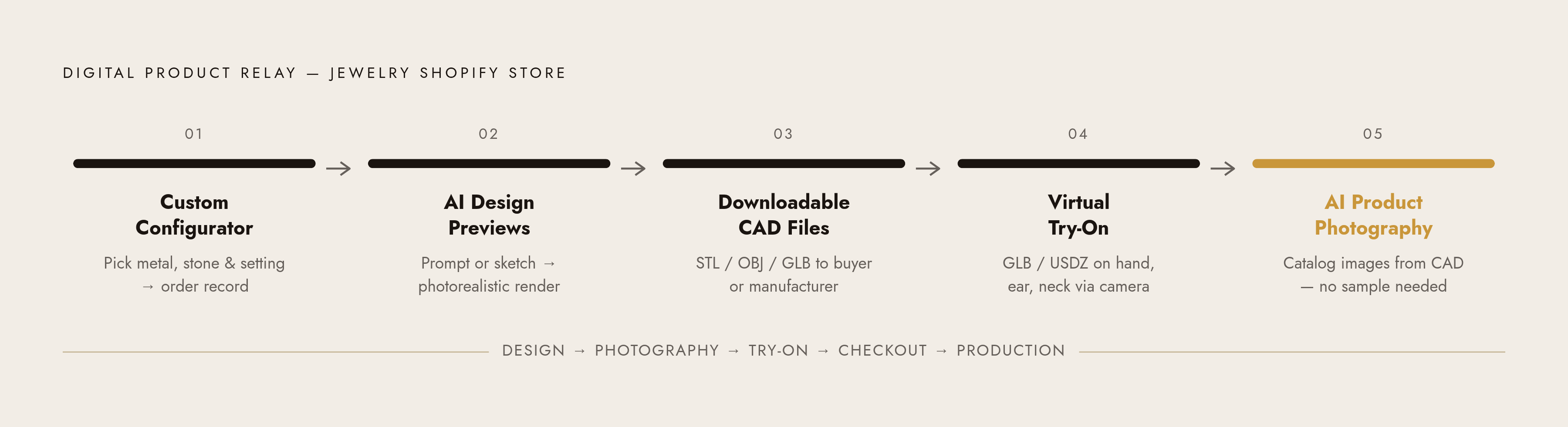
Five digital product categories, treated separately, are five separate projects with five separate budgets and five separate failure points. Treated as a relay, they compound.
Design hands off to photography. Photography hands off to try-on. Try-on hands off to checkout. Brands that keep each leg isolated leave conversion sitting on the table at every single handoff between them.
A parametric CAD model drives that relay inside an actual Shopify jewelry business, feeding the configurator, generating the 3D file try-on needs, exporting the production STL a manufacturer will cast, and feeding the inputs AI photography uses to build a catalog. The configurator captures what a customer chose and turns it into an order record tied to a specific file. Try-on and AI photography make that configured choice feel real and trustworthy before money changes hands. The downloadable or delivered production file closes the loop, connecting what the customer approved to what the manufacturer receives.
The made-to-order model is the business logic holding the whole relay together. Because a piece gets made after it's configured, a brand carries no unsold inventory sitting in a safe somewhere, which makes the digital product stack the inventory strategy itself.
VRAI shows what this looks like when a brand builds around it from the start. It sells loose diamonds and lets customers design rings around their own preferences, with customization and transparency built into the core of the business. It's what the brand actually is.