Rule-Based Jewelry Configuration vs. AI-Generated Design
Each tool solves a different production problem, so choose based on your bottleneck.
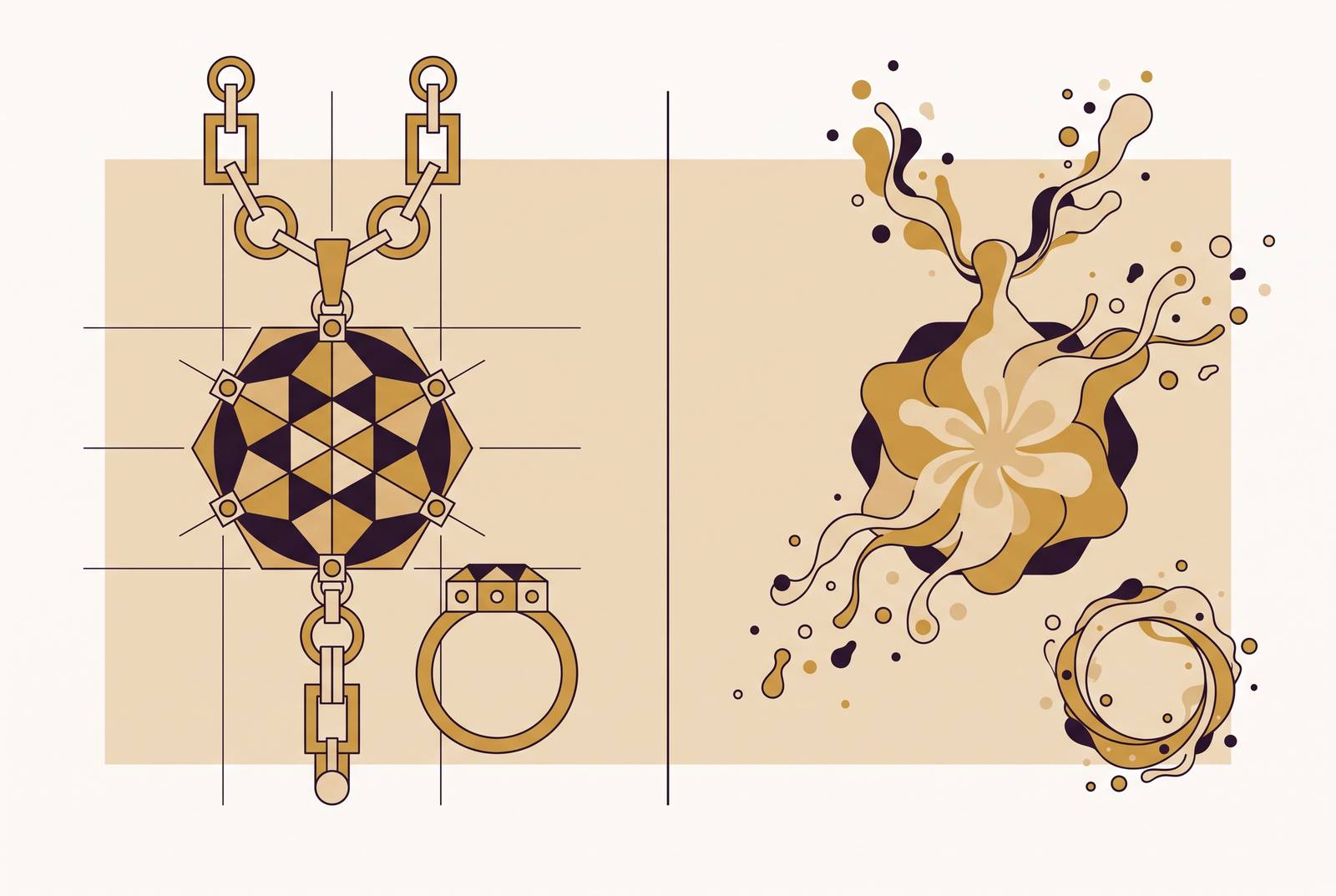
Rule-based jewelry configuration and AI-generated design solve different halves of the same problem. Configuration keeps designs within manufacturing rules, while AI expands the ideas available to explore. Pencil Design combines these approaches in one workflow, but the buying decision should still turn on the output. A team should assess whether it needs a better way to imagine jewelry, a reliable way to make it, or both.
The core tension that makes this comparison matter
A client approves a convincing ring render, but someone still needs to fix the file before anything can be cast. Elsewhere, a customer wants a design that a configurator cannot produce because its rules never allowed it. Both teams bought a faster way to design, yet each has hit a different kind of stop sign. Mixing up these problems can lead a team to buy the right tool for the wrong job.
The confusion starts with how the tools are presented. Both involve digital design, both can be marketed as “AI-powered,” and both promise speed. Those similarities conceal where each tool intervenes in the production pipeline. Generative design helps show what a piece might look like, while rule-based configuration controls which versions can be made. Neither function becomes the other simply because the interface looks clever.
This is therefore not an old-versus-new technology contest. A brand that treats a concept image as a finished production file leaves engineering work unresolved. Conversely, a brand that puts every creative decision inside a configurator accepts the limits of the rules already written. Misunderstanding leads to disappointment with software and a workflow built around a handoff that nobody planned.
What rule-based configuration actually does and how it enforces manufacturability
A parametric configurator works within a constrained geometry space where selectable combinations have already been established as manufacturable. When a buyer changes a variable, including metal, stone, band width or prong count, the engine recalculates the geometry in real time. The resulting form remains coherent rather than becoming a patchwork of swapped visual assets. The buyer sees choices, but the system enforces the rules that link them. That enforcement is what gives “production-ready” a meaning beyond looking finished.
A production configurator also connects the design to the commercial details of the order. Real-time inventory and pricing sync allow the quote to reflect live costs. At checkout, automatic bill of materials and CAD export supply the information needed downstream, including metal weight, stone specifications, prong count, assembly notes and a 2D drawing.
The bill of materials is the bridge between selection and production. In an integrated workflow such as Pencil Design’s, the parametric engine provides a 3D preview and produces a complete bill of materials and production-ready CAD file at checkout. The guarantee, however, has a boundary. The system can only generate combinations that its rules permit, so the rule author’s imagination sets the ceiling.
What AI-generated design actually does and where its production gap sits
A text or image prompt produces a photorealistic 2D concept render, which gives the designer something to judge and revise. Mesh construction then reconstructs that reference as a 3D mesh with full volumetric geometry. Refinement follows through parametric adjustments to stone size, band width and prong position, using conversational AI or direct mesh editing. Finally, the model is exported as STL, OBJ or a similar format for 3D printing or casting.
The first image communicates shape and styling while leaving the geometry and structural details required to make the piece unresolved. Mesh construction, refinement and export bring the idea closer to being made, but an export format alone does not prove castability. A file extension is not a certificate of good behavior. The production question remains whether the geometry inside the file satisfies the relevant constraints.
Tools built for jewelry can do more to close this gap than general-purpose image generators. Training on jewelry imagery makes terms such as “cathedral setting,” “milgrain border” and “prong configuration” more useful within the design process. Tools that also understand production constraints can connect that vocabulary to parametric adjustments. AI’s value is not diminished by a later engineering step, provided that step is part of the plan.
Where each paradigm breaks down under real operating conditions
Missing or inconsistent product data is the most common reason implementations stall. The engine forces the structure of a brand’s catalog into the open because its rules need consistent inputs. A team that is ready for this can use it to spot problems. For an unprepared team, the same process can halt launch, and no amount of polishing the interface repairs the catalog underneath.
Once the data is sound, the creative boundary remains. A single parametric template can offer hundreds of ring combinations, but every combination has been pre-authorized by the engineer. The tool restricts customers to choices described by its rules to prevent unbuildable designs.
AI encounters its characteristic limit at the production gate. The generative pipeline still requires human correction of structural details before a file can go to casting. Its images can approximate constructability without guaranteeing it. Inventory adds another constraint that neither attractive images nor coherent geometry can wish away. Among hundreds of possible variations, only a few may exist as ready stock, while the rest are made-to-order with specific lead times.
If a configurator fails to show that distinction, or an AI concept skips it entirely, downstream teams must resolve which variations are ready stock and which require production lead times. This also exposes the weakness in the claim that adaptive AI experiences will make configurators obsolete. Adapting to customer behavior addresses exploration and interaction, with manufacturing requirements still to be resolved. A beautiful, unbuildable ring has not solved the problem that rule enforcement solves. Equally, a perfectly constrained template has not answered every creative brief.
What the production-path requirement reveals about which paradigm fits which workflow
The right choice follows the bottleneck. If every approved design must yield a castable file, a correct bill of materials and a live price, the parametric configurator is the load-bearing tool. AI can assist upstream without replacing that production guarantee. This is especially clear in B2B wholesale, where automated bill of materials generation at checkout separates a production system from a marketing experience. A concept render does not supply that bill of materials.
If the bottleneck sits earlier, the order changes. Clients may struggle to visualize what they want, revisions may be expensive, and the team may develop directions one at a time. In that case, AI-assisted ideation helps the team settle on a direction before detailed production work begins. Configuration or CAD follows once there is alignment. Engineering every idea before the client chooses one gives precision the wrong appointment time.
Parametric CAD provides a bridge between exploration and controlled output. Editable modeling features let designers turn a concept into a model and adjust its parameters within a manufacturing framework as the idea changes. Teams should choose where each belongs in the workflow. A team can need broad exploration at approval and strict enforcement at checkout without contradicting itself.
How brands combining both paradigms are resolving the creative-vs-manufacturability split
The useful combined pattern is to put AI where it shortens exploration or presentation, then retain parametric and CAD tools where geometry must be controlled. Auria Fine, a boutique brand on Shopify, illustrates the importance of keeping those roles distinct. Its AI-assisted visual production cut asset turnaround from two weeks to under an hour and lifted conversion rate to 1.57%. The intervention was in photography and presentation. It did not replace the underlying product configuration logic.
That distinction makes the example useful without asking it to prove more than it does. The broader workflow follows the same division of labor, with AI supporting ideation, visualization, client alignment and content production. Parametric and CAD tools check the geometry, generate the bill of materials and produce the output needed for manufacturing. The handoff is the important part.
At enterprise scale, the same split has to survive integration with a brand’s website and product rules. Pencil Design gives start-ups and global brands the same platform, and offers custom parametric designs and custom-trained AI agents for enterprise use. That establishes a route for combining the approaches across business sizes, rather than evidence of a particular enterprise result.
Where Pencil Design sits in this combined paradigm
Pencil Design brings AI-assisted concept generation and parametric production-ready CAD output into one platform. Designers can start with text or a reference, even if they have no CAD expertise. The parametric layer then adds the manufacturing framework needed to turn those ideas into pieces that can be made. This makes it a strong fit for brands that need both creative development and controlled configuration, rather than only a rendering tool or a fixed product selector.
Pencil Design’s parametric configurators offer a broad range of customization options, with every combination producing a production-grade STL file intended for casting. A bench review may still be required. That qualification belongs in the workflow, since intended casting output and permission to skip all review are different claims. The useful promise is that exploration resolves into constrained geometry before CAD export.
The same production logic extends into the sales channel. Custom configurators and digital product experiences can be embedded in storefronts so that what the customer sees matches what gets made. AI agents for websites and storefronts extend the design experience without a separate development team.
For teams choosing an integrated approach, having both layers in one platform removes the integration risk of stitching together separate ideation and configuration tools. Pencil Design’s large community of designers spans start-ups and global brands, so this approach is not reserved for large CAD departments. Integration is a relevant option when the requirement is a continuous path from initial idea to manufacturing output.
How to evaluate any configuration or AI design tool against the production-path requirement
Evaluation should begin with a catalog audit. Missing or inconsistent product data can stall a configurator regardless of the engine behind it. Once the inputs are understood, the central question is what the tool outputs and whether that output can move directly to manufacturing. “AI-powered” describes neither the deliverable nor the work still required. The demo may sparkle, but the file has to earn its keep.
First, examine the output format and its condition. A watertight, manifold-ready STL or equivalent castable file is different from a render or mesh that needs manual cleanup. Next, establish whether checkout or export creates a complete bill of materials without manual input, including metal weight, stone specifications, prong count and assembly notes. Then test where geometry enforcement happens. Preventing unbuildable combinations during configuration is a different service from discovering them after submission to a manufacturer.
Finally, check where the tool fits in the pipeline. An ideation tool with a clean, standardized CAD handoff may fit the job well, but it should not be evaluated as though it owns the full production path. Similarly, useful CAD controls do not by themselves make a complete checkout-to-production configurator. For the tool to fit into production, its output, materials information, geometry enforcement and handoff must work together.
Only after those requirements are precise does the build, buy or combine decision become meaningful. A team needing faster client approval can prioritize exploration, while a team needing dependable order output can prioritize configuration. A team that needs both can judge an integrated platform by the same requirements, even if having both in one place makes it easier to use. Choose the next tool by the work its output must do next.