Wholesale and B2B Ordering Portals for Jewelry Brands
Jewelry wholesale needs portals built for variants, custom orders, and production-ready files.
Jewelry wholesale runs on a wall of variants, negotiated prices, and custom requests that most B2B software just wasn't built for. This piece walks through what a jewelry-specific ordering portal actually needs to do, where the current platforms stand, and why the gap between "custom order" and "file a foundry can use" costs brands real accounts. Read on, or don't, but your wholesale buyers are already judging you for it.
The global jewelry market hit hundreds of billions of dollars in 2024 and is headed for well over half a trillion dollars by 2033. Online demand is moving even faster: Technavio expects the online segment alone to add tens of billions of dollars between 2024 and 2029. Buyers have noticed, and wholesale accounts now want the same self-serve access, live pricing, and stock checks they get shopping for themselves at midnight on their phones. Brands still running wholesale through email threads, PDF line sheets, and phone tag lose time and deals at every step. The portal is the front door now, whether a brand meant it to be or not.
What makes jewelry wholesale structurally more complex than generic B2B
Most B2B software gets built for the boring, blessed simplicity of "product has three sizes." Jewelry never worked that way.
Take a single ring style. Split it into sterling, yellow gold, and rose gold, across five sizes, with two stone options, and you've got thirty products from one design, each needing its own inventory count, price, and photo. Standard catalog tools choke on that kind of branching fast, and brands feel it first in the SKU list, then in the spreadsheet nobody wants to own.
Pricing stacks another layer on top. Volume breaks, account-tier discounts, memo arrangements, one-off negotiated terms, all of it has to live in the same system at the same time without contradicting itself. MOQ isn't always a fixed number. It often shifts based on production costs, the value of the relationship, and where the account sits in the market. Lead times vary depending on order size and how much customization gets involved.
Then there's the stuff with no real equivalent elsewhere. Engravings, stone substitutions, bespoke builds, all of it is routine at wholesale, never an edge case. High-value orders bring deposits and net terms into the mix. Add memo-to-sale conversions and repair workflows, and you've got an order list that most generic platforms simply weren't designed to hold.
The capabilities a jewelry B2B portal must cover as a baseline
Strip away the extras and a jewelry portal still needs a working baseline, or it's just a pretty website that generates phone calls anyway.
Account-specific catalog access comes first: control over who sees what, and the ability to hold back exclusive SKUs for priority buyers. Tiered pricing has to show up inline, so a buyer sees their negotiated rate without emailing a rep to ask what they actually pay. Inventory needs to sync in real time, because nothing sours a retail relationship faster than confirming an order for something that sold out an hour ago.
Order management has to flex across types too: standard reorders, custom requests, engravings, memo conversions, drop-ship. Reps need mobile access so they can write orders and quotes on a trade show floor instead of scribbling notes to enter later, half of which get lost anyway. The portal has to talk to accounting and ERP systems, QuickBooks, NetSuite, Salesforce, because a portal that doesn't sync with the rest of the business becomes one more island someone has to manually reconcile at month-end. Payment handling needs range: deposits, net terms, case-pack minimums, per-unit or per-weight pricing. And buyers, for all their online sophistication, still want a PDF line sheet and a purchase order that matches what they saw on screen, an old habit, but a real one.
How the named B2B portal platforms approach jewelry's requirements
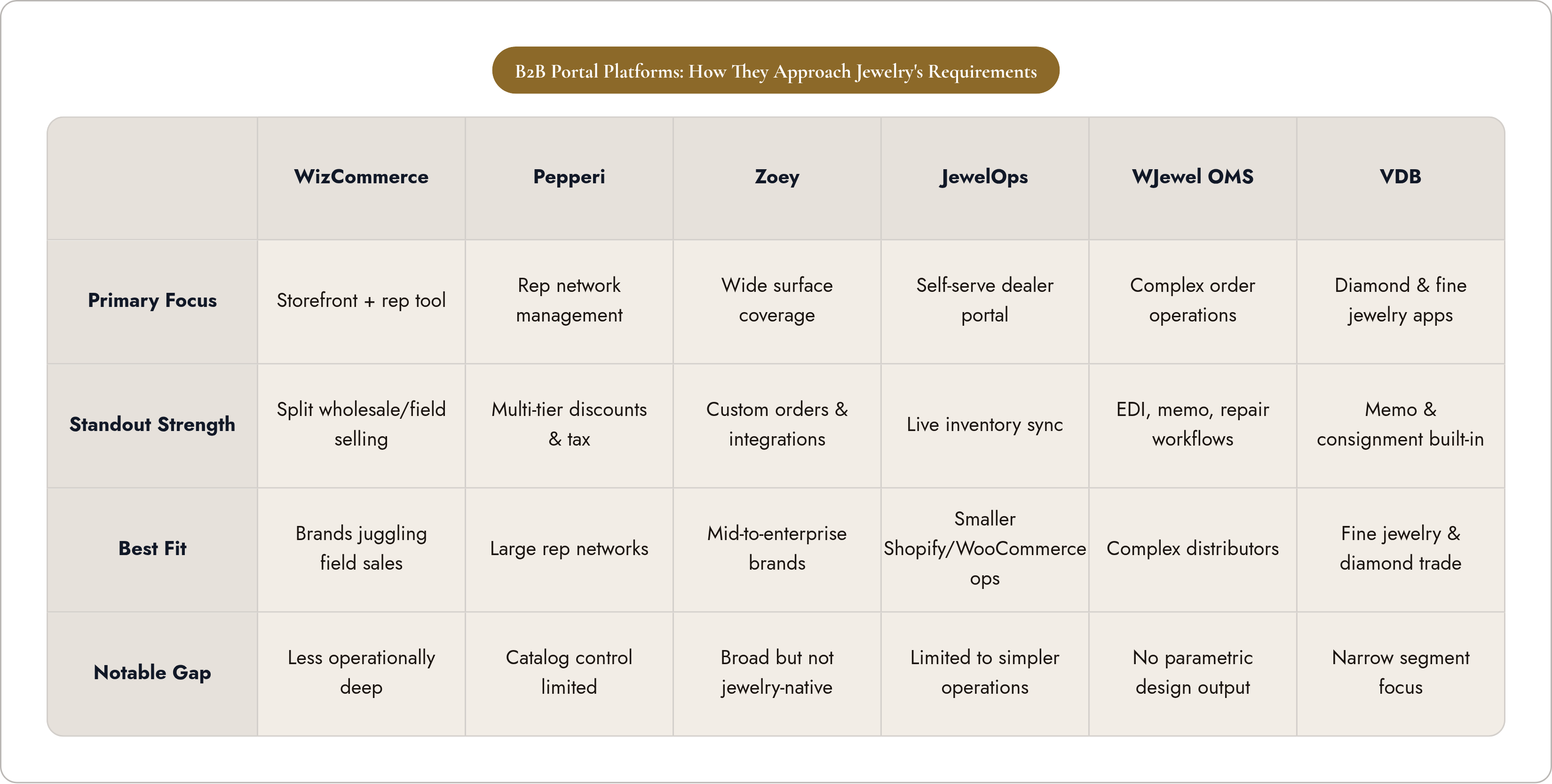
A handful of platforms have built specifically around these problems, and each one leans a different direction.
WizCommerce splits into a storefront (WizShop) and a rep-facing order tool (WizOrder), aimed at brands juggling wholesale and field selling at once. Pepperi leans rep-centric: it calculates discounts across multiple loyalty tiers and handles the tax mess of municipal versus state rates, which suits brands running large rep networks. Zoey covers a wide surface: segmented catalogs, incremental packaging quantities, engraving and custom order management, deposit payments, mobile quoting on the show floor, and integrations with QuickBooks Online, Salesforce, and NetSuite.
JewelOps takes the simpler route. It's a self-serve dealer portal with live availability and tiered pricing built into the subscription, syncing in real time with Shopify or WooCommerce, aimed at smaller operations that want function without a custom build. Uploadify goes catalog-first, with tiered pricing display, password-protected buyer access, instant updates across catalogs when stock changes, and one-click conversion from browsing to purchase order, a good fit for brands whose wholesale motion is mostly visual. WJewel OMS handles the widest order-type range, including EDI, bulk tiered pricing, drop-ship, memo-to-sale conversions, and repair workflows, which makes it the most operationally complete option for complex distributors. VDB builds custom apps specifically for the diamond and fine jewelry trade, with memo and consignment workflows baked in from the start.
A newer category, AI-driven design and configurator platforms, closes a gap none of the above fully touch: generating manufacturing-ready CAD output straight from a buyer's custom configuration, so a retailer ordering something bespoke gets a file ready for production instead of a pretty picture that still needs a CAD technician to finish the job. No single platform wins on every front here. The right pick depends on whether a brand's real headache is order management, pricing logic, catalog control, or custom design output.
Where most portals stop short: the custom configuration and production-ready gap
Most portals handle ordering fine and handle design not at all, and that split is where things fall apart. A custom request goes into a text box, gets forwarded to someone on a CAD team, and disappears into a separate process the portal has zero visibility into.
That gap, between what a buyer configures and a file a foundry can actually cast, mill, or print from, is the industry's real bottleneck. Two-dimensional AI design tools still need two to eight weeks from concept to finished piece once CAD conversion and revision rounds get counted. Traditional CAD work runs two to twelve weeks depending on complexity. None of that is fast, and none of it scales the way a self-serve portal implies it should.
"Production-ready" has one meaning worth being blunt about: a file that goes straight to casting, CNC milling, or 3D printing, no extra interpretation needed. A rendering, a sketch, or a concept a CAD tech still has to translate falls short of that bar every time, and a design that needs a human middle step before it can be built is not production-ready, full stop. A portal that takes custom orders it can't fulfill without that manual detour is stacking up work it will eventually have to pay down, and every custom order that needs a human CAD step caps how many accounts a brand can actually serve at once.
Platforms built on 3D-native, parametric output close this gap directly. The configuration a buyer picks inside the portal produces the same file that ends up at the foundry, no translation layer in between. Major jewelry brands expanding into AI-assisted customization, letting buyers personalize pieces through 3D digital design, is worth reading closely for what it signals. Even the biggest players in the industry see this heading toward a baseline requirement, not a nice-to-have.
How parametric design changes what a wholesale configurator can offer
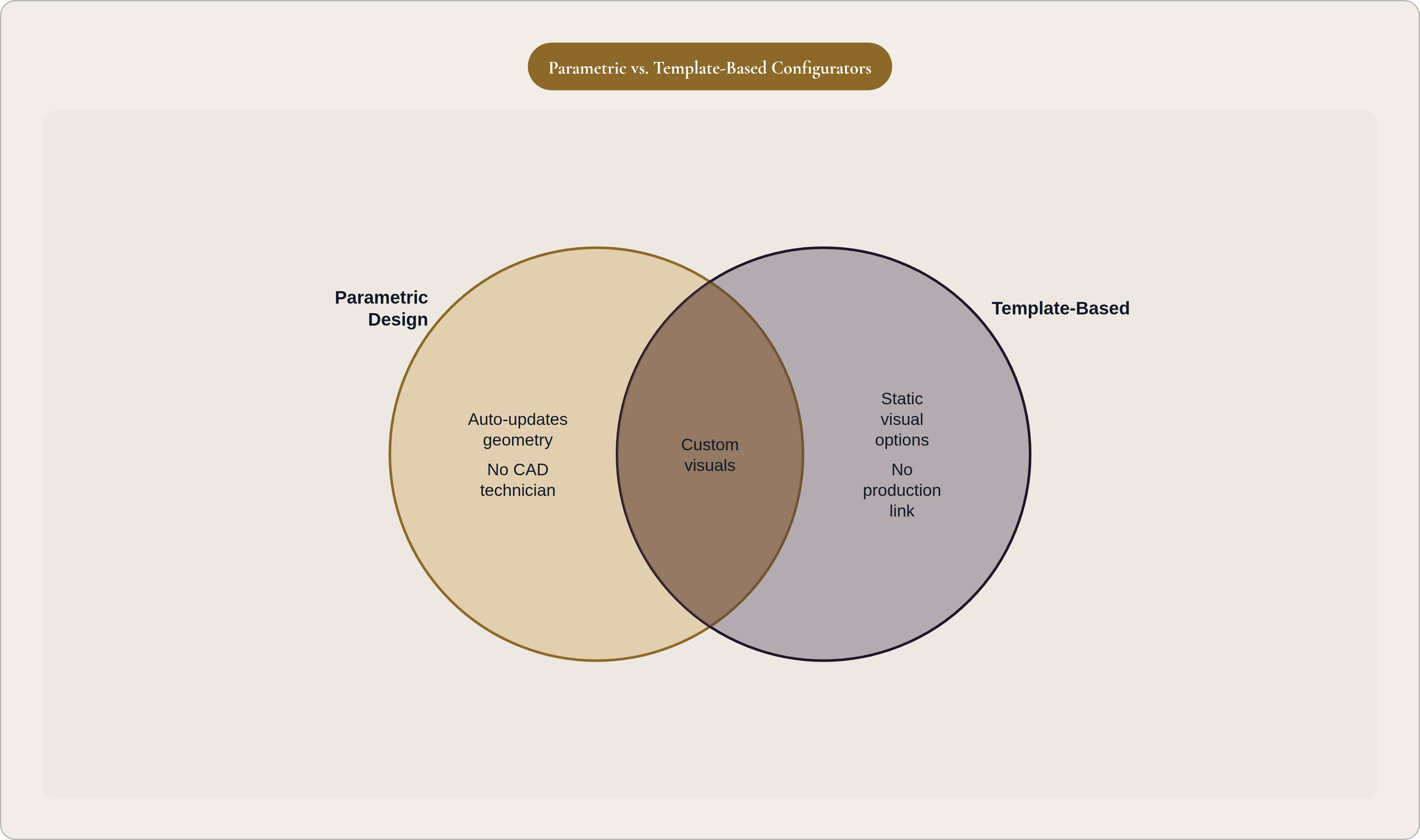
Parametric design means every dimension, material, and stone setting follows a rule instead of a fixed shape. Change one input, ring size, metal weight, stone diameter, and the whole model updates automatically, geometry included.
That's what makes a configurator actually useful at wholesale instead of just decorative. A buyer picking a 7mm oval sapphire in 18k yellow gold gets a structurally sound, dimensionally correct model back, not an approximation somebody fixes by hand later. Compare that to template-based configurators, which show static, visual-only options with no real link to what production can build. The buyer sees something that looks right on screen, and the file that actually reaches the shop floor might not match it at all. That mismatch is where returns and remakes come from.
Parametric logic lets a platform expose real customization (metal type, stone shape, prong style, band width, finish) without turning inventory management into a nightmare of manually tracked SKUs. For a wholesale account, that means specifying their own configuration and getting back an actual production file, not a request that lands in someone's queue and sits there for a week. The 3D printed jewelry sector, valued at $4.89 billion in 2026 and growing at 17.3% a year, is expanding for exactly this reason: parametric-to-print workflows aren't locked behind the walls of major manufacturers anymore.
What tiered pricing and MOQ structures should look like inside a modern portal
A single flat MOQ is a blunt tool. Multiple tiers, each with its own price break, can serve different buyer sizes instead of forcing everyone through the same door.
Some suppliers have moved toward lower or flexible MOQ thresholds to reach smaller business accounts, though that shift brings quality consistency risks a brand has to actively watch for. Inside the portal itself, pricing tiers need to stay account-specific and invisible across accounts, so a boutique on a standard plan sees different numbers than a chain running a negotiated rate.
Margins are getting squeezed from another direction too. Lab-grown diamond wholesale prices dropped 6.7% in the second quarter of 2025, tightening margins across fine jewelry generally. Brands running configurator-driven portals can push back against that by offering accessible custom entry points, competing on design instead of racing to the bottom on price. On the practical side, a portal needs volume breaks by unit, by case pack, by metal weight, tax handling across jurisdictions, currency support for international accounts, and deposit triggers for high-value or custom orders. And the pricing shown has to be live: the second a rep or buyer builds an order, the number on screen should already reflect their tier, their volume, their account status, no quote request, no waiting on a callback.
Connecting the portal to trade show and field sales workflows
Trade shows still close deals in this industry, but an order scrawled on paper or emailed the following Tuesday is an order that's lost its momentum, and probably some accuracy too.
A mobile-capable portal lets a rep pull up a buyer's account right there on the floor, build the order against live inventory and that account's actual pricing, and submit it before the buyer's attention drifts to the next booth. New prospects without a login yet still need quote generation from that same mobile interface, with a clean path to a confirmed order once terms get settled.
Running reps through the same system that powers the self-serve portal kills the version-control problem outright. No separate price sheet floating around somewhere, no manual reconciling later between what a rep promised and what the system actually recorded. For brands hitting multiple shows a year, that's not a small convenience: every show's orders drop straight into the same fulfillment pipeline, no manual re-entry, no lag.
What brands get wrong when they build or choose a B2B portal
The most common mistake is building for the average account instead of the best ones. Portals tuned for small, simple reorders end up frustrating the high-volume buyers who need custom configurations, negotiated terms, and EDI support, and those are usually the accounts worth the most money.
Another mistake: treating the portal as a catalog with a checkout button bolted on, instead of a full order management environment. The result is buyers who browse happily online and then call a rep anyway the moment anything gets complicated, which defeats the entire point of building the thing. Skipping catalog access controls causes its own damage, showing every buyer every product and quietly breaking exclusivity deals with the accounts a brand cares most about keeping.
Disconnecting the portal from inventory and ERP systems creates a different kind of mess: a SKU marked available that isn't, orders that need manual re-entry into some other system, small errors that chip away at trust with retail accounts one mistake at a time. And accepting bespoke orders through a text field, then routing them by hand to a CAD team, puts a hard ceiling on how many custom-capable wholesale accounts a brand can actually serve. Onboarding gets underestimated too. A confusing first-time experience sends buyers straight back to calling a rep, and the self-serve value the brand paid for evaporates, replaced by the exact rep workload the portal was supposed to remove.
The portal as a growth surface, not just an order intake tool
A well-built portal does more than take orders. It surfaces reorder timing, puts upsell and cross-sell options in front of a buyer while they're already paying attention, and hands the brand real data on which accounts are active and which have gone quiet.
Account-specific catalogs aren't just gatekeeping. They're a way to put new collections directly in front of buyers who already qualify for them, no outbound call needed. A custom configurator built into the portal turns wholesale accounts into something closer to collaborators. A retailer who can specify their own build feels more invested in the result, and is less likely to go find the same look somewhere else.
For brands scaling from boutique wholesale toward enterprise accounts, the portal's architecture has to already fit the next tier of complexity before it arrives. Finding out the system can't handle EDI, tiered pricing, or production-ready custom output right when a major account signs on is about the worst possible moment to learn it. The brands closing more wholesale accounts, and fulfilling them without friction, built the portal to match the industry's actual complexity from day one, instead of starting simple and patching in capability every time something breaks.