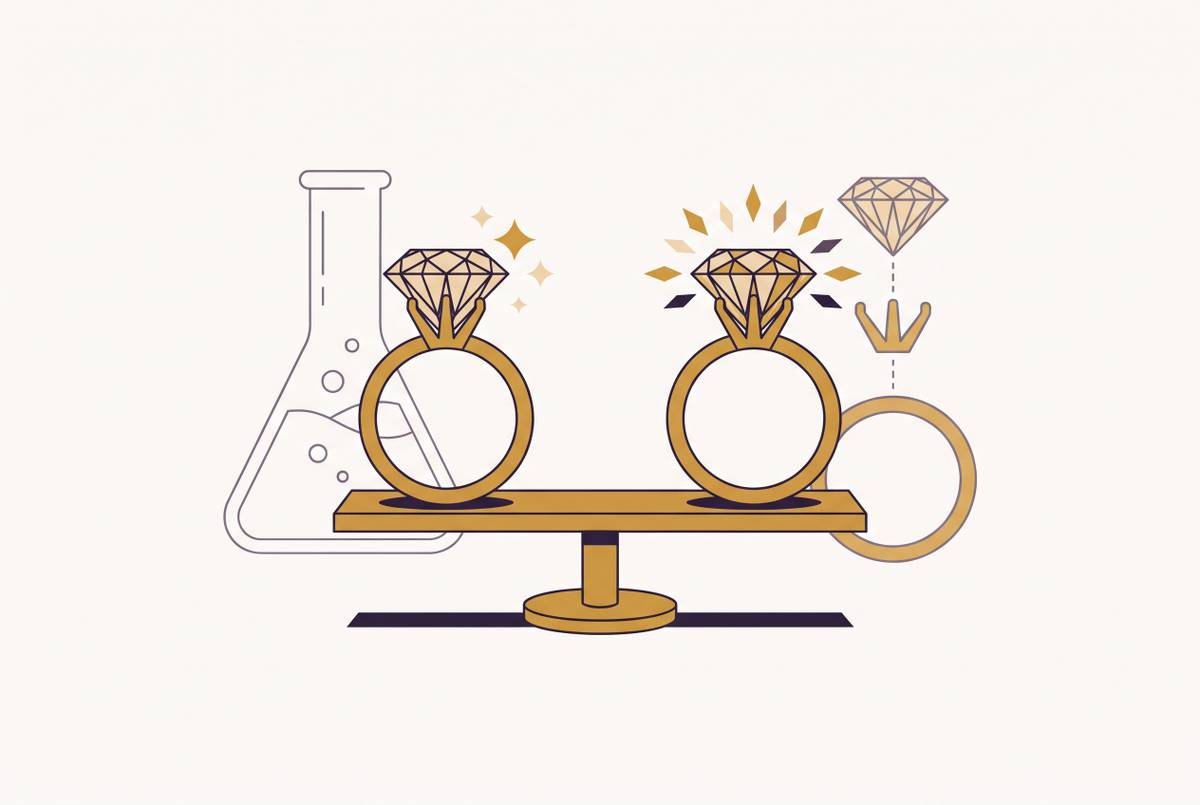
Side Stone and Halo Settings for Lab-Grown Diamond Rings
How center stone shape and daily wear should guide your setting choice.
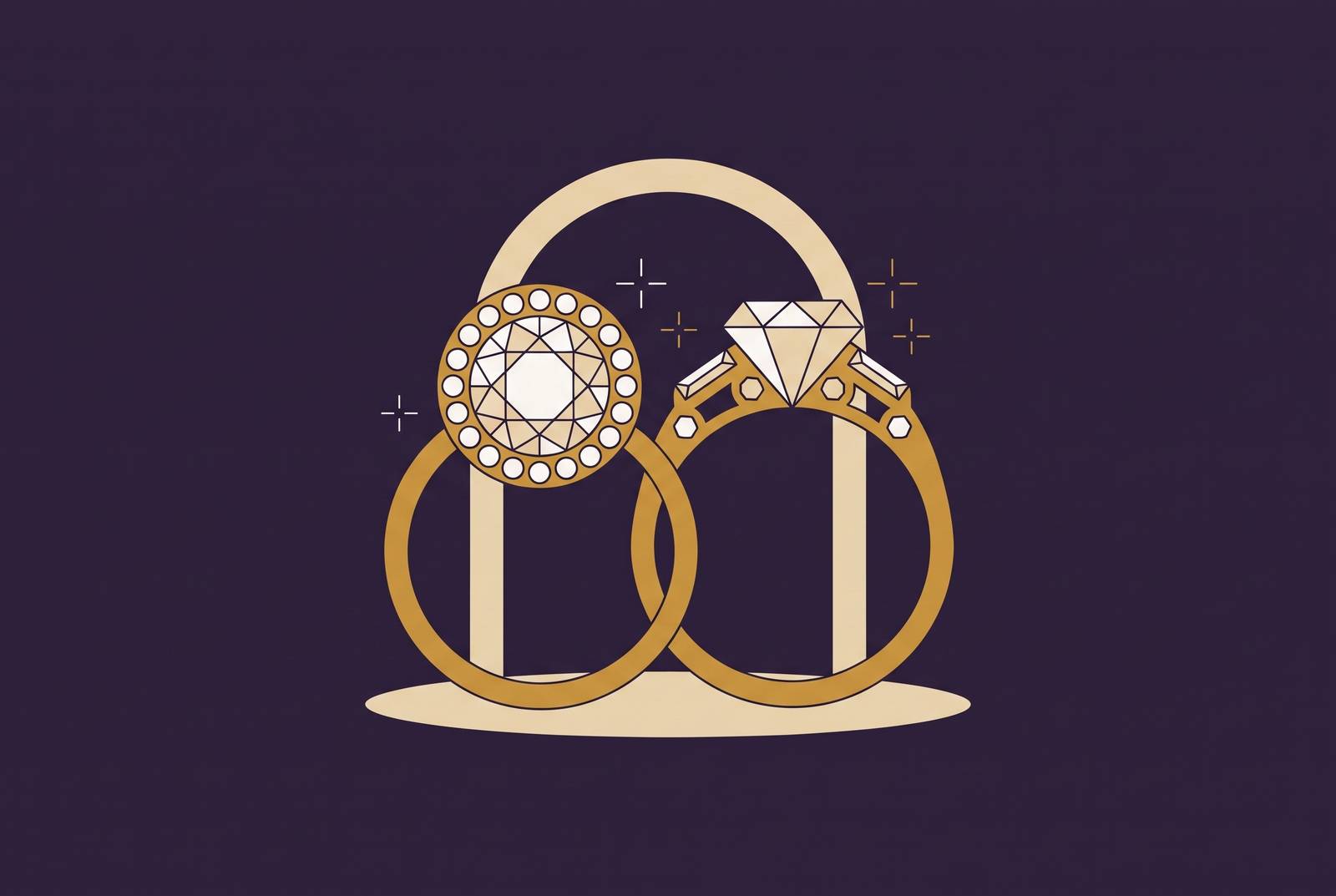
Choosing between side stone and halo settings for lab-grown diamond rings is a design decision. The better choice depends on how the setting works with the center stone’s size, shape and light, and how the finished ring handles daily wear.
Why lab-grown diamonds have made the setting decision more consequential
The Knot 2026 Real Weddings Study, cited by Draco Diamond, reports that a majority of US engagement ring center stones are now lab-grown. Because these diamonds cost a fraction of comparable mined stones, buyers have more room to spend on the setting. That extra room in the budget opens up three-stone arrangements, diamond-set bands and hidden detailing that might previously have been out of reach.
A large oval may need less framing, while a marquise needs a setting that respects its length and protects its tips. More available carat weight does not automatically call for more surrounding diamonds. Sometimes the setting’s most useful job is knowing when to get out of the way.
Draco Diamond reports that bezel, hidden halo and vintage settings are gaining ground, while classic halos have declined and simpler solitaire bands have lost share to diamond-set bands. Queensmith data in the same report shows that roughly one in four rings has hidden diamond detailing. These choices reflect more than changing taste. Lab-grown pricing gives buyers the means to put complexity where they want it, rather than letting the center stone consume the entire budget.
How side stone settings actually work and what they do for a ring's proportions
Side stones change how wide and heavy a ring looks, drawing the eye along the shank toward the center. Their size and shape establish the hierarchy. Small, matched accents can keep the center dominant, while a different arrangement can make the whole ring feel more architectural.
Balacia describes the three-stone configuration as a center stone flanked by two matching side stones, which can stay smaller to preserve the main focal point. The arrangement also creates a broader footprint across the finger. Pavé extends that logic along the band. Stienhardt describes a pavé band as producing continuous sparkle along the finger, lifting the whole ring.
That distinction becomes important with elongated stones. An oval, pear or marquise already reads long for its carat weight, so side stones can support that direction or compete with it through their orientation and scale. Shape compatibility comes before adding more diamonds. Vintage-inspired designs add milgrain, filigree and other surface detail, which looks different around a round brilliant than around an emerald or asscher cut.
The added stones also change the structural demands. Three-stone rings create more points of contact with surfaces, and Balacia flags their more involved resizing as a practical limitation. For people who work with their hands, it identifies bezel settings as the strongest daily-durability option. A bezel, also called a rubover mount, surrounds the stone’s girdle with metal rather than relying on prongs, trading exposed edges for protection.
How halo settings work and the distinct visual problems they solve
Instead of spreading visual weight along the finger, its surrounding diamonds expand the center’s apparent face-up outline. Balacia describes this as a way to gain perceived size without increasing the main stone’s carat weight. That suits a buyer who puts more of the budget into cut quality and color grade but still wants visual scale.
A hidden halo solves a different problem. Its small diamonds sit beneath the center stone, leaving a solitaire-like outline from above and adding sparkle from the side. Balacia names the oval hidden halo as its best-overall pick because it combines that clean outline with a detailed profile. On an elongated oval, it avoids the extra border that can make a standard halo feel over-framed.
Balacia notes that oval diamonds can show a dark bowtie across their center and describes careful diamond selection to avoid it. A hidden halo does not replace that selection work. The setting and the center stone still have different jobs.
Color gives buyers another choice while the halo’s basic structure stays the same. MollyJewelryUS describes halos using sapphires, emeralds or lab-grown colored diamonds for contrast and personal symbolism. These accents require attention to depth and prong style because saturation and refractive index affect how they read. Stones set in the same places can still look different.
More small stones also mean more maintenance touchpoints. Balacia flags regular cleaning and professional inspection for hidden halos, whose undersettings collect debris, and notes that additional prongs provide places for dust and lotion to gather. Lotion is an enthusiastic, if unwelcome, design collaborator. Long-term visual success also depends on matching the accents to the center’s color and cut grade and sizing the halo’s outer diameter to its girdle.
How stone shape determines which setting family actually fits
Center stone shape is the first practical filter. Round brilliants have a symmetrical girdle that suits an even halo, with no strong directional preference to complicate side stone placement. That makes them especially flexible for both halos and three-stone designs. Choosing accents usually comes down to how much emphasis they should receive.
Ovals require more restraint around their perimeter. Their length already supplies visual scale, and a broad frame can dilute that effect by adding width. Pears and marquises present the same tension, with pointed outlines adding another constraint. Rosec Jewels notes that elongated cuts such as pear and marquise enhance the appearance of finger length, so a setting that widens them substantially can work against a reason for choosing them.
Emerald and asscher cuts need a different balance. Their step-cut facets produce a hall-of-mirrors reflection pattern rather than brilliant sparkle, while their large open tables make inclusions more visible and demand higher clarity grades. Strong accents can outshine that quieter center. A halo therefore needs to complement the stone’s reflection pattern.
Cushions bridge rounded and angular arrangements because their soft corners work with either kind of side stone. Princess cuts put protection ahead of embellishment. Their sharp corners need protection from a prong or bezel before the designer adds the surrounding stones. For side stones more broadly, a tapered baguette beside a round brilliant reads classically, while the same baguette beside a kite-set marquise can create directional competition.
Scale can reverse the intended effect entirely. Halo accents should be calibrated to the center stone’s table width, since very small stones may disappear against its brilliance and oversized ones can form a crown. A halo that is too large can make the center look smaller. More frame is not always more picture.
What wearability and daily durability mean for setting choice
Rosec Jewels says the best ring fits what the wearer does each day, their personal style, the symbolism they want and what they expect from it over time. A setting that photographs beautifully but struggles through a working day has a design mismatch. For buyers, the lesson is to weigh the ring’s contact points and cleaning needs before approving its silhouette.
Halo settings collect lotion, soap and daily debris between their accents and center stone and behind the basket. Pavé has a different pressure point. Stones along the inner band, where the ring contacts adjacent fingers, can loosen under lateral pressure over time. Both styles remain options, with each issue factored into the decision.
Bezel settings offer the most protection and the lowest maintenance burden. Their metal rim wraps around the girdle without prongs to catch or snag. Balacia also identifies cathedral settings as an option for people who work with their hands. These raise the stone within metal arches, trading some of the bezel’s full coverage for a more dramatic profile height.
A bezel-framed center with a pavé or diamond-set shank puts the protective structure around the main stone and the sparkle along the band. The pavé still has its own wear considerations. This combination nevertheless shows how design can answer two priorities at once, rather than treating durability and detail as opposing teams.
How the setting choice lands differently across the stone shapes dominating the 2026 market
Draco Diamond identifies round, oval, emerald, pear and marquise as shapes drawing buyer attention in 2026, with round and oval effectively tied at the lead in the Knot study. A round brilliant works well with standard halo, hidden halo, three-stone and pavé settings. Geometry leaves the decision unusually open. Proportion and personal preference can therefore lead, whether the aim is a larger-looking center or a broader ring.
Oval is where the hidden halo earns its clearest recommendation. It preserves the elongated face-up outline while adding detail below, rather than using another border to enlarge a stone that may already be substantial. A standard halo around a large oval can create a cluster effect. Buyers can choose to draw the eye to the oval itself or to the ring as a whole.
Emerald cuts call for accents that respect the center’s step-cut character. Side stones or a halo can work, provided their sparkle does not overpower its broad reflections. The priority is balance. This is also where the center’s clarity deserves attention, because an elaborate setting does not change what its open table reveals.
Pear cuts need protection at the pointed tip. Draco Diamond identifies pear as one of the fastest-climbing shapes from a low base, making that detail increasingly relevant to setting choices. A protective prong or v-prong constrains the halo’s fit around the point. Side stones along the shank leave that outline clear, though the center’s tip still needs protection.
Marquise doubles the tip-management task because it has two pointed ends. A halo must fit both ends, and the height of the setting at those tips is a particular weak point. For daily wear, a well-fitted side stone arrangement with secure tip prongs and a diamond-set band offers a more structurally reliable route. Keeping excess width out of the center also preserves the length that makes the shape distinctive.
Metal is the finishing variable. Draco Diamond reports that yellow gold is ahead of each other metal in US rings in the 2026 data, although white metals together still account for most rings. Yellow gold makes halos look warmer and works well with vintage detailing and colored accents. MollyJewelryUS describes mixed-metal bands as another way to add dimension, with the visual result depending on which metal holds the accent stones.
Why digital configuration is now the right tool for resolving these setting decisions before production
Changing an accent stone’s diameter affects both the ring’s appearance and the space available to set it, while a different band width or prong treatment changes the manufacturing specification as well as the silhouette. Metal color introduces another visual comparison, particularly beneath colored accents. A pretty rendering alone cannot resolve those relationships.
Designers can then use parametric configuration before the ring is made. A parametric model allows related dimensions to change together instead of requiring each version to be rebuilt from scratch. AI-powered tools that produce production-ready CAD can connect the approved configuration to a castable file. The purpose is to close the gap between what the buyer chose and what the manufacturer receives.
That changes the approval conversation in useful ways. A designer can show three or four finished versions with different accent sizes, prong treatments or metal colors, so the buyer can see how the choices differ. One model can also handle round and oval centers in yellow gold, white gold, rose gold and platinum without the design work growing at the same rate as the number of choices.
Every selectable configuration needs to be production-ready, with constraints that prevent accent stones from crowding the center and keep prong height clear of the band profile. Otherwise, the configurator is selling a picture and leaving production to negotiate with it.
The useful system recalculates geometry as the buyer changes stone size, metal or accent color. It is a manufacturing specification tool with a customer-facing view. That is what makes digital configuration a fitting way to resolve this choice, because the setting can be judged as both an appearance and a structure before either becomes expensive to change.