Just-in-Time Manufacturing Applied to Custom Jewelry Fulfillment
Fast, accurate design-to-production handoffs unlock customization without inventory risk.
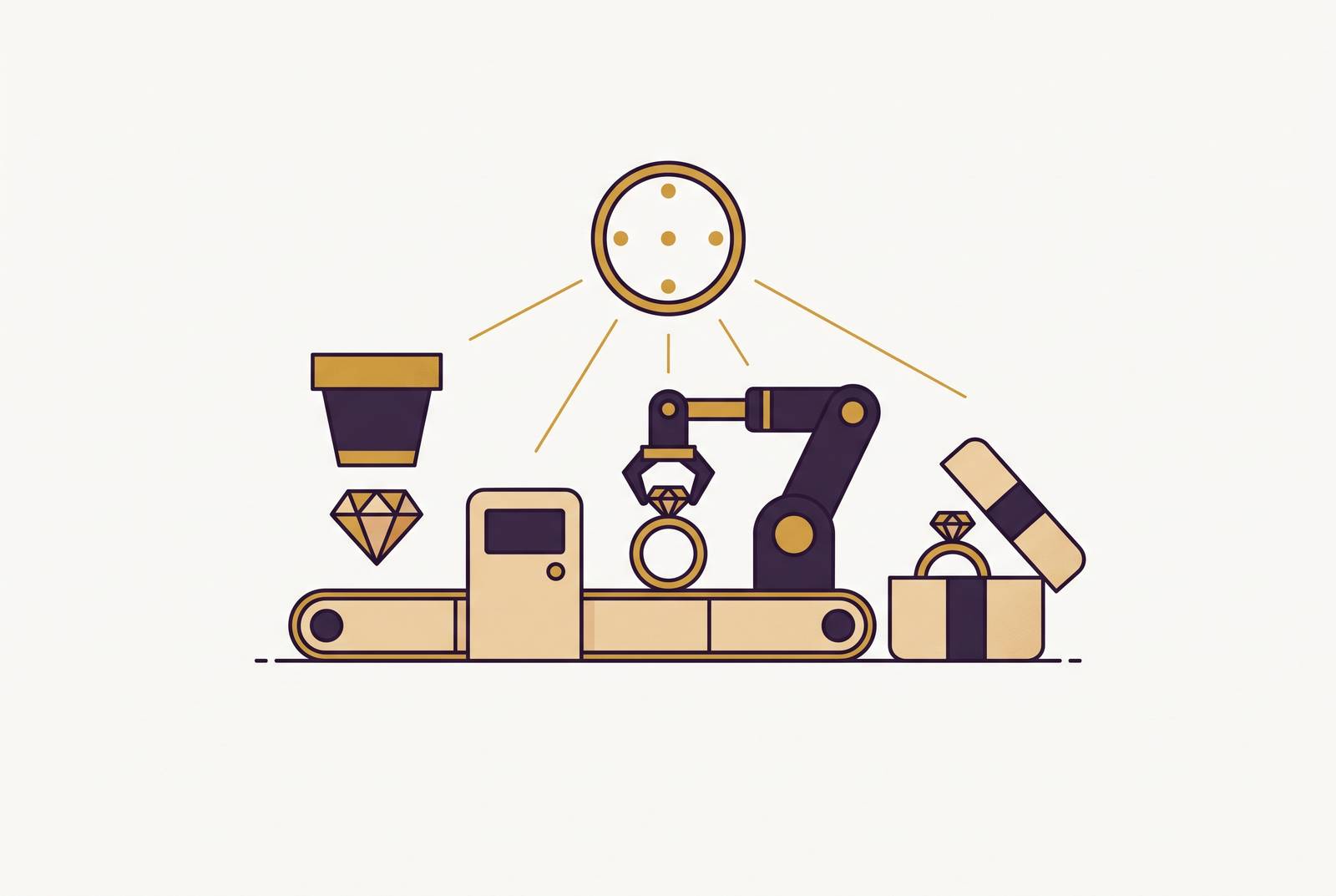
Just-in-time manufacturing can work for custom jewelry, but only when the digital pipeline turns a customer’s choices into production-ready CAD quickly and precisely enough for each order to trigger production. The breakthrough is replacing the forecast with the purchase, so a brand can offer wide customization without first placing a bet on what will sell.
Why JIT manufacturing has historically failed for custom jewelry
The traditional obstacle was the handoff between design and production. JIT’s core logic is to produce only what is ordered, when it is ordered, which requires a near-instant signal from the sale to the factory floor. In custom jewelry, generating that signal could take days or weeks because someone had to translate the customer’s wishes into a usable design. The sale was only the starting gun. With production still waiting on manual design work, brands defaulted to forecasting demand and holding finished or semi-finished stock. That locked capital into inventory, restricted the range they could afford to offer, and slowed their response to changing tastes. Customization remained an in-store service rather than a scalable product because each order brought its own translation job.
What has changed: three converging forces that make JIT viable now
AI-compressed design time removes the first delay by shortening the gap between an idea and a first file from hours to minutes. That changes the economics of preparing individual designs, but a first file is not necessarily a manufacturing instruction. Speed alone does not complete the job. If someone still has to rebuild the geometry for each customer’s size, stone, or metal choice, the bottleneck has just moved one desk down. AI makes the beginning faster, while parametric design makes variation repeatable.
A parametric model recalculates geometry when the customer changes an input, without repeated modeling or manual edits. That turns a selection into something more useful than a design brief. The resulting file can become the production signal once it meets manufacturing requirements. Yet even a file made quickly and accurately cannot start single-unit production at a factory that needs a batch. A one-unit minimum order quantity completes the chain by allowing a manufacturing partner to make the piece when its order arrives.
AI and parametric design without minimum-one manufacturing still leave orders waiting to accumulate. With minimum-one manufacturing and fast ideation but no parametric configuration, someone still has to do design work by hand for each variation. With parametric configuration and a willing factory but no compressed design time, new ideas still take a long time to enter the pipeline. All three must meet at the handoff. Together, they make the individual order a workable unit of production.
How the digital pipeline actually works, from customer input to castable file
The pipeline begins with customer configuration. A web-embedded configurator captures the metal type, stone, size, and finish, then generates a quote, bill of materials, and exportable file in the same session. Those outputs connect the buying decision to the production requirements. For JIT, the value is that the choices already exist in a form the rest of the pipeline can use.
The second stage is the geometric work behind those choices. The parametric engine adapts the model to the selected inputs rather than asking a designer to remodel each version. This is where speed must remain tied to precision. A fast response on screen is useful only if the resulting geometry also supports the next manufacturing step.
Manufacturing validation is the third stage, and it is not a ceremonial rubber stamp. Someone still needs to check the wall thickness and stone settings in AI-generated meshes before casting. That review can be much shorter than building the file from scratch, but it does not disappear. Checking the piece keeps it sound, while passing information along by hand just gets it to the next step. JIT benefits from removing the latter.
The fourth stage is having the validated file in the correct format for manufacturing. An exportable file from the customer session is not, by itself, proof that this condition has been met. Only then does the fifth stage begin. The validated, correctly formatted file allows the order to trigger production without waiting for other orders to form a batch. Precision failures in geometry, validation, or formatting delay that trigger even when every other step is fast. The pipeline runs at the speed of its slowest unresolved problem.
The configurator as the customer-facing entry point to JIT
The configurator connects that internal sequence to the buying moment. Its job is not merely to show a ring changing color on a screen, pleasant though that may be. It must connect what the customer selects to what the factory can produce. Three capabilities make that connection possible, including instant parametric recalculation, real-time pricing and inventory sync, and automatic bill-of-materials and CAD export. Together, they keep the quote tied to live costs and let the order move toward production without a manual administrative handoff.
Without those capabilities, a configurator remains a visualization tool. It may help sell the idea, but someone still has to work out what the choices call for, prepare the information needed for production, or send it elsewhere. By contrast, one parametric model can adapt to each customer’s inputs without repeated modeling, whether the brand is handling one order or many.
That also changes the customer’s part in the design conversation. Someone who struggles to describe a desired piece can react to a generated option. Choosing is often easier than describing a mental picture. This cuts the time spent talking through each design, which made traditional custom orders costly to take on one at a time. It reduces the interpretation needed before manufacturing review can begin.
What JIT actually changes about inventory, capital, and business model design
Once pieces are manufactured only after purchase, the brand no longer needs finished-goods stock or a warehouse for those finished pieces. The risk of forecasting demand for that stock goes away too. The brand still needs a working design and fulfillment system, but it does not have to fund finished pieces before customers choose them.
Linton’s case study describes PupRing arriving with substantial inventory costs and moving to a make-to-order model that eliminated that inventory risk while scaling to thousands of orders per day. Each piece was manufactured after purchase and shipped directly to the end customer. OPJ Studio, backed by PAJ Group’s manufacturing experience, supports retailers from customization setup through made-to-order production and direct fulfillment. With that model, retailers can offer more personalized pieces without keeping finished inventory.
For a startup, that sequence makes a lean launch possible with minimal starting capital because upfront production runs are no longer the price of entry. For a broader catalog, it changes the role of the SKU. One ring design can have a huge number of configurations across metal types, stone qualities, and sizes without a piece in stock for every combination. The variety moves into the data model. That makes a robust parent-child SKU structure and a backend able to handle the variations essential.
The larger consequence is a different product offering. Made-to-order production therefore enables fully personalized, customer-configured fine jewelry as a category because it cannot exist as a finished stocked item before the customer has specified it. Essentials Jewelry offers made-to-order gold jewelry with customization across karat, metal color, and stone selection in 3 to 7 working days.
The operational problems JIT introduces and how well-run brands manage them
Without finished inventory, the main risks are how long orders take and how reliably they move through the pipeline. Every order becomes a production event with its own timeline, so the brand cannot treat delivery promises as an afterthought. There is no finished piece waiting to rescue a delay. The operating discipline is to state lead times clearly at purchase, build buffer into production estimates, and underpromise. MJJ Brilliant uses a no-MOQ model with turnaround measured in weeks for repeat styles after design approval. That approval is a managed checkpoint whose timing must be included in the customer’s expectations.
The same discipline applies to catalog growth. A single jewelry design can have many different configurations, but generic platforms can struggle to keep up as the catalog grows. Complex jewelry attributes are hard to keep track of without a backend built for them. The stockroom may be gone, but the complexity remains. It now sits in the relationships between designs, options, prices, and production files, where manual handling becomes a limit on growth.
Customers still think carefully before buying custom fine jewelry, with doubts about sizing and trust that the fulfillment model alone cannot settle. The digital buying experience deserves as much attention as the production pipeline. A customer must be willing to commit before the just-in-time sequence has an order to act on.
Imagery creates another bottleneck because new configurations can enter the catalog faster than traditional per-SKU studio photography can follow. AI photography tools can reduce the cost and time needed for routine catalog and marketplace images, but their usefulness depends on source-image quality. Bad inputs can produce fabricated product details. That is a poor bargain for a category already dealing with trust barriers. Hero campaign shots and optically complex pieces, including layered necklaces and stacked rings, still benefit from traditional shooting or a tightly reviewed hybrid process.
What the pipeline must look like for JIT to hold at scale
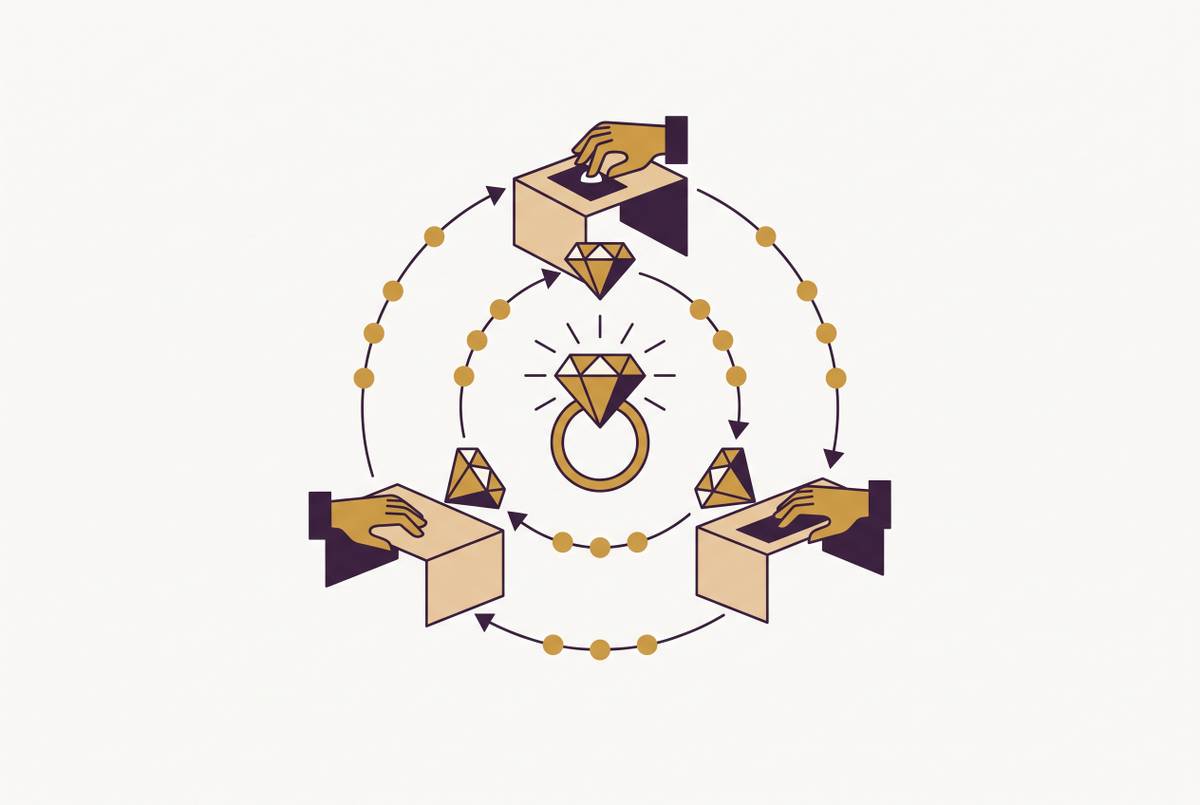
At scale, customer configuration, parametric modeling, AI design, CAD validation, and the factory handoff must operate as one closed-loop pipeline, leading from the purchase to a castable file and then to a fulfilled order. Gaps between stages bring back waiting and manual effort. OPJ’s support from customization setup through production and direct fulfillment shows how far an integrated model needs to reach, with fulfillment still part of the job after export.
Automatic pricing, geometry changes, and file export save people from doing the same work over and over, while checks during manufacturing help ensure the piece is made correctly. Even a design that looks polished on screen still needs work before production if someone has to do much more to interpret or rebuild it after configuration. As order volume grows, that distinction separates repeatable fulfillment from a growing queue of custom design tasks.
The resulting business is structurally different from one built around forecasts and stock. Its capital is less exposed to unsold finished pieces, its range can expand through configurable designs, and its production responds to choices customers have already made. Demand comes first, and the piece follows. JIT in custom jewelry is therefore not an operational tweak to a conventional inventory business. It is a different way of building a jewelry business, with the order itself at the center.