Engagement Ring Styles for Women With Active Careers
Your job, not a label, should decide the setting, profile, and metal.

An engagement ring for a woman with an active career should suit the daily demands her “active lifestyle” places on her hands. The right setting, profile, band width, and metal depend on whether those hands wear gloves, type, lift weights, or work in clay. Practical need not mean plain. It means choosing beauty that does not spend the working week in a drawer.
Why career context, not lifestyle category, should drive ring style decisions
A ring catches the cuff of a glove in an exam room, and suddenly its lovely prongs have become a small engineering problem. That moment tells a healthcare worker more about suitability than the label “perfect for active women.” The label leaves out the actual work. A nurse wearing latex gloves all shift, a software engineer at a keyboard for eight hours, and a trainer gripping barbells do not need protection from the same things.
The nurse needs room for the ring under a glove, while the engineer needs one that will not keep knocking against desk equipment. The trainer faces impact and pressure from a closed-fist grip. Those differences should shape the design from the start. “Low-profile” is useful vocabulary, but it is not a complete brief. A useful brief identifies what a particular working day does to a ring and which features can withstand it.
The design variables that change by profession are setting type, profile height, band width, and metal
Setting type determines how the stone is held and how much of it remains exposed. A bezel surrounds it with a solid metal rim, removing exposed prongs and giving it strong protection. A flush setting, also called gypsy or burnish, recesses the stone into the band so its surface sits level with the metal. Channel settings protect small stones within a channel, adding sparkle without exposed prongs. Traditional prongs let more light reach the stone, but their exposed tips can catch on things and loosen when the hand makes the same motion over and over.
Height is a separate decision from setting type. A bezel still needs to sit low enough for its intended job, whether that means clearing a glove or avoiding equipment. Band width affects the ring’s substance and its fit beside a wedding band, while a straight, unadorned band can sit flush against a plain matching band without a contour gap or grinding between them. These details are less glamorous than the centre stone. They are also the details the hand lives with.
Platinum displaces rather than loses material when scratched, making it longer-lasting under heavy use than gold. Among gold alloys, 14ct is slightly harder and more scratch-resistant than 18ct. Stone hardness supports those choices. Diamond is the hardness benchmark, moissanite is a durable option, and ruby and sapphire resist scratching well except against diamond. Shape introduces a different risk, because the sharp corners of marquise, pear, and princess cuts are more vulnerable to impact than round, oval, and cushion cuts.
Healthcare workers and the case for the bezel setting
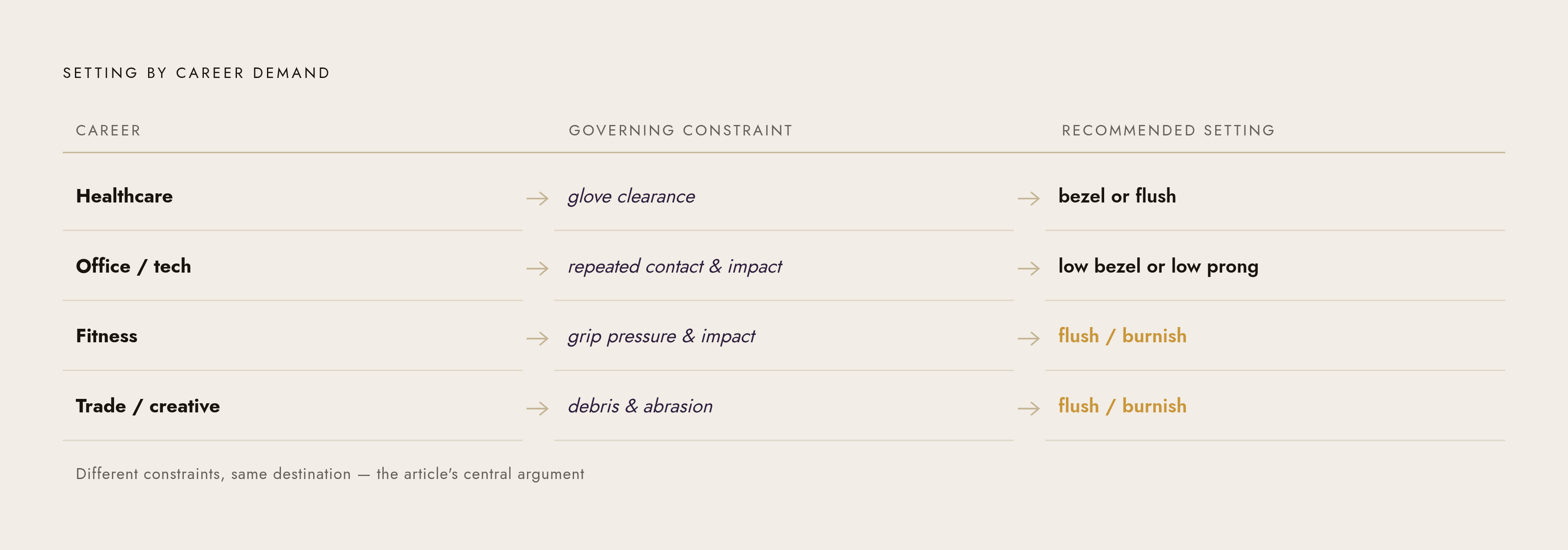
For healthcare workers, the glove sets the terms. A ring must fit inside latex or nitrile without stretching or tearing it, so a smooth outline and low height serve a clinical purpose. A low bezel answers both needs by enclosing the stone without exposed prongs.
The ring also has to stand up to hand-washing and disinfectants. Chemicals can affect prong tips over time, so the stone needs to be held firmly and the metal needs to last. For someone who wants the ring to stick out as little as possible, a flush setting has an even lower profile. It does lose some brilliance, though few people get to see the sparkle beneath a glove.
Practical choices also have room for personal style. The trend towards a chunky, wider yellow gold band with a bezel setting puts fashion and function on the same side of the counter. The width and bezel depth still have to fit under the glove, though. Some healthcare workers instead wear only their wedding band on shift and save the engagement ring for off-hours. That is a valid choice.
Office and technology workers face repetitive contact rather than compression
A prong can repeatedly catch a keyboard edge, while a high-set stone can knock against a mouse or touchpad. Profile height therefore becomes the main variable, because a ring close to the finger avoids the repeated knocks and grinding that can work at a setting. Without the glove constraint, complete enclosure is less pressing.
A bezel or low-prong setting with a band of moderate width works well at a desk, where the stone need not be flush-set. A half-bezel, enclosed at the sides and open at the top and bottom, offers a middle ground between protection and light exposure. A low four-prong setting can work well too. Women who wear both rings each day should take just as much care over how they fit together. A straight-banded engagement ring against a plain matching wedding band avoids a gap that catches debris and keeps the rings from grinding against one another.
Fitness professionals and regular training make the case for a flush setting
A ring can take knocks from barbells, floor work, and equipment grips, and a closed fist puts pressure across the band. Many fitness professionals remove their rings for training entirely, and that is a legitimate answer. In that case, the design brief concerns the hours around exercise.
For a ring intended for an active routine, flush setting is the most defensible design because the stone does not project above the band. There is no raised setting to catch equipment or concentrate grip pressure at a single point. That advantage does not make training with a ring automatically safe.
Stone shape deserves more weight here than at a keyboard. Sharp corners on marquise, pear, and princess cuts are vulnerable when they meet a hard surface, making round, oval, and cushion cuts the safer choices where impact is possible. Metal choice becomes more consequential for the same reason. Platinum shifts rather than sheds material when scratched, offering a useful durability advantage over gold. It can still show wear, but the scratch does not represent the same loss of metal.
Hands-on creative and trade work can demand more than a bezel
Clay, massage oil, and construction dust change the problem again. A raised rim that protects a stone can also create a pocket for material to collect, bringing hygiene concerns and abrasion around the setting. A potter’s ring goes into clay. A massage therapist also needs to avoid edges that could catch a client’s skin. Construction combines dust and materials with the pressures of manual work.
Even a bezel can stand too far out from the band for this work. A flush or burnish setting keeps the stone recessed into the band, with no raised rim to trap material and no projecting edge to snag skin or fabric. This is where its minimal profile earns its keep. The cost is visibly reduced brilliance, because less light reaches the stone than in a bezel or prong setting. That is a choice to make before purchase.
A wider, more substantial band spreads pressure during gripping and resists deformation better than a thin shank. Even so, some professionals choose a plain metal band for work and reserve the engagement ring for other hours. That may be a separate everyday band or the wedding band alone. The decision is about what belongs in the working environment.
How to evaluate any ring against a specific career environment before buying
Name the two or three physical demands your hands encounter most often, then connect each demand to a design feature. A glove makes height and exposed edges important. Against a hard surface, the profile and stone corners matter, while clay or oil can collect in recesses and around raised rims. This gives an attractive ring a specific test to pass.
First, consider what goes over or around the hand. If a glove, mitt, or equipment grip requires a smooth, flat profile, bezel or flush settings make more sense than exposed prongs. Next, consider repeated impact or abrasion against keyboards, barbells, or tools, which favours low height and a round stone over sharp-cornered cuts. Finally, consider immersion in materials such as water, oil, clay, or chemicals. For that kind of exposure, consider a flush setting and check how well the metal stands up to the chemicals involved.
These demands can overlap without having equal weight. A healthcare worker encounters liquids, for example, but glove clearance remains the governing constraint described here, while clay makes debris pockets central to a potter’s choice. The test identifies which feature cannot be compromised so the other choices can be judged around it. Someone who removes her ring for the most demanding task has a different brief from someone choosing for wear throughout the day.
The wedding band belongs in that evaluation before purchase. For daily wear together, a straight engagement band and a plain matching band that sit flush offer the cleanest fit. Custom and configurable options are worth considering when a ready-made ring gets the setting right but misses the width or height. Parametric builders allow those dimensions, including setting depth, to be adjusted. That makes “almost right” a design question whose answer can prevent daily irritation.
What custom design makes possible for active-career women
An off-the-shelf ring rarely has the exact mix of setting depth, band width, metal, and stone shape needed. In the past, getting those choices in one ring meant a bespoke commission with a designer who could turn what the ring needed to do into a computer-aided design file. The process could involve weeks of revisions. Its price could be similar to, or modestly above, that of a comparable retail ring, but time and access still created barriers.
AI-driven parametric design and browser-based configurators now make that process more direct. On retail websites equipped with these tools, shoppers can adjust setting type, band width, metal, and stone choice while seeing the design update. Pricing can change live with metal weight and current metal costs. At checkout, a manufacturing-ready file can go with the order, without a designer acting as the intermediary. The useful part is not the technology’s vocabulary, but the ability to order the combination the job requires.
Through retailers offering these tools, a profession-first ring is available at the same price point as a standard retail ring. Its value lies in the choices it puts together. A healthcare worker can prioritise glove clearance without giving up her preferred metal, while someone with a gym schedule can choose a restrained profile for the hours she plans to wear it.