Vintage and Art Deco Engagement Ring Design Elements
Five period details, from milgrain to platinum, work as one system.

Art Deco engagement rings look distinctive because their details work together. Geometry, milgrain, filigree, calibré-cut stones and platinum form a shared design language. Knowing that language helps buyers and designers choose vintage-inspired details for a reason, rather than dress a modern ring in an elaborate period costume.
What Art Deco engagement rings actually looked like, and why the era produced such a distinct visual style
Art Deco engagement rings of the 1920s and 1930s got their crisp outlines from a culture in which Modernist architecture, Cubism and the machine age played a growing part. Jewelry moved away from the flowing floral forms of the Edwardian and Art Nouveau periods toward straight lines, angles and bilateral symmetry. The shift was more than a change of decoration. A ring’s outline, the way its stones were placed and its metalwork began to share the same geometric order.
Platinum made it possible to carry that order into fine details. Its strength supported thin shanks, pierced galleries and fine edging, while its cool white color complemented colorless diamonds and precisely fitted colored accents. The result could look intricate and light, as the fine metalwork helped bring out the clear architectural shape.
The geometric forms that give Art Deco rings their architectural silhouette
Octagons, hexagons, rectangles and chevrons provide the framework of an Art Deco ring. Its visual weight is usually balanced on either side of a central axis, giving even a richly detailed design a sense of order. The outline does the first heavy lifting. A rectangular or hexagonal head establishes a different character from a round setting before any beading, openwork or colored stone enters the picture.
A step-cut center stone, most characteristically an emerald cut, reinforces that framework because its facet lines echo the angular metalwork around it. The same logic can extend into tapering baguette shoulders, angular side stones and stepped band profiles. Geometry does not stop at the center stone. A chevron repeated in the shank ties the ring’s face to its band, so the head avoids looking like a small building dropped onto the wrong street.
Those choices also constrain the details that follow. A square, rectangular or hexagonal head affects the shapes of surrounding accents, the layout of the metalwork and the room available for filigree or milgrain. The smaller details have to live inside it.
Milgrain edging — what it is, how it is made, and what it does visually
Milgrain is a continuous row of tiny metal beads along an edge, and its name comes from the French for “thousand grains.” It turns a hard border into a fine, granular line. The effect is small but immediately recognizable. Around stones, prong shoulders, galleries and band edges, it adds texture without the need for a bulky frame.
Traditionally, a jeweler makes milgrain by rolling a milgrain wheel, a small knurling tool, along the metal edge. Fine beads and regular spacing depend on skilled handwork. That labor becomes more significant as the edging extends from one short stretch to many borders. Visually, the repeated texture softens the transition between setting and finger while keeping the ring’s angular outline legible.
For a buyer inspecting a ring, bead size and regularity are useful clues to execution. Fine milgrain reads as a delicate border, while coarse spacing can look imprecise. Bigger beads do not mean more vintage. Because milgrain works with nearly every other Art Deco element, it can unify a restrained design, but coarse execution can distract from the ring.
Filigree — how Art Deco geometric lace differs from earlier floral filigree, and what makes it technically demanding
Edwardian filigree often resembles curling botanical lace, while Art Deco filigree is closer to a pierced architectural grille. Greek key patterns, angular interlocking shapes and geometric lattices replace vines and flowers. Both can be delicate, but they speak different languages. A ring with floral scrollwork may look antique without looking specifically Art Deco.
Filigree uses thin wires or pierced metalwork to create open spaces, often through the gallery beneath the ring’s head. Those gaps lighten the visual weight of the setting. The empty space is part of the design. It lets a platinum structure look airy even when, seen from above, it holds a large group of stones and borders.
Preserving that openness is the difficult production task. True wire openwork cannot simply become a textured surface in a mold and retain the same construction, although casting processes can produce filigree when they preserve its open geometry.
To make faithful geometric filigree, a designer has to allow for a lot of hand labor or find a way to make it that keeps the fine spaces and detail. A closed gallery with a lace-like pattern may resemble filigree from one angle. It does not perform the same visual job.
Calibré-cut accent stones — the technique, the visual effect, and how they anchor the geometric composition
Calibré-cut stones are colored gemstones cut to a particular shape and size for an exact position in a setting. Each fits a custom-made collet or channel. The fit is the defining feature here. These stones are components of the ring’s geometry.
Rectangular baguettes can line the shoulders, while tapered baguettes converge toward the center stone. Square-cut stones can run in a row through a channel band, and accents that are fan-shaped or kite-shaped can fill out a geometric halo. Each shape serves the surrounding pattern. Color appears locked into the metalwork rather than floating above it, giving the ring a continuous composition.
That effect requires close coordination between gemstone cutter and metalsmith. The stones must be cut to match the setting, or the setting must be built around the stones, with less tolerance for variation than prong-set rounds allow. Precision is what lets the stone and metal meet as parts of the same design, distinguishing this approach from later compositions in which accent stones are added to a form rather than integrated into it.
Platinum settings — why the metal choice is a design decision, not just a material preference
Platinum and white gold may offer a similar color direction, but they are not interchangeable in this design vocabulary. Platinum’s strength and malleability allow fine edging, thin settings and open gallery work at the delicacy associated with Art Deco. The metal helps determine the drawing. Substituting another material can change the dimensions needed to support that drawing.
The distinction between surface hardness and long-term durability is important here. Platinum is softer at the surface than alloyed gold, yet retains more metal over time and can hold prongs securely with relatively little material. Thin does not automatically mean fragile. Its density also gives a ring more weight than its modest dimensions might suggest, contributing to how the finished piece feels.
Color adds another practical difference. White gold needs rhodium plating to look as cool-white as platinum and needs re-plating as that finish wears, while platinum keeps its color as it takes on a patina. The maintenance paths are therefore different too. When a platinum design has very open filigree or very fine borders, making it in white gold may call for thicker walls to keep them from bending. A modern reproduction can make that adaptation, but the thicker structure changes its visual delicacy, so the choice belongs in both the design conversation and the material order.
How these elements interact and reinforce one another within a single ring
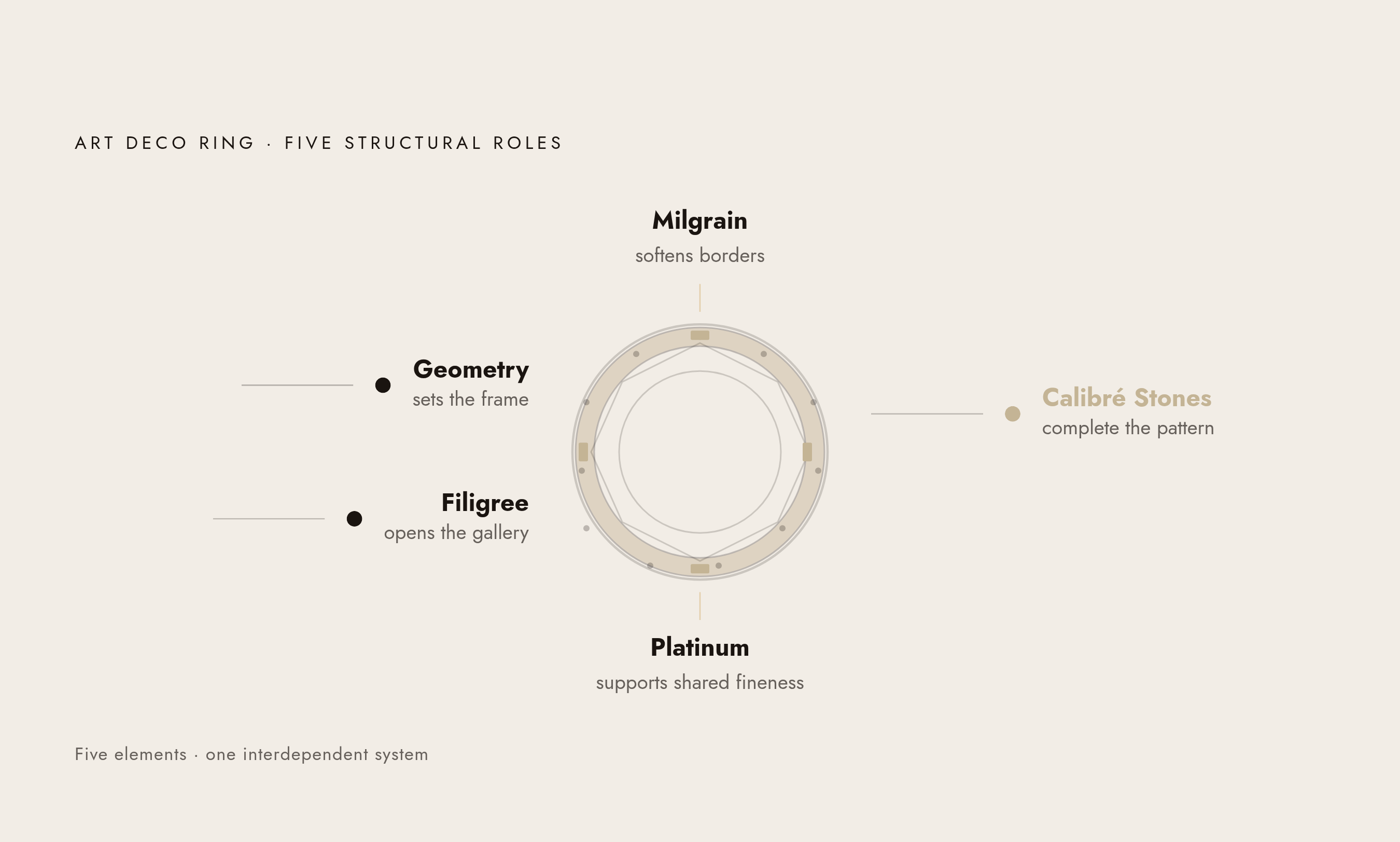
Within a coherent Art Deco ring, each element has a different job. Geometry sets the frame, milgrain softens its borders, filigree opens the gallery, and calibré stones complete the pattern in color. Platinum supports their shared fineness. The interest comes from those relationships.
Consider an emerald-cut center with calibré shoulders and a geometric gallery. The center’s facet lines start a pattern of angles that carries through the shoulder stones and repeats in the metal of the openwork below. Each view belongs to the same design. By contrast, that step-cut stone in a plain prong setting remains a step-cut stone, but no longer participates in the same architectural arrangement.
This does not make every element compulsory. Angular form, fine milgrain and platinum can make a consistent composition without colored accents or elaborate filigree. Restraint is allowed into the room too. For designers and buyers, the useful framework is to choose which relationships should define the ring, then include details that strengthen them. Milgrain on a non-geometric setting may provide attractive softness, for example, serving a decorative role.
What distinguishes a faithful vintage-inspired ring from a modern ring with antique detail applied as ornament
The practical test is whether a period detail helps organize the ring or merely decorates a form that would otherwise look unchanged. “Load-bearing” applies visually as well as structurally here. A geometric head earns its place when its shape guides the center cut, shoulder accents and gallery below. It is not just an angular border around an unrelated setting.
For a buyer applying that test, the gallery is a useful place to look. Genuine openings through the metal do a different job from engraved or cast texture on a closed back. The gaps should actually be gaps. Milgrain gives another clue when it runs along the design’s borders through the gallery and shoulders, rather than sitting only on the top edge to add a touch of age.
Calibré accents complete the metalwork through their fitted shapes, whereas round melee in a channel does not provide that same relationship. Similarly, a round brilliant prong head grafted onto a milgrain shank can leave two separate visual ideas competing. One vintage detail cannot broker every disagreement.
A lab-grown center stone can sit within a period-accurate geometric setting, and a simple band can hold a filigree gallery with truly open spaces. Neither choice defeats the design’s internal logic. A faithful vintage-inspired ring retains historic elements that shape its appearance and construction.
How AI-assisted CAD and parametric design tools handle Art Deco elements today, and what that means for custom vintage-inspired work
Modern custom work has to translate those visual relationships into geometry that can actually be made. AI-assisted jewelry CAD can make geometric settings, place stones and shape band profiles without designers having to learn complex software, and for standard ring types it can reduce the time needed to make production-ready STL files from hours to minutes. That shortens the route from concept to file. Art Deco’s finer details, however, put particular demands on what the file contains.
Milgrain needs beads that are evenly spaced and clear in fine detail, while filigree needs openings with exact shapes. Calibré stones require seats shaped for the individual accents. A convincing picture is not a manufacturing specification. Tools that check wall thickness, stone seating and minimum dimensions address these demands more directly than image-based generators that offer a visual approximation.
Parametric design is especially well suited to this work because Art Deco geometry is symmetric and rule-based. Proportions, stone sizes and band dimensions can be adjusted within one underlying model. The relationships remain available for precise editing. Production-grade parametric files allow changes such as moving a stone, adjusting a band width or specifying a prong diameter to be reflected in the geometry sent toward casting, rather than existing only in a render or a non-editable mesh.
For retailers and brands, configurators bring those choices to websites and sales floors, where customers can choose geometric settings, stone shapes and metals and see the price change as they change the specifications. The interface makes the conversation more accessible. It does not remove the need to preserve open filigree, fitted stone seats or adequate walls. In custom vintage-inspired work, the useful measure of a tool is therefore not how quickly it produces an antique-looking image, but how precisely it specifies the details the finished ring must deliver.