Engagement Ring Cuts Meaning and Setting Compatibility
Each cut's symbolism and the setting that protects and flatters it.
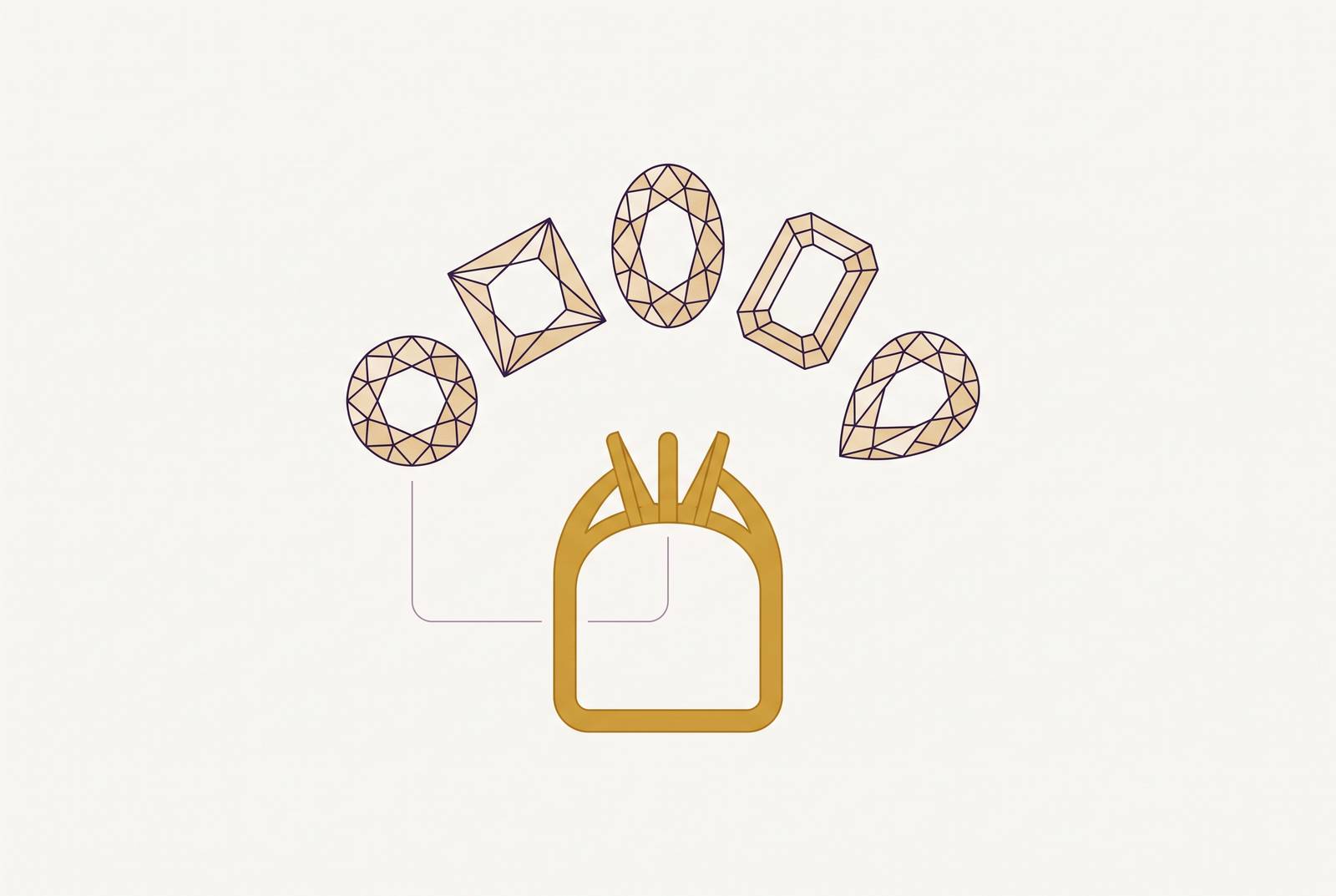
An engagement ring’s cut gives it character, but the setting decides how clearly that character comes through. The best match says something personal and works with the stone’s shape and light while keeping its fragile edges safe.
Why the cut of an engagement ring carries meaning beyond its appearance
The ring’s circular form has symbolized eternity across cultures for centuries, including ancient Egypt and ancient Rome. A stone adds another layer to that symbolism. Its geometry can suggest openness, confidence, warmth, or grandeur, giving a shared symbol of commitment a more personal expression. The choice is not just decorative.
GIA says cut can be the most complex and the most important of the 4Cs in bringing a diamond’s beauty to life. Here, a distinction helps. Shape gives the stone its outline and the ideas linked to it, while cut quality affects how beautifully the diamond handles light. Couples may choose a shape on instinct, but understanding its meaning and setting compatibility turns that first attraction into a coherent choice.
What each of the major engagement ring cuts symbolizes
Round brilliant. Its symmetry gives it a universal character rather than a narrowly defined personality. That versatility helps explain why it suits such a broad range of settings.
Its appeal lies in balancing boldness with practicality, without rounding off the personality.
Oval. Elongated curves symbolize femininity, creativity, emotional balance, and openness. The shape also lengthens the finger visually and creates an impression of greater size.
Transparency and honesty are its defining associations, with visible flaws making that openness a confident choice.
Cushion. Rounded corners and large facets suggest gentleness, old-world romance, and emotional warmth. More than 200 years of use gives its sentimental character some staying power.
Pear. This teardrop hybrid of round and marquise symbolizes individuality, creative spirit, and emotional depth. Its traditional association with tears of joy fits an engagement rather neatly.
Marquise. An elongated outline with pointed ends conveys grandeur, ambition, and bold charisma. It was first made for royalty in 18th-century France, which suits a shape that does not enter quietly.
Asscher. This square step-cut shape has Art Deco origins and associations with wisdom, loyalty, and depth. It appeals to a love of historical beauty and thoughtful commitment.
It brings traditional and modern styles together.
Heart. The most literal love symbol in jewelry expresses passion, affection, and emotional openness. Achieving the right symmetry is technically demanding, which helps explain its less frequent appearance.
Trillion. This triangular cut is rarely used as a center stone. It more often adds geometric edge and visual drama as an accent beside a traditional center.
Their distinct outlines make the setting’s response especially important, because the shape is already doing much of the talking.
How a setting either reinforces or fights a cut's character
A setting controls more than where the stone stays put. Its structure and height affect how the stone sits against the hand, how much light enters from the sides and below, and how much of its surface remains visible. The setting also influences daily wear and wedding-band fit. It is a working structure.
That structure can either support or compete with the cut’s character. A clean, tailored setting leaves an emerald cut’s hall-of-mirrors effect in view, while heavy ornament surrounds its openness with visual noise. Round brilliant is more forgiving because its symmetry suits solitaires, halos, pavé, and cathedral settings. Not every shape has that freedom. A setting that flatters one stone can make another look as though it arrived at the wrong party.
Pointed cuts introduce a less subjective concern. Pear, marquise, and heart shapes have vulnerable tips that need protection from the setting. Leaving those tips exposed creates practical fragility in a ring intended to symbolize permanence.
Setting compatibility for each cut, with the reasoning behind each pairing
Round brilliant. A solitaire gives the stone an uninterrupted stage, while a halo increases its perceived size. Pavé adds surface brilliance without changing the center stone’s silhouette, and a cathedral setting raises it for drama. The symmetry makes each approach coherent. Its flexibility is a feature.
A halo can also emphasize the square outline cleanly. Corner protection is the deciding detail here. Prong arrangements that leave those corners exposed work against both daily durability and the cut’s impression of modern strength.
Oval. A slim solitaire or delicate micro-halo follows the elongated outline without interrupting it. Length is the feature to preserve. A heavy or ornate halo can shorten the visual impression, trading the oval’s graceful proportions for a larger but less distinct surround.
Cushion. A halo that is in proportion to the cushion brings out its warmth and makes it look bigger. The surrounding sparkle suits its romantic character. The pairing works when the frame complements the rounded outline and keeps the center stone prominent.
Emerald. Step-cut side baguettes or a tailored bezel echo the stone’s crisp lines. Restraint gives the facets room to work. Heavy texture and ornament compete with the hall-of-mirrors effect, so a clear geometric setting best serves the cut’s association with transparency.
Pear. A slim solitaire with a V-prong protects the point while preserving the elongated silhouette. A bezel encases the tip for greater durability and adds a clean, modern edge. A halo offers a softer visual approach. It can protect the point while tempering the asymmetry for someone who wants less drama.
Marquise. Both tips need to be kept safe, so a V-prong solitaire is a classic match for its bold lines. A halo amplifies the elongated drama, while a bezel gives it a sleeker, more contemporary frame. The setting should respond to the cut’s grandeur.
Asscher. Clean four-prong and bezel settings echo its precise geometry and Art Deco heritage. A halo can work if it closely follows the square outline. The structure should remain easy to read. Surrounds with organic or floral shapes clash with its look of a built structure.
Radiant. A halo suits the radiant’s lively sparkle, while channel-set side stones bring out its geometric edges. This hybrid has room for elaboration. Its combination of brilliance and trim lines lets it accommodate more detail than a restrained step cut without losing its identity.
Heart. A three-prong arrangement at the lobes and tip keeps the outline visible, with a V-prong protecting the point. A bezel can work, but it tends to obscure the shape. Visibility is essential to the meaning here.
The halo trade-off: when the most popular setting choice helps and when it hides
A halo surrounds the center stone with smaller accent diamonds, increasing its perceived size. That effect can suit oval, cushion, and round stones when a look of size and warmth is part of the design. The extra sparkle has a purpose. It is not automatically excess, any more than a frame is automatically a distraction from a painting.
But the same sparkle can draw the eye away from a dimmer or included center stone. That is a different bargain. A halo may make the ring look better without making the diamond at its center any better, so couples should look closely at why they want one. The practical rule is never to sacrifice cut quality to afford a more elaborate setting. A dim diamond does not become brighter by hiring an entourage.
For emerald and Asscher cuts, the trade-off is more about visual clarity than size. A halo that fits closely can keep an Asscher’s square outline clear but still make the area around its step-cut facets look busy. Those are separate judgments. Where transparency is the priority, restraint better serves the stone, even when a halo is geometrically compatible.
Pavé also need not be treated as the halo’s alternative. It describes a stone-setting technique used in halo rings, solitaire-style rings, and other designs. The choice is not strictly either-or. A well-proportioned halo can be an excellent match when the cut’s character and the center stone justify it.
Practical factors that should inform the final setting decision
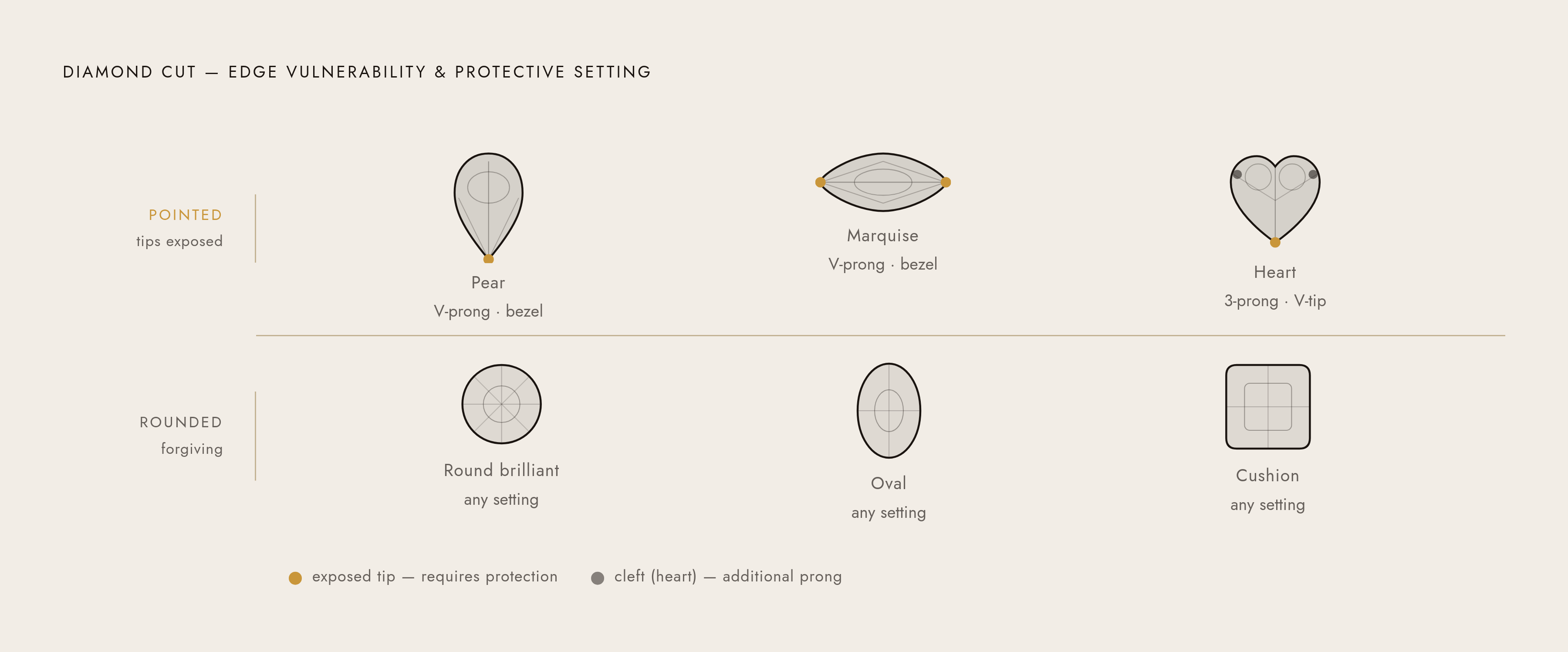
Daily wear is the first practical test. Pear, marquise, and heart cuts require more conscious care on active hands, while rounder shapes handle daily impact more forgivingly. For a couple making the final choice, the setting should suit how the ring will actually be worn. Photographs are not much of an endurance test.
The hand’s proportions need as much thought as those of the ring. Oval, pear, and marquise shapes visually elongate the finger, while princess and Asscher cuts broaden its apparent width. Neither effect is inherently better. Trying on the cut and setting together before choosing can show how they look on the hand in ways that pictures may miss.
Wedding-band plans can also change the setting decision. A setting’s height and profile can allow a straight band to sit flush or require a contoured design. Some high cathedral settings and halo configurations create a gap that calls for a curved or custom-fit band. That is a planning issue. Considering both rings early avoids treating the wedding band as an awkward afterthought.
Maintenance is another part of the bargain. Pavé and halo designs contain more stones and prongs, creating more potential points of wear than a bezel or simple solitaire. Lower upkeep is a legitimate preference. The jewelry someone already wears gives clues to their habits and taste, so it helps to look at it before choosing. Someone who likes angular, geometric pieces may feel more drawn to a princess or emerald cut with a setting that has similar lines.
How custom and parametric design tools let couples match cut, setting, and meaning without tradeoffs
Couples once had to find someone who could make the ring even after they knew which cut and setting they wanted. Traditional custom design required commissioning a CAD file, waiting for revisions, and accepting a result without seeing it worn or in a real-world context. That route could be slow and expensive. Tools built for jewelry design make it easier to turn a clear idea into a ring without the customer having to learn CAD.
Parametric tools let one base design take on different shapes, sizes, and metals. An oval in a slim halo need not depend on that exact combination appearing in fixed inventory. The design can be configured instead. Live pricing tied to real metal costs lets couples try those changes with a clearer idea of what they can afford, so the price comes as less of a surprise at checkout.
Brilliant Earth’s configurator filters 10,000+ diamond and setting combinations without lag, illustrating how interactive selection can make a broad range manageable. The value is not simply more options. Filters and combinations help customers connect a preferred cut with a suitable setting. For jewelers, that understanding also makes it easier to guide a customer toward a design that can be manufactured.
Visualization files without manufacturing-ready geometry have to be converted before the ring can be made, while jewelry CAD platforms built for the task can make files ready for casting. Agentic CAD tools that understand wall thickness, prong placement, and stone seat depth address compatibility at the engineering level. The tip protection and proportions must work in the ring as well as on the screen.
These tools can remove the need to settle for an ill-matched combination simply because it is available. The useful advance is control over the details. A cut chosen for openness can have a setting that leaves it open, while a shape chosen for boldness can receive the support its edges need.