Shopify Plus Jewelry Integrations for Made-to-Order Catalogs
Three integration layers carry a custom ring from checkout to casting.

Made-to-order jewelry on Shopify Plus needs more than a product page that looks good. It needs three connected layers that share catalog data, let customers configure pieces at live prices, and turn paid orders into production-ready CAD files. The catalog works only if those layers pass a complete specification from the customer to the casting house.
Why a made-to-order jewelry catalog breaks Shopify's default assumptions
Shopify’s standard product model assumes that finished goods are already in stock. Made-to-order jewelry reverses that sequence because the order triggers production. There is no finished piece to reserve. Instead, the commerce system must preserve a configuration, secure a deposit, and pass a complete specification downstream while the piece still exists only as a set of choices.
Those choices reach beyond ordinary product variants. A ring’s size, metal, stone, and setting must translate what a customer can select into something a jeweler can actually make. A checkout can accept money without resolving that distinction. The resulting order may be perfectly legible to a sales associate yet incomplete for the bench or casting house.
Shopify’s jewelry ecosystem is well developed, but there is still a long way to go from a front-end choice to a production-ready file. Closing that distance takes three distinct integration layers, each with a job that Shopify cannot do on its own.
What Shopify Plus adds that standard Shopify withholds for made-to-order
Shopify Plus has the commerce tools for this workflow, including partial payments and deposits, unlimited B2B catalogs with per-company or per-location assignment, and sales-rep permission scoping. Deposits reserve the capacity to make a custom piece before it exists. Payment is usually split between when the order is placed and when it ships, with the Plus-tier payment capability used to collect the first part when the customer commits.
Catalog assignment addresses a different need for brands selling both retail and wholesale. It lets them expose manufacturer pricing and product ranges to specific trade accounts without showing those terms to retail customers. The same business can therefore operate a consumer storefront and a trade portal with different commercial rules. That separation is useful before any configurator enters the picture.
Plus is a base. At meaningful B2B GMV scale, its platform fees can exceed the infrastructure cost of a fully headless build, so its economics deserve scrutiny. Headless is a real alternative, but the starting question is whether Plus supplies the payment and account controls the business needs without imposing disproportionate costs.
Layer one: catalog syndication and how JewelCloud 2.0's Shopify integration works
GemFind’s JewelCloud 2.0 Shopify integration, launched June 25, 2026, illustrates the first layer. It lets manufacturers maintain a single product database and distribute images, descriptions, pricing, specifications, and inventory to participating Shopify retailer storefronts through one connection. That removes manual uploads and duplicate data entry.
Real-time synchronization also addresses catalog drift. A manufacturer’s price change or new collection propagates automatically to connected stores, reducing the gap between what the supplier offers and what the retailer displays. A retail partner using the platform reported that product onboarding time fell by more than half and that collection launches became almost instant.
GemFind, founded in 1999, identifies itself as a Shopify Plus Partner and the only Certified Shopify Partner serving the jewelry industry. Its other tools include Ring Builder, Diamond Link for live diamond feeds, and Stuller Showcase. Distributing product data does not itself create a customer configuration or a manufacturing file.
Layer two: customer-facing configurators with live diamond feeds and live pricing
The configurator must let customers build a piece, pull live stone inventory, and work out the right price. This layer offers plenty of choice among tools whose capabilities may cover one task or all three. It also demands the closest reading of pricing models and capability gaps, because an attractive preview says little about what happens after the customer changes the stone.
Flat-monthly options include Jewelith Studio, Ring Facet, Custom Ring Builder, Keyideas RingBuilder, which offers a free plan plus paid tiers, and Brilliance Builder. Kickflip combines a monthly fee with a per-order percentage, while Zakeke combines tiered monthly fees with a per-order percentage. VDB Ring Creator uses a one-time setup fee plus an ongoing monthly fee. When enough orders come in, percentage fees have the biggest effect on how much the tools cost. Flat-monthly tools are not automatically the cheaper answer, however, if their capabilities do not cover the required workflow.
ECOSIRE’s bespoke Shopify builder shows what a more complete configuration flow can contain. It pulls a live diamond feed from RapNet, Nivoda, or IDEX and normalizes cut, carat, color, clarity, fluorescence, and GIA/IGI certification for real-time filtering. The builder combines setting, stone, and metal into one price. It then creates a single Shopify line item, with the full configuration stored in line-item properties and order metafields so fulfillment can identify the setting, stone certificate, and metal.
Metal pricing introduces another moving part. Gold Price Editor, built exclusively for Shopify, uses weight × metal price × purity + labor + diamond + gemstone + markup + tax for gold, silver, platinum, and palladium. Its monthly tiers scale with variant count, and the higher tier supports up to 50,000 variants with automated spot-price updates. For custom quote flows, Formpify calculates precious metal base rates and dynamic diamond carat multipliers within the storefront, then sends itemized branded PDF confirmations to the customer and store admin. The comparison is therefore about price completeness as well as display.
Platform reach also changes the choice. Keyideas Jewelry Customizer offers Shopify and WordPress WooCommerce versions, with a one-time setup fee for WooCommerce and no setup fee for Shopify. Jewelith’s 3D Configurator supports Shopify, WooCommerce, and other platforms, with a 14-day free trial on Shopify, while Kickflip supports Shopify, WooCommerce, Wix, BigCommerce, and a custom API. Channel support differs too. Jewelith has guided concierge and independent self-serve modes, so either an associate or the customer can lead the same design process.
What the configurator layer cannot do: the gap between a customer's choice and a castable file
A captured configuration tells the business what the customer wants. It does not necessarily tell a casting house how to make it. The output may consist only of a visual representation or a mesh. A beautiful ring on a screen is still allowed to have terrible engineering.
Casting imposes constraints that a visual preview does not establish. The design needs suitable wall thickness, prong geometry, stone seats and undercuts, a shank in a real ring size, and a hollow back that does not trap investment. These requirements decide whether the promised piece will hold up through production, setting, and wear.
AI can shorten modeling from many hours per piece to minutes, but speed does not erase this distinction. Most AI-to-CAD tools hand over a mesh rather than a parametric 3DM, so even after an impressive demonstration, more work is needed to get the file ready for production. Micro-pavé, channel settings, and unusual prong configurations still require human validation before casting. The prevailing workflow is therefore hybrid, with AI accelerating the front end and a CAD jeweler or bench review supplying manufacturing judgment at the back.
Layer three: AI-driven parametric CAD as the production handoff that closes the loop
Purpose-built AI jewelry CAD addresses that gap by generating parametric, production-grade output. For a retailer without a traditional CAD operator in-house, it offers an accessible route to the manufacturing handoff. The system must understand jewelry geometry and validate its output against the manufacturing constraints already described.
Agentic parametric CAD is designed to make those engineering decisions autonomously. Purpose-built tools can produce files in minutes instead of hours, reducing the labor involved in in-house or outsourced modeling. That makes their role specific. They belong between the accepted customer specification and the production file, with human validation retained where the design requires it.
Parametric design also changes how the catalog scales. Instead of building individual SKUs one by one for every metal, size, and stone combination, a single design generates variants from adjustable parameters. But changing geometry can change metal weight. The model must therefore recompute that weight automatically, and the configurator’s live price must stay synchronized with what the model will produce.
For a Shopify Plus retailer, this capability needs a commerce connection. Once the order is placed and the deposit captured, the production-ready file should flow through without a separate manual design request to a CAD operator. A fast CAD tool in a disconnected window only solves part of the problem.
Connecting the three layers: how the order flow should work end to end
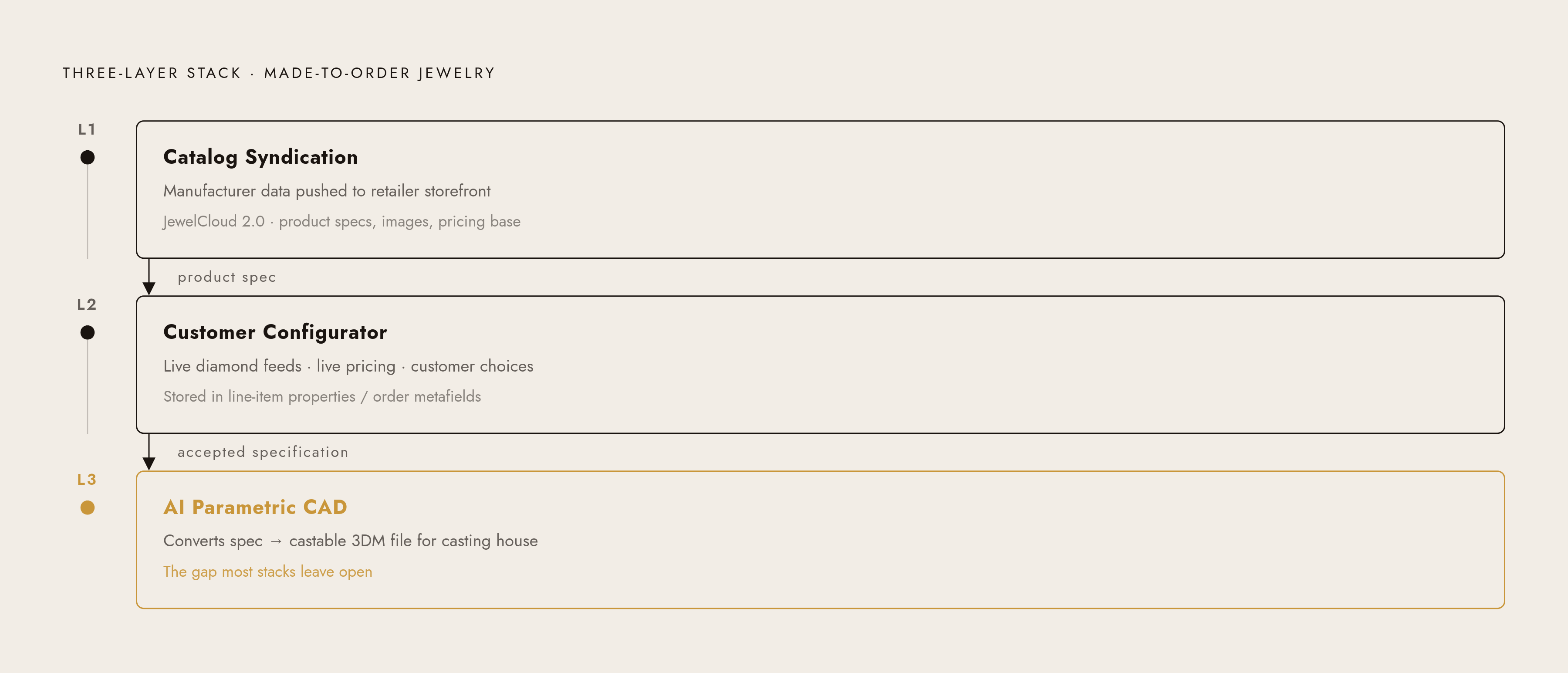
The flow should start with the manufacturer sending product data to the retailer’s Shopify store through catalog syndication. The customer configures the piece, receives a live price, places the order, and pays a deposit through Plus partial payments. The configurator records the full specification in line-item properties and order metafields. The production layer retrieves that specification and generates the castable file, which reaches the casting house while fulfillment receives the matching order record. No one should have to type the ring twice.
The handoff from configuration to production fails most often. A text note may make sense to a person, but it does not provide the structured data the production layer needs to act automatically. Someone then has to enter the choices again.
If a parameter changes the geometry and metal weight, a price calculated from the old weight no longer reflects the piece being made. The margin is wrong before production begins. Keeping the configuration, deposit, price, and production file attached to the same order record gives the workflow a common reference, but the pricing and CAD calculations still have to agree.
The same architecture can support a consultation at a counter. Jewelry Studio Manager, launched July 2026 in the Shopify App Store, tracks commissions from inquiry through design, client approval, production, and delivery, including each client’s ring size, metal, and gemstone choices. It can raise a Shopify order for a deposit or the full amount directly from the consultation. Across channels, a sales associate and a customer shopping on a phone at midnight need the same configuration-to-production chain.
Where native Shopify Plus still falls short and what that means for how you build
Shopify Plus still has built-in limits even when the stack is connected. Very large SKU counts bring soft limits, with search performance degrading and administration becoming unwieldy without a third-party search layer. Parametric designs can generate effectively unlimited variants, but that does not make an unlimited catalog effortless to manage. Native production-file management remains absent too, so the manufacturing connection continues to depend on integrations.
The practical decision rule is to start with Plus and the three layers for most independent jewelers and boutique brands building their first made-to-order catalog. Its app availability, ecosystem depth, and operational familiarity justify that starting point. Businesses that sell mostly wholesale need to work out the costs separately. They should model when Plus platform fees may exceed the infrastructure cost of a fully headless build rather than discover that transition after growth has made it expensive.
A Shopify-headless build addresses storefront constraints without discarding the familiar Admin. Shopify remains the engine for cart, checkout, payments, and orders, while a Next.js or similar storefront handles custom experiences, including the ring builder and production handoff. This is a useful option when those requirements exceed the app model’s capabilities and the platform is visibly constraining growth, with some Shopify-related costs remaining.
The durable decision is how the jobs connect. Whether the commerce engine is Plus, Shopify headless, WooCommerce, BigCommerce, or a custom stack, made-to-order jewelry still needs catalog syndication, customer configuration with live pricing, and production-ready CAD handoff. Platforms can change without changing that logic. The customer buys one piece, and the system has to preserve that piece’s identity all the way to production.