ERP-to-CAD Data Pipeline Design for Jewelry Manufacturers
A locked design master keeps CAD, BOMs, and costing in sync.
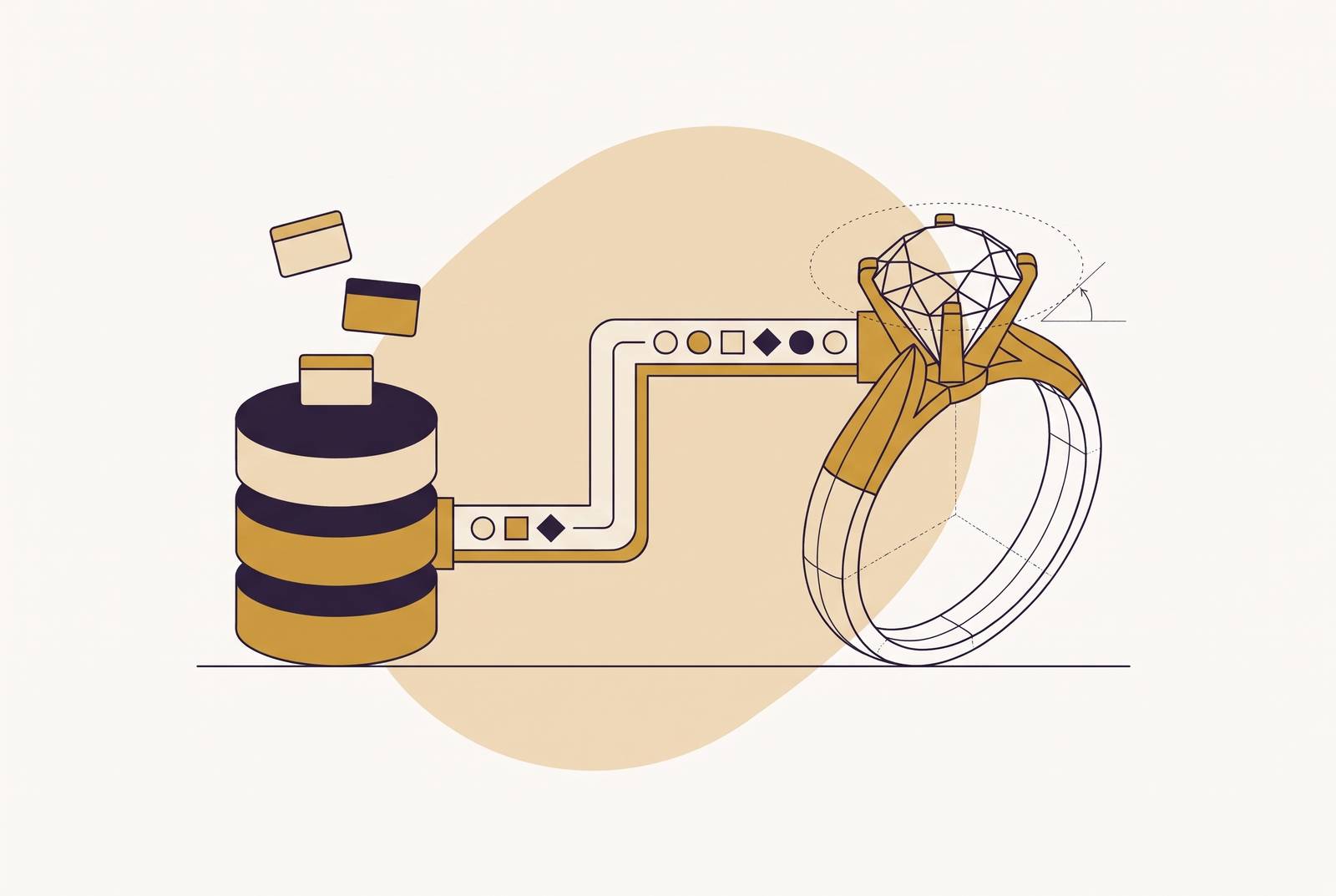
An ERP-to-CAD data pipeline for jewelry manufacturers needs more than connected software. It needs a versioned design master that holds the geometry, structured bills of materials, specifications for metal and stone, and costing data. Every downstream module must use that authoritative record. Otherwise, integration just moves conflicting information faster, which is an expensive way to improve delivery speed.
Why jewelry manufacturers cannot treat ERP and CAD as two separate systems
A casting order goes ahead against the wrong bill of materials, or a stone parcel arrives that does not match the setting count. The mistake starts upstream and may be visible on the shop floor. Design and production have been working from different records, with someone translating between them by hand. The software may be working exactly as configured. The connection is what has failed.
Email attachments, USB drives, and remembered revisions turn each handoff into another opportunity for error. Across dozens of custom orders a month and five or more handoffs, those errors compound into remakes, missed deadlines, and material waste. Memory is a poor inventory system, especially before coffee. Jewelry adds a further complication because gold and diamonds need real-time visibility across both stock and consignment positions.
Generic ERP records can also lack the detail needed to reconcile scrap by alloy or flag a mismatch between stone parcel weight and setting count. Consequently, a transferred record can be complete in the receiving system yet incomplete for production. That gap lets costing errors accumulate across hundreds of SKUs without an obvious warning.
What a digital thread actually means across the jewelry production stages
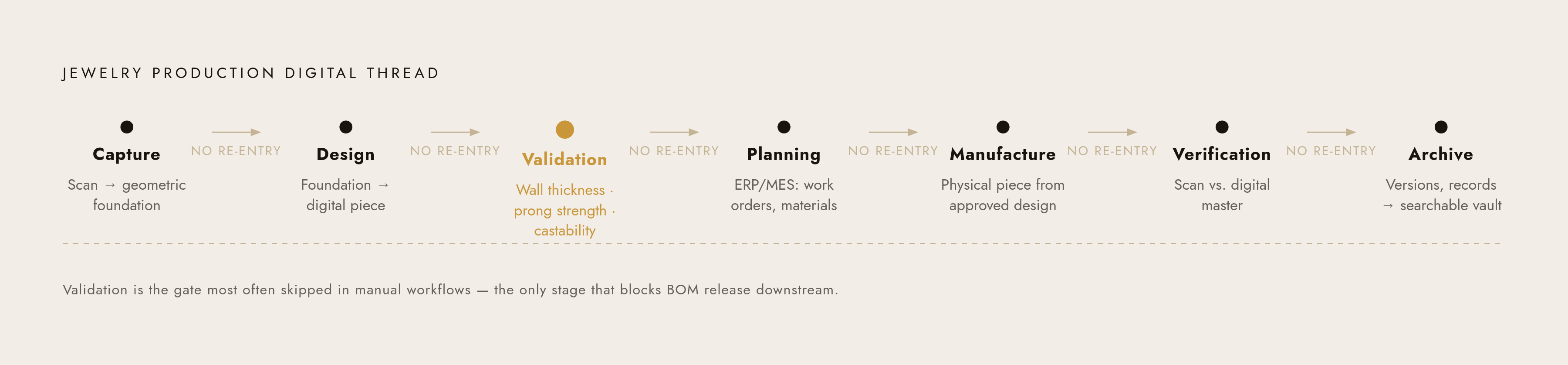
Capture digitizes a physical piece, gemstone, or model so the scan becomes the geometric foundation for CAD. Design develops that foundation into the digital piece. Validation checks wall thickness, prong strength, stone clearances, and castability before production begins. Production planning uses ERP and MES tools to plan the work, reserve the materials, and create work orders. Manufacture makes the physical piece from the approved design. Verification compares scans of finished castings with the digital master to detect shrinkage, warping, or surface defects. Archive preserves versions, revisions, and material records in a searchable digital vault.
The links between those stages make up the digital thread. Each tool’s output goes straight into the next tool as its input, without anyone having to convert or re-enter the data. The record follows the piece through production, linking its CAD file to the artisan, metal lot, and stones used. Integration keeps files linked to the job when they are made available in another application.
That continuity also supports approval before production. Retailers and manufacturers can share CAD files and 3D renders before any metal is cast, rather than waiting for a physical piece to settle a design question. But what holds this thread together at the data level?
The design master as the single source of truth every downstream module depends on
The design master is a versioned record containing CAD geometry, the tech-pack, structured BOMs, costing data, and tag copy that downstream modules reference. Its stable identity connects the design to production and sale, while its revision identifies the specification being made. Both are necessary. A catalogue number identifies the design, but a locked revision establishes which version the job uses.
FlowSense gives every design a stable catalogue number and organizes its specification into three structured BOMs. The metal BOM contains karat, weight, and tolerance. The stone BOM contains shape, cut, colour, clarity, and carat. The labour BOM covers casting, filing, setting, and polishing. All three are versioned and costed, so locking a revision gives job cards, casting orders, and karigar ledgers the same frozen reference.
The platform also associates CAD files with RPT and 3D views, and passes the catalogue number through to the showroom tag without re-keying. Its design record supports live cost-to-make quotes against today’s metal rate. This distinguishes the approved production specification from the rate used to price it. Variance above tolerance appears as an exception.
How metal accounting and stone reconciliation flow from the design master through the shop floor
FlowSense runs casting orders against a tree/flask plan and issues the alloy mix by karat. After casting, the metal is reconciled against theoretical weight, while sprue recovery is captured with scrap valuation. Those movements post to the same karat-segregated metal ledger. The ledger closes daily. Casting, filing, and polishing each have a tolerance band, with deviations raised as exceptions.
Stone setting follows a separate reconciliation path. Stones are issued by piece or lot against a job with tolerances, actual consumption is captured, and breakage is tracked. The stage closes with a stone reconciliation that the setter can sign off. An accurate starting specification is essential because reconciliation against a manually copied setting count can faithfully reconcile the wrong job.
Each in-house or outsourced artisan has a ledger of metal issued, metal returned, stones consumed, wages earned, and deductions for losses above tolerance. This is not simply payroll with a jeweler’s apron. It accounts for valuable materials entrusted to a person as well as the work performed.
Scanning the finished casting against the digital master shows shrinkage, warping, or surface defects before the piece is delivered. The material records and digital comparison together make product genealogy possible, so a finished piece can be traced back to its raw inputs.
What the ERP-to-CAD data handoff requires at the structural level
At the boundary, both the ERP and CAD/CAM layer must be able to read the design master’s BOM fields, metal specifications, stone specifications, and tolerances without manual translation. The approved geometry must be tied to a specific metal type, weight, and karat. The stone data must have the seat count and the shape, cut, and carat weight for each seat. A picture shows the intended piece, and the fields specify the structured quantities production must reserve and reconcile.
Validation must precede the locked production record. Wall thickness, prong strength, stone clearances, and castability need to pass automated checks before approval sends the BOM downstream. STL or STEP exports must include the manufacturing tolerances required for production. The exchange needs standard file formats and naming conventions, along with fixed casting parameters, written setting procedures, and written QC checkpoints.
The practical test is what happens after CAD approval. A working handoff generates the work order, reserves the gold, and schedules the caster without someone copying fields from a PDF. If a person must translate the approved design into production data, the boundary remains manual. The cleaner the shared data model, the less reconciliation any particular pair of tools requires.
How purpose-built jewelry ERP platforms implement this pipeline in practice
The named platforms concentrate on different parts of this boundary, and their roles should not be blurred. 3Design is a CAD application with manufacturing file export, rather than a shop-floor routing or job-tracking system. Its parametric engine supports recalculation and cross-platform compatibility. Its contribution starts on the design side. Production control still needs the receiving system to interpret and use the exported information.
Rhinojewel connects the job lifecycle through manufacturing orders, routings, work-in-process updates, and completion records associated with the customer piece. CAD import and exportable manufacturing outputs support that connection.
FlowSense concentrates on the design library, catalogue control, structured BOMs, and the operational records that follow. Casting and alloying, stone issue and setting, artisan management, metal and wastage accounting, costing, and QC through dispatch share its ledger model. How much work the casting, setting, and polishing benches can take on helps set promise dates, while margin dashboards flag designs that lose money at the current rate.
When geometry and BOM are generated together, the ERP receives less information that must be assembled or reconciled after approval. That is the opening for parametric and AI-assisted design.
How AI-powered parametric design changes what the ERP receives at the design-master boundary
A parametric engine recalculates geometry when inputs such as ring size, band width, gemstone size, or metal thickness change. When the BOM comes from that same constrained model, its quantities stay in line with the geometry used to make the piece. Production-ready output still requires real-time constraints against impossible configurations, topology validation, and STL and STEP export with manufacturing tolerances.
AI generation is a different capability from production validation. Tools can quickly turn text or images into 3D mesh geometry, cutting work that once took days of manual CAD effort. Human review of stone settings and wall thickness remains part of the workflow before locking the design master.
For collections with many SKUs, generated models can serve as proxies while designs are edited, with full CAD reserved for those that survive selection. That keeps speculative BOMs out of the production pipeline. Diatech Studio announced AI-powered image-to-CAD capabilities in February 2026, with automated BOM estimation illustrating how design-stage geometry can supply costing data rather than requiring separate calculation and re-entry.
RhinoArtisan 7 integrates generative AI and agent tools within its desktop parametric application, although some features require external API accounts. AI is therefore entering established CAD workflows as well as newer platforms. At the ERP boundary, the useful result is castable geometry matched to a structured BOM and costing data.
Where the pipeline extends downstream to configurators, wholesale feeds, and retail handoff
The same structured design record can supply the data for a customer configurator, a wholesale inventory feed, and a retail product record. A configurator lets wholesalers and retailers create custom orders through variable parameters and transfer them automatically to ERP. The approved configuration can then become production input. Product data does not need a second life in a separate spreadsheet.
For B2B wholesale, that connection depends on instant parametric recalculation, real-time inventory and pricing sync, and automatic BOM/CAD export. Retailers can offer hundreds of ring combinations from one template, priced through the wholesale feed. A collection launch becomes the publication of a template and data feed rather than a photography exercise for hundreds of SKUs. Real-time consignment feeds extend the record with purity, weight, and location, where even a karat-weight error can distort margin calculations.
Product imagery can draw from the same source. AI-generated photography from CAD can render a studio image for each configuration, keeping its geometry the same while changing the materials. In a made-to-order model, those renderings can be used to market the piece before it is made, and production starts after the order is confirmed. The design master thus serves as both the marketing asset and the production specification.
This is the commercial return on the architecture. The manufacturer publishes product data already grounded in production for each sales channel.
Implementation sequence for building the pipeline without stopping production
The practical sequence starts with master data, moves to job-card integration, and then connects downstream modules. Categories, purity designations, tax rules, making-charge rules, and CAD file naming conventions must be established before those modules exchange records. Otherwise, each module interprets the same information differently. More connections will not cure conflicting definitions.
FlowSense describes a phased rollout that adds one operating rhythm at a time without stopping production to go live. Each design first gets the stable catalogue number that downstream records use to refer to it. The design master must be locked and BOM versioning enforced before expanding the connection. Automated checks for wall thickness, prong strength, and stone clearances belong before entry into the master library and before a casting order has been scheduled.
Data readiness shapes the work involved. Folio3 identifies item master data, BOM structures, and open inventory records as the biggest driver of implementation timelines. Many jewelry operations are still digitising, with fragmented records and isolated systems across the value chain. A locked design master can provide value before every stage is connected.
Before more pieces or a wider range of products are made, design standards and production tolerances need to be written down in one reference. That reference is the durable investment, even when the ERP or CAD application changes. Every downstream module must still draw from one authoritative, versioned design record.