Unique Engagement Ring Styles for Nontraditional Couples
Seven alternative ring styles, and how to make each one wearable.
An engagement ring can tell a couple’s story without having a round diamond. The best nontraditional designs use color, shape, metal or meaning with a clear purpose. Understanding those differences helps couples find a ring that reflects them and can be made for daily wear. Different is easy. Personal takes a little more thought.
Why so many couples are rejecting the diamond solitaire right now
Millennial and Gen Z couples are seeking personal stories rather than universal symbols of status, and jewelers are changing what they stock and design in response. Sustainability concerns also make a ring’s origin and ethics part of its meaning. Social media also shows buyers styles they have never seen before they reach a store.
The familiar round brilliant diamond in a symmetrical white-metal solitaire stands for a certain idea of romance. Not every couple shares it, and the alternative need not be a small variation on that template. So what do they choose instead? There are now genuinely distinct approaches, from a different center stone to a ring whose metalwork is the main event.
What actually makes a ring "nontraditional" and why the distinction matters when shopping
A nontraditional ring departs from the classic diamond solitaire through its stone choice, setting geometry, metal combination or overall form. But departure alone does not make a design personal. A trend can become a uniform surprisingly quickly. Narrative specificity is the more useful test, meaning that the design expresses something particular through a shared reference, a meaningful stone origin or repurposed heirloom metal.
That connection also needs to hold up beyond the first impression. A ring worn every day has more to offer than a first impression when its texture, asymmetry or a hidden detail gives the wearer a reason to look closely. Manufacturability is the other essential test, because surviving casting and daily wear requires suitable wall thickness, stone seat depth, prong count and shank geometry.
Colored gemstones as the center stone, and what each stone communicates
Replacing the diamond with a colored center stone is the most common nontraditional move, but different stones say very different things. Sapphire has a historical grounding in royal and antique rings across centuries, making it feel classic. Blue is only part of its range. Sapphires in other colors share that long ring tradition, giving couples a way to draw on it with a color other than blue.
Emerald has a bolder look, with rich color and a step-cut face that stands out. Its departure from the conventional diamond is immediately legible. Morganite speaks in a softer voice. Its peach-pink tone, often paired with rose gold, feels warm and romantic rather than edgy, so a colored stone can be a quiet choice.
Opal puts individuality at the center through its play-of-color, with no two stones identical. That expressiveness comes with a practical condition, because its softness requires a protective setting. Raw and uncut stones take another route altogether. Their natural, unpolished crystal forms foreground origin. Lab-grown sapphires and emeralds offer a different choice within the colored-stone category, allowing couples to prioritize color quality and size without the cost or sourcing concerns of natural stones.
Two-stone and multi-stone settings, and why toi et moi resonates with couples specifically
Toi et moi is well suited to an engagement ring because its two stones each keep their own character in one setting. Together does not have to mean identical. The symbolism sits in the arrangement itself, rather than depending on an explanation supplied afterward. Differences in shape, color or cut make that relationship visible.
Modern versions lean toward bold, sculptural compositions, including asymmetric pairings of diamond and sapphire or emerald and morganite. Three-stone settings add another narrative layer. Past, present and future is one reading, while two origins and a shared future is another. The arrangement gives the couple room to decide what the stones stand for.
East-west settings change the composition through orientation. An elongated marquise, oval or emerald cut sits horizontally across the finger, giving a familiar shape a modern silhouette. Sometimes the departure is simply a change of direction. That shift leads naturally to designs where geometry, rather than the identity of the stone, becomes the main source of character.
Asymmetric and sculptural settings, and what happens when the ring's form itself carries the design
Sculptural rings move the center of attention from the stone to the metalwork. Fluid forms, sweeping arcs and airy silhouettes use space and light as part of the composition, while thicker bands give metal deliberate visual weight.
Asymmetry makes a related break with the solitaire’s logic, but it is not another word for imprecision. As in architecture or ceramic design, balance can come from visual weight. Unequal does not have to look unfinished. A curve and a thicker section can contribute different things to the same composition, making the whole ring read as a designed object.
That emphasis on form also leaves room for quieter meaning. A hidden detail can hold a shared reference without making it the ring’s public identity.
Nature-inspired and organic forms, and how botanical and elemental motifs translate into wearable metal
Organic rings offer a different departure for couples who find architectural forms too stark. Vines, leaves, branches, flowers and flowing water replace geometric precision with movement and texture. Art Nouveau rings from the late nineteenth and early twentieth century used natural motifs among their influences, giving this approach a historical foundation even when the execution is contemporary.
The motif can do more than decorate the band. Vine-and-leaf shanks can wrap a colored center stone, with foliage forming part of the prong structure. Floral halos and bezels place the stone within a sculpted flower. Texture adds another route into the style. Bark-like surfaces, hammered metal and granulation give a band material depth that a polished shank does not.
Natural irregularity allows asymmetry to read as intentional, but it does not excuse metal that cannot be made. A vine can look graceful in a render while containing sections too thin to cast. For a custom organic ring, the distance between an appealing image and a castable file can be especially large, so the production work is part of realizing the design.
Mixed metals and how combining two metal colors changes a ring's visual logic
Mixed metals create foreground and background through metal-color contrast. A yellow gold shank with a white gold or platinum head makes the stone look whiter and brighter against the cooler top, while the gold’s warmth still shows on the finger. One ring gets two distinct visual effects. The technique can work within a toi et moi, sculptural or organic design.
There is a practical appeal as well, because the combination coordinates with both yellow and white metal jewelry the wearer already owns. The jewelry box need not pick a side. Manufacturing is more involved, since the metals need clean joins, and where a rhodium coating supplies the bright white finish, friction wears it away over time, requiring periodic replating. That finishing commitment belongs in the choice.
Lab-grown diamonds as a path to a larger or more unusually cut stone without the traditional cost
Lab-grown diamonds continue to dominate engagement ring trends in 2026 because they offer larger sizes, unusual cuts and higher color and clarity grades at a fraction of the cost of comparable natural stones. The setting gets more room in the budget. Elaborate sculptural metalwork, a nature-inspired shank or a toi et moi composition can receive a greater share of the spending when the stone costs less.
This makes lab-grown diamonds both a design tool and an ethical position. A large hexagonal rose cut, chunky cushion or very long marquise can become accessible where its natural counterpart would be rare or prohibitively expensive. Shape can then lead the design decision. The choice is not an argument that every couple should prefer lab-grown stones, but an explanation of how they open options that a natural-stone budget might rule out.
How custom design actually works now, and what nontraditional couples need to know before commissioning a ring
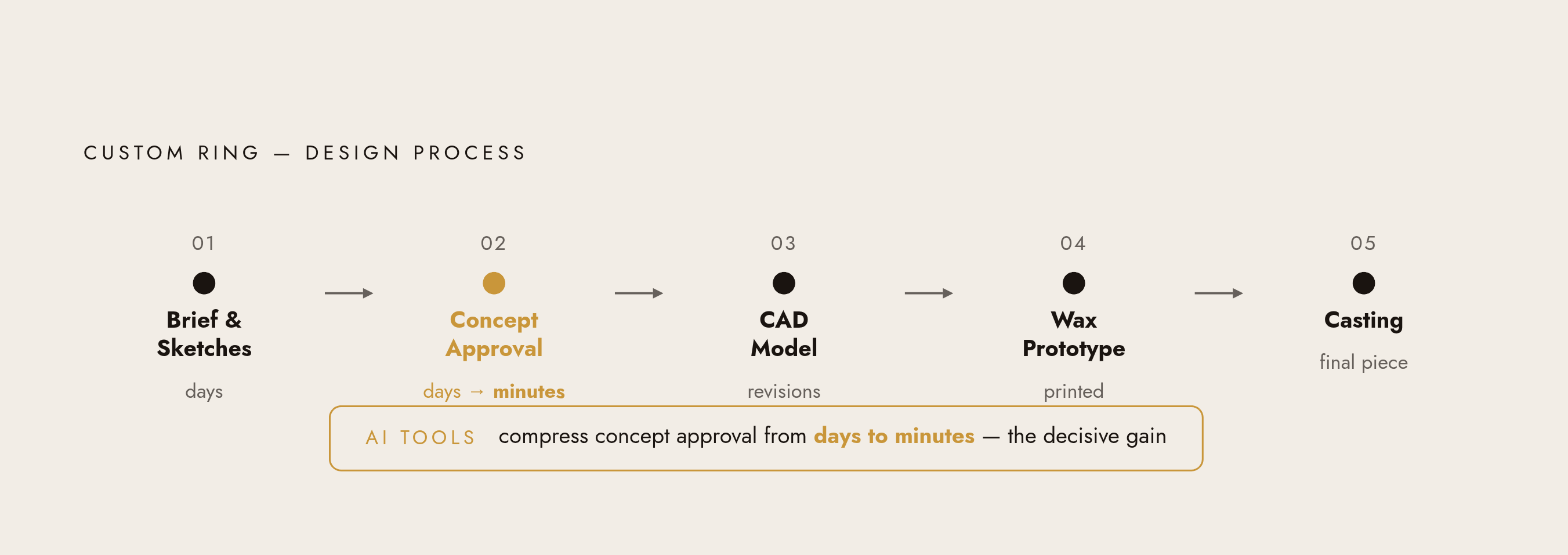
For couples ready to turn a preferred style into a ring, custom design is the bridge between inspiration and something wearable. The traditional process begins with a brief and hand sketches, moves through revisions and a CAD model, then reaches a printed wax prototype and casting. That route can take weeks. Going back over the design again and again adds cost, especially when the couple and jeweler still have different pictures in mind.
AI-assisted concept tools can compress the early work of generating options and approving a direction from days to minutes. Organic, sculptural and asymmetric designs particularly benefit because they can be hard to describe in words. “Curvy, but not that curvy” only gets so far. Comparing visual directions before CAD work begins gives the couple a clearer way to express what fits and what does not.
An approved image is still only a concept, however. Platforms built for jewelry can turn that idea into geometry ready to be made, with the right wall thickness, stone seats and shank tolerances. The file is the decisive difference. A photorealistic render shows what a ring might look like, while a casting house needs real dimensions and validated geometry it can work from.
What to look for in a jeweler or platform when the design you want is genuinely unconventional
For couples choosing a maker, the useful questions follow directly from that distinction between appearance and production. Can the jeweler or platform supply a castable CAD file with verified tolerances? Can it show and refine multiple directions before expensive modeling begins? A beautiful image is not a production plan. Early visual iteration protects couples from paying to revise a model whose basic direction was never quite right.
The maker also needs to understand the constraints of the particular style. Organic forms call for different wall-thickness reviews than geometric settings, asymmetric compositions need center-of-gravity checks, and mixed-metal joints need specific finishing plans. General confidence is not a substitute for those answers. Tools built for jewelry take stone seat depth, prong counts and shank tolerances into account instead of handling the ring like any other 3D object.
For couples exploring online before approaching a jeweler, builders and configurators can provide a concrete reference through live 3D visualization. Some also offer real-time pricing tied to metal costs and direct checkout with manufacturing files attached. Pricing deserves attention in custom work. A manual quote based on a static price list can go stale as metal markets move, while dynamic pricing keeps the cost basis current for both parties, especially on complex designs using more metal.
The goal is a ring that looks as the couple imagined and is made to last. A good custom process, the right tools and the right jeweler can achieve that, with the ring’s personal design and the work of making it going hand in hand. The romance need not end where the CAD file begins.